fuel PEUGEOT PARTNER 2014 Owner's Manual
[x] Cancel search | Manufacturer: PEUGEOT, Model Year: 2014, Model line: PARTNER, Model: PEUGEOT PARTNER 2014Pages: 244, PDF Size: 10.39 MB
Page 128 of 244
126
Partner-2-VU_en_Chap07_Verification_ed02-2014
Topping-up the AdBlue® additive
Filling the AdBlue® tank is an operation
included in every routine service on
your vehicle by a PEUGEOT dealer or
a qualified workshop.
Nevertheless, given the capacity
of the tank, it may be necessary to
top-up the additive between services,
more particularly if an alert (warning
lamps and a message) signals the
requirement.
You can got to a PEUGEOT dealer or a
qualified workshop.
If you envisage topping-up yourself,
please read the following warnings
carefully. Precautions in use
The AdBlue® additive is an urea-based
solution. This liquid is non-flammable,
colourless and odourless (kept in a
cool area).
In the event of contact with the skin,
wash the affected area with soap and
water. In the event of contact with the
eyes, wash (irrigate) the eyes with
large amounts of water or with an eye
wash solution for at least 15 minutes.
If a burning sensation or irritation
persists, get medical attention.
If swallowed, immediately wash out the
mouth with clean water and then drink
plenty of water.
In certain conditions (high ambient
temperature, for example), the risk
of release of ammonia cannot be
excluded: do not inhale the product.
Ammonia vapour has en irritant effect
on mucous membranes (eyes, nose
and throat).
Keep AdBlue
® out of the reach of
children, in its original bottle.
Never transfer AdBlue
® to another
container: it would loose its purity. Use only AdBlue
® additive that meets
the ISO 22241 standard.
Never dilute the additive with
water.
Never pour the additive into the Diesel
fuel tank.
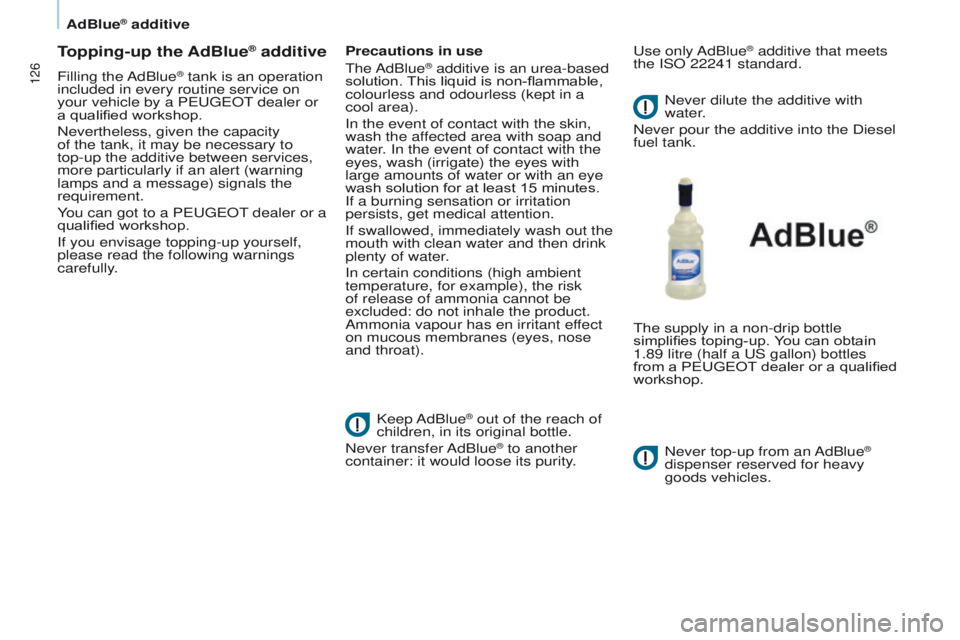
The supply in a non-drip bottle
simplifies toping-up. You can obtain
1.89 litre (half a US gallon) bottles
from a PEUGEOT
dealer or a qualified
workshop.
Never top-up from an AdBlue
®
dispenser reserved for heavy
goods vehicles.
AdBlue® additive
Page 129 of 244
127
Partner-2-VU_en_Chap07_Verification_ed02-2014
Recommendations on storage
AdBlue® freezes at about -11°C
and deteriorates above 25°C. It is
recommended that bottles be stored in
a cool area and protected from direct
sunlight.
Under these conditions, the additive
can be kept for at least a year.
If the additive has frozen, can be used
once it has completely thawed out.
Never store bottles of AdBlue
® in
your vehicle. Procedure
Before topping-up, ensure that the
vehicle is parked on a flat and level
surface.
In wintry conditions, ensure that the
temperature of the vehicle is above
-11°C. Otherwise, by freezing, the
AdBlue
® cannot be poured into its tank.
Park your vehicle in a warmer area for
a few hours to allow the top-up to be
carried out.
F
Switch of
f the ignition and remove
the key.
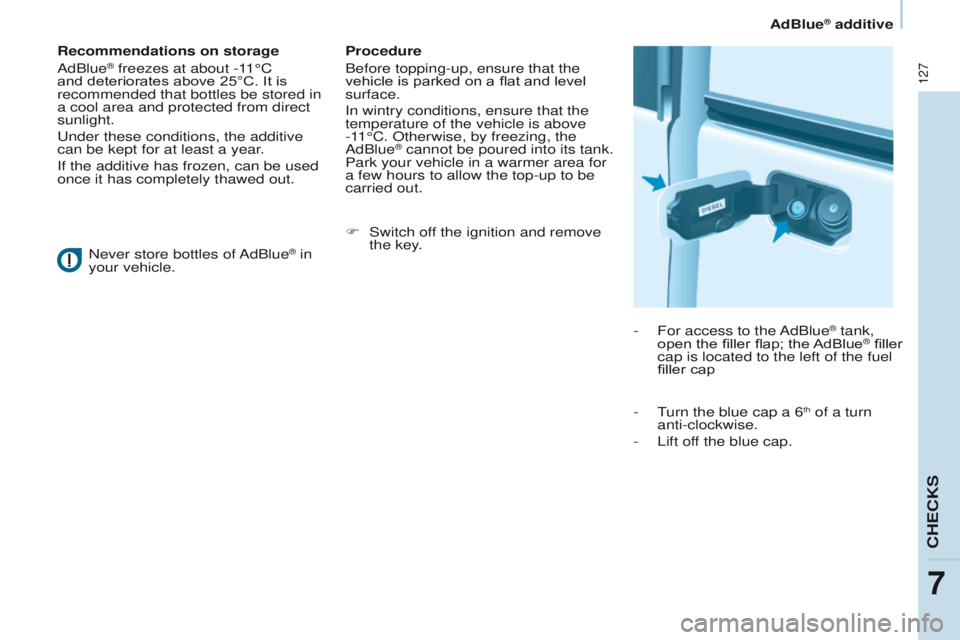
-
For access to the
AdBlue
® tank,
open the filler flap; the AdBlue® filler
cap is located to the left of the fuel
filler cap
-
T
urn the blue cap a 6
th of a turn
anti-clockwise.
-
Lift of
f the blue cap.
CHECKS
7
AdBlue® additive
Page 157 of 244
155
Partner-2-VU_en_Chap09_Caract-technique_ed02-2014
WEIGHTS AND TOWED LOADS
The weights and towable loads for your
vehicle can be found on the vehicle's
registration certificate.
These values, expressed in kg, are
laos present on the manufacturer's
plate or label.The recommended nose weight is
the downward force on the towball
(removable with or without tools).
In each country, it is imperative that
the towed loads authorised by local
legislation are complied with. To find
out your vehicle's towing capacities
and its gross train weight, consult a
PEUGEOT dealer.
The kerb weight is equal to the weight
without load + driver (75 kg) + fuel tank
filled to 90%.
The GTW and towed load values
indicated are valid up to a maximum
altitude of 1000 metres. The value of
the towed load mentioned must be
reduced by 10 % for each additional
1000 metres.
With load transfer, the braked trailer
weight can be increased, on condition
that the equivalent of this load is
removed from the vehicle so that the
GTW is not exceeded. High ambient temperatures
may result in a reduction in the
performance of the vehicle in
order to protect the engine. When the
ambient temperature is higher than
37
°C, limit the towed weight.
Refer to chapter 9, "Identification
markings" section.
ENGINE CHARACTERISTICS
The engine characteristics (capacity,
maximum power, maximum power
speed, fuel, CO
2 emissions...) for your
vehicle are given in the registration
document.
These characteristics correspond
to the values type-approved
on a test bed, under conditions
defined in European legislation
(Directive
1999/99/EC).
For more information, refer to the
manufacturer's website or sales
brochure for the model. Contact
a PEUGEOT dealer or a qualified
workshop. GVW: gross vehicle weight, the
maximum authorised weight.
GTW: gross train weight, the maximum
weight for vehicle plus trailer.
Towing with a lightly loaded
vehicle can adversely affect road
holding.
Towing a trailer increases braking
distances.
When towing, the maximum permitted
speed is reduced (comply with the
legislation in force in the country).
TECHNICAL DATA
9
Weights
Page 205 of 244
11
10.47
Partner-2-VU_en_Chap10b_RT6-2-8_ed02-2014
TRIP COMPUTER
Trip computer
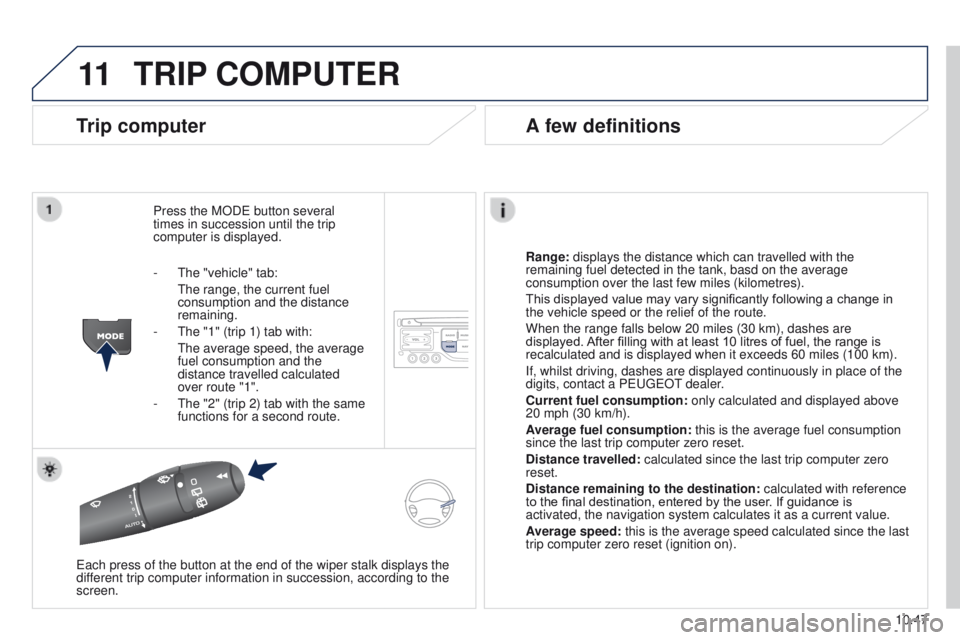
Press the MODE button several
times in succession until the trip
computer is displayed.
Range: displays the distance which can travelled with the
remaining fuel detected in the tank, basd on the average
consumption over the last few miles (kilometres).
This displayed value may vary significantly following a change in
the vehicle speed or the relief of the route.
When the range falls below 20 miles (30 km), dashes are
displayed. After filling with at least 10 litres of fuel, the range is
recalculated and is displayed when it exceeds 60 miles (100 km).
If, whilst driving, dashes are displayed continuously in place of the
digits, contact a PEUGEOT dealer.
Current fuel consumption:
only calculated and displayed above
20 mph (30 km/h).
Average fuel consumption: this is the average fuel consumption
since the last trip computer zero reset.
Distance travelled: calculated since the last trip computer zero
reset.
Distance remaining to the destination:
calculated with reference
to the final destination, entered by the user. If guidance is
activated, the navigation system calculates it as a current value.
Average speed: this is the average speed calculated since the last
trip computer zero reset (ignition on).
Each press of the button at the end of the wiper stalk displays the
different trip computer information in succession, according to the
screen.
A few definitions
- The "vehicle" tab:
The range, the current fuel
consumption and the distance
remaining.
-
The "1" (trip 1) tab with:
The average speed, the average
fuel consumption and the
distance travelled calculated
over route "1".
-
The "2" (trip 2) tab with the same
functions for a second route.
Page 231 of 244
08
14
10.73
Partner-2-VU_en_Chap10c_RD45_ed02_2014
TRIP COMPUTER
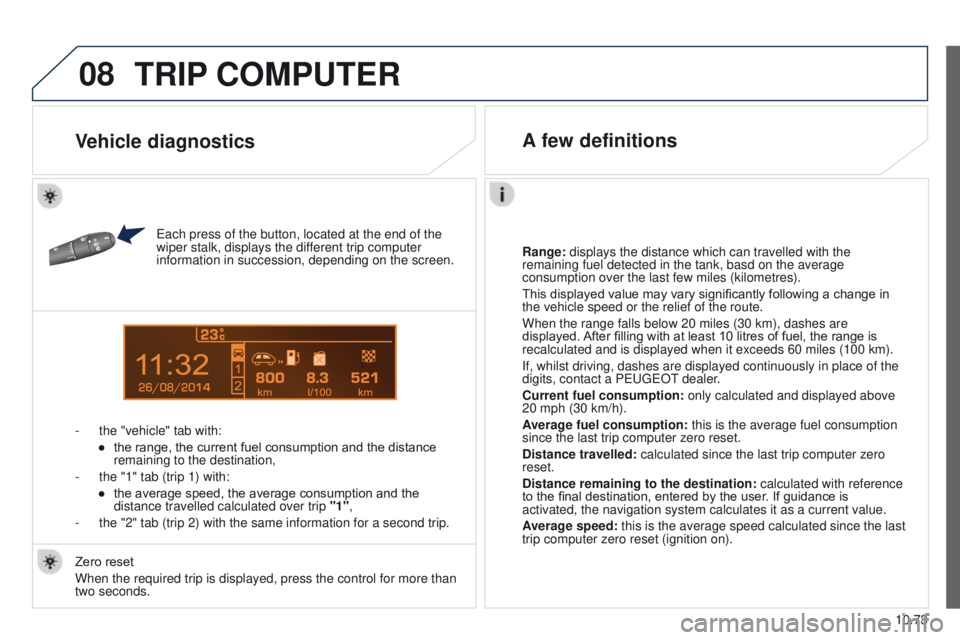
Each press of the button, located at the end of the
wiper stalk, displays the different trip computer
information in succession, depending on the screen.
-
the "vehicle" tab with:
●
the range, the current fuel consumption and the distance
remaining to the destination,
-
the "1" tab (trip 1) with:
●
the average speed, the average consumption and the
distance travelled calculated over trip "1"
,
-
the "2" tab (trip 2) with the same information for a second trip. Range:
displays the distance which can travelled with the
remaining fuel detected in the tank, basd on the average
consumption over the last few miles (kilometres).
This displayed value may vary significantly following a change in
the vehicle speed or the relief of the route.
When the range falls below 20 miles (30 km), dashes are
displayed. After filling with at least 10 litres of fuel, the range is
recalculated and is displayed when it exceeds 60 miles (100 km).
If, whilst driving, dashes are displayed continuously in place of the
digits, contact a PEUGEOT dealer.
Current fuel consumption:
only calculated and displayed above
20 mph (30 km/h).
Average fuel consumption: this is the average fuel consumption
since the last trip computer zero reset.
Distance travelled: calculated since the last trip computer zero
reset.
Distance remaining to the destination:
calculated with reference
to the final destination, entered by the user. If guidance is
activated, the navigation system calculates it as a current value.
Average speed: this is the average speed calculated since the last
trip computer zero reset (ignition on).
Zero reset
When the required trip is displayed, press the control for more than
two seconds.
Vehicle diagnostics A few definitions
Page 233 of 244
09
10.75
Partner-2-VU_en_Chap10c_RD45_ed02_2014
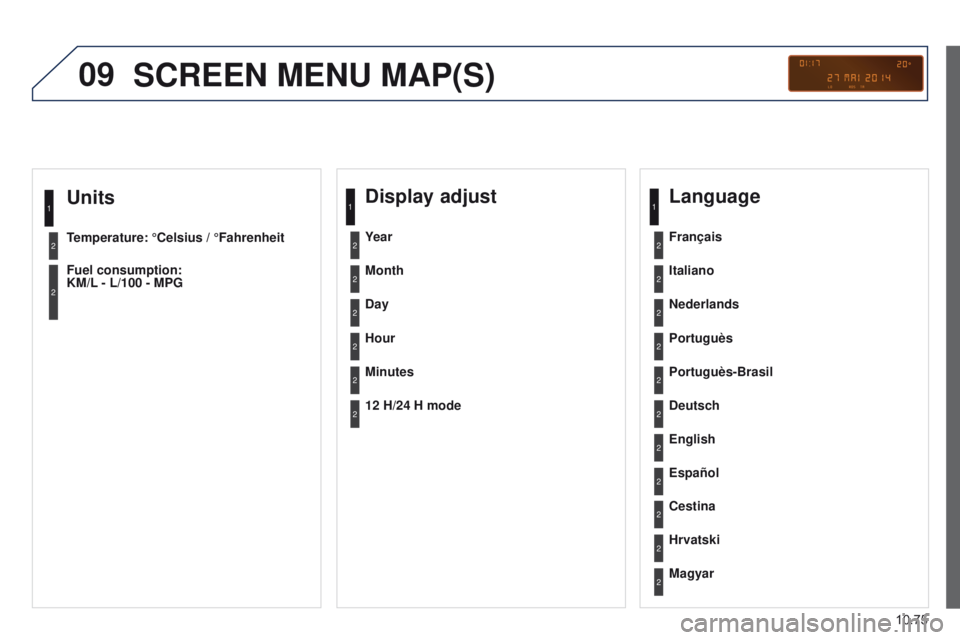
Units
Temperature: °Celsius / °Fahrenheit
Fuel consumption:
KM/L - L/100 - MPG
1
2
2
SCREEN MENU MAP(S)
Display adjust
Month
Day
Hour
Minutes Year
12 H/24 H mode
Language
Italiano
Nederlands
Portuguès
Portuguès-Brasil Français
Deutsch
Cestina English
Hrvatski Español
Magyar
1
2
2
2
2
2
2
2
1
2
2
2
2
2
2
2
2
2
2