ABS PEUGEOT PARTNER 2014 Owners Manual
[x] Cancel search | Manufacturer: PEUGEOT, Model Year: 2014, Model line: PARTNER, Model: PEUGEOT PARTNER 2014Pages: 244, PDF Size: 10.39 MB
Page 4 of 244
2
Partner-2-VU_en_Chap00a_Sommaire_ed02-2014
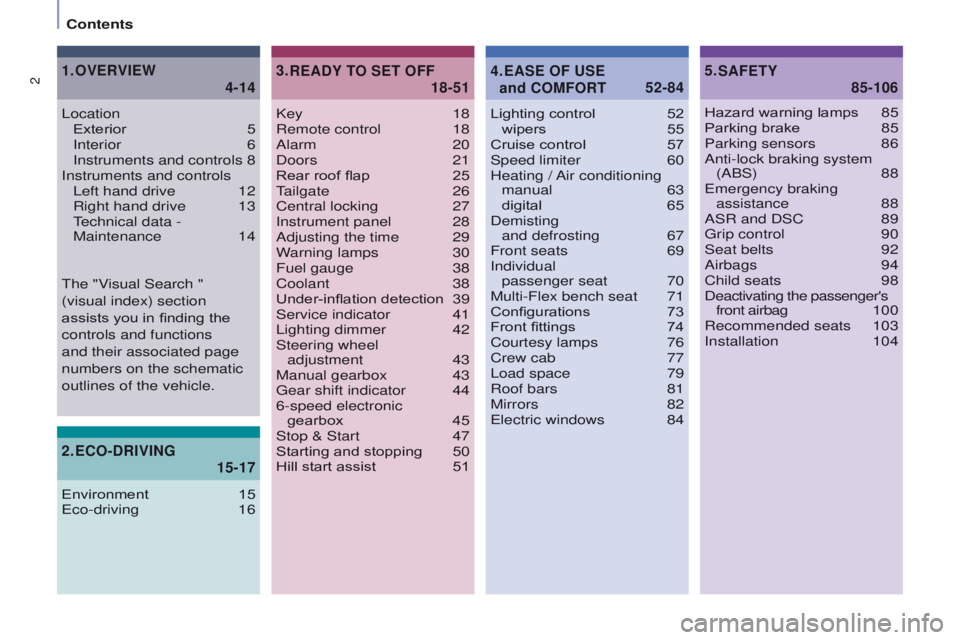
Key 18
Remote control 18
Alarm
20
Doors
21
Rear roof flap
25
T
ailgate 26
Central locking
27
Instrument panel
28
Adjusting the time
29
W
arning lamps
30
Fuel gauge
38
Coolant
38
Under-inflation detection
39
Service indicator
41
Lighting dimmer
42
Steering wheel
adjustment
43
Manual gearbox
43
Gear shift indicator
44
6-speed electronic
gearbox
45
Stop & Start
47
Starting and stopping
50
Hill start assist
51Lighting control
52 wipers
55
Cruise control
57
Speed limiter
60
Heating /
Air conditioning
manual
63
digital
65
Demisting
and defrosting
67
Front seats
69
Individual
passenger seat
70
Multi-Flex bench seat
71
Configurations
73
Front fittings
74
Courtesy lamps
76
Crew cab
77
Load space
79
Roof bars
81
Mirrors
82
Electric windows
84
3.
18-51
READY TO SET OFF
5.
85-106
SAFETY
Location
Exterior 5
Interior
6
Instruments and controls
8
Instruments and controls Left hand drive
12
Right hand drive
13
T
echnical data -
Maintenance
14
1.
4-14
OVERVIEW
Hazard warning lamps 85
Parking brake 85
Parking sensors
86
Anti-lock braking system (ABS)
88
Emergency braking assistance
88
ASR and DSC
89
Grip control
90
Seat belts
92
Airbags
94
Child seats
98
Deactivating the passenger's
front airbag
1
00
Recommended seats
103
Installation
104
4.
52-84
EASE OF USE
and COMFORT
2.
15-17
ECO-DRIVING
Environment 15
Eco-driving 16
The "Visual Search "
(visual
index) section
assists you in finding the
controls and functions
and their associated page
numbers on the schematic
outlines of the vehicle.
Contents
Page 7 of 244
5
Partner-2-VU_en_Chap01_vue-ensemble_ed02-2014
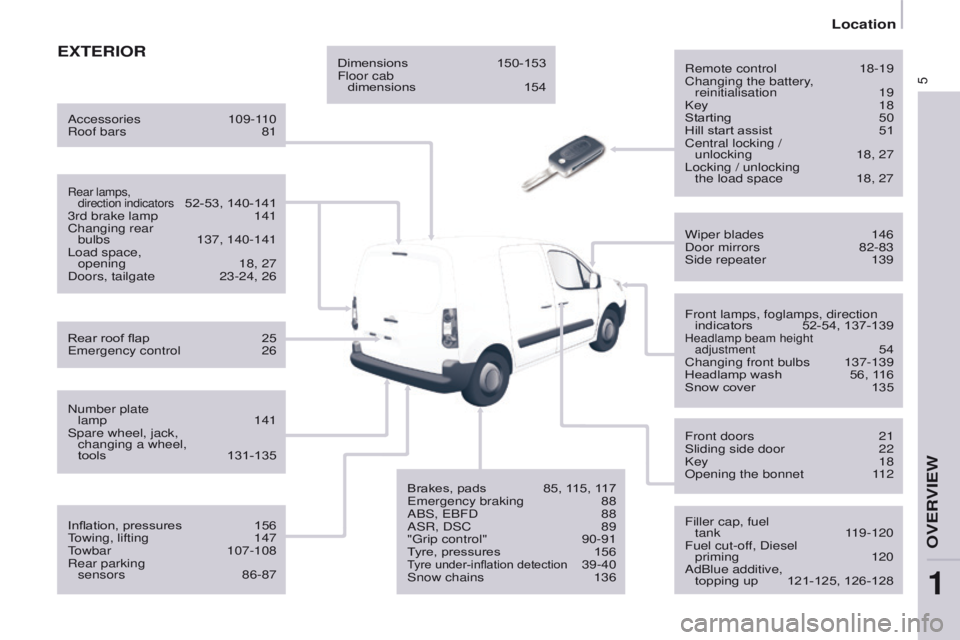
EXTERIORRemote control 18-19
Changing the battery ,
reinitialisation
19
Key
18
Starting
50
Hill start assist
51
Central locking /
unlocking
18, 27
Locking / unlocking
the load space
18, 27
Filler cap, fuel
tank
119-120
Fuel cut-off, Diesel priming
120
AdBlue additive, topping up
121-125, 126-128
Wiper blades
146
Door mirrors
82-83
Side repeater
139
Front lamps, foglamps, direction indicators
52-54, 137-139Headlamp beam height adjustment 54
Changing front bulbs 137-139
Headlamp wash
56, 1
16
Snow cover
135
Front doors
21
Sliding side door
22
Key
18
Opening the bonnet
1
12
Inflation, pressures
156
T
owing, lifting
147
T
owbar
107-108
Rear parking
sensors
86-87
Number plate
lamp
141
Spare wheel, jack,
changing a wheel,
tools
131-135
Rear lamps,
direction indicators 52-53, 140-141
3rd brake lamp
141
Changing rear
bulbs
137, 140-141
Load space,
opening
18, 27
Doors, tailgate
23-24, 26
Accessories
109-110
Roof bars
81
Rear roof flap
25
Emergency control
26 Dimensions
150-153
Floor cab
dimensions
154
Brakes, pads
85, 1
15, 117
Emergency braking
88
ABS, EBFD
88
ASR, DSC
89
"Grip control"
90-91
T
yre, pressures
156Tyre under-inflation detection 39-40
Snow chains
136
1
OVERVIEW
Location
Page 32 of 244

30
Partner-2-VU_en_Chap03_Pret-a-partir_ed02-2014Partner-2-VU_en_Chap03_Pret-a-partir_ed02-2014
WARNING LAMPS
Each time the vehicle is started: a series of warning lamps comes on app\
lying a self-test check. They go off almost immediately.
When the engine is running: the warning lamp becomes a warning if it remains on continuously or flashes. This initial warning may be
accompanied by an audible signal and a message which appears in the scre\
en.
Do not ignore these warnings.
Warning lamp is indicatesSolution - action
STOP on, associated
with another
warning
lamp and
accompanied
by a message
in the screen. major faults linked with
the "Brake fluid level",
"Engine oil pressure and
temperature", "Coolant
temperature", "Electronic
brake force distribution"and
"Power steering" warning
lamps.
You must stop as soon as it is safe to do
so. Park and switch off the ignition. Have it
checked by a PEUGEOT dealer or a qualified
workshop.
Parking
brake
/ Brake
fluid level /
EBFD on.
that the parking brake is applied
or has not been released fully.Releasing the parking brake switches off the
warning lamp.
on. low brake fluid level. Top up using a fluid recommended by PEUGEOT.
remaining on even
though the level
is correct and
associated with the
ABS warning lamp.
a fault with the electronic
brake force distribution. You must stop as soon as it is safe to do
so. Park and switch off the ignition. Have it
checked by a PEUGEOT dealer or a qualified
workshop.
Engine oil
pressure and
temperature on while
driving.
low pressure or a high
temperature. Park and switch off the ignition then allow to cool.
Visually check the level.
Chapter 7, "Levels" section.
remaining on,
even though
the level is
correct. a major fault.
Have it checked by a PEUGEOT dealer or a
qualified workshop.
Instruments and controls
Page 35 of 244

+
ABS
33
Partner-2-VU_en_Chap03_Pret-a-partir_ed02-2014
Warning lamp isindicatesSolution - action
Power
steering on. a fault with the
system.The vehicle retains conventional steering without
assistance. Have it checked by a PEUGEOT
dealer or a qualified workshop.
Door open
detection on and accompanied
by a message in the
screen. that a door is not
closed correctly.
Check that all of the doors are closed.
ABS remaining on. a fault with the anti-
lock braking system.The vehicle retains conventional braking.
Have it checked by a PEUGEOT dealer or a
qualified workshop.
ESC flashing.
triggering of the ASR
or DSC regulation.The system optimises traction and improves the
directional stability of the vehicle.
Chapter 5, "Driving safety" section.
remaining on. a fault with the
system. E.g.: under-
inflation of the tyres.E.g.: check the pressure of the tyres. (Wheel
speed sensor, hydraulic block, ...). Have it
checked by a PEUGEOT dealer or a qualified
workshop.
Under-
inflation on.
The tyre pressure is
too low in or more
wheels.Check the tyre pressure as soon as possible.
This check should preferably be done with the
tyres cold.
flashing then
remaining on,
accompanied by the
Service warning lamp,
and depending on
equipment, the display
of a message. The tyre pressure
monitoring system
has a fault or one of
the wheels does not
have a sensor.
Detection of under-inflation is no longer assured.
have it checked by a PEUGEOT dealer or a
qualified workshop.
Particle filter on. a problem with the
particle filter (fuel
additive level, risk of
blockage,
...).Have the filter checked by a PEUGEOT dealer or
a qualified workshop.
Chapter 7, "Levels" section.
READY TO SET OFF
3
Instruments and controls
Page 90 of 244
ABS
ABS
88
Partner-2-VU_en_Chap05_Securite_ed02-2014
ANTI-LOCK BRAKING SYSTEM
(ABS - EBFD)
The ABS and EBFD (electronic brake
force distribution) systems improve the
stability and manoeuvrability of your
vehicle on braking, in particular on
poor or slippery surfaces.
The ABS prevents locking of the
wheels, the EBFD provides control of
the braking pressure wheel by wheel.If this warning lamp comes
on, accompanied by an
audible signal and a message
in the screen, it indicates a
malfunction of the ABS which
could result in a loss of control of the
vehicle on braking.
If this warning lamp comes
on, together with the brake
and STOP warning lamps,
accompanied by an audible
signal and a message in the
screen, it indicates a malfunction of
the electronic brake force distribution
which could result in a loss of control of
the vehicle on braking.
EMERGENCY BRAKING
ASSISTANCE SYSTEM (EBA)
In an emergency, this system enables
the optimum braking pressure to be
reached more quickly, press the pedal
firmly without releasing it.
It is triggered by the speed at which the
brake pedal is activated.
This alters the resistance of the brake
pedal under your foot.
To prolong the operation of the
emergency braking assistance system:
keep your foot on the brake pedal.
Good practice
The anti-lock braking system comes
into operation automatically when
there is a risk of wheel lock. It does not
reduce the braking distance.
On very slippery surfaces (ice,
oil,
etc...) the ABS may increase the
braking distance. When braking in
an emergency, do not hesitate to
press the brake pedal firmly, without
releasing the pressure, even on a
slippery surface, you will then be able
to continue to manoeuvre the vehicle
to avoid an obstacle.
Normal operation of the ABS may be
felt by slight vibration of the brake
pedal.
When changing wheels (tyres
and rims), ensure that these are
recommended by PEUGEOT. Stop as soon as it is safe to do so.
In both cases, contact a PEUGEOT
dealer or a qualified workshop.
Driving safely
Page 91 of 244
89
Partner-2-VU_en_Chap05_Securite_ed02-2014
ANTI-SLIP REGULATION (ASR)
AND DYNAMIC STABILITY
CONTROL (DSC)
These systems are linked and
complement the ABS.
The ASR system is very useful for
maintaining optimum drive and
avoiding losses of control of the vehicle
on acceleration.
The system optimises drive to prevent
the wheels skidding, by acting on the
brakes of the drive wheels and on the
engine. It also allows the directional
stability of the vehicle to be improved
on acceleration.
Use the DSC to hold your course
without attempting to countersteer.
If there is a variation between the
trajectory followed by the vehicle and
that required by the driver, the DSC
system automatically acts on the
engine and the brake of one or more
wheels, in order to put the vehicle back
on course.
Deactivation
In certain exceptional conditions
(starting the vehicle when stuck in mud
or snow, or on loose ground...), it could
prove useful to deactivate the ASR and
DSC systems to make the wheels spin
and regain grip.
Operating fault
Good practice
The ASR/DSC systems offer increased
safety during normal driving, but
should not incite the driver to take risks
or to drive at high speed.
The operation of these systems is
ensured if the recommendations
of the manufacturer regarding
the wheels (tyres and rims), the
braking components, the electronic
components and the fitting and repair
procedures are observed.
After an impact, have these systems
checked by a PEUGEOT dealer or a
qualified workshop.
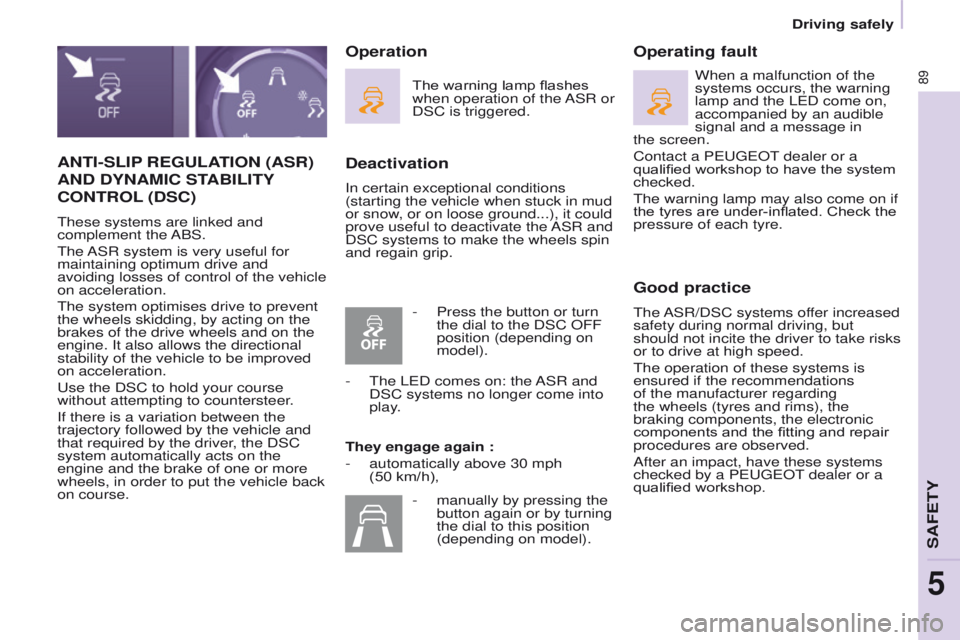
Operation
The warning lamp flashes
when operation of the ASR or
DSC is triggered.
They engage again :
-
automatically above 30 mph
(50 km/h), When a malfunction of the
systems occurs, the warning
lamp and the LED come on,
accompanied by an audible
signal and a message in
the
screen.
Contact a PEUGEOT dealer or a
qualified workshop to have the system
checked.
The warning lamp may also come on if
the tyres are under-inflated. Check the
pressure of each tyre.
-
Press the button or turn
the dial to the DSC OFF
position (depending on
model).
-
The LED comes on: the
ASR and
DSC systems no longer come into
play.
-
manually by pressing the
button again or by turning
the dial to this position
(depending on model).
SAFETY
5
Driving safely
Page 110 of 244
108
Partner-2-VU_en_Chap06_Accessoire_ed02-2014
Good Practice
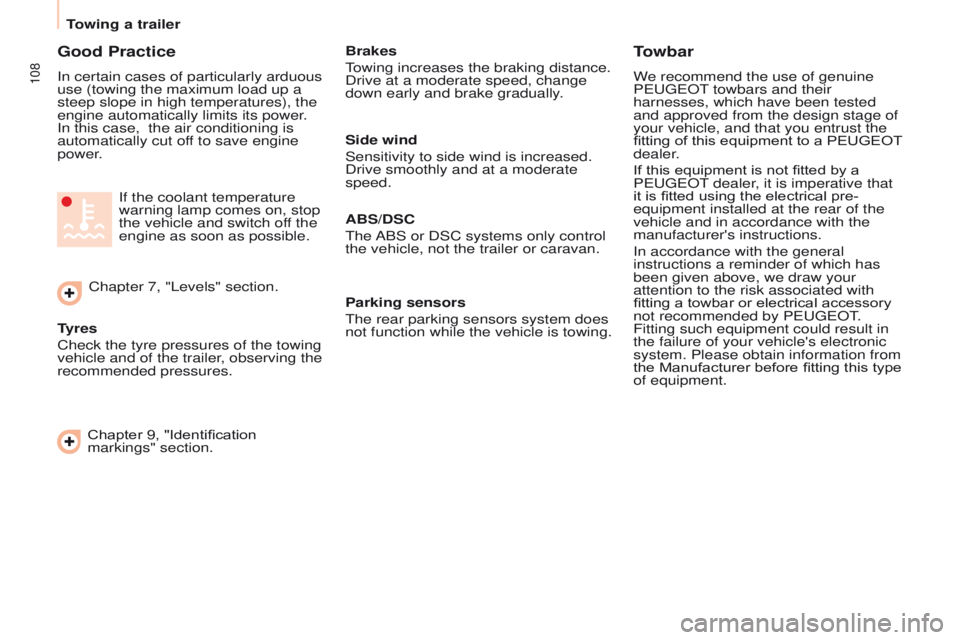
In certain cases of particularly arduous
use (towing the maximum load up a
steep slope in high temperatures), the
engine automatically limits its power.
In this case, the air conditioning is
automatically cut off to save engine
power.
Tyres
Check the tyre pressures of the towing
vehicle and of the trailer, observing the
recommended pressures. Chapter 7, "Levels" section.If the coolant temperature
warning lamp comes on, stop
the vehicle and switch off the
engine as soon as possible. Brakes
Towing increases the braking distance.
Drive at a moderate speed, change
down early and brake gradually.
Towbar
We recommend the use of genuine
PEUGEOT towbars and their
harnesses, which have been tested
and approved from the design stage of
your vehicle, and that you entrust the
fitting of this equipment to a PEUGEOT
dealer.
If this equipment is not fitted by a
PEUGEOT dealer, it is imperative that
it is fitted using the electrical pre-
equipment installed at the rear of the
vehicle and in accordance with the
manufacturer's instructions.
In accordance with the general
instructions a reminder of which has
been given above, we draw your
attention to the risk associated with
fitting a towbar or electrical accessory
not recommended by PEUGEOT.
Fitting such equipment could result in
the failure of your vehicle's electronic
system. Please obtain information from
the Manufacturer before fitting this type
of equipment.
Side wind
Sensitivity to side wind is increased.
Drive smoothly and at a moderate
speed.
ABS/DSC
The ABS or DSC systems only control
the vehicle, not the trailer or caravan.
Parking sensors
The rear parking sensors system does
not function while the vehicle is towing.
Chapter 9, "Identification
markings" section.
Towing a trailer
Page 142 of 244
140
Partner-2-VU_en_Chap08_Aide-rapide_ed02-2014
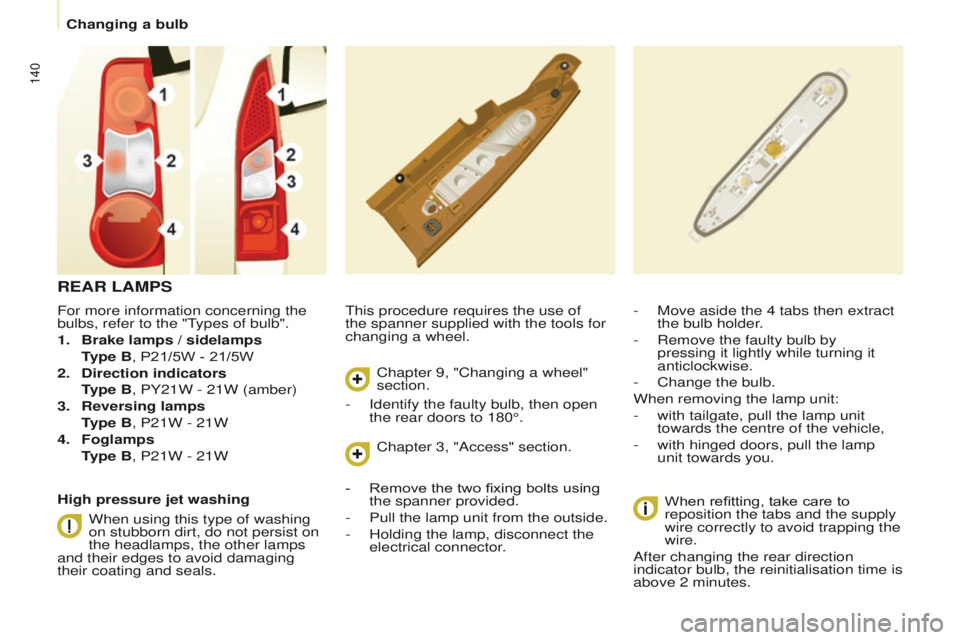
For more information concerning the
bulbs, refer to the "Types of bulb".
1.
Brake lamps / sidelamps
T
ype B, P21/5W - 21/5W
2.
Direction indicators
T
ype B, PY21W - 21W (amber)
3.
Reversing lamps
T
ype B, P21W - 21W
4.
Foglamps
T
ype B, P21W - 21W This procedure requires the use of
the spanner supplied with the tools for
changing a wheel.
-
Move aside the 4 tabs then extract
the bulb holder
.
-
Remove the faulty bulb by
pressing it lightly while turning it
anticlockwise.
-
Change the bulb.
When removing the lamp unit:
-
with tailgate, pull the lamp unit
towards the centre of the vehicle,
-
with hinged doors, pull the lamp
unit towards you.
When refitting, take care to
reposition the tabs and the supply
wire correctly to avoid trapping the
wire.
After changing the rear direction
indicator bulb, the reinitialisation time is
above 2 minutes.
REAR LAMPS
High pressure jet washing
When using this type of washing
on stubborn dirt, do not persist on
the headlamps, the other lamps
and their edges to avoid damaging
their coating and seals. Chapter 9, "Changing a wheel"
section.
Chapter 3, "Access" section.
-
Identify the faulty bulb, then open
the rear doors to 180°.
-
Remove the two fixing bolts using
the spanner provided.
-
Pull the lamp unit from the outside.
-
Holding the lamp, disconnect the
electrical connector
.
Changing a bulb
Page 149 of 244
147
Partner-2-VU_en_Chap08_Aide-rapide_ed02-2014
Without lifting (4 wheels on the
road)
You should always use a towing bar.
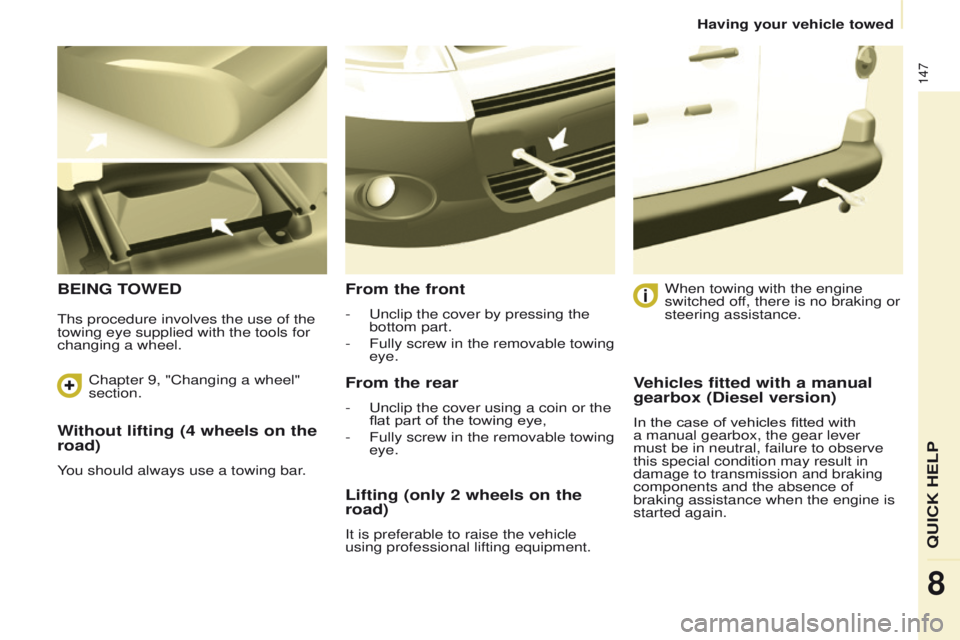
BEING TOWEDFrom the front
- Unclip the cover by pressing the
bottom part.
-
Fully screw in the removable towing
eye.
From the rear
- Unclip the cover using a coin or the
flat part of the towing eye,
-
Fully screw in the removable towing
eye. When towing with the engine
switched of
f, there is no braking or
steering assistance.
Lifting (only 2 wheels on the
road)
It is preferable to raise the vehicle
using professional lifting equipment.
Ths procedure involves the use of the
towing eye supplied with the tools for
changing a wheel.
Vehicles fitted with a manual
gearbox (Diesel version)
In the case of vehicles fitted with
a manual gearbox, the gear lever
must be in neutral, failure to observe
this special condition may result in
damage to transmission and braking
components and the absence of
braking assistance when the engine is
started again.
Chapter 9, "Changing a wheel"
section.
QUICK HELP
8
Having your vehicle towed
Page 213 of 244
10.55
Partner-2-VU_en_Chap10b_RT6-2-8_ed02-2014
FREQUENTLY ASKED QUESTIONS
QUESTION ANSWER SOLUTION
Some characters in the
media information are not
displayed correctly while
playing. The audio system does not display some types of characters.
Use standard characters to name tracks and
folders.
Playing of streaming files
does not start. The peripheral device connected does not support automatic play. Start the playback from the device.
The names of tracks and
the track length are not
displayed on the screen
when streaming audio. The Bluetooth profile does not allow the transfer of this information.
The quality of reception
of the radio station
listened to gradually
deteriorates or the stored
stations do not function
(no sound, 87.5
Mhz is
displayed...). The vehicle is too far from the transmitter used by the station listened\
to or there is no transmitter in the geographical area through which the\
vehicle is travelling.
Activate the "RDS" function by means of the
short-cut menu to enable the system to check
whether there is a more powerful transmitter in the
geographical area.
The environment (hills, buildings, tunnels, basement car parks...) blo\
ck
reception, including in RDS mode. This phenomenon is normal and does not indicate
a fault with the audio system.
The aerial is absent or has been damaged (for example when going
through a car wash or into an underground car park). Have the aerial checked by a PEUGEOT dealer.
I cannot find some radio
stations in the list of
stations received. The station is not received or its name has changed in the list.
Some radio stations send other information in place of their name (the \
title of the song for example).
The system interprets this information as the name of the station.
The name of the radio
station changes.