braking system Peugeot Partner 2015 Owner's Manual
[x] Cancel search | Manufacturer: PEUGEOT, Model Year: 2015, Model line: Partner, Model: Peugeot Partner 2015Pages: 244, PDF Size: 10.44 MB
Page 4 of 244
2
Partner-2-VU_en_Chap00a_Sommaire_ed02-2014
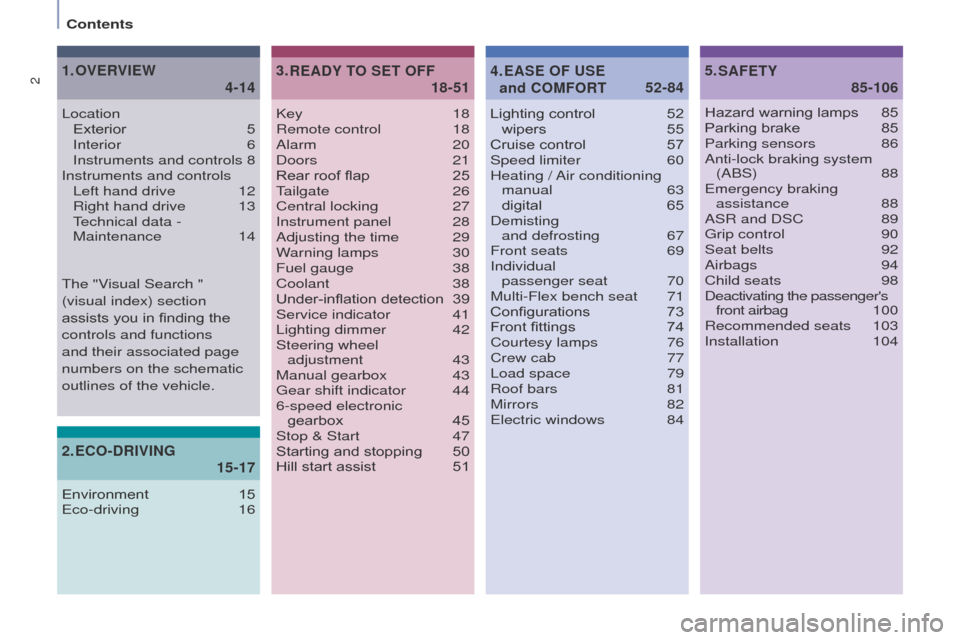
Key 18
Remote control 18
Alarm
20
Doors
21
Rear roof flap
25
T
ailgate 26
Central locking
27
Instrument panel
28
Adjusting the time
29
W
arning lamps
30
Fuel gauge
38
Coolant
38
Under-inflation detection
39
Service indicator
41
Lighting dimmer
42
Steering wheel
adjustment
43
Manual gearbox
43
Gear shift indicator
44
6-speed electronic
gearbox
45
Stop & Start
47
Starting and stopping
50
Hill start assist
51Lighting control
52 wipers
55
Cruise control
57
Speed limiter
60
Heating /
Air conditioning
manual
63
digital
65
Demisting
and defrosting
67
Front seats
69
Individual
passenger seat
70
Multi-Flex bench seat
71
Configurations
73
Front fittings
74
Courtesy lamps
76
Crew cab
77
Load space
79
Roof bars
81
Mirrors
82
Electric windows
84
3.
18-51
READY TO SET OFF
5.
85-106
SAFETY
Location
Exterior 5
Interior
6
Instruments and controls
8
Instruments and controls Left hand drive
12
Right hand drive
13
T
echnical data -
Maintenance
14
1.
4-14
OVERVIEW
Hazard warning lamps 85
Parking brake 85
Parking sensors
86
Anti-lock braking system (ABS)
88
Emergency braking assistance
88
ASR and DSC
89
Grip control
90
Seat belts
92
Airbags
94
Child seats
98
Deactivating the passenger's
front airbag
1
00
Recommended seats
103
Installation
104
4.
52-84
EASE OF USE
and COMFORT
2.
15-17
ECO-DRIVING
Environment 15
Eco-driving 16
The "Visual Search "
(visual
index) section
assists you in finding the
controls and functions
and their associated page
numbers on the schematic
outlines of the vehicle.
Contents
Page 18 of 244

16
Partner-2-VU_en_Chap02_eco-conduite_ed02-2014
Eco-driving is a range of everyday practices that allow the motorist to \
optimise their fuel consumption and CO2
emissions.
ECO-DRIVING
Optimise the use of your gearbox
With a manual gearbox, move off gently and change up
without waiting. During acceleration change up early.
With an automatic or electronic gearbox, give preference
to automatic mode and avoid pressing the accelerator
pedal heavily or suddenly.
The gear shift indicator invites you engage the most
suitable gear: as soon as the indication is displayed in the
instrument panel, follow it straight away.
For vehicles fitted with an electronic or automatic gearbox,
this indicator appears only in manual mode.
Drive smoothly
Maintain a safe distance between vehicles, use engine
braking rather than the brake pedal, and press the
accelerator progressively. These practices contribute
towards a reduction in fuel consumption and CO
2
emissions and also helps reduce the background traffic
noise.
If your vehicle has cruise control, make use of the system
at speeds above 25 mph (40 km/h) when the traffic is
flowing well.
Control the use of your electrical equipment
Before moving off, if the passenger compartment is too
warm, ventilate it by opening the windows and air vents
before using the air conditioning.
Above 30 mph (50 km/h), close the windows and leave the
air vents open.
Remember to make use of equipment that can help keep
the temperature in the passenger compartment down
(sunroof and window blinds...).
Switch off the air conditioning, unless it has automatic
regulation, as soon as the desired temperature is attained.
Switch off the demisting and defrosting controls, if not
automatic.
Switch off the heated seat as soon as possible.
Switch off the headlamps and front foglamps when the
level of light does not require their use.
Avoid running the engine before moving off, particularly in
winter; your vehicle will warm up much faster while driving.
As a passenger, if you avoid connecting your multimedia
devices (film, music, video game...), you will contribute
towards limiting the consumption of electrical energy, and
so of fuel.
Disconnect your portable devices before leaving the vehicle.
Motoring & Environment
Page 35 of 244
+
ABS
33
Partner-2-VU_en_Chap03_Pret-a-partir_ed02-2014
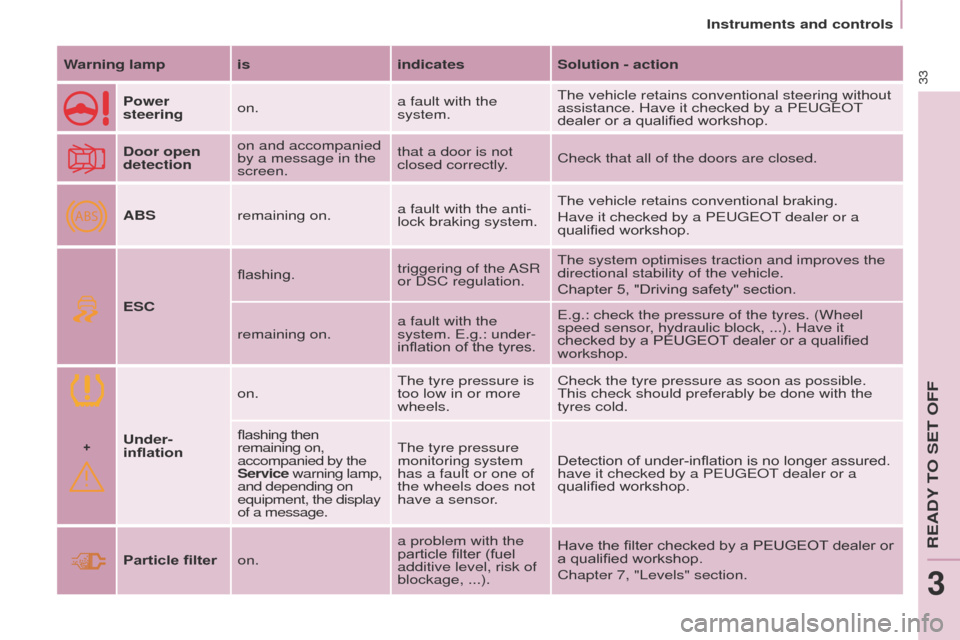
Warning lamp isindicatesSolution - action
Power
steering on. a fault with the
system.The vehicle retains conventional steering without
assistance. Have it checked by a PEUGEOT
dealer or a qualified workshop.
Door open
detection on and accompanied
by a message in the
screen. that a door is not
closed correctly.
Check that all of the doors are closed.
ABS remaining on. a fault with the anti-
lock braking system.The vehicle retains conventional braking.
Have it checked by a PEUGEOT dealer or a
qualified workshop.
ESC flashing.
triggering of the ASR
or DSC regulation.The system optimises traction and improves the
directional stability of the vehicle.
Chapter 5, "Driving safety" section.
remaining on. a fault with the
system. E.g.: under-
inflation of the tyres.E.g.: check the pressure of the tyres. (Wheel
speed sensor, hydraulic block, ...). Have it
checked by a PEUGEOT dealer or a qualified
workshop.
Under-
inflation on.
The tyre pressure is
too low in or more
wheels.Check the tyre pressure as soon as possible.
This check should preferably be done with the
tyres cold.
flashing then
remaining on,
accompanied by the
Service warning lamp,
and depending on
equipment, the display
of a message. The tyre pressure
monitoring system
has a fault or one of
the wheels does not
have a sensor.
Detection of under-inflation is no longer assured.
have it checked by a PEUGEOT dealer or a
qualified workshop.
Particle filter on. a problem with the
particle filter (fuel
additive level, risk of
blockage,
...).Have the filter checked by a PEUGEOT dealer or
a qualified workshop.
Chapter 7, "Levels" section.
READY TO SET OFF
3
Instruments and controls
Page 41 of 244
39
Partner-2-VU_en_Chap03_Pret-a-partir_ed02-2014
UNDER-INFLATION DETECTIONEMISSIONS CONTROLS
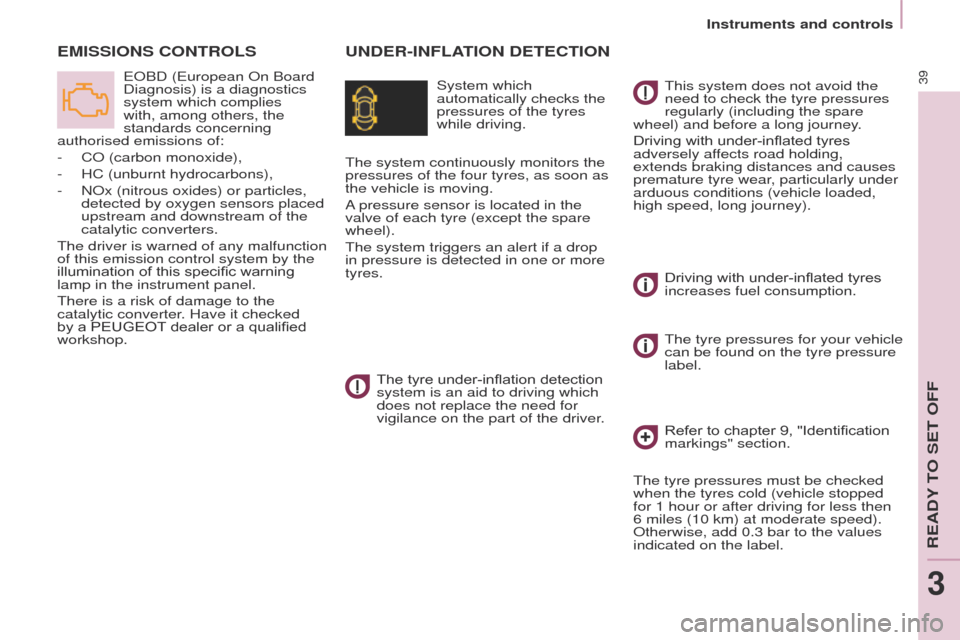
System which
automatically checks the
pressures of the tyres
while driving.
EOBD (European On Board
Diagnosis) is a diagnostics
system which complies
with, among others, the
standards
concerning
authorised emissions of:
-
CO (carbon monoxide),
-
HC (unburnt hydrocarbons),
-
NOx (nitrous oxides) or particles,
detected by oxygen sensors placed
upstream and downstream of the
catalytic converters.
The driver is warned of any malfunction
of this emission control system by the
illu
mination of this specific warning
lamp in the instrument panel.
There is a risk of damage to the
catalytic converter. Have it checked
by a PEUGEOT dealer or a qualified
workshop. The system continuously monitors the
pressures of the four tyres, as soon as
the vehicle is moving.
A pressure sensor is located in the
valve of each tyre (except the spare
wheel).
The system triggers an alert if a drop
in pressure is detected in one or more
tyres.
The tyre under-inflation detection
system is an aid to driving which
does not replace the need for
vigilance on the part of the driver
.This system does not avoid the
need to check the tyre pressures
regularly (including the spare
wheel) and before a long journey.
Driving with under-inflated tyres
adversely affects road holding,
extends braking distances and causes
premature tyre wear, particularly under
arduous conditions (vehicle loaded,
high speed, long journey).
Driving with under-inflated tyres
increases fuel consumption.
The tyre pressures for your vehicle
can be found on the tyre pressure
label.
Refer to chapter 9, "Identification
markings" section.
The tyre pressures must be checked
when the tyres cold (vehicle stopped
for 1 hour or after driving for less then
6 miles (10 km) at moderate speed).
Otherwise, add 0.3 bar to the values
indicated on the label.
READY TO SET OFF
3
Instruments and controls
Page 46 of 244
44
Partner-2-VU_en_Chap03_Pret-a-partir_ed02-2014Partner-2-VU_en_Chap03_Pret-a-partir_ed02-2014
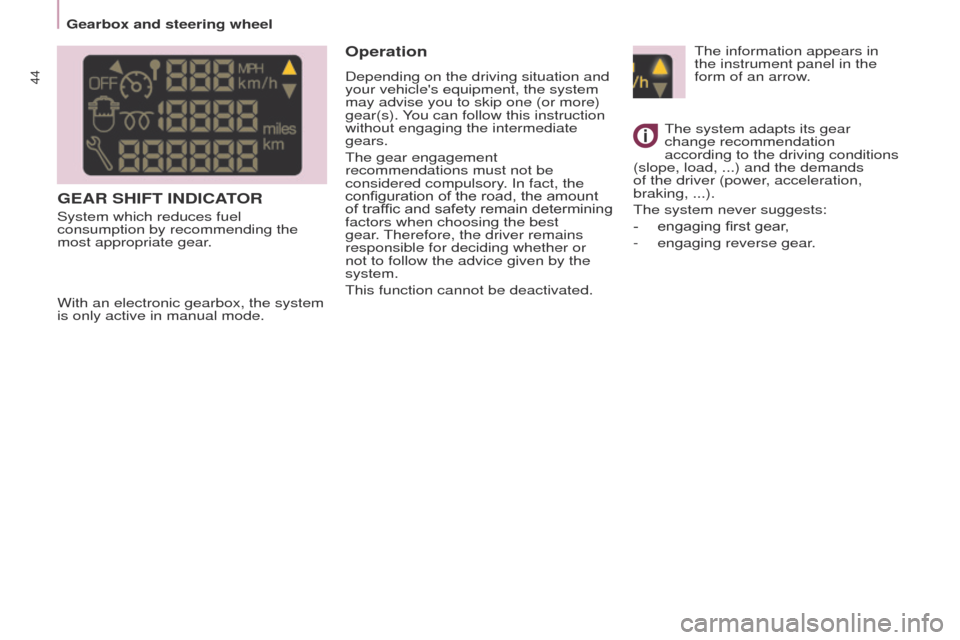
GEAR SHIFT INDICATOR
System which reduces fuel
consumption by recommending the
most appropriate gear.
Operation
Depending on the driving situation and
your vehicle's equipment, the system
may advise you to skip one (or more)
gear(s). You can follow this instruction
without engaging the intermediate
gears.
The gear engagement
recommendations must not be
considered compulsory. In fact, the
configuration of the road, the amount
of traffic and safety remain determining
factors when choosing the best
gear. Therefore, the driver remains
responsible for deciding whether or
not to follow the advice given by the
system.
This function cannot be deactivated.
With an electronic gearbox, the system
is only active in manual mode. The system adapts its gear
change recommendation
according to the driving conditions
(slope, load,
...) and the demands
of the driver (power, acceleration,
braking,
...).
The system never suggests:
-
engaging first gear
,
-
engaging reverse gear
.
The information appears in
the instrument panel in the
form of an arrow.
Gearbox and steering wheel
Page 49 of 244
47
Partner-2-VU_en_Chap03_Pret-a-partir_ed02-2014
STOP & START
The Stop & Start system puts the
engine temporarily on standby - ST OP
mode - during stops in the traffic (red
lights, traffic jams, or other...). The
engine restarts automatically - START
mode - as soon as you want to move
off. The restart takes place instantly,
quickly and silently.
Perfect for urban use, the Stop & Start
system reduces fuel consumption and
exhaust emissions as well as the noise
level when stationary.
Operation
Going into engine STOP mode
The "ECO" warning lamp
comes on in the instrument
panel and the engine goes into
standby:
-
with a manual gearbox
, at speeds
below 12 mph (20 km/h), when you
put the gear lever into neutral and
release the clutch pedal,
-
with the 6-speed electronic gear
control gearbox
, at a speed below
5 mph (8 km/h), when you press
the brake pedal or put the gear
lever into position N. If your vehicle is fitted with the system,
a time counter calculates the sum of
the periods in STOP mode during a
journey. It rests itself to zero every time
the ignition is switched on with the key.
With the automatic gearbox
system, for your comfort during
parking manoeuvres, STOP mode
is not available for a few seconds after
coming out of reverse gear.
STOP mode does not affect the
functionality of the vehicle, such as
braking, power steering, for example.
Never refuel with the engine in
STOP mode; you must switch off
the ignition with the key. Special cases: STOP mode
unavailable
STOP mode is not invoked when:
-
the driver's door is open,
-
the driver's seat belt is not
fastened,
-
the vehicle has not exceeded
6
mph (10 km/h) since the last
engine start using the key,
-
the engine is needed to maintain
a comfortable temperature in the
passenger compartment,
-
demisting is on,
-
some special conditions (battery
charge, engine temperature,
braking assistance, ambient
temperature...) where the engine
is needed to assure control of a
system.
In this case, the
"ECO"
warning lamp flashes for a
few seconds, then goes off.
This operation is perfectly normal.
READY TO SET OFF
3
Stop & Start
Page 50 of 244
48
Partner-2-VU_en_Chap03_Pret-a-partir_ed02-2014Partner-2-VU_en_Chap03_Pret-a-partir_ed02-2014
Going into engine START modeThe "ECO" warning lamp
goes off and the engine
starts:
-
with a manual gearbox
, when you
fully depress the clutch pedal,
-
with the 6-speed electronic gear
control gearbox
:
●
gear lever in position
A or M,
when you release the brake
pedal,
●
or gear lever in position
N and
the brake pedal released, when
you move the gear lever to posi-
tion A or M,
●
or when you engage reverse
gear
.
With a manual gearbox in STOP
mode, if a gear is engaged without
fully depressing the clutch pedal, a
warning lamp comes on or a message
is displayed asking you to depress the
clutch pedal to restart the engine. Special cases: START invoked
automatically
For your safety and comfort, START is
invoked automatically when:
-
you open the driver's door
,
-
you unfasten the driver's seat belt,
-
the speed of the vehicle exceeds
15 mph (25 km/h) with a manual
gearbox or 7 mph (1
1 km/h) with
the 6-speed electronic gearbox
system,
-
some special conditions (battery
charge, engine temperature,
braking assistance, ambient
temperature...) where the engine
is needed to assure control of a
system.In this case the
"ECO"
warning lamp flashes for
few
seconds, then goes off.
This operation is perfectly normal.Deactivation
At any time, press the "ECO
OFF" switch to deactivate the
system.
This is confirmed by the switch warning
lamp coming on accompanied by a
message in the screen.
If the system has been deactivated
in STOP mode, the engine restarts
immediately.
Stop & Start
Page 53 of 244
51
Partner-2-VU_en_Chap03_Pret-a-partir_ed02-2014
HILL START ASSIST
Operation
With the brake pedal and clutch pedal
pressed, from the time you release the
brake pedal you have approximately
2 seconds before the vehicle starts to
roll back and without using the parking
brake within which to move off.
During the moving off phase, the
function is deactivated automatically,
gradually releasing the braking
pressure. During this phase, the
characteristic noise of mechanical
release of the brakes may be heard,
indicating the imminent movement of
the vehicle.
Operating fault
Hill start assist is deactivated in the
following situations:
-
when the clutch pedal is released,
-
when the parking brake is applied,
-
when the engine is switched of
f,
-
when the engine stalls. If a malfunction of the system
occurs, this warning lamp
comes on accompanied
by an audible signal and
confirmed by a message in
the screen. Have the system checked
by at a PEUGEOT
dealer or a qualified
workshop.
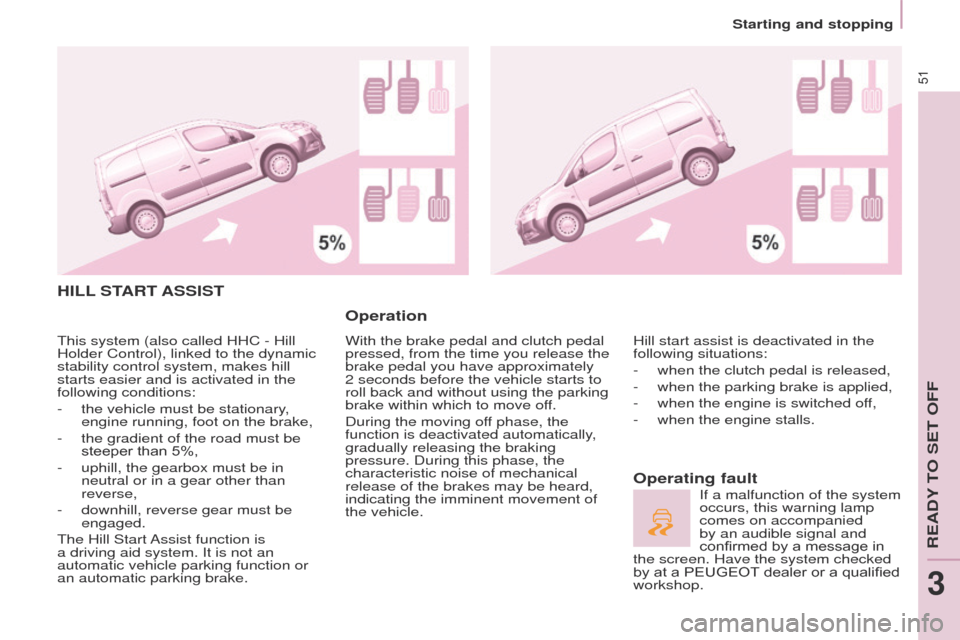
This system (also called HHC - Hill
Holder Control), linked to the dynamic
stability control system, makes hill
starts easier and is activated in the
following conditions:
-
the vehicle must be stationary
,
engine running, foot on the brake,
-
the gradient of the road must be
steeper than 5%,
-
uphill, the gearbox must be in
neutral or in a gear other than
reverse,
-
downhill, reverse gear must be
engaged.
The Hill Start
Assist function is
a driving aid system. It is not an
automatic vehicle parking function or
an automatic parking brake.
READY TO SET OFF
3
Starting and stopping
Page 90 of 244
ABS
ABS
88
Partner-2-VU_en_Chap05_Securite_ed02-2014
ANTI-LOCK BRAKING SYSTEM
(ABS - EBFD)
The ABS and EBFD (electronic brake
force distribution) systems improve the
stability and manoeuvrability of your
vehicle on braking, in particular on
poor or slippery surfaces.
The ABS prevents locking of the
wheels, the EBFD provides control of
the braking pressure wheel by wheel.If this warning lamp comes
on, accompanied by an
audible signal and a message
in the screen, it indicates a
malfunction of the ABS which
could result in a loss of control of the
vehicle on braking.
If this warning lamp comes
on, together with the brake
and STOP warning lamps,
accompanied by an audible
signal and a message in the
screen, it indicates a malfunction of
the electronic brake force distribution
which could result in a loss of control of
the vehicle on braking.
EMERGENCY BRAKING
ASSISTANCE SYSTEM (EBA)
In an emergency, this system enables
the optimum braking pressure to be
reached more quickly, press the pedal
firmly without releasing it.
It is triggered by the speed at which the
brake pedal is activated.
This alters the resistance of the brake
pedal under your foot.
To prolong the operation of the
emergency braking assistance system:
keep your foot on the brake pedal.
Good practice
The anti-lock braking system comes
into operation automatically when
there is a risk of wheel lock. It does not
reduce the braking distance.
On very slippery surfaces (ice,
oil,
etc...) the ABS may increase the
braking distance. When braking in
an emergency, do not hesitate to
press the brake pedal firmly, without
releasing the pressure, even on a
slippery surface, you will then be able
to continue to manoeuvre the vehicle
to avoid an obstacle.
Normal operation of the ABS may be
felt by slight vibration of the brake
pedal.
When changing wheels (tyres
and rims), ensure that these are
recommended by PEUGEOT. Stop as soon as it is safe to do so.
In both cases, contact a PEUGEOT
dealer or a qualified workshop.
Driving safely
Page 91 of 244
89
Partner-2-VU_en_Chap05_Securite_ed02-2014
ANTI-SLIP REGULATION (ASR)
AND DYNAMIC STABILITY
CONTROL (DSC)
These systems are linked and
complement the ABS.
The ASR system is very useful for
maintaining optimum drive and
avoiding losses of control of the vehicle
on acceleration.
The system optimises drive to prevent
the wheels skidding, by acting on the
brakes of the drive wheels and on the
engine. It also allows the directional
stability of the vehicle to be improved
on acceleration.
Use the DSC to hold your course
without attempting to countersteer.
If there is a variation between the
trajectory followed by the vehicle and
that required by the driver, the DSC
system automatically acts on the
engine and the brake of one or more
wheels, in order to put the vehicle back
on course.
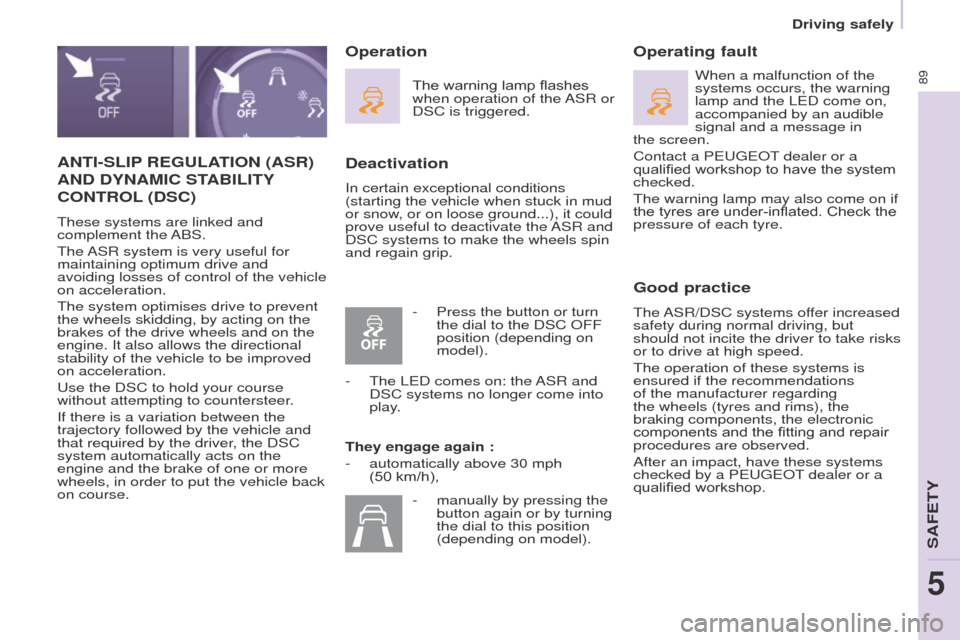
Deactivation
In certain exceptional conditions
(starting the vehicle when stuck in mud
or snow, or on loose ground...), it could
prove useful to deactivate the ASR and
DSC systems to make the wheels spin
and regain grip.
Operating fault
Good practice
The ASR/DSC systems offer increased
safety during normal driving, but
should not incite the driver to take risks
or to drive at high speed.
The operation of these systems is
ensured if the recommendations
of the manufacturer regarding
the wheels (tyres and rims), the
braking components, the electronic
components and the fitting and repair
procedures are observed.
After an impact, have these systems
checked by a PEUGEOT dealer or a
qualified workshop.
Operation
The warning lamp flashes
when operation of the ASR or
DSC is triggered.
They engage again :
-
automatically above 30 mph
(50 km/h), When a malfunction of the
systems occurs, the warning
lamp and the LED come on,
accompanied by an audible
signal and a message in
the
screen.
Contact a PEUGEOT dealer or a
qualified workshop to have the system
checked.
The warning lamp may also come on if
the tyres are under-inflated. Check the
pressure of each tyre.
-
Press the button or turn
the dial to the DSC OFF
position (depending on
model).
-
The LED comes on: the
ASR and
DSC systems no longer come into
play.
-
manually by pressing the
button again or by turning
the dial to this position
(depending on model).
SAFETY
5
Driving safely