engine oil Peugeot Partner 2017 User Guide
[x] Cancel search | Manufacturer: PEUGEOT, Model Year: 2017, Model line: Partner, Model: Peugeot Partner 2017Pages: 260, PDF Size: 9.05 MB
Page 133 of 260
131
Partner-2-VU_en_Chap07_Verification_ed02-2016
Good practice
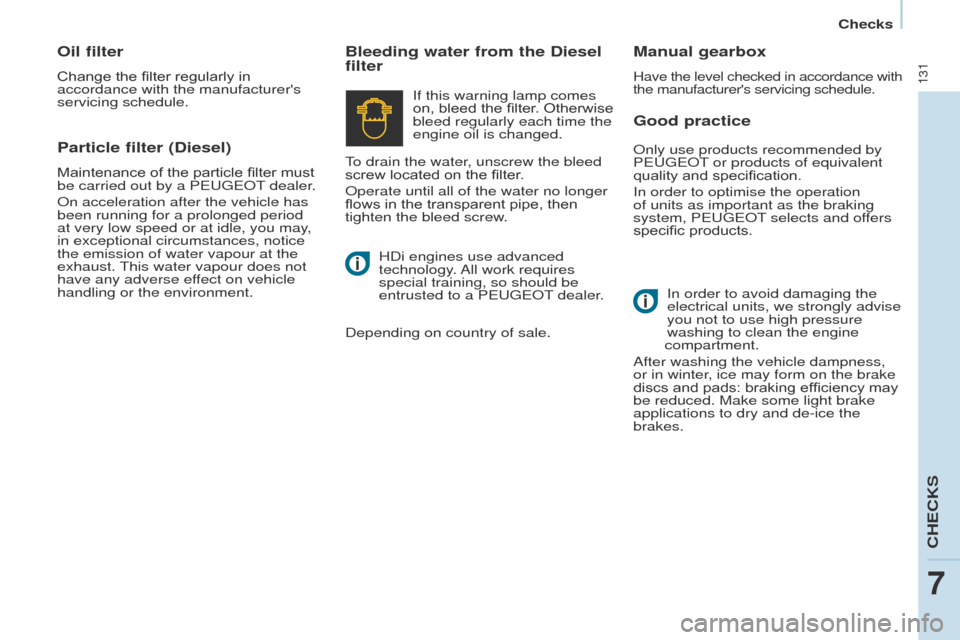
Bleeding water from the Diesel
filter
Manual gearbox
Have the level checked in accordance with
the manufacturer's servicing schedule.
In order to avoid damaging the
electrical units, we strongly advise
you not to use high pressure
washing to clean the engine
compartment.
After washing the vehicle dampness,
or in winter, ice may form on the brake
discs and pads: braking efficiency may
be reduced. Make some light brake
applications to dry and de-ice the
brakes.
If this warning lamp comes
on, bleed the filter. Otherwise
bleed regularly each time the
engine oil is changed.
To drain the water, unscrew the bleed
screw located on the filter.
Operate until all of the water no longer
flows in the transparent pipe, then
tighten the bleed screw.
Particle filter (Diesel)
Maintenance of the particle filter must
be carried out by a PEUGEOT dealer.
On acceleration after the vehicle has
been running for a prolonged period
at very low speed or at idle, you may,
in exceptional circumstances, notice
the emission of water vapour at the
exhaust. This water vapour does not
have any adverse effect on vehicle
handling or the environment.
Oil filter
Change the filter regularly in
accordance with the manufacturer's
servicing schedule.
HDi engines use advanced
technology
. All work requires
special training, so should be
entrusted to a PEUGEOT dealer.
Depending on country of sale. Only use products recommended by
PEUGEOT or products of equivalent
quality and specification.
In order to optimise the operation
of units as important as the braking
system, PEUGEOT selects and offers
specific products.
CHECKS
7
Checks
Page 135 of 260
133
Partner-2-VU_en_Chap07_Verification_ed02-2016
Travelling abroad
Certain fuels could damage the
engine of your vehicle. In certain
countries, the use of a particular
fuel may be required (specific
octane rating, specific sales
name…) to ensure correct operation
of the engine.
For any additional information, contact
your dealer.
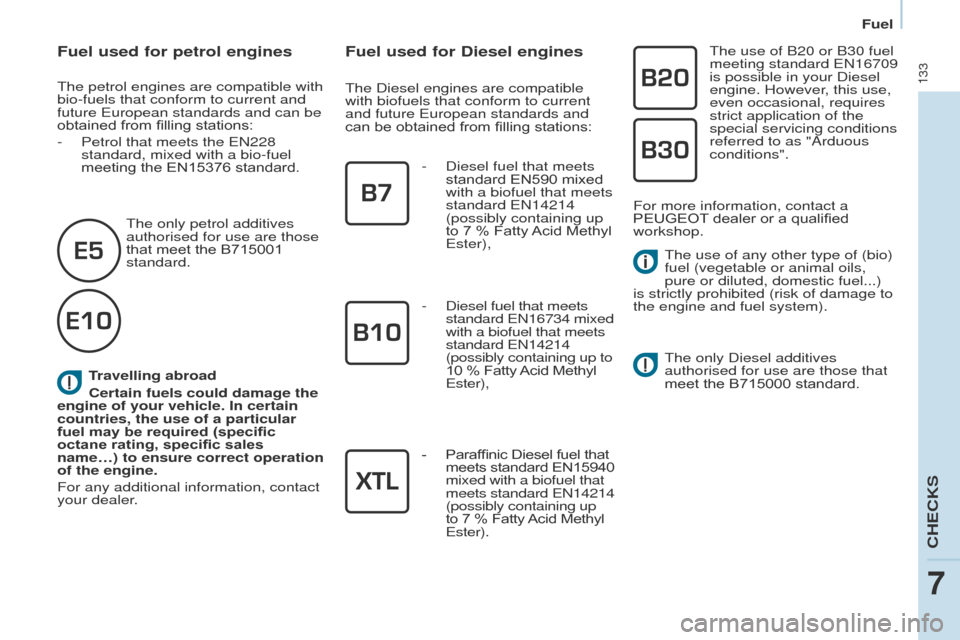
Fuel used for petrol engines
The petrol engines are compatible with
bio-fuels that conform to current and
future European standards and can be
obtained from filling stations:
-
Petrol that meets the EN228
standard, mixed with a bio-fuel
meeting the EN15376 standard.
The only petrol additives
authorised for use are those
that meet the B715001
standard.
Fuel used for Diesel engines
The Diesel engines are compatible
with biofuels that conform to current
and future European standards and
can be obtained from filling stations: -
Diesel fuel that meets
standard EN590 mixed
with a biofuel that meets
standard EN14214
(possibly containing up
to 7 % Fatty
Acid Methyl
Ester), The use of B20 or B30 fuel
meeting standard EN16709
is possible in your Diesel
engine. However, this use,
even occasional, requires
strict application of the
special servicing conditions
referred to as "Arduous
conditions".
-
Diesel fuel that meets
standard EN16734 mixed
with a biofuel that meets
standard EN14214
(possibly containing up to
10 % Fatty Acid Methyl
Ester), For more information, contact a
PEUGEOT dealer or a qualified
workshop.
-
Paraffinic Diesel fuel that
meets standard EN15940
mixed with a biofuel that
meets standard EN14214
(possibly containing up
to 7 % Fatty Acid Methyl
Ester). The use of any other type of (bio)
fuel (vegetable or animal oils,
pure or diluted, domestic fuel...)
is strictly prohibited (risk of damage to
the engine and fuel system).
The only Diesel additives
authorised for use are those that
meet the B715000 standard.
CHECKS
7
Fuel