gearbox Peugeot Partner 2017 User Guide
[x] Cancel search | Manufacturer: PEUGEOT, Model Year: 2017, Model line: Partner, Model: Peugeot Partner 2017Pages: 260, PDF Size: 9.05 MB
Page 47 of 260
45
Partner-2-VU_en_Chap03_Pret-a-partir_ed02-2016
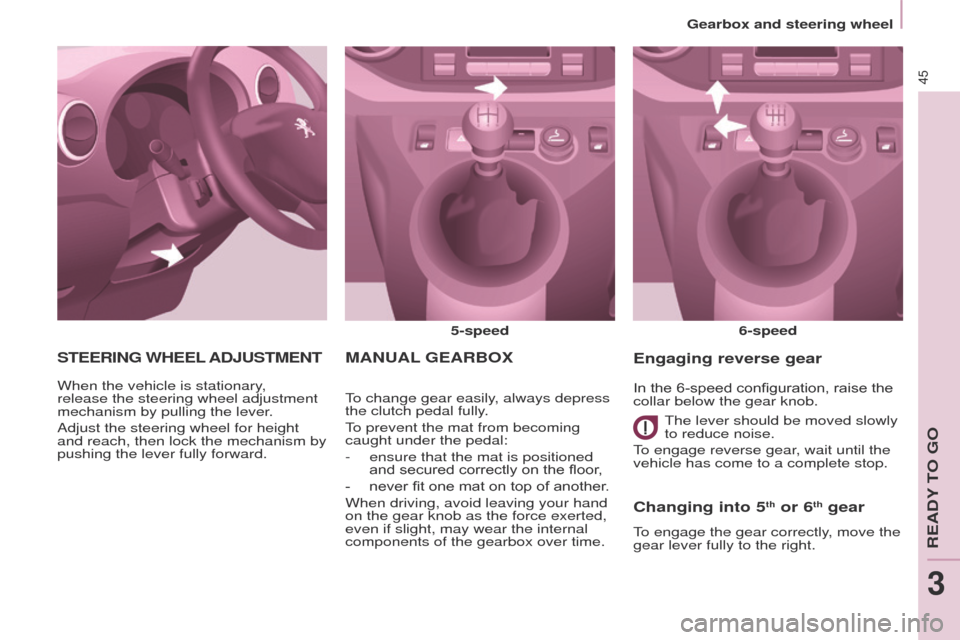
MANUAL GEARBO x
5-speed
6-speed
To change gear easily, always depress
the clutch pedal fully.
To prevent the mat from becoming
caught under the pedal:
-
ensure that the mat is positioned
and secured correctly on the floor
,
-
never fit one mat on top of another
.
When driving, avoid leaving your hand
on the gear knob as the force exerted,
even if slight, may wear the internal
components of the gearbox over time.
Changing into 5th or 6th gear
To engage the gear correctly, move the
gear lever fully to the right. In the 6-speed configuration, raise the
collar below the gear knob.
Engaging reverse gear
S
TEERING
WHEEL
ADJUSTMENT
When the vehicle is stationary,
release the steering wheel adjustment
mechanism by pulling the lever.
Adjust the steering wheel for height
and reach, then lock the mechanism by
pushing the lever fully forward. The lever should be moved slowly
to reduce noise.
To engage reverse gear, wait until the
vehicle has come to a complete stop.
READY TO GO
3
Gearbox and steering wheel
Page 48 of 260
46
Partner-2-VU_en_Chap03_Pret-a-partir_ed02-2016
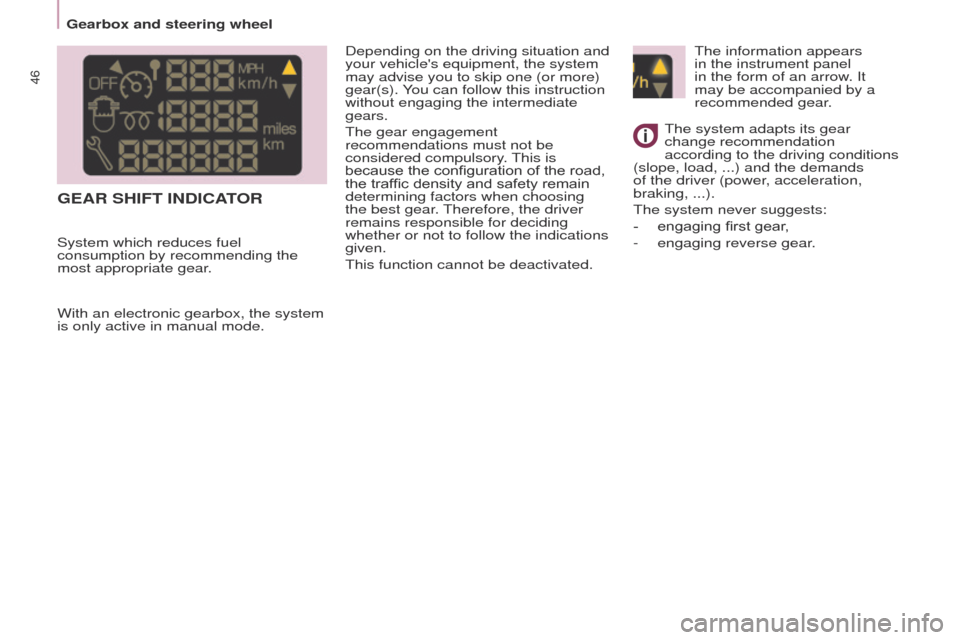
GEAR SHIFT INDICATOR
Depending on the driving situation and
your vehicle's equipment, the system
may advise you to skip one (or more)
gear(s). You can follow this instruction
without engaging the intermediate
gears.
The gear engagement
recommendations must not be
considered compulsory. This is
because the configuration of the road,
the traffic density and safety remain
determining factors when choosing
the best gear. Therefore, the driver
remains responsible for deciding
whether or not to follow the indications
given.
This function cannot be deactivated.
With an electronic gearbox, the system
is only active in manual mode. The system adapts its gear
change recommendation
according to the driving conditions
(slope, load,
...) and the demands
of the driver (power, acceleration,
braking,
...).
The system never suggests:
-
engaging first gear
,
-
engaging reverse gear
.
The information appears
in the instrument panel
in the form of an arrow. It
may be accompanied by a
recommended gear.
System which reduces fuel
consumption by recommending the
most appropriate gear.
Gearbox and steering wheel
Page 49 of 260
47
Partner-2-VU_en_Chap03_Pret-a-partir_ed02-2016
Moving off
- To start the engine, the gear selector must be in position N.
-
Press firmly on the brake pedal.
-
Operate the starter
.
-
When the engine is running, place
the gear selector on
R, A or M as
desired.
-
Release the brake pedal and
accelerate.
If the gear selector is not in position N,
and/or if the brake pedal is not pressed,
the engine will not start. Repeat the
above procedure.
Reverse gear Engaging reverse gear
Move the gear selector to R.
Only attempt to select reverse gear
when the vehicle is stationary.
Neutral Changing to neutral
Move the gear selector to N. If the
vehicle is moving, do not select this
position even momentarily.
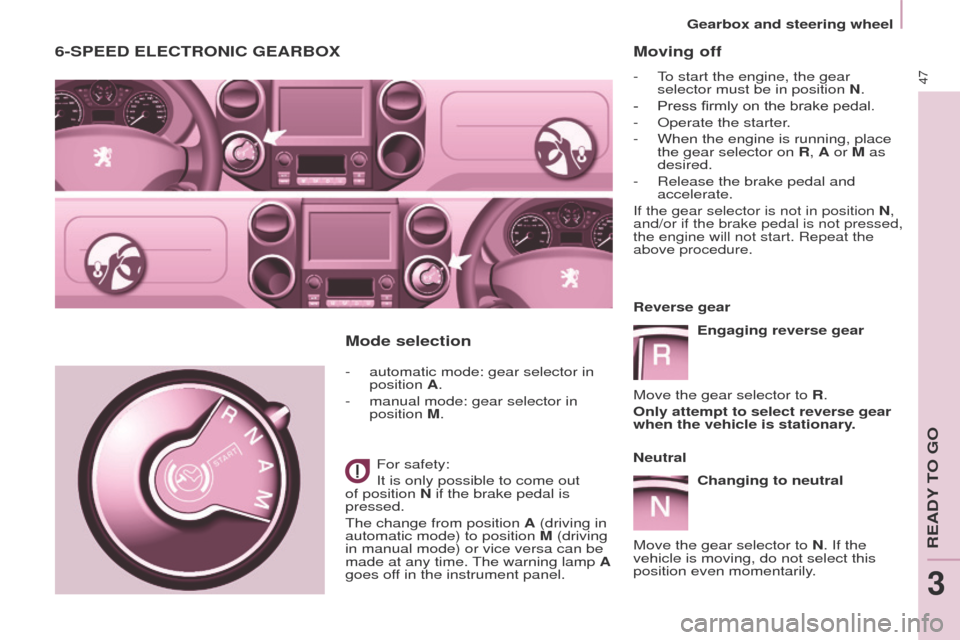
6-SPEED ELECTRONIC GEARBOx
- automatic mode: gear selector in
position A.
-
manual mode: gear selector in
position
M.
For safety:
It is only possible to come out
of position N if the brake pedal is
pressed.
The change from position A (driving in
automatic mode) to position M (driving
in manual mode) or vice versa can be
made at any time. The warning lamp A
goes off in the instrument panel.
Mode selection
READY TO GO
3
Gearbox and steering wheel
Page 50 of 260
48
Partner-2-VU_en_Chap03_Pret-a-partir_ed02-2016
Manual modeChanging to manual mode
Move the gear selector to M.
Automatic mode
Changing to automatic
mode
Move the gear selector to A.
The gearbox then operates in
automatic mode, without any action on
your part.
It constantly selects the gear that is
best suited to the following conditions:
-
driving style,
-
road profile,
-
optimum fuel consumption.
Vehicle stationary, with
the
engine running
In the event of a prolonged stop with
the engine running, the gearbox
changes automatically to neutral N.
Stopping the vehicle
Before stopping the engine, put the
gear selector in position N.
In all cases, it is essential to apply
the parking brake. Check that the
parking brake warning lamp is on in the
instrument panel.
Before doing anything in the
engine compartment, check that
the gear selector is in neutral N.
Acceleration
For optimum acceleration (e.g. to
overtake another vehicle), simply
press the pedal beyond the point of
resistance at the end of its travel, by
pressing down firmly.
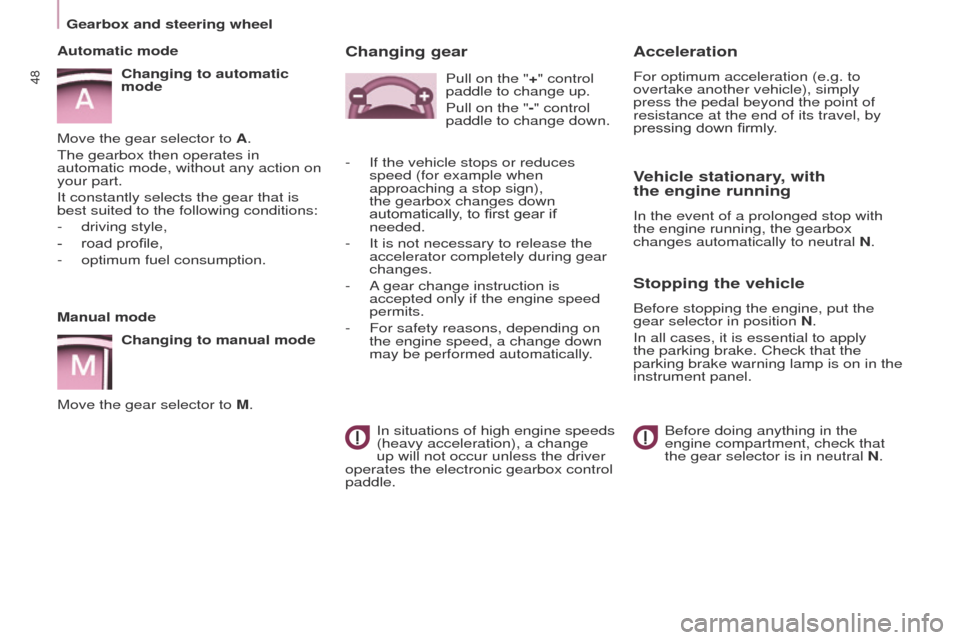
Changing gear
In situations of high engine speeds
(heavy acceleration), a change
up will not occur unless the driver
operates the electronic gearbox control
paddle. Pull on the "+" control
paddle to change up.
Pull on the "-" control
paddle to change down.
-
If the vehicle stops or reduces
speed (for example when
approaching a stop sign),
the gearbox changes down
automatically
, to first gear if
needed.
-
It is not necessary to release the
accelerator completely during gear
changes.
-
A
gear change instruction is
accepted only if the engine speed
permits.
-
For safety reasons, depending on
the engine speed, a change down
may be performed automatically
.
Gearbox and steering wheel
Page 51 of 260
49
Partner-2-VU_en_Chap03_Pret-a-partir_ed02-2016
STOP & START
The Stop & Start system puts the
engine temporarily on standby - ST OP
mode - during stops in the traffic (red
lights, traffic jams, or other...).
The engine restarts automatically -
START mode - as soon as you want to
move off.
The restart takes place instantly,
quickly and silently.
Perfect for urban use, the Stop & Start
system reduces fuel consumption and
exhaust emissions as well as the noise
level when stationary.
Operation
Going into engine STOP mode
The "ECO" warning lamp
comes on in the instrument
panel and the engine goes
into standby:
-
with a manual gearbox
, at speeds
below 12 mph (20 km/h), when you
put the gear lever into neutral and
release the clutch pedal,
-
with a 6-speed electronic
gearbox
, at speeds below 5 mph
(8 km/h), when you press the brake
pedal or put the gear lever into
position N. If your vehicle is fitted with the system,
a time counter calculates the sum of
the periods in STOP mode during a
journey. It rests itself to zero every time
the ignition is switched on with the key.
With a 6-speed electronic
gearbox, for your comfort during
parking manoeuvres, STOP mode
is not available for a few seconds after
coming out of reverse gear.
STOP mode does not affect the
functionality of the vehicle, such as
braking, power steering, for example.
Never refuel with the engine in
STOP mode; you must switch off
the ignition with the key. Special cases: STOP mode
unavailable
STOP mode is not invoked when:
-
the vehicle is on a steep slope
(rising or fallin
g),
-
the driver's door is open,
-
the driver's seat belt is not
fastened,
-
the vehicle has not exceeded 6
mph (10 km/h) since the last engine
start using the key
,
-
the engine is needed to maintain
a comfortable temperature in the
passenger compartment,
-
demisting is on,
-
some special conditions (battery
charge, engine temperature,
braking assistance, ambient
temperature...) where the engine
is needed to assure control of a
system.
In this case, the
"ECO"
warning lamp flashes for a
few seconds, then goes off.
This operation is perfectly normal.
READY TO GO
3
Stop & Start
Page 52 of 260
50
Partner-2-VU_en_Chap03_Pret-a-partir_ed02-2016
Going into engine START modeThe "ECO" warning lamp
goes off and the engine
starts:
-
with a manual gearbox
, when you
fully depress the clutch pedal,
-
with a 6-speed electronic
gearbox
:
●
gear lever in position
A or M,
when you release the brake
pedal,
●
or gear lever in position
N and
the brake pedal released, when
you move the gear lever to posi-
tion A or M,
●
or when you engage reverse
gear
.
With a manual gearbox in STOP
mode, if a gear is engaged without
fully depressing the clutch pedal, a
warning lamp comes on or a message
is displayed asking you to depress the
clutch pedal to restart the engine. Special cases: START invoked
automatically
For your safety and comfort, START is
invoked automatically when:
-
you open the driver's door
,
-
you unfasten the driver's seat belt,
-
the speed of the vehicle exceeds
15 mph (25 km/h) with a manual
gearbox or 7 mph (1
1 km/h) with
the 6-speed electronic gearbox
system,
-
some special conditions (battery
charge, engine temperature,
braking assistance, ambient
temperature...) where the engine
is needed to assure control of a
system.In this case the
"ECO"
warning lamp flashes for
few
seconds, then goes off.
This operation is perfectly normal.Deactivation
In certain circumstances, such as
the need to maintain a comfortable
temperature in the passenger
compartment, it may be preferable
to deactivate Stop & Start.
At any time, press the "ECO OFF"
switch to deactivate the system.
This is confirmed by the switch warning
lamp coming on accompanied by a
message in the screen.
If the system has been deactivated
in ST
OP mode, the engine restarts
immediately.
Reactivation
Press the "ECO OFF" switch again.
The system is active again; this is
confirmed by the switch warning
lamp going off and a message in the
instrument panel.
The system is reactivated
automatically at every new start
using the key.
Stop & Start
Page 54 of 260
52
Partner-2-VU_en_Chap03_Pret-a-partir_ed02-2016
Starting and switching off
Good practice when stopping Good practice when starting
Diesel pre-heating warning
lamp
If the temperature is high
enough, the warning lamp
comes on for less than
one second, you can start
without waiting.
In cold weather, wait for this warning
lamp to go off then operate the starter
(Starting position) until the engine
starts.
Door or bonnet open warning lamp
If this comes on, a door or the
bonnet is not closed correctly, check!
Minimise engine and gearbox wear
When switching off the ignition, let the
engine run for a few seconds to allow
the turbocharger (Diesel engine) to
return to idle.
Do not press the accelerator when
switching off the ignition.
There is no need to engage a gear
after parking the vehicle.
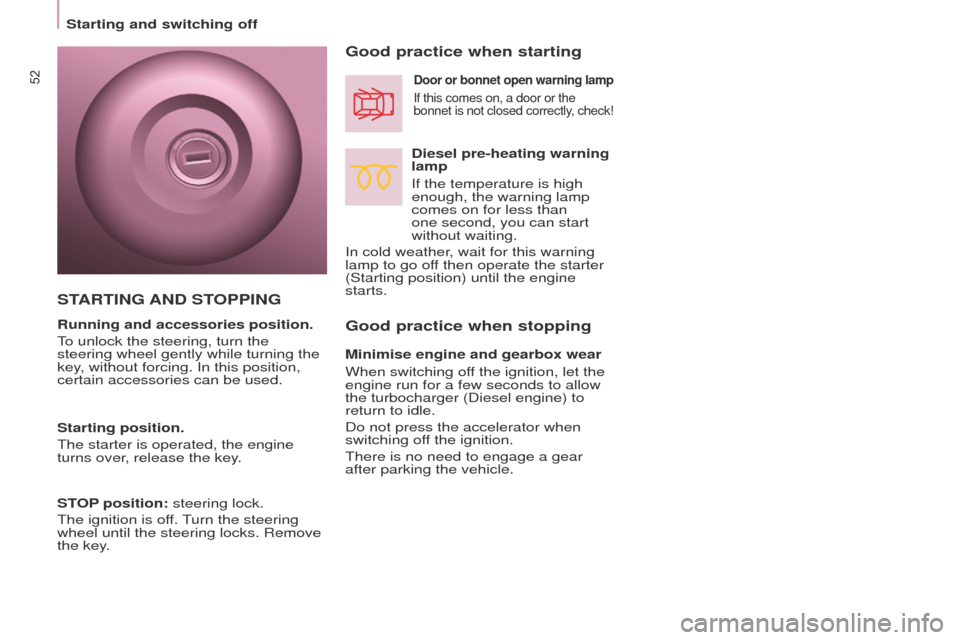
STARTING AND ST OPPING
Running and accessories position.
To unlock the steering, turn the
steering wheel gently while turning the
key, without forcing. In this position,
certain accessories can be used.
Starting position.
The starter is operated, the engine
turns over, release the key.
STOP position: steering lock.
The ignition is off. Turn the steering
wheel until the steering locks. Remove
the key.
Page 55 of 260
53
Partner-2-VU_en_Chap03_Pret-a-partir_ed02-2016
Starting and switching off
HILL START ASSIST
Operation
With the brake pedal and clutch pedal
pressed, from the time you release
the brake pedal, without using the
parking brake, you have approximately
2
seconds to move off before the
vehicle starts to roll back.
During the moving off phase, the
function is deactivated automatically,
gradually releasing the braking
pressure. During this phase, the
characteristic noise of mechanical
release of the brakes may be heard,
indicating the imminent movement of
the vehicle.
Operating fault
Hill start assist is deactivated in the
following situations:
-
when the clutch pedal is released,
-
when the parking brake is applied,
-
when the engine is switched of
f,
-
when the engine stalls. If a malfunction of the system
occurs, this warning lamp
comes on accompanied
by an audible signal and
confirmed by a message in
the screen. Have the system checked
by a PEUGEOT
dealer or a qualified
workshop.
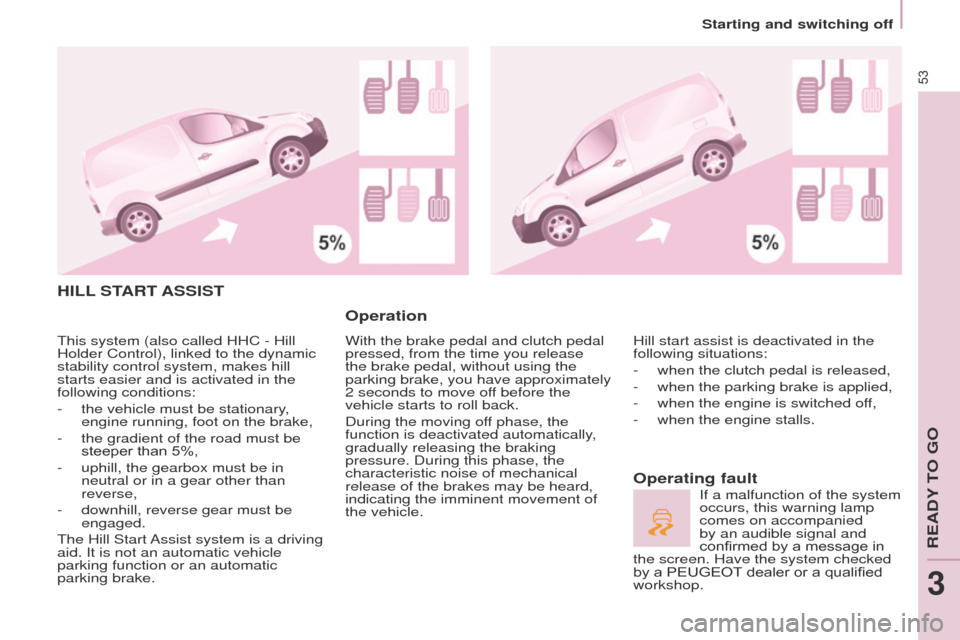
This system (also called HHC - Hill
Holder Control), linked to the dynamic
stability control system, makes hill
starts easier and is activated in the
following conditions:
-
the vehicle must be stationary
,
engine running, foot on the brake,
-
the gradient of the road must be
steeper than 5%,
-
uphill, the gearbox must be in
neutral or in a gear other than
reverse,
-
downhill, reverse gear must be
engaged.
The Hill Start
Assist system is a driving
aid. It is not an automatic vehicle
parking function or an automatic
parking brake.
READY TO GO
3
Page 56 of 260
54
Partner-2-VU_en_Chap03_Pret-a-partir_ed02-2016
Starting and switching off
DRIVING RECOMMENDATIONS
Observe the driving regulations and
remain vigilant whatever the traffic
conditions.
Pay close attention to the traffic and
keep your hands on the wheel so that
you are ready to react at any time to
any eventuality.
As a safety precaution, the driver
must only carry out actions requiring
sustained attention when the vehicle is
stationary.
On a long journey, a break every two
hours is strongly recommended.
In difficult weather, drive smoothly,
anticipate the need to brake and
increase the distance from other
vehicles.
Driving on flooded roads
We strongly advise against driving
on flooded roads, as this could cause
serious damage to the engine or
gearbox, as well as to the electrical
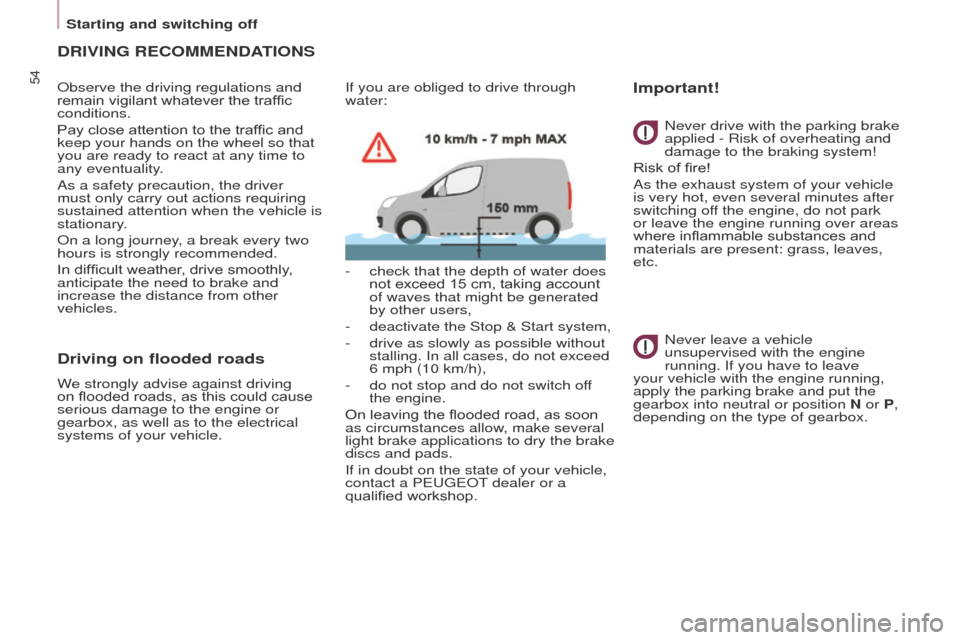
systems of your vehicle.If you are obliged to drive through
water:
-
check that the depth of water does
not exceed 15 cm, taking account
of waves that might be generated
by other users,
-
deactivate the Stop & Start system,
-
drive as slowly as possible without
stallin
g. In all cases, do not exceed
6 mph (10 km/h),
- do not stop and do not switch of f
the engine.
On leaving the flooded road, as soon
as circumstances allow, make several
light brake applications to dry the brake
discs and pads.
If in doubt on the state of your vehicle,
contact a PEUGEOT dealer or a
qualified workshop. Never drive with the parking brake
applied - Risk of overheating and
damage to the braking system!
Risk of fire!
As the exhaust system of your vehicle
is very hot, even several minutes after
switching off the engine, do not park
or leave the engine running over areas
where inflammable substances and
materials are present: grass, leaves,
etc.
Never leave a vehicle
unsupervised with the engine
running. If you have to leave
your vehicle with the engine running,
apply the parking brake and put the
gearbox into neutral or position N or P,
depending on the type of gearbox.
Important!
Page 120 of 260
11 8
Towing a trailer
Partner-2-VU_en_Chap06_Accessoire_ed02-2016
For more information about
weights and towed loads, refer to
chapter 9, "Weights" section.
TOWING A TRAILER , A CARA VAN ...
Distribution of loads
Distribute the load in the trailer so
that the heaviest objects are as
close as possible to the axle and
the nose weight is close to the
maximum authorised without, however,
exceeding it.
Cooling
Towing a trailer on a slope increases
the coolant temperature. As the fan is electrically controlled, its
cooling capacity is not dependent on
the engine speed.
You should therefore use a high gear
to lower the engine speed and reduce
your speed.
In all cases, pay attention to the
coolant temperature.
Driving advice
A towed vehicle must free wheel:
gearbox in neutral.