ECU Peugeot Partner Tepee 2011 User Guide
[x] Cancel search | Manufacturer: PEUGEOT, Model Year: 2011, Model line: Partner Tepee, Model: Peugeot Partner Tepee 2011Pages: 232, PDF Size: 7.4 MB
Page 97 of 232
95
EASE OF USE
andCOMFOR
T
3
Practical information
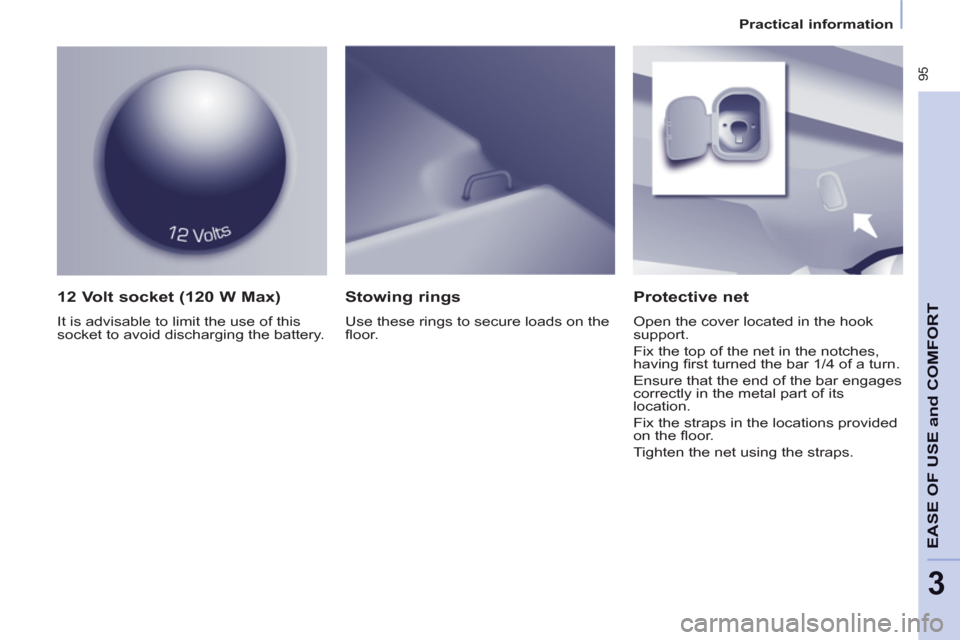
12 Volt socket (120 W Max)
It is advisable to limit the use of this
socket to avoid discharging the battery.
Protective net
Open the cover located in the hook
support.
Fix the top of the net in the notches,
having fi rst turned the bar 1/4 of a turn.
Ensure that the end of the bar engages
correctly in the metal part of its
location.
Fix the straps in the locations provided
on the fl oor.
Tighten the net using the straps.
Stowing rings
Use these rings to secure loads on the
fl oor.
Page 98 of 232
96
Practical information
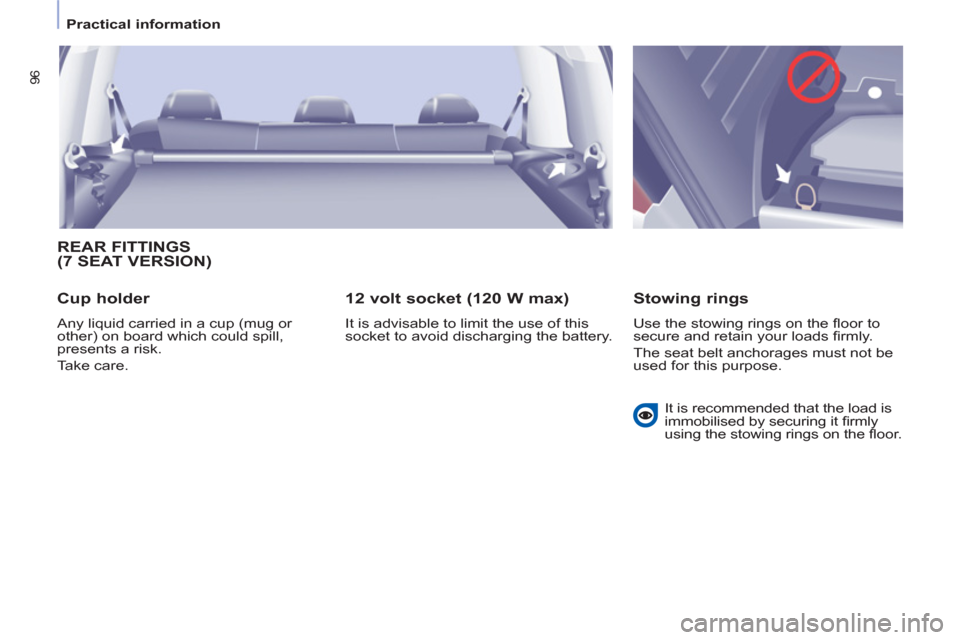
REAR FITTINGS (7 SEAT VERSION)
Cup holder
Any liquid carried in a cup (mug or
other) on board which could spill,
presents a risk.
Take care.
12 volt socket (120 W max)
It is advisable to limit the use of this
socket to avoid discharging the battery.
Stowing rings
Use the stowing rings on the fl oor to
secure and retain your loads fi rmly.
The seat belt anchorages must not be
used for this purpose.
It is recommended that the load is
immobilised by securing it fi rmly
using the stowing rings on the fl oor.
Page 102 of 232
100
Practical information
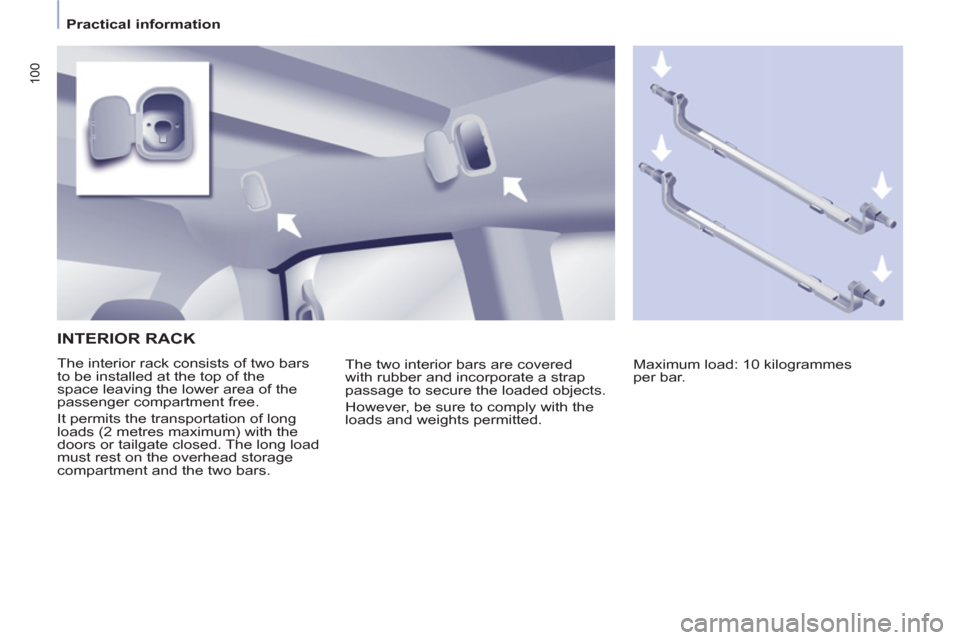
INTERIOR RACK
The interior rack consists of two bars
to be installed at the top of the
space leaving the lower area of the
passenger compartment free.
It permits the transportation of long
loads (2 metres maximum) with the
doors or tailgate closed. The long load
must rest on the overhead storage
compartment and the two bars. Maximum load: 10 kilogrammes
per bar. The two interior bars are covered
with rubber and incorporate a strap
passage to secure the loaded objects.
However, be sure to comply with the
loads and weights permitted.
Page 106 of 232
104
Mirrors and windows
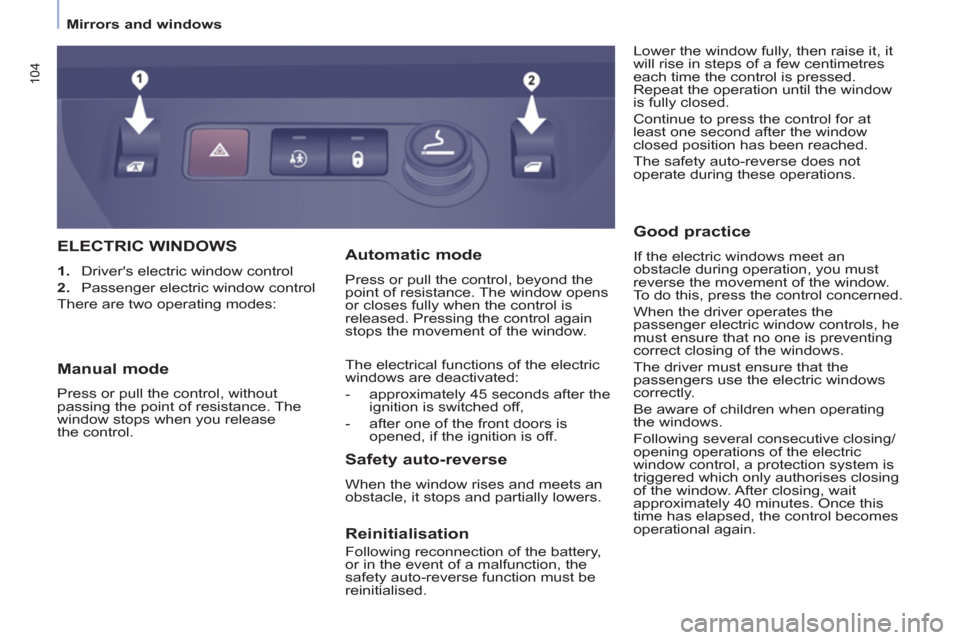
ELECTRIC WINDOWS
1. Driver's electric window control
2. Passenger electric window control
There are two operating modes: Lower the window fully, then raise it, it
will rise in steps of a few centimetres
each time the control is pressed.
Repeat the operation until the window
is fully closed.
Continue to press the control for at
least one second after the window
closed position has been reached.
The safety auto-reverse does not
operate during these operations.
Safety auto-reverse
When the window rises and meets an
obstacle, it stops and partially lowers.
Automatic mode
Press or pull the control, beyond the
point of resistance. The window opens
or closes fully when the control is
released. Pressing the control again
stops the movement of the window.
The electrical functions of the electric
windows are deactivated:
- approximately 45 seconds after the
ignition is switched off,
- after one of the front doors is
opened, if the ignition is off.
Good practice
If the electric windows meet an
obstacle during operation, you must
reverse the movement of the window.
To do this, press the control concerned.
When the driver operates the
passenger electric window controls, he
must ensure that no one is preventing
correct closing of the windows.
The driver must ensure that the
passengers use the electric windows
correctly.
Be aware of children when operating
the windows.
Following several consecutive closing/
opening operations of the electric
window control, a protection system is
triggered which only authorises closing
of the window. After closing, wait
approximately 40 minutes. Once this
time has elapsed, the control becomes
operational again.
Manual mode
Press or pull the control, without
passing the point of resistance. The
window stops when you release
the control.
Reinitialisation
Following reconnection of the battery,
or in the event of a malfunction, the
safety auto-reverse function must be
reinitialised.
Page 115 of 232
11 3
SAFETY
4
Seat belts
SEAT BELTS
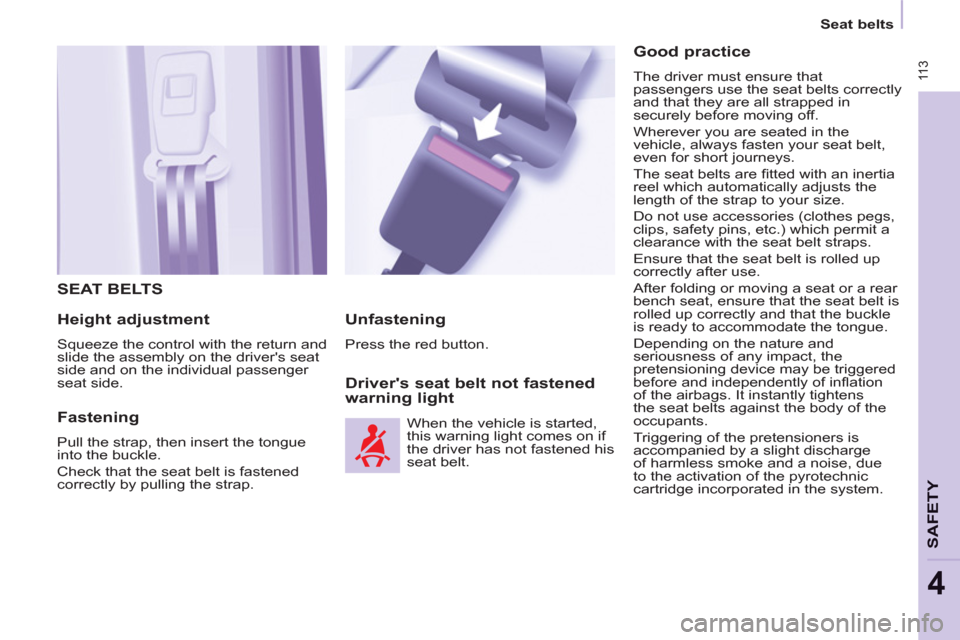
Height adjustment
Squeeze the control with the return and
slide the assembly on the driver's seat
side and on the individual passenger
seat side.
Fastening
Pull the strap, then insert the tongue
into the buckle.
Check that the seat belt is fastened
correctly by pulling the strap.
Driver's seat belt not fastened
warning light
Unfastening
Press the red button.
When the vehicle is started,
this warning light comes on if
the driver has not fastened his
seat belt.
Good practice
The driver must ensure that
passengers use the seat belts correctly
and that they are all strapped in
securely before moving off.
Wherever you are seated in the
vehicle, always fasten your seat belt,
even for short journeys.
The seat belts are fi tted with an inertia
reel which automatically adjusts the
length of the strap to your size.
Do not use accessories (clothes pegs,
clips, safety pins, etc.) which permit a
clearance with the seat belt straps.
Ensure that the seat belt is rolled up
correctly after use.
After folding or moving a seat or a rear
bench seat, ensure that the seat belt is
rolled up correctly and that the buckle
is ready to accommodate the tongue.
Depending on the nature and
seriousness of any impact, the
pretensioning device may be triggered
before and independently of infl ation
of the airbags. It instantly tightens
the seat belts against the body of the
occupants.
Triggering of the pretensioners is
accompanied by a slight discharge
of harmless smoke and a noise, due
to the activation of the pyrotechnic
cartridge incorporated in the system.
Page 123 of 232
121
4
121
Child safety
Refer to chapter 4, "Airbags" section.
The child seats function and
the passenger airbag disarming
function are common to the entire
PEUGEOT range.
If the passenger airbag is not
disarmed, the installation of a
"rearwards-facing" child seat in the
front is strictly prohibited.
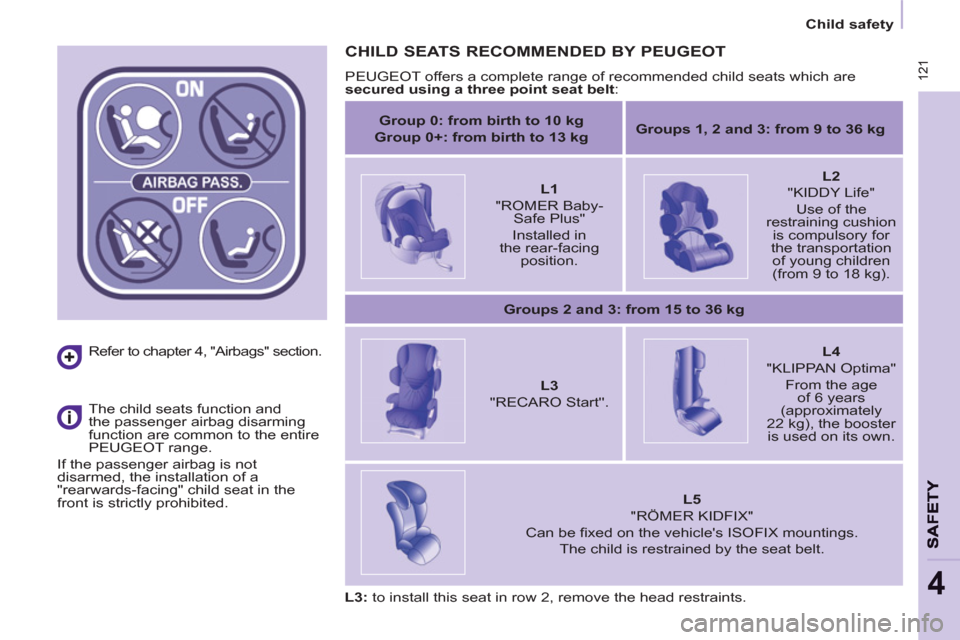
CHILD SEATS RECOMMENDED BY PEUGEOT
PEUGEOT offers a complete range of recommended child seats which are
secured using a three point seat belt
:
Group 0: from birth to 10 kg
Group 0+: from birth to 13 kg
Groups 1, 2 and 3: from 9 to 36 kg
L1
"ROMER Baby-
Safe Plus"
Installed in
the rear-facing
position
.
L2
"KIDDY Life"
Use of the
restraining cushion
is compulsory for
the transportation
of young children
(from 9 to 18 kg).
Groups 2 and 3: from 15 to 36 kg
L3
"RECARO Start''
.
L4
"KLIPPAN Optima"
From the age
of 6 years
(approximately
22 kg), the booster
is used on its own.
L5
"RÖMER KIDFIX"
Can be fi xed on the vehicle's ISOFIX mountings.
The child is restrained by the seat belt.
L3: to install this seat in row 2, remove the head restraints.
Page 124 of 232
122 122
Child safety
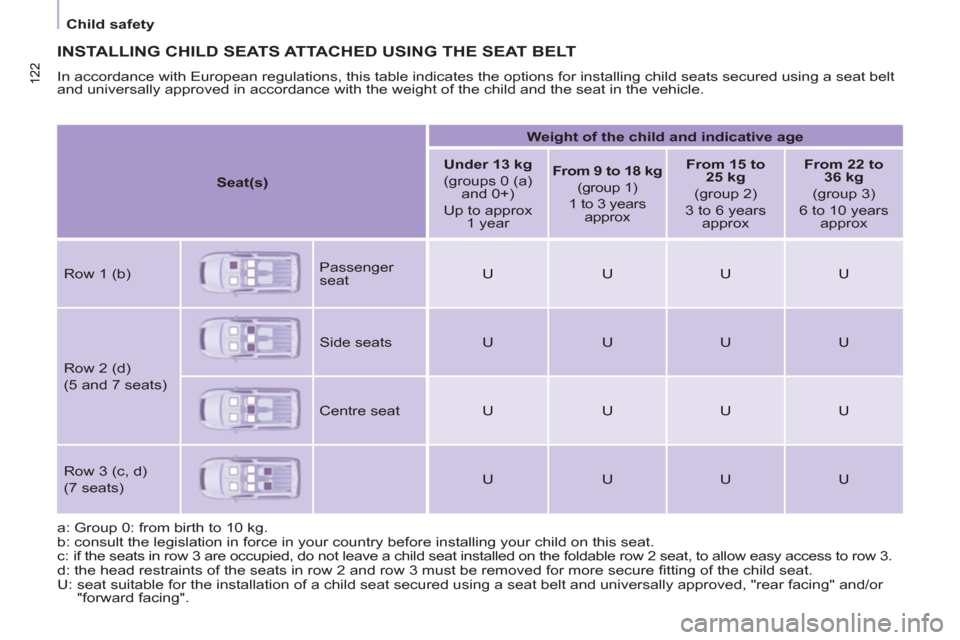
INSTALLING CHILD SEATS ATTACHED USING THE SEAT BELT
In accordance with European regulations, this table indicates the options for installing child seats secured using a seat belt
and universally approved in accordance with the weight of the child and the seat in the vehicle.
a: Group 0: from birth to 10 kg.
b: consult the legislation in force in your country before installing your child on this seat.
c: if the seats in row 3 are occupied, do not leave a child seat installed on the foldable row 2 seat, to allow easy access to row 3.
d: the head restraints of the seats in row 2 and row 3 must be removed for more secure fi tting of the child seat.
U: seat suitable for the installation of a child seat secured using a seat belt and universally approved, "rear facing" and/or
"forward facing".
Seat(s)
Weight of the child and indicative age
Under 13 kg
(groups 0 (a)
and 0+)
Up to approx
1 year
From 9 to 18 kg
(group 1)
1 to 3 years
approx
From 15 to
25 kg
(group 2)
3 to 6 years
approx
From 22 to
36 kg
(group 3)
6 to 10 years
approx
Row 1 (b) Passenger
seat
U
U
U
U
Row 2 (d)
(5 and 7 seats) Side seats
U
U
U
U
Centre seat
U
U
U
U
Row 3 (c, d)
(7 seats)
U
U
U
U
Page 125 of 232
123
SAFETY
4
123
Child safety
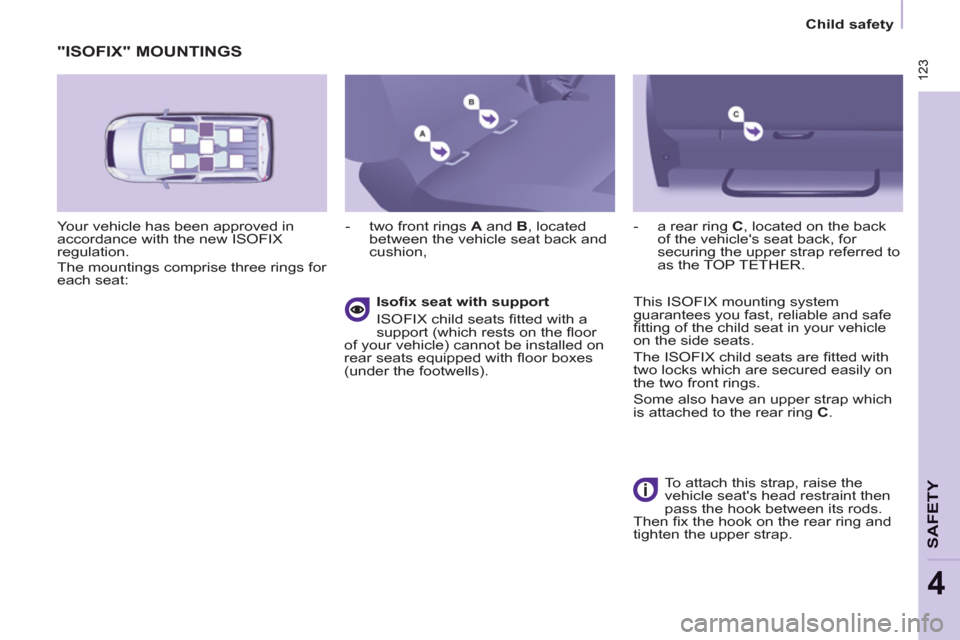
"ISOFIX" MOUNTINGS
Your vehicle has been approved in
accordance with the new ISOFIX
regulation.
The mountings comprise three rings for
each seat:
- two front rings A and B , located
between the vehicle seat back and
cushion,
- a rear ring C , located on the back
of the vehicle's seat back, for
securing the upper strap referred to
as the TOP TETHER.
This ISOFIX mounting system
guarantees you fast, reliable and safe
fi tting of the child seat in your vehicle
on the side seats.
The ISOFIX child seats are fi tted with
two locks which are secured easily on
the two front rings.
Some also have an upper strap which
is attached to the rear ring C .
To attach this strap, raise the
vehicle seat's head restraint then
pass the hook between its rods.
Then fi x the hook on the rear ring and
tighten the upper strap.
Isofi x seat with support
ISOFIX child seats fi tted with a
support (which rests on the fl oor
of your vehicle) cannot be installed on
rear seats equipped with fl oor boxes
(under the footwells).
Page 126 of 232
124 124
Child safety
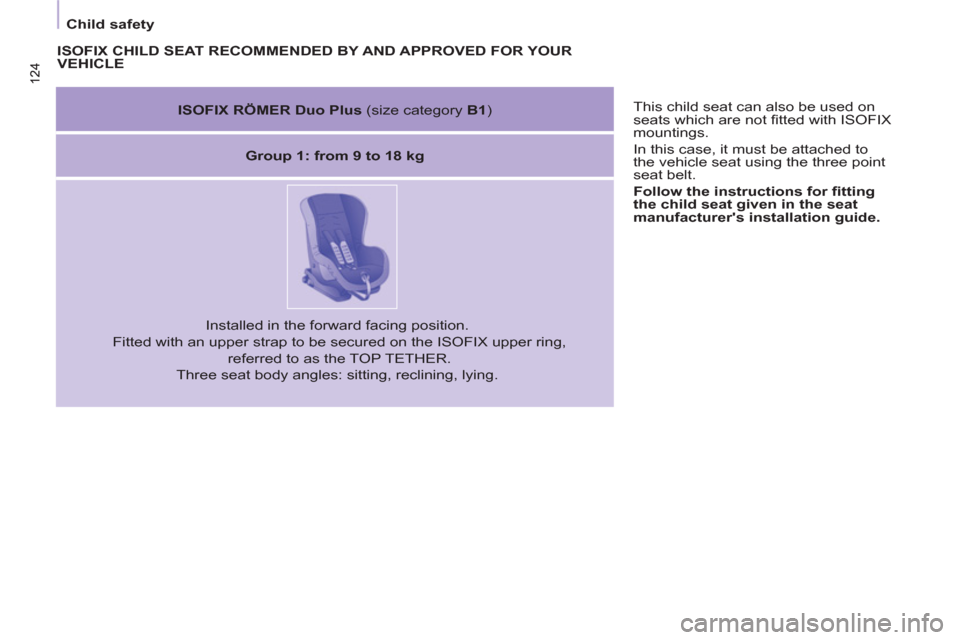
This child seat can also be used on
seats which are not fi tted with ISOFIX
mountings.
In this case, it must be attached to
the vehicle seat using the three point
seat belt.
Follow the instructions for fi tting
the child seat given in the seat
manufacturer's installation guide.
ISOFIX CHILD SEAT RECOMMENDED BY AND APPROVED FOR YOUR
VEHICLE
ISOFIX RÖMER Duo Plus
(size category B1
)
Group 1: from 9 to 18 kg
Installed in the forward facing position.
Fitted with an upper strap to be secured on the ISOFIX upper ring,
referred to as the TOP TETHER.
Three seat body angles: sitting, reclining, lying.
Page 127 of 232
125
SAFETY
4
125
Child safety
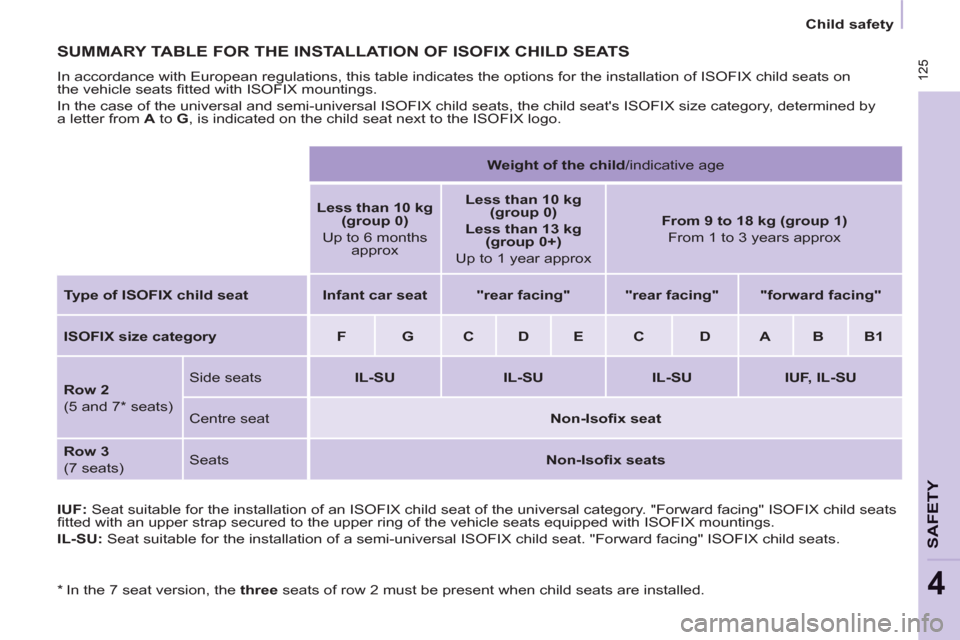
SUMMARY TABLE FOR THE INSTALLATION OF ISOFIX CHILD SEATS
In accordance with European regulations, this table indicates the options for the installation of ISOFIX child seats on
the vehicle seats fi tted with ISOFIX mountings.
In the case of the universal and semi-universal ISOFIX child seats, the child seat's ISOFIX size category, determined by
a letter from A
to G
, is indicated on the child seat next to the ISOFIX logo.
Weight of the child
/indicative age
Less than 10 kg
(group 0)
Up to 6 months
approx
Less than 10 kg
(group 0)
Less than 13 kg
(group 0+)
Up to 1 year approx
From 9 to 18 kg (group 1)
From 1 to 3 years approx
Type of ISOFIX child seat
Infant car seat
"rear facing"
"rear facing"
"forward facing"
ISOFIX size category
F
G
C
D
E
C
D
A
B
B1
Row 2
(5 and 7 * seats)
Side seats
IL-SU
IL-SU
IL-SU
IUF, IL-SU
Centre seat
Non-Isofi x seat
Row 3
(7 seats)
Seats
Non-Isofi x seats
IUF:
Seat suitable for the installation of an ISOFIX child seat of the universal category. "Forward facing" ISOFIX child seats
fi tted with an upper strap secured to the upper ring of the vehicle seats equipped with ISOFIX mountings.
IL-SU:
Seat suitable for the installation of a semi-universal ISOFIX child seat. "Forward facing" ISOFIX child seats.
*
In the 7 seat version, the three seats of row 2 must be present when child seats are installed.