bonnet Peugeot Partner Tepee 2012 Owner's Manual
[x] Cancel search | Manufacturer: PEUGEOT, Model Year: 2012, Model line: Partner Tepee, Model: Peugeot Partner Tepee 2012Pages: 240, PDF Size: 7.41 MB
Page 5 of 240
3
Contents
CONTENT
S
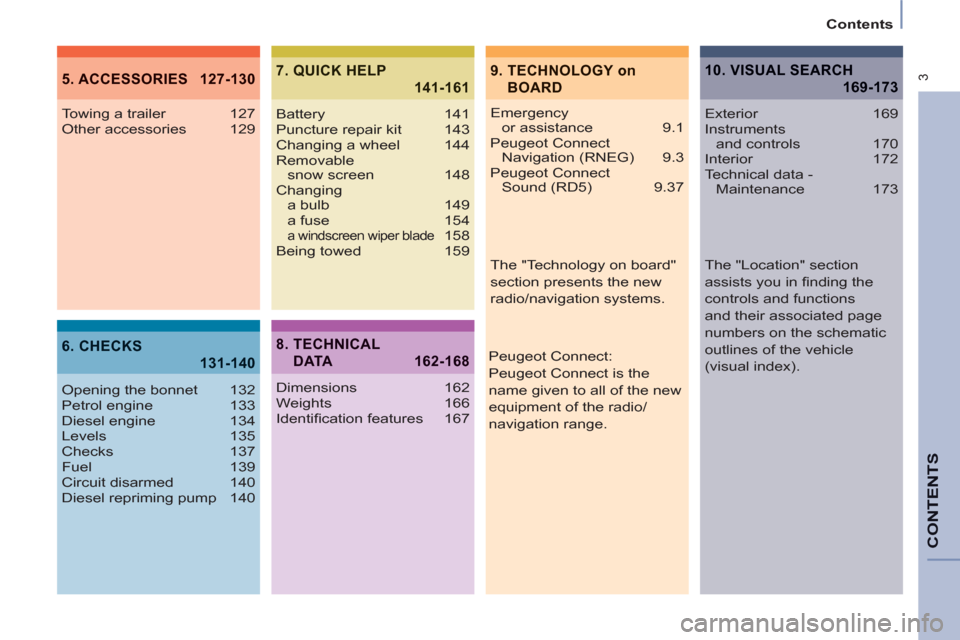
9. TECHNOLOGY on
BOARD5. ACCESSORIES 127-130
6. CHECKS
131-140
7. QUICK HELP
141-161
Emergency
or assistance 9.1
Peugeot Connect
Navigation (RNEG) 9.3
Peugeot Connect
Sound (RD5) 9.37 Towing a trailer 127
Other accessories 129
Opening the bonnet 132
Petrol engine 133
Diesel engine 134
Levels 135
Checks 137
Fuel 139
Circuit disarmed 140
Diesel repriming pump 140Battery 141
Puncture repair kit 143
Changing a wheel 144
Removable
snow screen 148
Changing
a bulb 149
a fuse 154
a windscreen wiper blade 158
Being towed 159
8. TECHNICAL
DATA 162-168
Dimensions 162
Weights 166
Identifi cation features 167
10. VISUAL SEARCH
169-173
Exterior 169
Instruments
and controls 170
Interior 172
Technical data -
Maintenance 173
Peugeot Connect:
Peugeot Connect is the
name given to all of the new
equipment of the radio/
navigation range.
The "Technology on board"
section presents the new
radio/navigation systems.
The "Location" section
assists you in fi nding the
controls and functions
and their associated page
numbers on the schematic
outlines of the vehicle
(visual index).
Page 9 of 240
2c
2e
2b7a4
6a
7b
2a6b
4
2d
7
1
FAMILIARISATION
Exterior
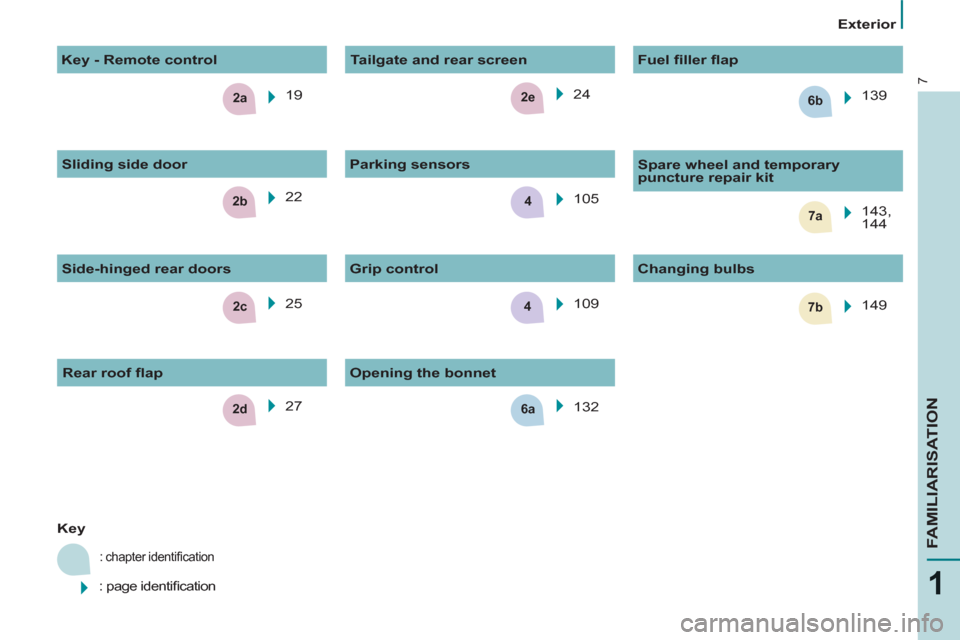
Key
: chapter identifi cation
: page identifi cation
19
25 24
105
109
Grip control
Changing bulbs
149
139
Fuel fi ller fl ap
Parking sensors
Opening the bonnet
132 22
Key - Remote control
Side-hinged rear doors
Sliding side door
Tailgate and rear screen
Spare wheel and temporary
puncture repair kit
143,
144
27
Rear roof fl ap
Page 10 of 240
8
Interior
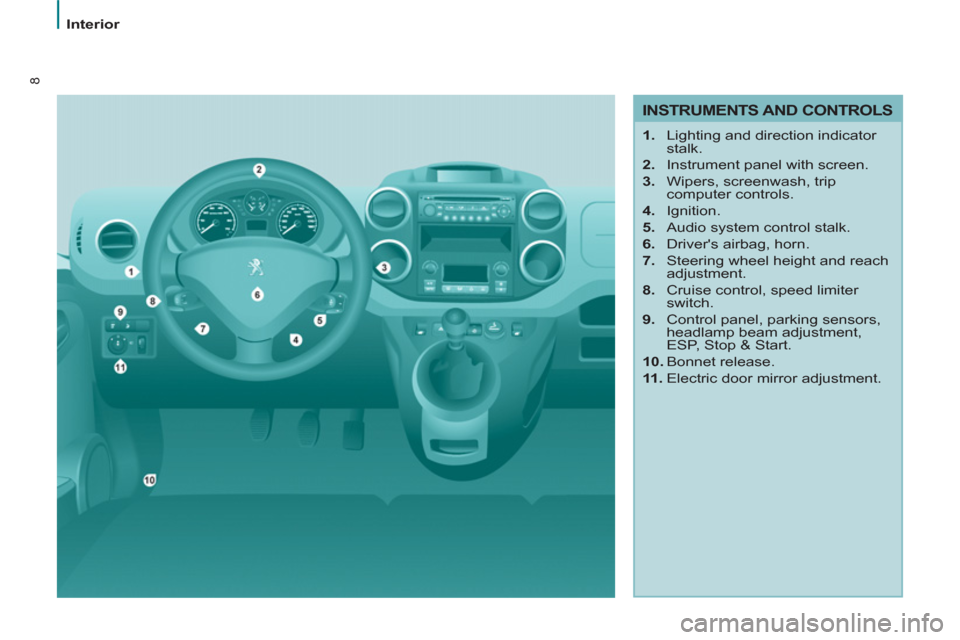
INSTRUMENTS AND CONTROLS
1.
Lighting and direction indicator
stalk.
2.
Instrument panel with screen.
3.
Wipers, screenwash, trip
computer controls.
4.
Ignition.
5.
Audio system control stalk.
6.
Driver's airbag, horn.
7.
Steering wheel height and reach
adjustment.
8.
Cruise control, speed limiter
switch.
9.
Control panel, parking sensors,
headlamp beam adjustment,
ESP, Stop & Start.
10.
Bonnet release.
11 .
Electric door mirror adjustment.
Page 49 of 240
47
READY TO SET OFF
22
Stop & Start
Reactivation
Press the "ECO OFF"
switch again.
The system is active again; this is
confi rmed by the switch warning
lamp going off and a message in the
instrument panel.
The system is reactivated
automatically at every new start
using the key.
Operating fault
In the event of a malfunction
with the system, the "ECO
OFF"
switch warning lamp
fl ashes, then comes on
continuously.
have it checked by a PEUGEOT dealer
or a qualifi ed workshop.
In the event of a fault in STOP
mode, the vehicle may stall. It is then
necessary to switch off the ignition and
start the engine again using the key.
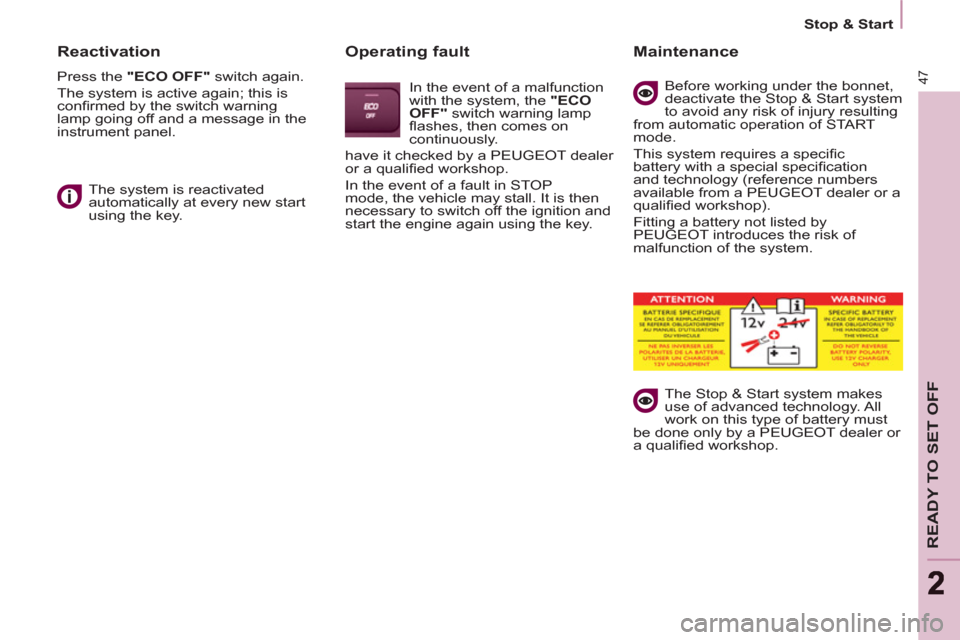
Maintenance
Before working under the bonnet,
deactivate the Stop & Start system
to avoid any risk of injury resulting
from automatic operation of START
mode.
This system requires a specifi c
battery with a special specifi cation
and technology (reference numbers
available from a PEUGEOT dealer or a
qualifi ed workshop).
Fitting a battery not listed by
PEUGEOT introduces the risk of
malfunction of the system.
The Stop & Start system makes
use of advanced technology. All
work on this type of battery must
be done only by a PEUGEOT dealer or
a qualifi ed workshop.
Page 50 of 240
Starting and stopping
Good practice when stopping
Good practice when starting
Diesel pre-heating warning
lamp
If the temperature is high
enough, the warning lamp
comes on for less than one
second, you can start without
waiting.
In cold weather, wait for this warning
lamp to go off then operate the starter
(Starting position) until the engine
starts.
Door or bonnet open
warning light
If this comes on, a door or the bonnet
is not closed correctly, check!
Minimise engine and gearbox wear
When switching off the ignition, let the
engine run for a few seconds to allow
the turbocharger (Diesel engine) to
return to idle.
Do not press the accelerator when
switching off the ignition.
There is no need to engage a gear
after parking the vehicle.
STARTING AND STOPPING
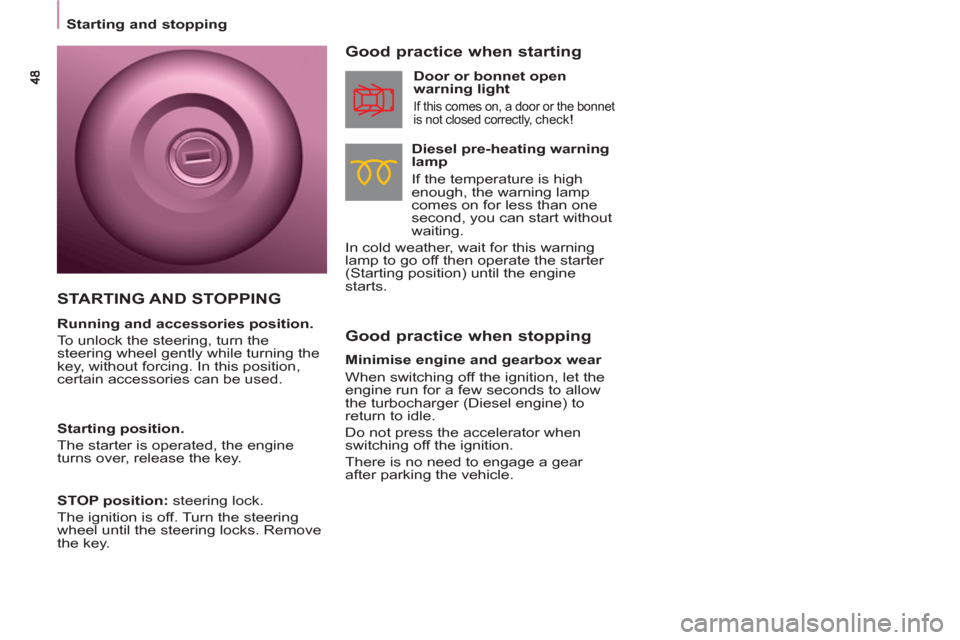
Running and accessories position.
To unlock the steering, turn the
steering wheel gently while turning the
key, without forcing. In this position,
certain accessories can be used.
Starting position.
The starter is operated, the engine
turns over, release the key.
STOP position:
steering lock.
The ignition is off. Turn the steering
wheel until the steering locks. Remove
the key.
Page 134 of 240
132
Opening the bonnet
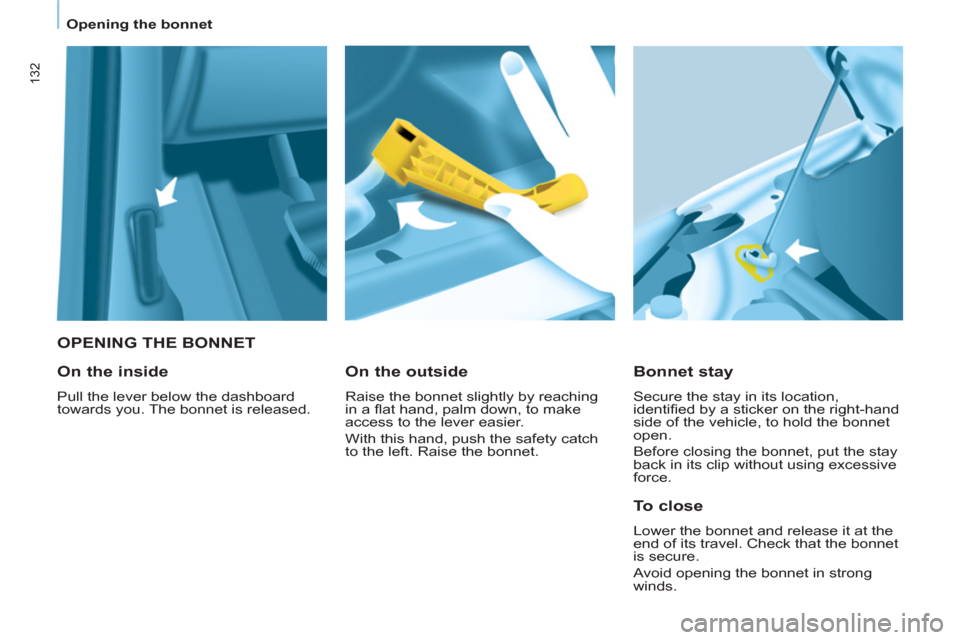
OPENING THE BONNET
Bonnet stay
Secure the stay in its location,
identifi ed by a sticker on the right-hand
side of the vehicle, to hold the bonnet
open.
Before closing the bonnet, put the stay
back in its clip without using excessive
force.
On the outside
Raise the bonnet slightly by reaching
in a fl at hand, palm down, to make
access to the lever easier.
With this hand, push the safety catch
to the left. Raise the bonnet.
On the inside
Pull the lever below the dashboard
towards you. The bonnet is released.
To close
Lower the bonnet and release it at the
end of its travel. Check that the bonnet
is secure.
Avoid opening the bonnet in strong
winds.
Page 135 of 240
133
6
Under the bonnet
CHECK
S
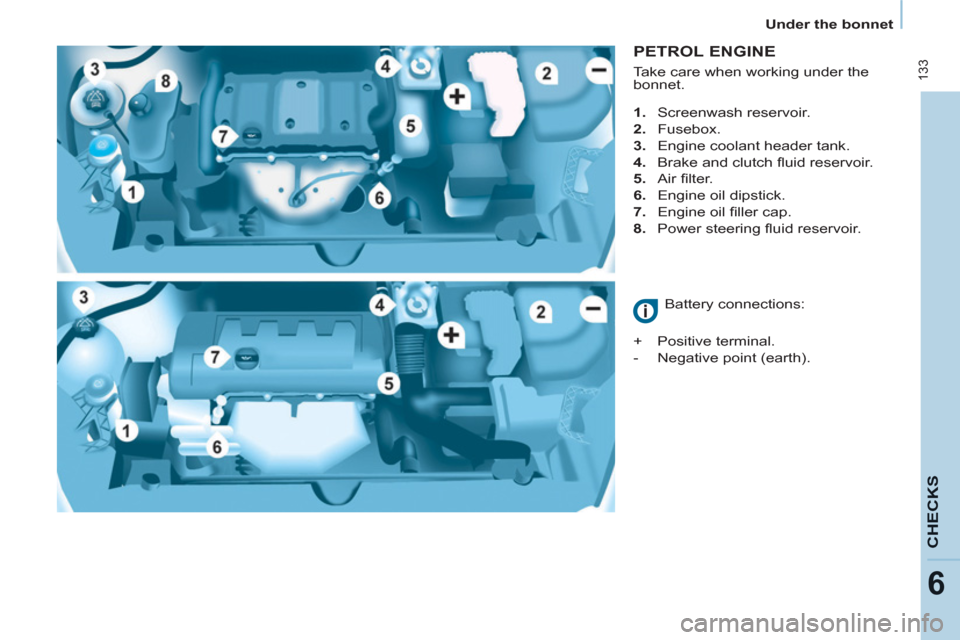
PETROL ENGINE
1. Screenwash reservoir.
2. Fusebox.
3. Engine coolant header tank.
4. Brake and clutch fl uid reservoir.
5. Air fi lter.
6. Engine oil dipstick.
7. Engine oil fi ller cap.
8. Power steering fl uid reservoir.
Battery connections:
+ Positive terminal.
- Negative point (earth). Take care when working under the
bonnet.
Page 136 of 240
134
Under the bonnet
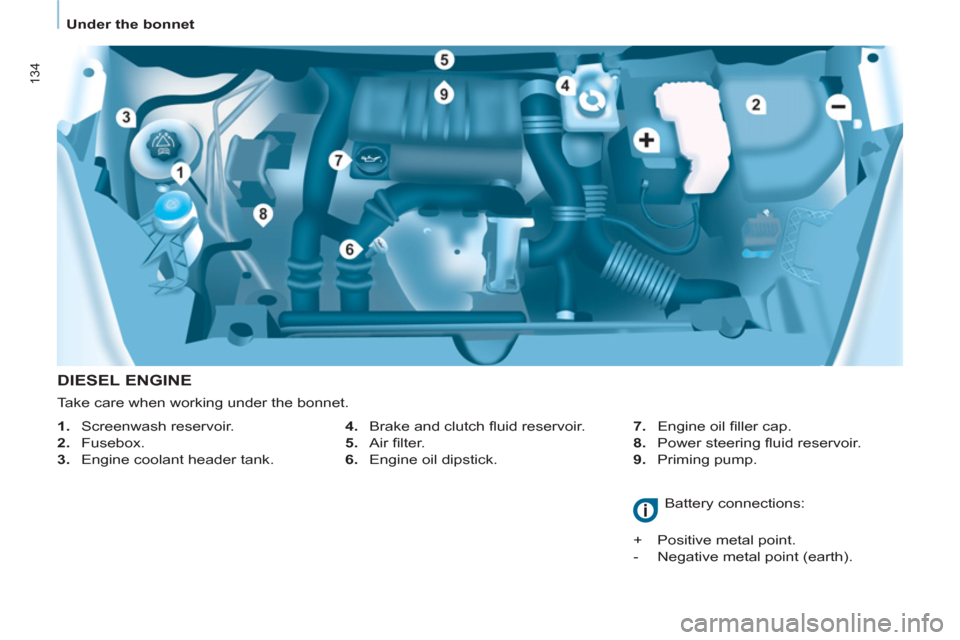
DIESEL ENGINE
4. Brake and clutch fl uid reservoir.
5. Air fi lter.
6. Engine oil dipstick.
7. Engine oil fi ller cap.
8. Power steering fl uid reservoir.
9. Priming pump.
1. Screenwash reservoir.
2. Fusebox.
3. Engine coolant header tank.
Battery connections:
+ Positive metal point.
- Negative metal point (earth). Take care when working under the bonnet.
Page 137 of 240
135
6
Levels
CHECK
S
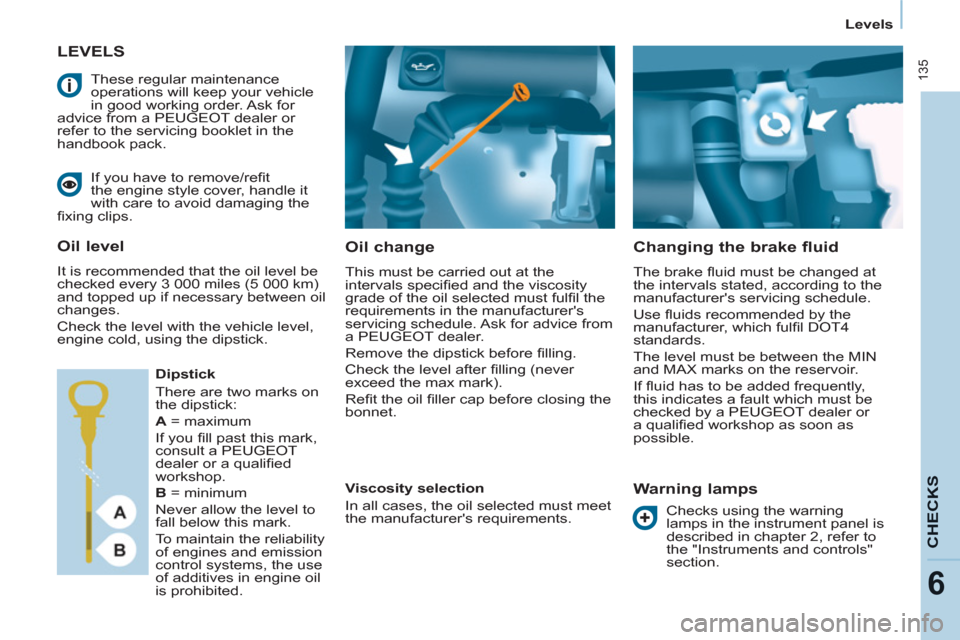
LEVELS
Oil change
This must be carried out at the
intervals specifi ed and the viscosity
grade of the oil selected must fulfi l the
requirements in the manufacturer's
servicing schedule. Ask for advice from
a PEUGEOT dealer.
Remove the dipstick before fi lling.
Check the level after fi lling (never
exceed the max mark).
Refi t the oil fi ller cap before closing the
bonnet.
Changing the brake fluid
The brake fl uid must be changed at
the intervals stated, according to the
manufacturer's servicing schedule.
Use fl uids recommended by the
manufacturer, which fulfi l DOT4
standards.
The level must be between the MIN
and MAX marks on the reservoir.
If fl uid has to be added frequently,
this indicates a fault which must be
checked by a PEUGEOT dealer or
a qualifi ed workshop as soon as
possible.
Warning lamps
If you have to remove/refi t
the engine style cover, handle it
with care to avoid damaging the
fi xing clips.
Oil level
It is recommended that the oil level be
checked every 3 000 miles (5 000 km)
and topped up if necessary between oil
changes.
Check the level with the vehicle level,
engine cold, using the dipstick.
Dipstick
There are two marks on
the dipstick:
A
= maximum
If you fi ll past this mark,
consult a PEUGEOT
dealer or a qualifi ed
workshop.
B
= minimum
Never allow the level to
fall below this mark.
To maintain the reliability
of engines and emission
control systems, the use
of additives in engine oil
is prohibited.
Viscosity selection
In all cases, the oil selected must meet
the manufacturer's requirements.
These regular maintenance
operations will keep your vehicle
in good working order. Ask for
advice from a PEUGEOT dealer or
refer to the servicing booklet in the
handbook pack.
Checks using the warning
lamps in the instrument panel is
described in chapter 2, refer to
the "Instruments and controls"
section.
Page 142 of 240
DIESEL
140
Fuel
FUEL CUT-OFF
In a serious collision, a mechanism
automatically prevents fuel from
reaching the engine.
The fl ashing of this warning
lamp is accompanied by a
message in the screen.
Check that there is no odour or
leakage of fuel outside the vehicle and
re-establish the fuel supply:
- switch off the ignition (STOP position),
- remove the key,
- put the key back in the ignition,
- switch on the ignition and start.
DIESEL PRIMING PUMP
If you should run out of fuel, it is
necessary to prime the fuel circuit:
- fi ll the fuel tank with at least fi ve
litres of Diesel,
- squeeze and release the manual
priming pump, under the bonnet
under the protective cover,
- operate the starter until the engine
starts.
Refer to the "Under the bonnet"
section of chapter 6.
Quality of the fuel used for
Diesel engines
The Diesel engines are perfectly
compatible with biofuels which conform
to current and future European
standards (Diesel fuel which complies
with standard EN 590 mixed with a
biofuel which complies with standard
EN 14214) available at the pumps
(containing up to 7% Fatty Acid Methyl
Ester).
The B30 biofuel can be used in certain
Diesel engines; however, this use
is subject to strict application of the
special servicing conditions. Contact
a PEUGEOT dealer or a qualifi ed
workshop.
The use of any other type of (bio)fuel
(vegetable or animal oils, pure or
diluted, domestic fuel...) is strictly
prohibited (risk of damage to the
engine and fuel system).