tow Peugeot Partner Tepee 2015 User Guide
[x] Cancel search | Manufacturer: PEUGEOT, Model Year: 2015, Model line: Partner Tepee, Model: Peugeot Partner Tepee 2015Pages: 276, PDF Size: 12.76 MB
Page 58 of 276
56
Partner_2_VP_en_Chap04_ergonomie_ed02-2014
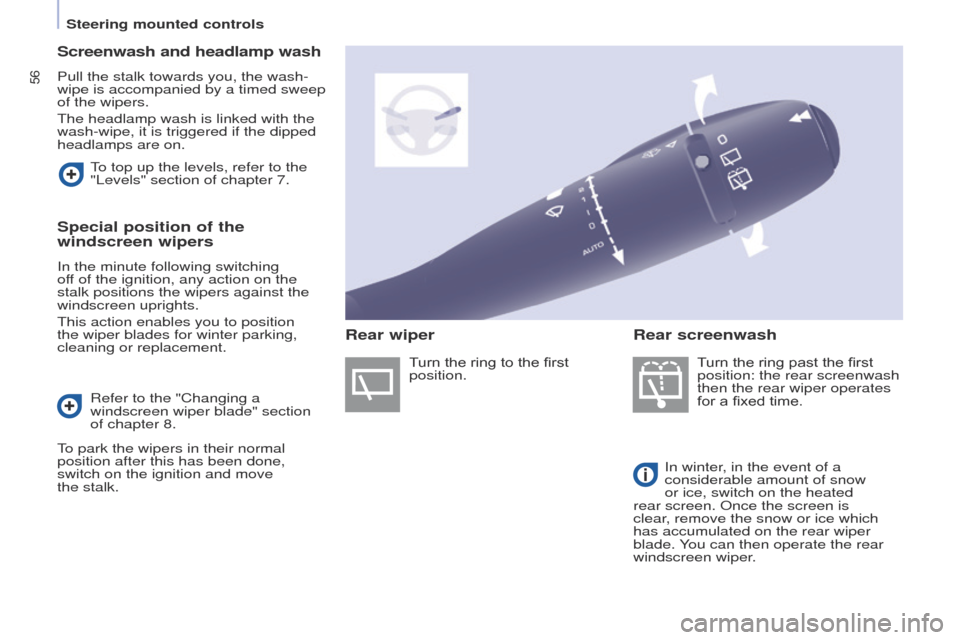
Screenwash and headlamp wash
Pull the stalk towards you, the wash-
wipe is accompanied by a timed sweep
of the wipers.
t
he headlamp wash is linked with the
wash-wipe, it is triggered if the dipped
headlamps are on.
Turn the ring past the first
position: the rear screenwash
then the rear wiper operates
for a fixed time.
In winter, in the event of a
considerable amount of snow
or ice, switch on the heated
rear screen. Once the screen is
clear, remove the snow or ice which
has accumulated on the rear wiper
blade. You can then operate the rear
windscreen wiper.
to top up the levels, refer to the
"Levels" section of chapter 7.
Special position of the
windscreen wipers
In the minute following switching
off of the ignition, any action on the
stalk positions the wipers against the
windscreen uprights.
t
his action enables you to position
the wiper blades for winter parking,
cleaning or replacement.
Refer to the "Changing a
windscreen wiper blade" section
of chapter 8.
to park the wipers in their normal
position after this has been done,
switch on the ignition and move
the
stalk. Turn the ring to the first
position.
Rear wiper
Rear screenwash
Steering mounted controls
Page 68 of 276
66
Partner_2_VP_en_Chap04_ergonomie_ed02-2014
Manual operation
You can, according to your
requirements, make a different selection
from that offered by the system by
changing a setting.
t
he other functions
will still be controlled automatically.
Pressing the AUTO button restores fully
automatic operation.
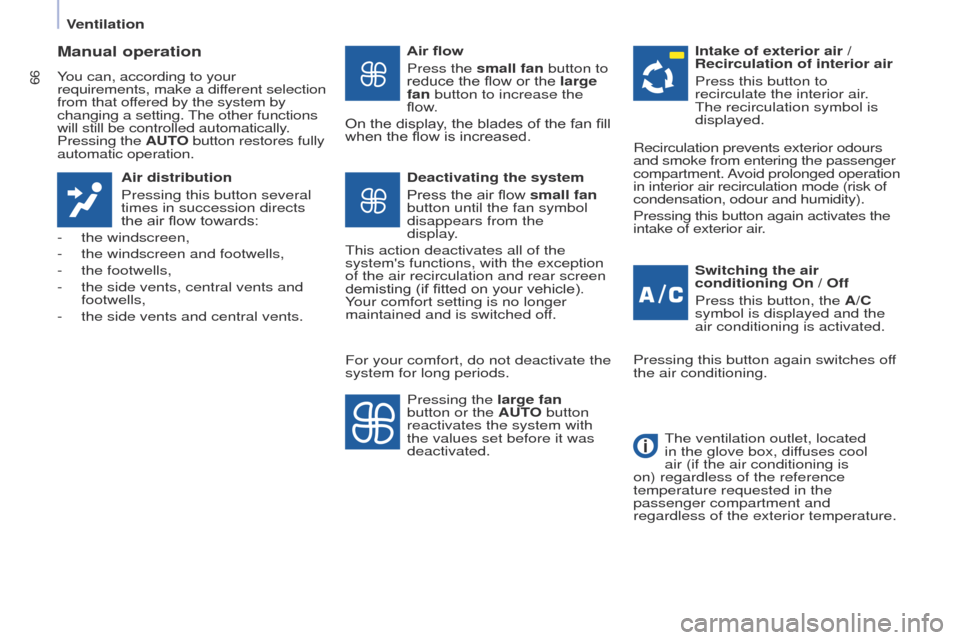
Air distribution
Pressing this button several
times in succession directs
the air flow towards:
-
the windscreen,
-
the windscreen and footwells,
-
the footwells,
-
the side vents, central vents and
footwells,
-
the side vents and central vents. Air flow
Press the
small fan button to
reduce the flow or the large
fan button to increase the
flow.
On the display, the blades of the fan fill
when the flow is increased.
Switching the air
conditioning On / Off
Press this button, the A/C
symbol is displayed and the
air conditioning is activated.
Deactivating the system
Press the air flow small fan
button until the fan symbol
disappears from the
display.
t
his action deactivates all of the
system's functions, with the exception
of the air recirculation and rear screen
demisting (if fitted on your vehicle).
Your comfort setting is no longer
maintained and is switched off. Intake of exterior air /
Recirculation of interior air
Press this button to
recirculate the interior air.
t
he recirculation symbol is
displayed.
Pressing the large fan
button or the AUTO button
reactivates the system with
the values set before it was
deactivated. Recirculation prevents exterior odours
and smoke from entering the passenger
compartment. Avoid prolonged operation
in interior air recirculation mode (risk of
condensation, odour and humidity).
Pressing this button again activates the
intake of exterior air.
Pressing this button again switches off
the air conditioning.
t
he ventilation outlet, located
in the glove box, diffuses cool
air (if the air conditioning is
on) regardless of the reference
temperature requested in the
passenger compartment and
regardless of the exterior temperature.
For your comfort, do not deactivate the
system for long periods.
Ventilation
Page 70 of 276
68
Partner_2_VP_en_Chap04_ergonomie_ed02-2014
DEMISTING AND DEFROSTINGGOOD PRACTICE
Vents
"Leave them open"
For optimum distribution and diffusion
of hot or cool air in the passenger
compartment, there are adjustable
central and side vents which can
be directed sideways (right or left)
or vertically (up or down). For your
comfort while driving, do not close
them and direct the flow of air towards
the windows instead.
Air vents in the footwells and directed
towards the windscreen complete the
equipment.
Do not block the vents located at the
windscreen or the air extractor located
in the boot.
Dust filter, odour filter
(activated carbon)
This filter traps certain dust and limits
odours.
Ensure that this filter is in good
condition and have all of the filter
elements replaced regularly.
Refer to the "Checks" section of
chapter 7.
Air conditioning
In all seasons, the air conditioning
should only be used with the windows
closed. However, if the interior
temperature remains high after a
prolonged period parked in the sun, do
not hesitate to ventilate the passenger
compartment for a few minutes.
u
se the A ut
O mode as much as
possible as it permits optimised
control of all of the functions: air flow
,
passenger compartment comfort
temperature, air distribution, air
intake mode or air recirculation in the
passenger compartment.
Operate the air conditioning system for
5 to 10 minutes, once or twice a month,
to keep it in good working order.
If the system does not produce cold air,
do not use it and contact a P
euge O t
dealer or a qualified workshop.
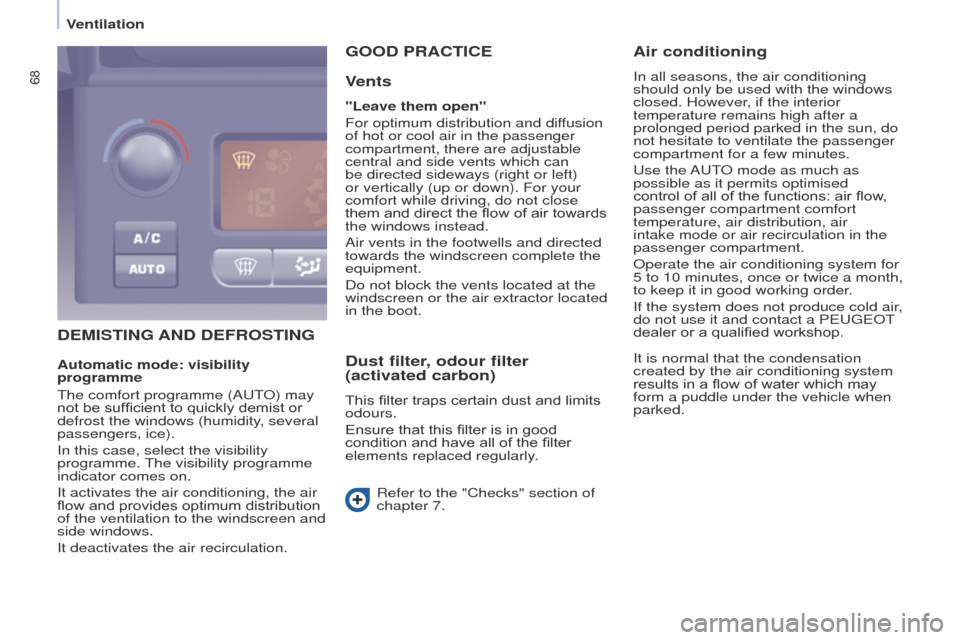
Automatic mode: visibility
programme
t
he comfort programme (A
ut
O) may
not be sufficient to quickly demist or
defrost the windows (humidity
, several
passengers, ice).
In this case, select the visibility
programme.
t
he visibility programme
indicator comes on.
It activates the air conditioning, the air
flow and provides optimum distribution
of the ventilation to the windscreen and
side windows.
It deactivates the air recirculation. It is normal that the condensation
created by the air conditioning system
results in a flow of water which may
form a puddle under the vehicle when
parked.
Ventilation
Page 85 of 276
83
Partner_2_VP_en_Chap04_ergonomie_ed02-2014
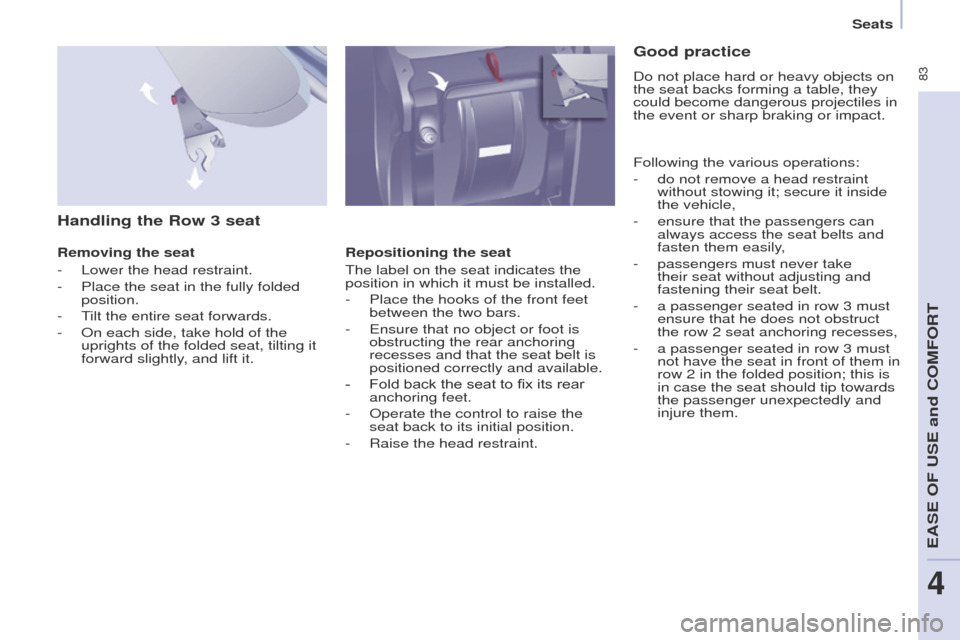
Handling the Row 3 seat
Removing the seat
-
Lower the head restraint.
-
Place the seat in the fully folded
position.
-
t
ilt the entire seat forwards.
-
On each side, take hold of the
uprights of the folded seat, tilting it
forward slightly
, and lift it. Repositioning the seat
t
he label on the seat indicates the
position in which it must be installed.
-
Place the hooks of the front feet
between the two bars.
-
e nsure that no object or foot is
obstructing the rear anchoring
recesses and that the seat belt is
positioned correctly and available.
-
Fold back the seat to fix its rear
anchoring feet.
-
Operate the control to raise the
seat back to its initial position.
-
Raise the head restraint.
Good practice
Do not place hard or heavy objects on
the seat backs forming a table, they
could become dangerous projectiles in
the event or sharp braking or impact.
Following the various operations:
-
do not remove a head restraint
without stowing it; secure it inside
the vehicle,
-
ensure that the passengers can
always access the seat belts and
fasten them easily
,
-
passengers must never take
their seat without adjusting and
fastening their seat belt.
-
a passenger seated in row 3 must
ensure that he does not obstruct
the row 2 seat anchoring recesses,
-
a passenger seated in row 3 must
not have the seat in front of them in
row 2 in the folded position; this is
in case the seat should tip towards
the passenger unexpectedly and
injure them.
Seats
eASe OF uSe and COMFORt
4
Page 96 of 276
94
Partner_2_VP_en_Chap04_ergonomie_ed02-2014
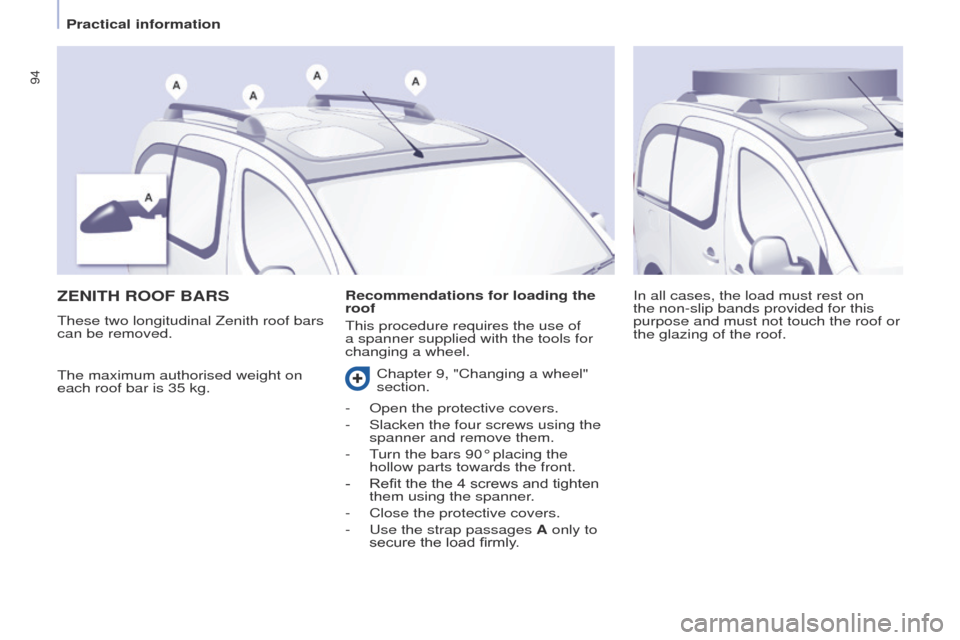
ZENITH ROOF BARS
the maximum authorised weight on
each roof bar is 35 kg. In all cases, the load must rest on
the non-slip bands provided for this
purpose and must not touch the roof or
the glazing of the roof.
Recommendations for loading the
roof
t
his procedure requires the use of
a spanner supplied with the tools for
changing a wheel.
t
hese two longitudinal Zenith roof bars
can be removed.
Chapter 9, "Changing a wheel"
section.
-
Open the protective covers.
-
Slacken the four screws using the
spanner and remove them.
-
t
urn the bars 90° placing the
hollow parts towards the front.
-
Refit the the 4 screws and tighten
them using the spanner
.
-
Close the protective covers.
-
u se the strap passages A only to
secure the load firmly.
Practical information
Page 99 of 276
97
Partner_2_VP_en_Chap04_ergonomie_ed02-2014
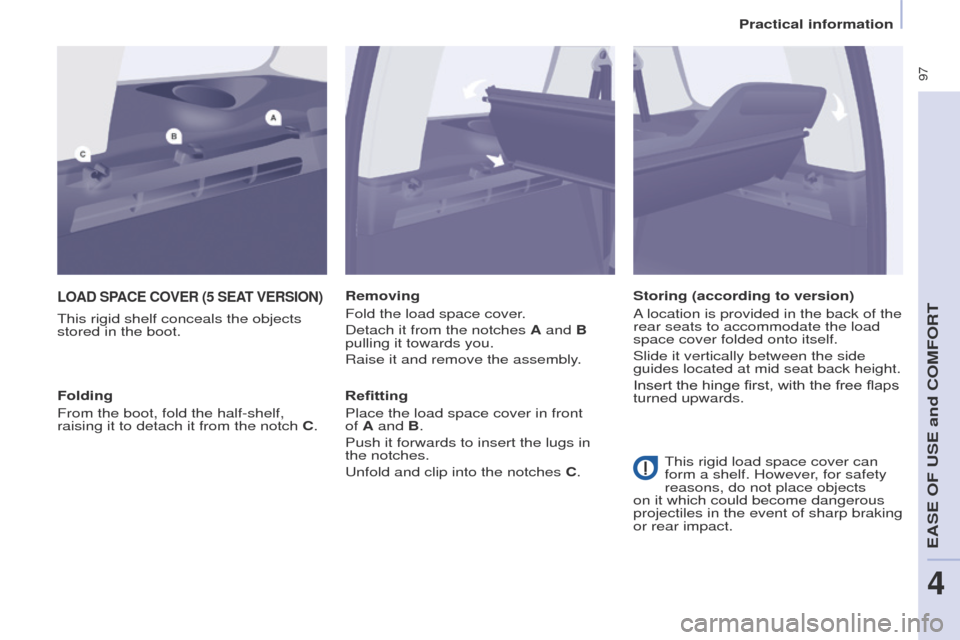
LOAD SPACE COVER (5 SEAT VERSION)
this rigid shelf conceals the objects
stored in the boot. Removing
Fold the load space cover
.
Detach it from the notches A and B
pulling it towards you.
Raise it and remove the assembly.
Refitting
Place the load space cover in front
of A and B.
Push it forwards to insert the lugs in
the notches.
u
nfold and clip into the notches C.
Folding
From the boot, fold the half-shelf,
raising it to detach it from the notch C. Storing (according to version)
A location is provided in the back of the
rear seats to accommodate the load
space cover folded onto itself.
Slide it vertically between the side
guides located at mid seat back height.
Insert the hinge first, with the free flaps
turned upwards.
t
his rigid load space cover can
form a shelf. However, for safety
reasons, do not place objects
on it which could become dangerous
projectiles in the event of sharp braking
or rear impact.
Practical information
eASe OF uSe and COMFORt
4
Page 100 of 276
98
Partner_2_VP_en_Chap04_ergonomie_ed02-2014
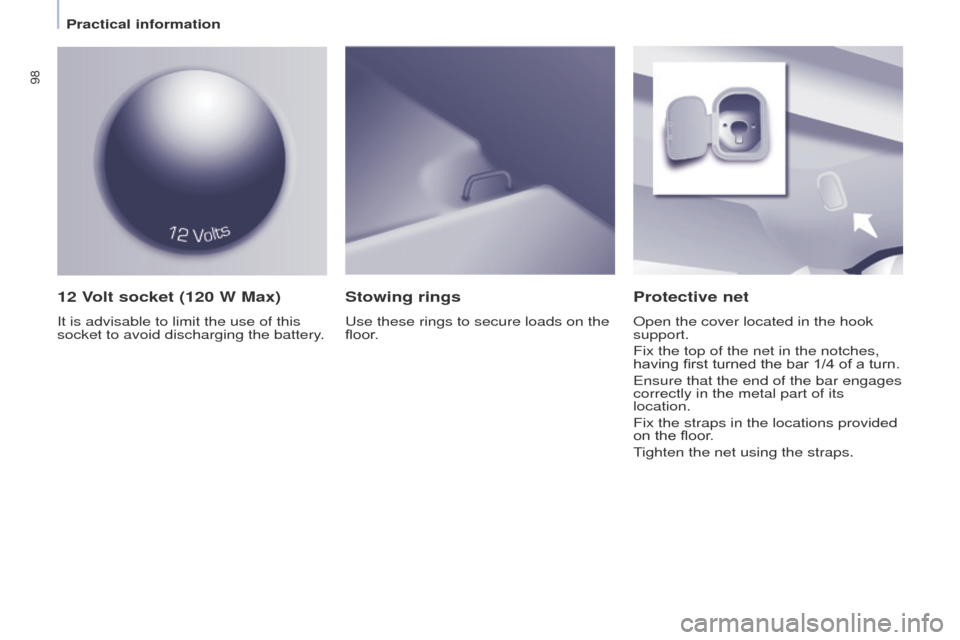
12 Volt socket (120 W Max)
It is advisable to limit the use of this
socket to avoid discharging the battery.
Protective net
Open the cover located in the hook
support.
Fix the top of the net in the notches,
having first turned the bar 1/4 of a turn.
e
nsure that the end of the bar engages
correctly in the metal part of its
location.
Fix the straps in the locations provided
on the floor.
tighten the net using the straps.
Stowing rings
use these rings to secure loads on the
floor .
Practical information
Page 101 of 276
99
Partner_2_VP_en_Chap04_ergonomie_ed02-2014
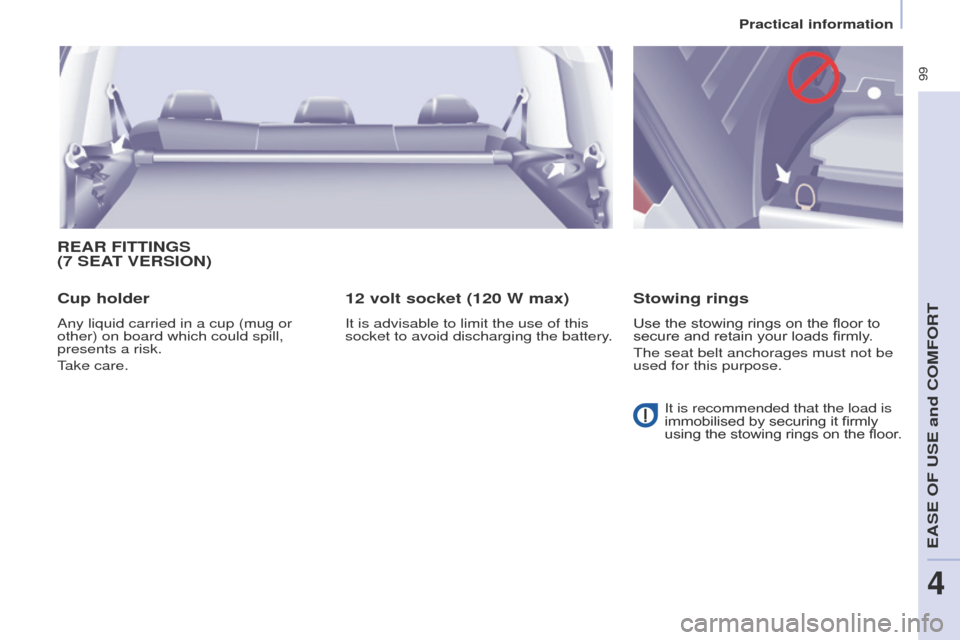
REAR FITTINGS
(7 SEAT VERSION )
Cup holder
Any liquid carried in a cup (mug or
other) on board which could spill,
presents a risk.
take care.
12 volt socket (120 W max)
It is advisable to limit the use of this
socket to avoid discharging the battery.
Stowing rings
Use the stowing rings on the floor to
secure and retain your loads firmly.
t
he seat belt anchorages must not be
used for this purpose.
It is recommended that the load is
immobilised by securing it firmly
using the stowing rings on the floor.
Practical information
eASe OF uSe and COMFORt
4
Page 103 of 276
101
Partner_2_VP_en_Chap04_ergonomie_ed02-2014
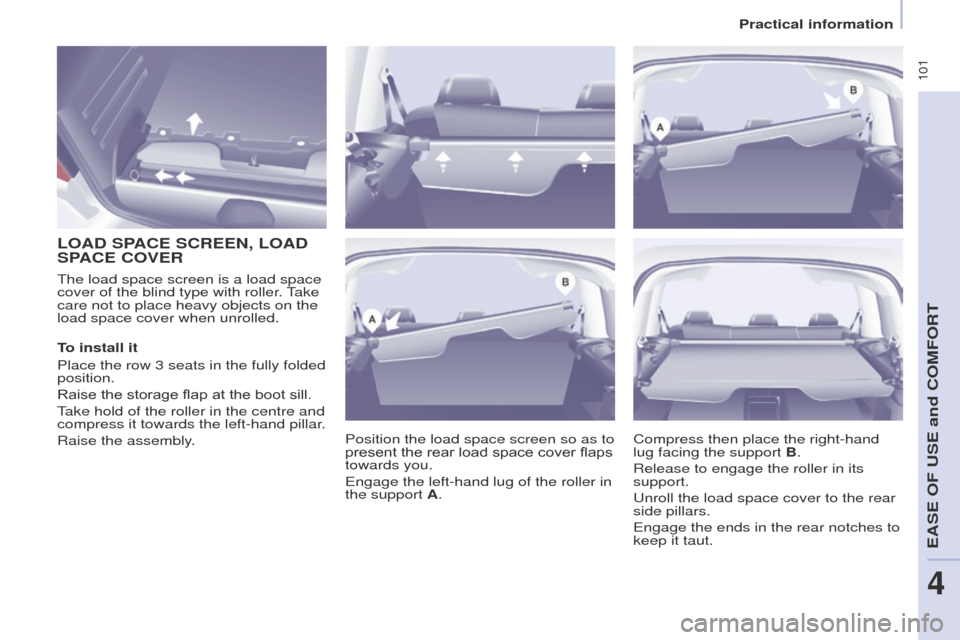
LOAD SPACE SCREEN, LOAD
SPACE COVER
the load space screen is a load space
cover of the blind type with roller . take
care not to place heavy objects on the
load space cover when unrolled.
Position the load space screen so as to
present the rear load space cover flaps
towards you.
e
ngage the left-hand lug of the roller in
the support A.
To install it
Place the row 3 seats in the fully folded
position.
Raise the storage flap at the boot sill.
take hold of the roller in the centre and
compress it towards the left-hand pilla
r.
Raise the assembly. Compress then place the right-hand
lug facing the support B.
Release to engage the roller in its
support.
u
nroll the load space cover to the rear
side pillars.
e
ngage the ends in the rear notches to
keep it taut.
Practical information
eASe OF uSe and COMFORt
4
Page 104 of 276
102
Partner_2_VP_en_Chap04_ergonomie_ed02-2014
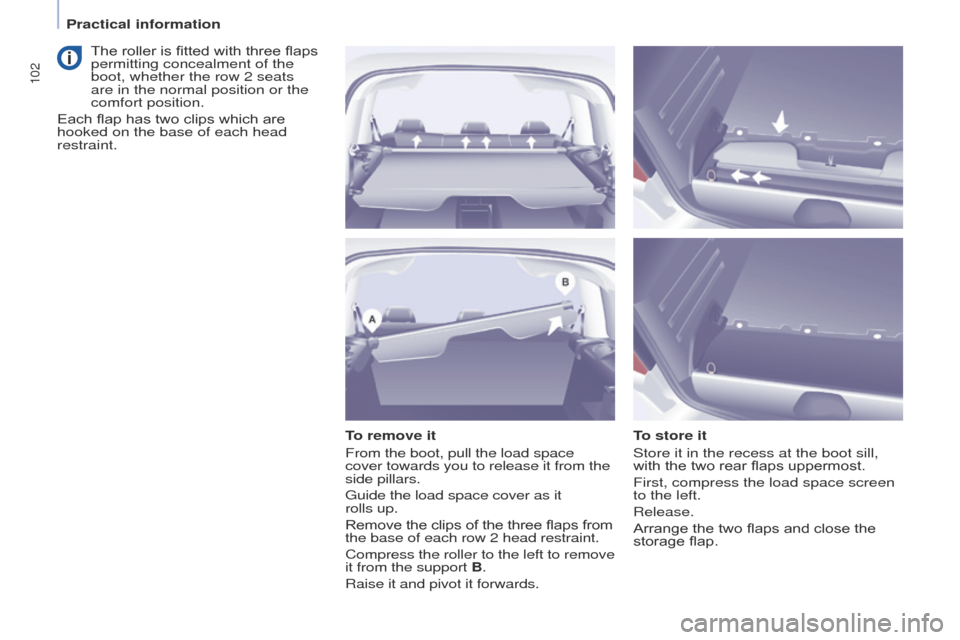
To remove it
From the boot, pull the load space
cover towards you to release it from the
side pillars.
g
uide the load space cover as it
rolls
up.
Remove the clips of the three flaps from
the base of each row 2 head restraint.
Compress the roller to the left to remove
it from the support B .
Raise it and pivot it forwards. To store it
Store it in the recess at the boot sill,
with the two rear flaps uppermost.
First, compress the load space screen
to the left.
Release.
Arrange the two flaps and close the
storage flap.
The roller is fitted with three flaps
permitting concealment of the
boot, whether the row 2 seats
are in the normal position or the
comfort position.
Each flap has two clips which are
hooked on the base of each head
restraint.
Practical information