belt Peugeot Partner Tepee 2015 Owner's Guide
[x] Cancel search | Manufacturer: PEUGEOT, Model Year: 2015, Model line: Partner Tepee, Model: Peugeot Partner Tepee 2015Pages: 276, PDF Size: 12.76 MB
Page 124 of 276
122
Partner_2_VP_en_Chap05_Securite_ed02-2014
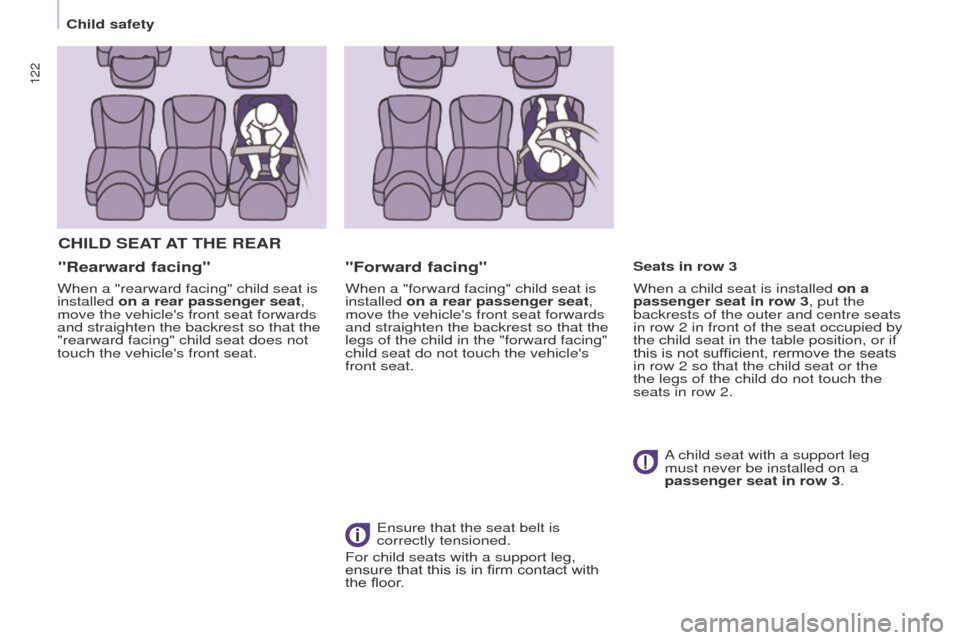
CHILD SEAT AT THE REAR
"Rearward facing"
When a "rearward facing" child seat is
installed on a rear passenger seat,
move the vehicle's front seat forwards
and straighten the backrest so that the
"rearward facing" child seat does not
touch the vehicle's front seat.
"Forward facing"
When a "forward facing" child seat is
installed on a rear passenger seat,
move the vehicle's front seat forwards
and straighten the backrest so that the
legs of the child in the "forward facing"
child seat do not touch the vehicle's
front seat.
e
nsure that the seat belt is
correctly tensioned.
For child seats with a support leg,
ensure that this is in firm contact with
the floor. When a child seat is installed on a
passenger seat in row 3, put the
backrests of the outer and centre seats
in row 2 in front of the seat occupied by
the child seat in the table position, or if
this is not sufficient, rermove the seats
in row 2 so that the child seat or the
the legs of the child do not touch the
seats in row 2. Seats in row 3
A child seat with a support leg
must never be installed on a
passenger seat in row 3.
Child safety
Page 128 of 276
126
Partner_2_VP_en_Chap05_Securite_ed02-2014
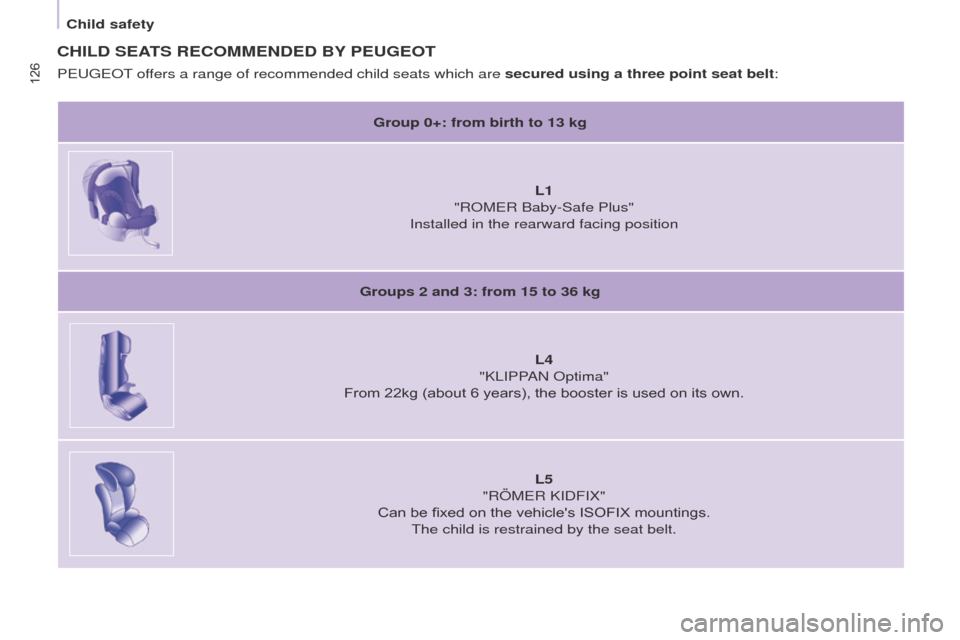
CHILD SEATS RECOMMENDED BY PEUGEOT
Group 0+: from birth to 13 kgL1
"ROM
e R Baby-Safe Plus"
Installed in the rearward facing position
Groups 2 and 3: from 15 to 36 kg L4
"KLIPPAN Optima"
From 22kg (about 6 years), the booster is used on its own.
L5
"RÖM
e R KIDFIX"
Can be fixed on the vehicle's ISOFIX mountings.
t
he child is restrained by the seat belt.
P
euge
O
t
of
fers a range of recommended child seats which are secured using a three point seat belt:
Child safety
Page 129 of 276
127
Partner_2_VP_en_Chap05_Securite_ed02-2014
INSTALLING A CHILD SEAT
WITH
A
SUPPORT LEG
Care must be taken when installing
a child seat with a support leg in
the vehicle. In particular you should
look for the presence of a storage
compartment below the rear seat
footwells.
t
he centre rear seat does not have
a storage compartment below the
footwell. You can therefore easily fit a
child seat with a support leg, whether
installed with the ISOFIX mountings or
using the 3 point seat belt.
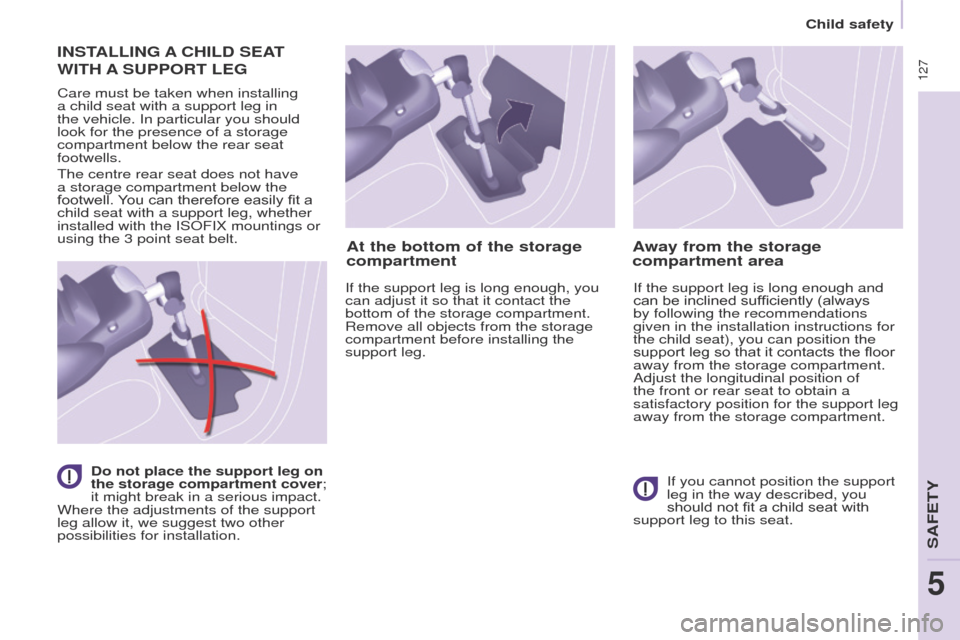
Do not place the support leg on
the storage compartment cover;
it might break in a serious impact.
Where the adjustments of the support
leg allow it, we suggest two other
possibilities for installation.
At the bottom of the storage
compartment
If the support leg is long enough, you
can adjust it so that it contact the
bottom of the storage compartment.
Remove all objects from the storage
compartment before installing the
support leg.
Away from the storage
compartment area
If the support leg is long enough and
can be inclined sufficiently (always
by following the recommendations
given in the installation instructions for
the child seat), you can position the
support leg so that it contacts the floor
away from the storage compartment.
Adjust the longitudinal position of
the front or rear seat to obtain a
satisfactory position for the support leg
away from the storage compartment.
If you cannot position the support
leg in the way described, you
should not fit a child seat with
support leg to this seat.
Child safety
SAFetY
5
Page 130 of 276

128
Partner_2_VP_en_Chap05_Securite_ed02-2014
INSTALLING CHILD SEATS ATTACHED USING THE SEAT BELT
* A child seat with support leg must never be installed on an outer passeng\
er seat in row 2.
** A child seat with support leg must never be installed on a passenger seat\
in row 3.
In accordance with
e uropean regulations, this table indicates the options for installing child seats secured using a seat belt
and universally approved (a) according to the weight of the child and \
the seat in the vehicle.
U:
seat suitable for the installation of a child seat secured using the sea\
t belt and universally approved, "rearward facing"
and/or "forward facing". Seat(s)
W
eight of the child and indicative age
Under 13 kg
(groups 0 (b) and 0+)
u
p to approx 1 year From 9 to 18 kg
(group 1)
1 to 3 years approx From 15 to 25 kg
(group 2)
3 to 6 years approx From 22 to 36 kg
(group 3)
6 to 10 years approx
Row 1 (c)(d) Passenger
seat U
UUU
Row 2 (e)
(5 and 7 seats) Outer seats
U*U* UU
Centre seat UUUU
Row 3 (f) (g)
(7 seats) All seats
U**U** UU
Child safety
Page 131 of 276
129
Partner_2_VP_en_Chap05_Securite_ed02-2014
(a) universal child seat: child seat
that can be installed in any vehicle
using the seat belt.
(b)
g roup 0: from birth to 10 kg.
(c)
Refer to the legislation in force in
your country before installin
g your
child on this seat.
(d) When a "rearward facing" child seat is installed on a front passenger
seat, the passenger's front airbag
must be deactivated. Otherwise,
the child would risk being
seriously injured or killed if the
airbag is deployed.
When a "forward facing" child seat
is installed on a
front passenger
seat, the passenger's front airbag
must remain active. Remove and stow the heads
restraint, before installing a child
seat with backrest on a passenger
seat.
Refit the head restraint once the child
seat has been removed.
(e) When a child seat is installed at the
rear, forward facing or rearward
facing, move the vehicle's seats
in the row in front forwards and
straighten their backrests to leave
enough space for the child seat or
the child's legs.
(f) Put the backrests of the outer and centre seats in row 2, located in
front of seat occupied by a child
seat, in the table position, or if this
is not sufficient, remove the seats
in row 2, so that the child seat or
the child's legs do not touch the
seats in row 2.
(g): if the seats in row 3 are occupied, do not leave a child seat installed
on the foldable row 2 seat, to allow
easy access to row 3.
Child safety
SAFetY
5
Page 133 of 276
131
Partner_2_VP_en_Chap05_Securite_ed02-2014
This child seat can also be used on seats which are not fitted with ISOFIX
mountings.
In this case, it must be attached to the vehicle seat using the three po\
int seat
belt.
Follow the instructions for fitting the child seat given in the seat
manufacturer's installation guide.
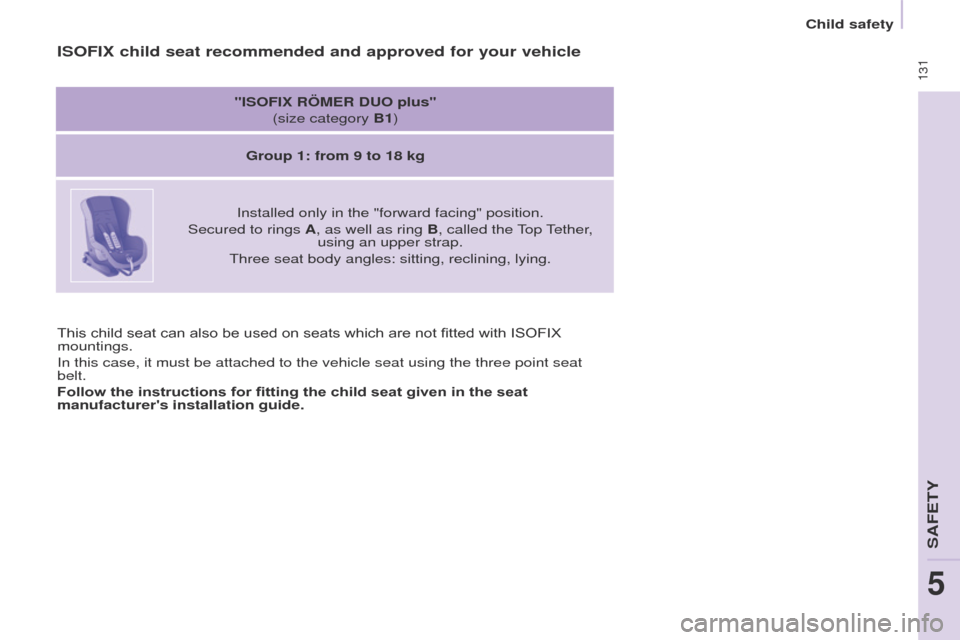
ISOFIX child seat recommended and approved for your vehicle
"ISOFIX RÖMER DUO plus" (size category B1)
Group 1: from 9 to 18 kg
Installed only in the "forward facing" position.
Secured to rings A, as well as ring B, called the
t
op
t
ether
,
using an upper strap.
t
hree seat body angles: sitting, reclining, lying.
Child safety
SAFetY
5
Page 135 of 276
133
Partner_2_VP_en_Chap05_Securite_ed02-2014
ADVICE ON CHILD SEATS
At the rear, always leave sufficient
space between the front seat and:
-
a "rearward facing" child seat,
-
the feet of a child seated in a
"forward facing" child seat.
For this, move the front seat forward
and, if necessary
, straighten its
backrest as well.
t
he incorrect installation of a child seat
in a vehicle compromises the child's
protection in the event of an accident.
Check that there is no seat belt or seat
belt buckle under the child seat, as this
could destabilise the seat.
Remember to fasten the seat belts or
the child seat harnesses keeping the
slack relative to the child's body to a
minimum, even for short journeys.
For the installation of a child seat using
the seat belt, ensure that the seat belt
is well tensioned on the child seat
and that it is holding the child seat
firmly against the vehicle's seat. If the
passenger seat is adjustable, move it
forward if necessary. For the optimum installation of a
"forward facing" child seat, ensure that
the back of the child seat is as close as
possible to the backrest of the vehicle's
seat, or in contact if possible.
t
he head restraint must be removed
before installing a child seat with a
backrest on the passenger seat.
e
nsure that the head restraint is
stowed or attached securely so that it
is not thrown around the vehicle in the
event of sharp braking.
Refit the head restraint as soon as the
child seat is removed.Children at the front
the legislation on carrying a child on
the front passenger seat is specific to
each country
. Refer to the legislation in
force in your country.
Deactivate the passenger's airbag
when a "rearward facing" child seat is
installed on the front seat.
Otherwise, the child would risk being
seriously injured or killed if the airbag
were deployed.
Installing a booster seat
the chest part of the seat belt must
be positioned on the child's shoulder
without touching the neck.
e
nsure that the lap part of the seat belt
passes correctly over the child's thighs.
P
euge O t
recommends the use of a
booster seat which has a back, fitted
with a seat belt guide at shoulder level.
As a safety precaution, never leave:
-
one or more children alone and
unsupervised in a vehicle,
-
a child or an animal in a vehicle
which is exposed to the sun, with
the windows closed,
-
the keys within reach of children
inside the vehicle.
to prevent accidental opening of the
doors, use the "Child Lock".
take care not to open the rear windows
by more than one third.
to protect young children from the rays
of the sun, fit side blinds to the rear
windows.
For an installation in row 3, put the
backrests of the outer and centre
seats in row 2 in the table position, or
remove these seats in row 2, so that
the child seat or the child's legs do not
touch the seats in row 2.
Child safety
SAFetY
5