steering Peugeot Partner Tepee 2015 Owner's Guide
[x] Cancel search | Manufacturer: PEUGEOT, Model Year: 2015, Model line: Partner Tepee, Model: Peugeot Partner Tepee 2015Pages: 276, PDF Size: 12.76 MB
Page 119 of 276
11 7
Partner_2_VP_en_Chap05_Securite_ed02-2014
Good practice
Sit in a normal upright position.
Wear a correctly adjusted seat belt.
Do not leave anything between the
occupants and the airbags (a child,
pet, object...).
t
his could hinder the
operation of the airbags or injure the
occupants.
After an accident or if the vehicle has
been stolen or broken into, have the
airbag systems checked.
All work on the airbag system is strictly
forbidden unless it is carried out by
qualified personnel at a PEUGEOT
dealer or a qualified workshop.
e
ven if all of the precautions
mentioned are observed, a risk of
injury or of minor burns to the head,
chest or arms when an airbag is
deployed cannot be ruled out. In fact,
the bag inflates almost instantly (within
a few milliseconds) then deflates within
the same time discharging the hot gas
via openings provided for this purpose. Lateral airbags
Only put recommended covers on
the seats.
t
hese will not hinder
inflation of the lateral airbags. Contact
a PEUGEOT dealer or a qualified
workshop.
Do not fix or attach anything to the seat
backs.
t
his could cause injury to the
chest or arms when the lateral airbag
inflates.
Do not sit with the upper part of the
body any nearer to the door than
necessary.
Front airbags
Do not drive holding the steering wheel
by its spokes or resting your hands on
the centre part of the wheel.
Do not allow passengers to place
their feet on the dashboard, they risk
serious injury if the airbag is deployed.
Smoke as little as possible as
deployment of the airbags can cause
burns or the risk of injury from a
cigarette or pipe.
Never remove or pierce the steering
wheel or hit it violently.
Airbags only operate when the
ignition is switched on.
t
his equipment only operates once.
If a second impact occurs (during the
same or a subsequent accident), the
airbag will not operate.
t
he deployment of an airbag or airbags
is accompanied by a slight discharge
of smoke and a noise, due to the
activation of the pyrotechnic cartridge
incorporated in the system.
t
his smoke is not harmful, but
sensitive individuals may experience
some irritation.
t
he noise of the detonation may result
in a slight loss of hearing for a short
time.
t
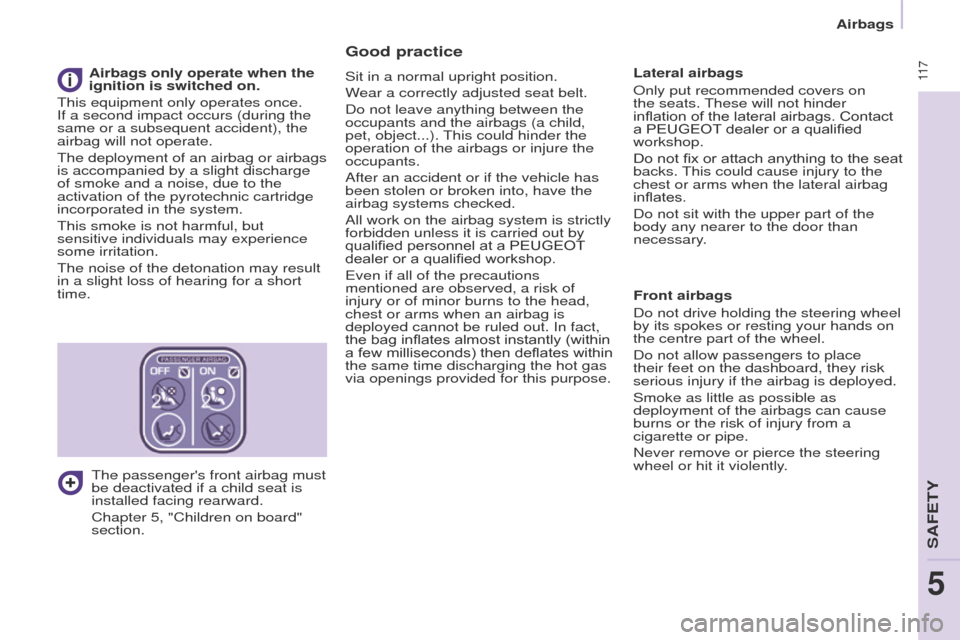
he passenger's front airbag must
be deactivated if a child seat is
installed facing rearward.
Chapter 5, "Children on board"
section.
Airbags
SAFetY
5
Page 121 of 276
11 9
Partner_2_VP_en_Chap05_Securite_ed02-2014
Front airbags
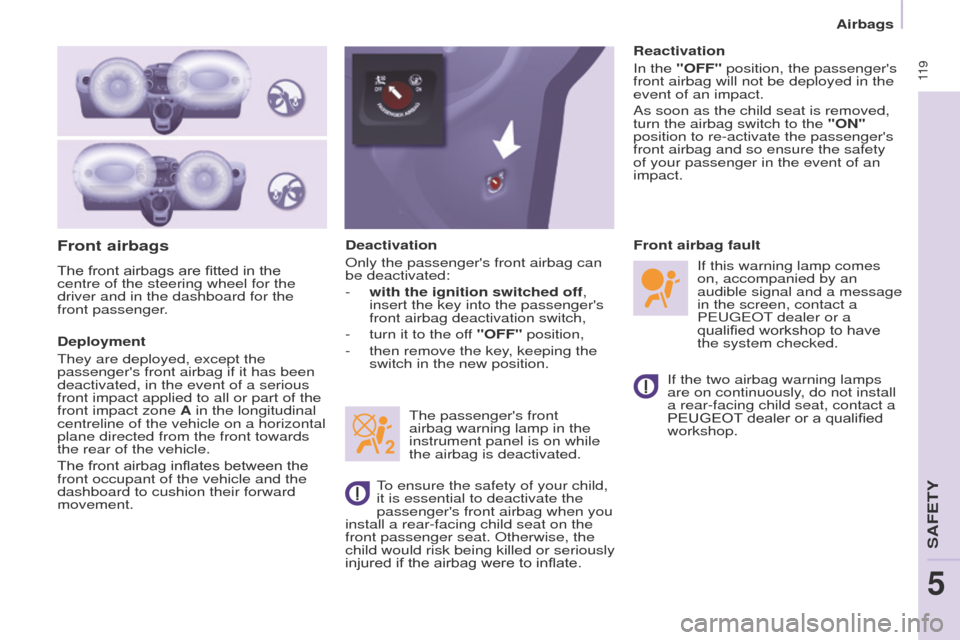
The front airbags are fitted in the
centre of the steering wheel for the
driver and in the dashboard for the
front passenger.
Deployment
t
hey are deployed, except the
passenger's front airbag if it has been
deactivated, in the event of a serious
front impact applied to all or part of the
front impact zone A in the longitudinal
centreline of the vehicle on a horizontal
plane directed from the front towards
the rear of the vehicle.
The front airbag inflates between the
front occupant of the vehicle and the
dashboard to cushion their forward
movement. Deactivation
Only the passenger's front airbag can
be deactivated:
-
with the ignition switched off
,
insert the key into the passenger's
front airbag deactivation switch,
-
turn it to the of
f "OFF" position,
-
then remove the key
, keeping the
switch in the new position.
t
he passenger's front
airbag warning lamp in the
instrument panel is on while
the airbag is deactivated. If the two airbag warning lamps
are on continuously, do not install
a rear-facing child seat, contact a
PEUGEOT dealer or a qualified
workshop.
Front airbag fault
to ensure the safety of your child,
it is essential to deactivate the
passenger's front airbag when you
install a rear-facing child seat on the
front passenger seat. Otherwise, the
child would risk being kille
d or seriously
injured if the airbag were to inflate. Reactivation
In the "OFF" position, the passenger's
front airbag will not be deployed in the
event of an impact.
As soon as the child seat is removed,
turn the airbag switch to the "ON"
position to re-activate the passenger's
front airbag and so ensure the safety
of your passenger in the event of an
impact.
If this warning lamp comes
on, accompanied by an
audible signal and a message
in the screen, contact a
P euge O t
dealer or a
qualified workshop to have
the system checked.
Airbags
SAFetY
5
Page 139 of 276
137
Partner_2_VP_en_Chap06_Accessoire_ed02-2014
OTHER ACCESSORIES
these accessories and parts, having
been tested and approved for reliability
and safety
, are all adapted to your
vehicle. A wide range of recommended
accessories and genuine parts is
available.
A further range is also available,
structured around comfort, leisure and
maintenance:
Anti-theft alarm, window etching, first
aid kit, high visibility vest, front and
rear parking sensors, warning triangle,
security bolts for alloy wheels, ...
Seat covers compatible with airbags
for the front seats, bench seat, rubber
mats, carpet mats, snow chains, blinds,
tailgate bicycle carrier, ...
to prevent the mat from becoming
caught under the pedals:
-
ensure that the mat and its fixings
are positioned correctly
,
-
never fit one mat on top of another
.Audio equipment, hands-free kit,
speakers, CD changer, satellite
navigation system, u
SB box, Video kit, ...
Regardless of the audio and telematic
equipment offered on the market, the
technical constraints associated with
the fitting of equipment of these product
groups mean that the special features
of the equipment and its compatibility
with the capacities of your vehicle's
standard equipment must be taken into
account. Please ask a P
euge O t
dealer
for more information before fitting such
equipment.
Maximum weights on bars
-
t
ransverse bars on longitudinal
bars: 75 Kg (these bars are not
compatible with the Zénith roof). Installing radiocommunication
transmitters
Y
ou are advised to contact a
P
euge O t
dealer before installin
g
accessory radiocommunication
transmitters with external aerial on
your vehicle.
t
he P euge O t dealer network
will inform you of the specification
(frequency band, maximum output
power, aerial position, specific
conditions of installation) of the
transmitters which can be fitted, in
accordance with the Motor Vehicle
e
lectromagnetic Compatibility Directive
(2004/104/
e C).
Front mud flaps, rear mud flaps,
15/17 inch alloy wheels, wheelarch
trim, leather steering wheel, ...
Screenwash, interior and exterior
cleaning and maintenance products,
spare bulbs, ...
equipment
ACCeSSORIeS
6
Page 143 of 276
141
Partner_2_VP_en_Chap07_Verification_ed02-2014
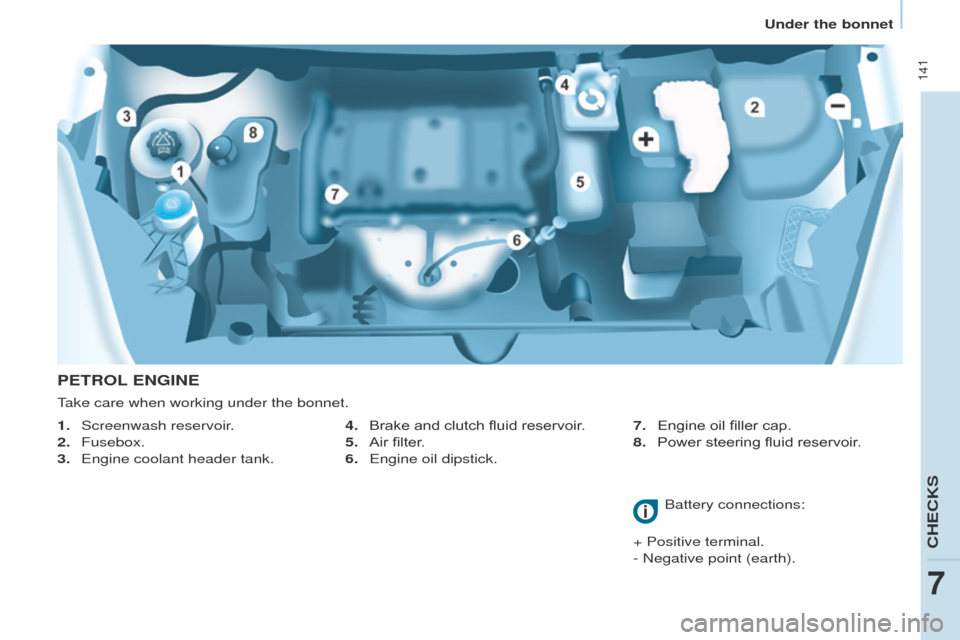
PETROL ENGINE
1. Screenwash reservoir.
2.
Fusebox.
3.
e ngine coolant header tank.
Battery connections:
+ Positive terminal.
- Negative point (earth).
take care when working under the bonnet. 4.
Brake and clutch fluid reservoir .
5.
Air filter
.
6.
e ngine oil dipstick.7.
Engine oil filler cap.
8.
Power steering fluid reservoir
.
under the bonnet
CHeCKS
7
Page 144 of 276
142
Partner_2_VP_en_Chap07_Verification_ed02-2014
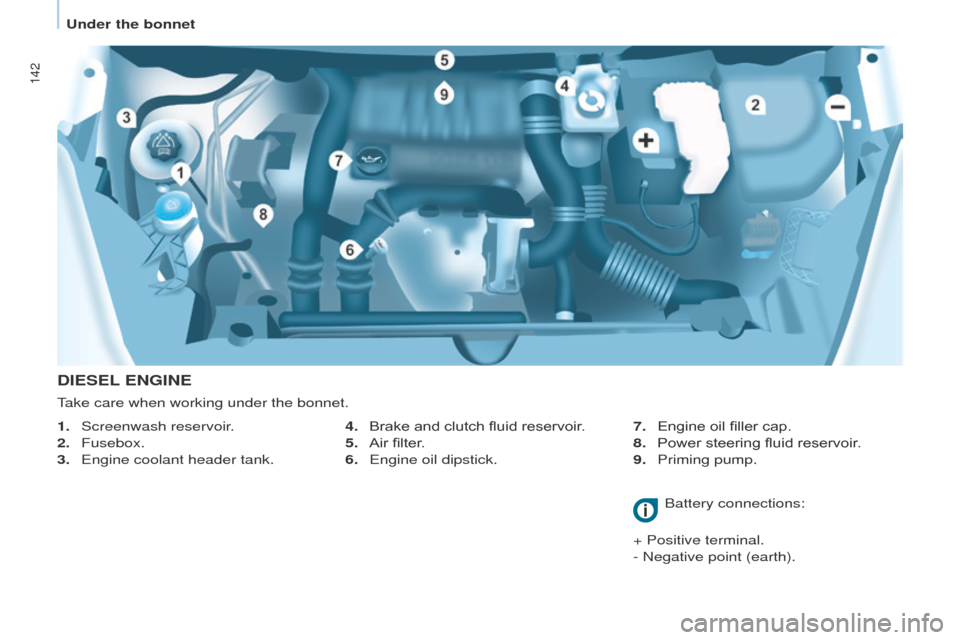
DIESEL ENGINE
4. Brake and clutch fluid reservoir.
5.
Air filter
.
6.
e ngine oil dipstick. 7.
Engine oil filler cap.
8.
Power steering fluid reservoir
.
9.
Priming pump.
1.
Screenwash reservoir
.
2.
Fusebox.
3.
e
ngine coolant header tank.
Battery connections:
+ Positive terminal.
- Negative point (earth).
take care when working under the bonnet.
under the bonnet
Page 146 of 276
144
Partner_2_VP_en_Chap07_Verification_ed02-2014
Cooling system
Only use the fluid recommended by the
manufacturer.
Otherwise, you risk seriously damaging
your engine.
When the engine is warm, the
temperature of the coolant is controlled
by the engine fan. As this fan can
operate with the ignition key removed
and because the cooling system is
pressurised, wait for at least one hour
after the engine has stopped before
carrying out any work.
Slacken the cap by 1/4 of a turn to
release the pressure to prevent any
risk of scalding. When the pressure
has dropped, remove the cap and top
up the level with coolant.
If fluid has to be added frequently,
this indicates a fault which must be
checked by a Peuge O t
dealer as
soon as possible.
Power steering fluid level
the vehicle must be parked on level
ground with the engine cold. u nscrew
the cap integrated with the gauge and
check the level which must be between
the MIN and MAX marks. In order to regenerate the filter, you
are advised to drive at a speed higher
than 40 mph (60 km/h) for at least five
minutes as soon as possible, when
traffic conditions permit (until the
message disappears and the service
warning lamp goes off).
During regeneration of the particle
emission filter, the noise of a relay
operating may be heard under the
dashboard.
If the message is still displayed and
if the service warning lamp remains
on, contact a P
euge O t
dealer or a
qualified workshop.
T
opping up
t
he level must be between the MIN
and MAX marks on the expansion
bottle. If more than 1 litre of fluid is
required to top up the level, have
the system checked by a P
euge
O
t
dealer or a qualified workshop.
Screenwash and headlamp
wash level
For best quality cleaning and for your
safety, we would advise that you use
products of the P
euge O t
range.
For optimum cleaning and to avoid
freezing, this fluid must not be topped
up or replaced with plain water
.
Capacity of the screenwash reservoir:
approximately 3 litres.
If your vehicle is fitted with headlamp
washers, the capacity of the reservoir
is 6 litres.
Diesel additive level
(Diesel with particle
emission filter)
Topping up
t
his additive must be topped up by
a PEUGEOT dealer or a qualified
workshop without delay.
Waste products
Avoid prolonged contact of used oil
with the skin.
Brake fluid is harmful to health and
very corrosive.
Do not dispose of used oil, brake fluid
or coolant into drains or into the ground
but into the containers dedicated to this
use at a P
euge O t
dealer (France) or
an authorised waste disposal site.
t
he minimum level of this additive
is indicated by lighting of the service
warning lamp, accompanied by an
audible signal and a message in the
screen.
When this occurs with the engine
running it is due to the start of
saturation of the particle emission filter
(exceptionally prolonged urban type
driving conditions: low speed, long
traffic jams, ...).
Levels
Page 161 of 276
159
Partner_2_VP_en_Chap08_Aide-rapide_ed02-2014
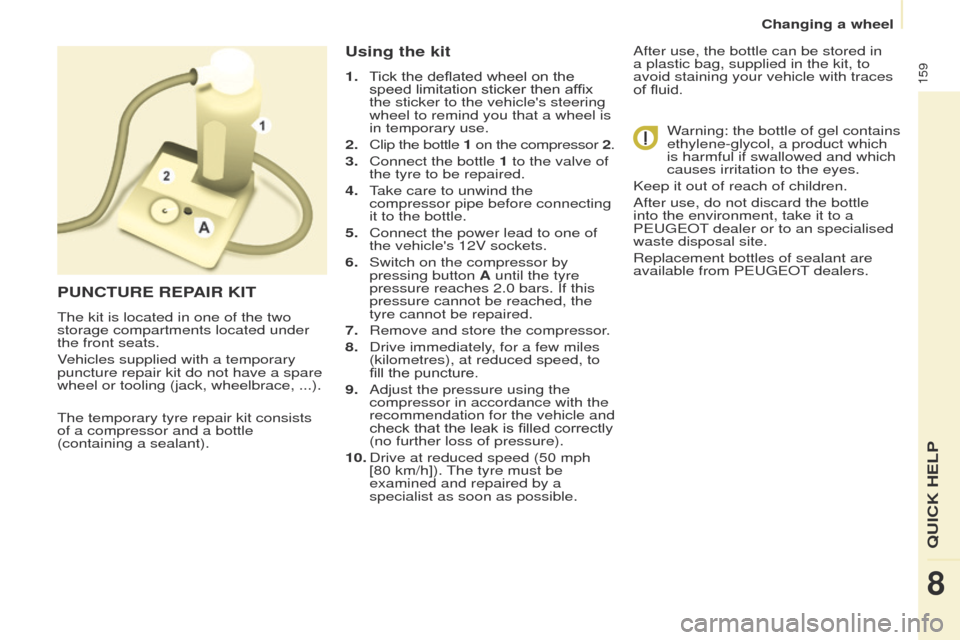
the temporary tyre repair kit consists
of a compressor and a bottle
(containing a sealant).
Using the kit
1. Tick the deflated wheel on the speed limitation sticker then affix
the sticker to the vehicle's steering
wheel to remind you that a wheel is
in temporary use.
2.
Clip the bottle
1 on the compressor
2.
3.
Connect the bottle
1 to the valve of
the tyre to be repaired.
4.
t
ake care to unwind the
compressor pipe before connecting
it to the bottle.
5.
Connect the power lead to one of
the vehicle's 12V sockets.
6.
Switch on the compressor by
pressing button
A until the tyre
pressure reaches 2.0 bars. If this
pressure cannot be reached, the
tyre cannot be repaired.
7.
Remove and store the compressor
.
8.
Drive immediately
, for a few miles
(kilometres), at reduced speed, to
fill the puncture.
9.
Adjust the pressure using the
compressor in accordance with the
recommendation for the vehicle and
check that the leak is filled correctly
(no further loss of pressure).
10.
Drive at reduced speed (50
mph
[80 km/h]).
t
he tyre must be
examined and repaired by a
specialist as soon as possible. After use, the bottle can be stored in
a plastic bag, supplied in the kit, to
avoid staining your vehicle with traces
of fluid.
Warning: the bottle of gel contains
ethylene-glycol, a product which
is harmful if swallowed and which
causes irritation to the eyes.
Keep it out of reach of children.
After use, do not discard the bottle
into the environment, take it to a
P
euge O t
dealer or to an specialised
waste disposal site.
Replacement bottles of sealant are
available from P
euge O t
dealers.
PUNCTURE REPAIR KIT
the kit is located in one of the two
storage compartments located under
the front seats.
V
ehicles supplied with a temporary
puncture repair kit do not have a spare
wheel or tooling (jack, wheelbrace, ...).
Changing a wheel
QuICK HeLP
8
Page 178 of 276
176
Partner_2_VP_en_Chap08_Aide-rapide_ed02-2014
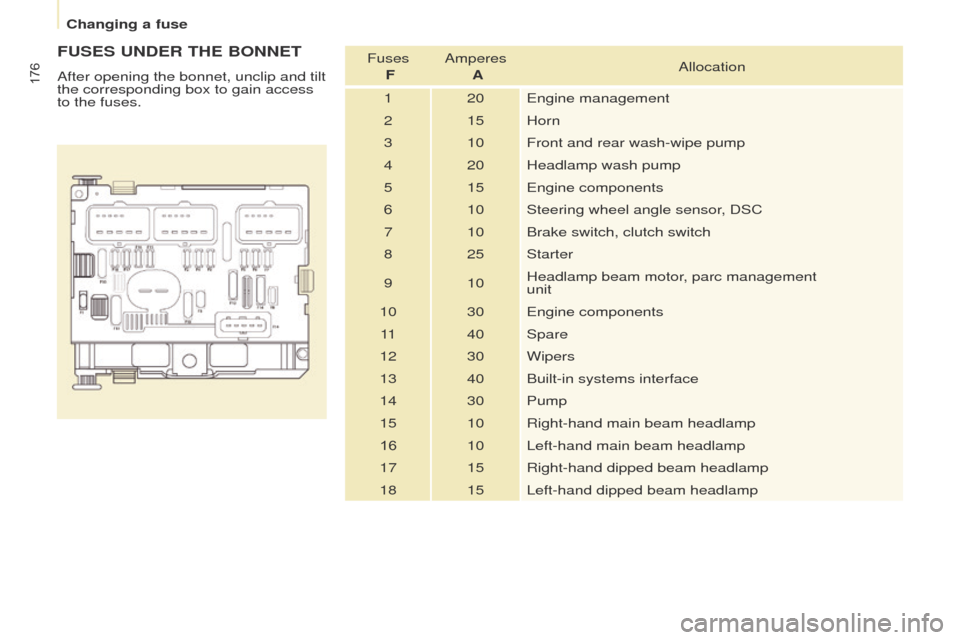
FUSES UNDER THE BONNET
After opening the bonnet, unclip and tilt
the corresponding box to gain access
to the fuses.Fuses
F Amperes
A Allocation
1 20
e
ngine management
2 15 Horn
3 10 Front and rear wash-wipe pump
4 20 Headlamp wash pump
5 15
e
ngine components
6 10 Steering wheel angle sensor, DSC
7 10 Brake switch, clutch switch
8 25 Starter
9 10 Headlamp beam motor, parc management
unit
10 30
e
ngine components
11 40 Spare
12 30 Wipers
13 40 Built-in systems interface
14 30 Pump
15 10 Right-hand main beam headlamp
16 10 Left-hand main beam headlamp
17 15 Right-hand dipped beam headlamp
18 15 Left-hand dipped beam headlamp
Changing a fuse
Page 180 of 276
178
Partner_2_VP_en_Chap08_Aide-rapide_ed02-2014
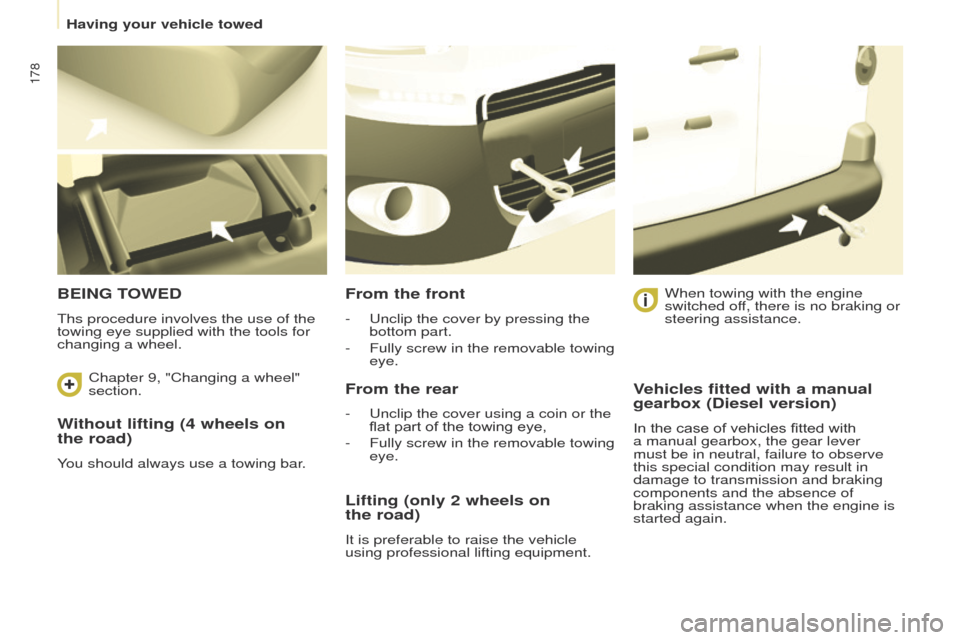
Without lifting (4 wheels on
the road)
You should always use a towing bar.
BEING TOWED
ths procedure involves the use of the
towing eye supplied with the tools for
changing a wheel.
From the front
- unclip the cover by pressing the
bottom part.
-
Fully screw in the removable towing
eye.
From the rear
- unclip the cover using a coin or the
flat part of the towing eye,
-
Fully screw in the removable towing
eye. When towing with the engine
switched of
f, there is no braking or
steering assistance.
Lifting (only 2 wheels on
the road)
It is preferable to raise the vehicle
using professional lifting equipment.
Vehicles fitted with a manual
gearbox (Diesel version)
In the case of vehicles fitted with
a manual gearbox, the gear lever
must be in neutral, failure to observe
this special condition may result in
damage to transmission and braking
components and the absence of
braking assistance when the engine is
started again.
Chapter 9, "Changing a wheel"
section.
Having your vehicle towed
Page 193 of 276
10.3
Partner_2_VP_en_Chap10b_RT6-2-8_ed02-2014
the system is protected in such a way that it will only
operate in your vehicle.
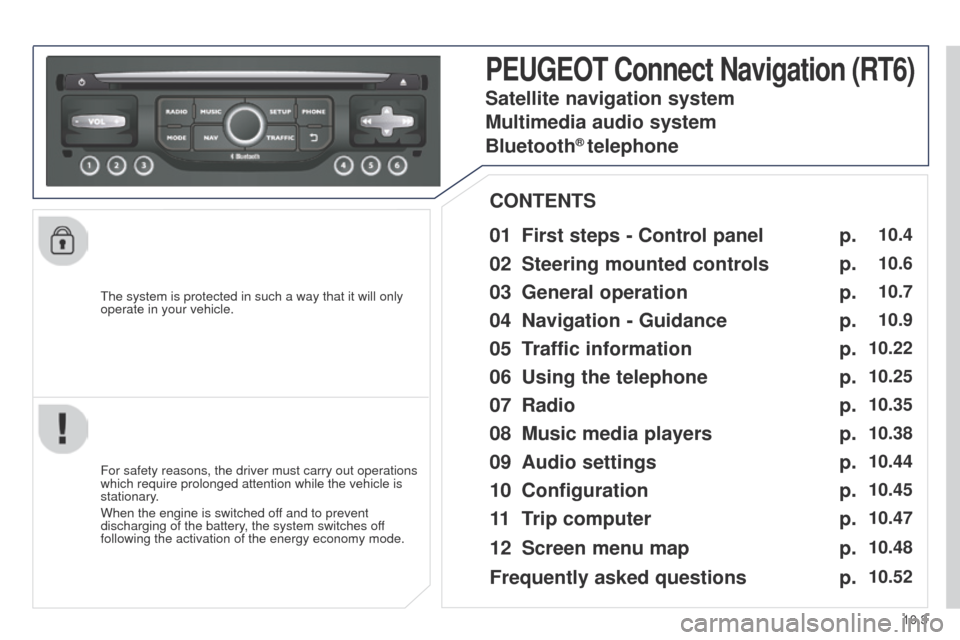
PEUGEOT Connect Navigation (RT6)
01 First steps - Control panel
For safety reasons, the driver must carry out operations
which require prolonged attention while the vehicle is
stationary.
When the engine is switched off and to prevent
discharging of the battery, the system switches off
following the activation of the energy economy mode.
CONTENTS
02
Steering mounted
controls
03
General operation
04
Navigation
- Guidance
05
T
raffic information
06
Using
the telephone
07
Radio
08
Music media players
09
Audio
settings
10
Configuration
11
T
rip computer
Satellite navigation system
Multimedia audio system
Bluetooth
® telephone
12
Screen menu
map
Frequently asked questions p.
p.
p.
p.
p.
p.
p.
p.
p.
p.
p.
p.
p.
10.4
10.6
10.7
10.9
10.22
10.25
10.35
10.38
10.44
10.45
10.47
10.48
10.52