Tyres Peugeot Partner Tepee 2016 Owner's Manual
[x] Cancel search | Manufacturer: PEUGEOT, Model Year: 2016, Model line: Partner Tepee, Model: Peugeot Partner Tepee 2016Pages: 296, PDF Size: 10.76 MB
Page 14 of 296
12
Location
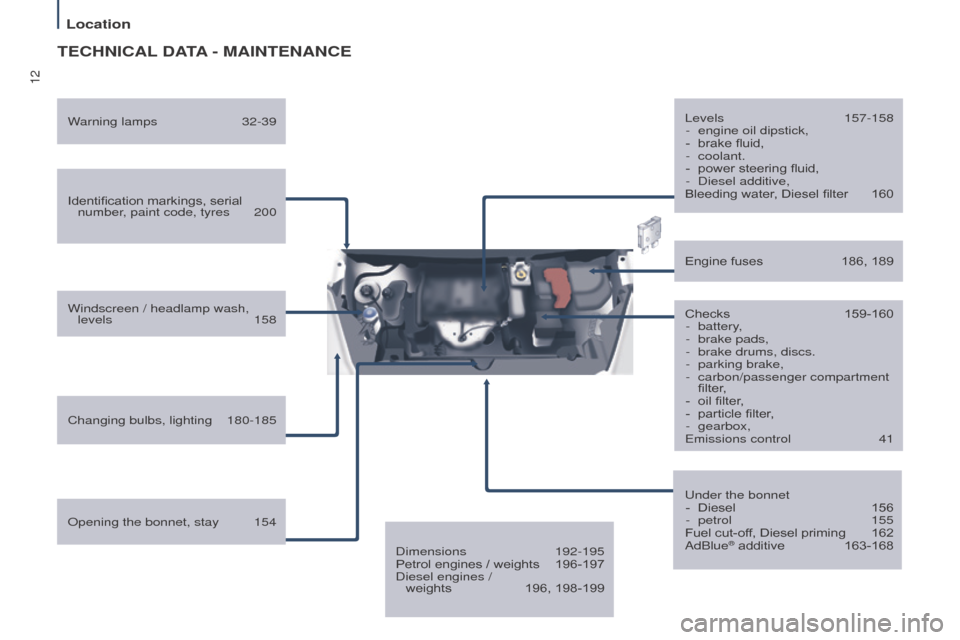
teCHNICAL DAtA - M AIN te NANC e
Identification markings, serial
number, paint code, tyres 200
Windscreen / headlamp wash, levels
158
Changing bulbs, lighting
180-185 Checks
159-160
-
battery
,
-
brake pads,
-
brake drums, discs.
-
parking brake,
-
carbon/passenger compartment
filter
,
-
oil filter
,
-
particle filter
,
-
gearbox,e
missions control
41
Engine fuses
186, 189
o
pening the bonnet, stay
154 Levels
157-158
-
engine oil dipstick,
-
brake fluid,
-
coolant.
-
power steering fluid,
-
Diesel additive,
Bleeding water
, Diesel filter 160
W arning lamps
32-39
u
nder the bonnet
-
Diesel
156
-
petrol
155
Fuel cut-of
f, Diesel priming
162
AdBlue® additive 163-168
Dimensions
192-195
Petrol engines / weights
196-197
Diesel engines /
weights
196, 198-199
Page 19 of 296
17
Motoring & the environment
Limit the causes of excess consumption
Spread loads throughout the vehicle; place the heaviest
items in the bottom of the boot, as close as possible to the
rear seats.
Limit the loads carried in the vehicle and reduce wind
resistance (roof bars, roof rack, bicycle carrier, trailer...).
u
se a roof box in preference.
Remove roof bars and roof racks after use.
At the end of winter, remove snow tyres and refit your
summer tyres.
observe the recommendations on maintenance
Check the tyre pressures regularly, when cold, referring to
the label in the door aperture, driver's side.
Carry out this check in particular:
-
before a long journey
,
-
at each change of season,
-
after a long period out of use.
Don't forget the spare wheel and the tyres on any trailer or
caravan.
Have your vehicle serviced regularly (engine oil, oil
filter
, air filter, passenger compartment filter...) and
observe the schedule of operations recommended in the
manufacturer's service schedule.
With a BlueHDi Diesel engine, if the SCR system is
faulty your vehicle becomes polluting; go to a P
eugeo T
dealer or a qualified workshop without delay to have the
emissions of nitrous oxides brought back to the legal level.
When refuelling, do not continue after the third cut-off of
the nozzle to avoid any overflow.
At the wheel of your new vehicle, it is only after the first
1 800 miles (3 000 kilometres) that you will see the fuel
consumption settle down to a consistent average.
2
eCo-DRIVINg
Page 37 of 296
+
ABS
Instruments and controls
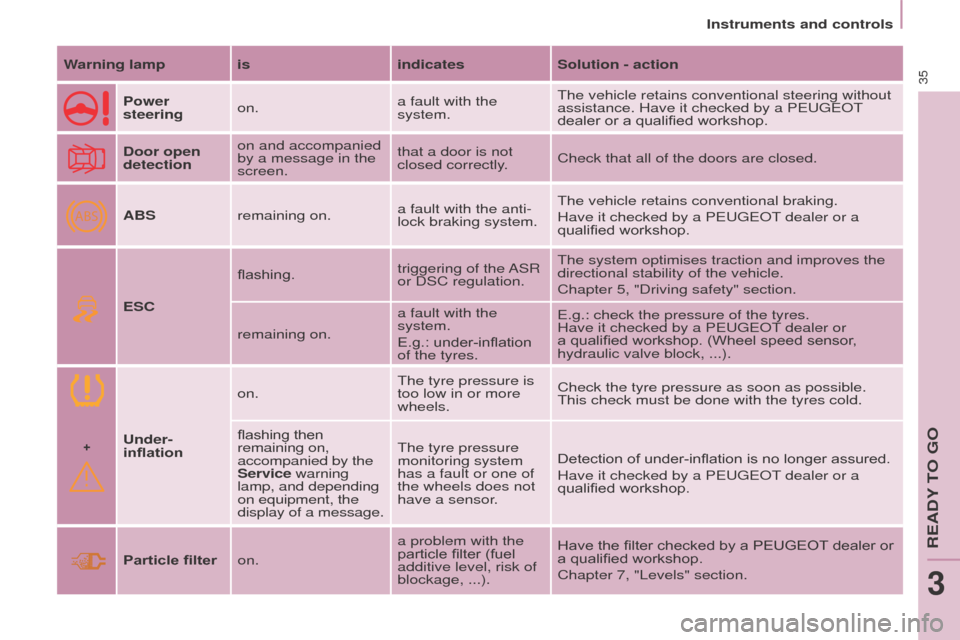
35Warning lamp isindicatesSolution - action
Power
steering on. a fault with the
system.The vehicle retains conventional steering without
assistance. Have it checked by a P
eugeo T
dealer or a qualified workshop.
Door open
detection on and accompanied
by a message in the
screen. that a door is not
closed correctly.
Check that all of the doors are closed.
ABS remaining on. a fault with the anti-
lock braking system.The vehicle retains conventional braking.
Have it checked by a P
eugeo T dealer or a
qualified workshop.
e
SC flashing.
triggering of the ASR
or DSC regulation.The system optimises traction and improves the
directional stability of the vehicle.
Chapter 5, "Driving safety" section.
remaining on. a fault with the
system.
E.g.: under-inflation
of the tyres.
e
.g.: check the pressure of the tyres.
Have it checked by a P
eugeo T dealer or
a qualified workshop. (Wheel speed sensor,
hydraulic valve block, ...).
u
nder-
inflation on.
The tyre pressure is
too low in or more
wheels.Check the tyre pressure as soon as possible.
This check must be done with the tyres cold.
flashing then
remaining on,
accompanied by the
Service warning
lamp, and depending
on equipment, the
display of a message. The tyre pressure
monitoring system
has a fault or one of
the wheels does not
have a sensor.
Detection of under-inflation is no longer assured.
Have it checked by a P
eugeo T dealer or a
qualified workshop.
Particle filter on. a problem with the
particle filter (fuel
additive level, risk of
blockage,
...).Have the filter checked by a PEUGEOT dealer or
a qualified workshop.
Chapter 7, "Levels" section.
ReADY to go
3
Page 43 of 296
Instruments and controls
41
eMISSIoNS CoNtRoLS
eoBD (european on Board
Diagnosis) is a diagnostics
system which complies
with, among others, the
standards on the authorised
emissions
of:
-
C
o
(carbon monoxide),
-
HC (unburnt hydrocarbons),
-
N
o
x (nitrous oxides) or particles,
detected by oxygen sensors placed
upstream and downstream of the
catalytic converters.
The driver is warned of any malfunction
of this emission control system by the
illumination of this specific warning
lamp in the instrument panel.
There is a risk of damage to the
catalytic converter. Have it checked
by a PEUGEOT dealer or a qualified
workshop.
uNDeR-INFLAt I o N D ete C t I o N
This system
continuously monitors
the pressures of the four
tyres, as soon as the
vehicle is moving.
A pressure sensor is located in the
valve of each tyre (except the spare
wheel).
The system triggers an alert if a drop
in pressure is detected in one or more
tyres.
The tyre under-inflation detection
system is an aid to driving which
does not replace the need for
vigilance on the part of the driver. This system does not avoid the
need to check the tyre pressures
regularly (including the spare
wheel) and before a long journey .
Driving with under-inflated tyres
adversely affects road holding,
extends braking distances and causes
premature tyre wear, particularly under
arduous conditions (vehicle loaded,
high speed, long journey).
Driving with under-inflated tyres
increases fuel consumption.
The tyre pressures for your vehicle
can be found on the tyre pressure
label.
Refer to chapter 9, "Identification
markings" section.
The tyre pressures must be checked
when the tyres cold (vehicle stopped
for 1 hour or after driving for less then
6 miles (10 km) at moderate speed).
o
therwise, add 0.3 bar to the values
indicated on the label.
ReADY to go
3
Page 44 of 296
Instruments and controls
42
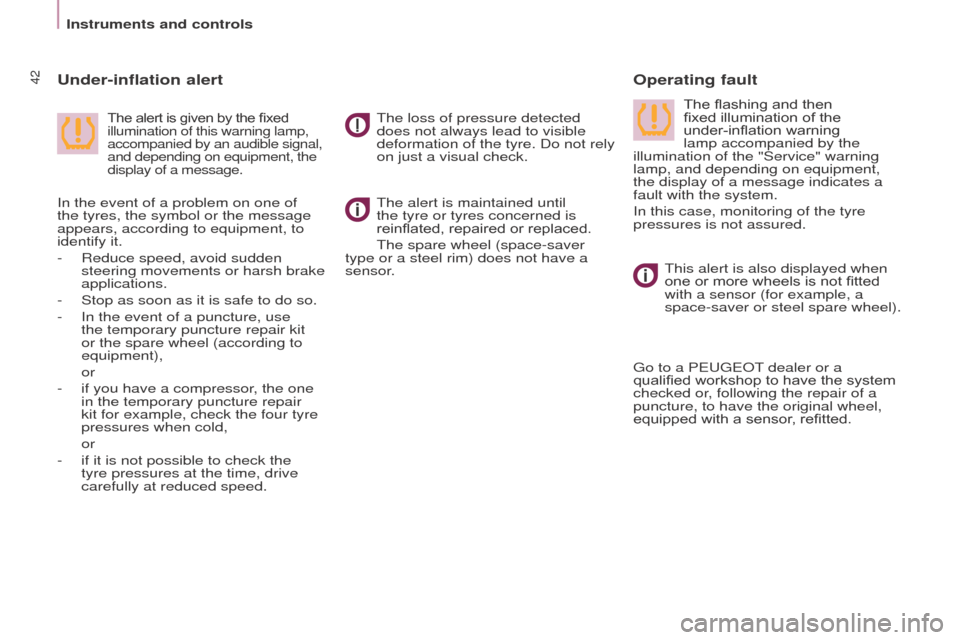
The alert is maintained until
the tyre or tyres concerned is
reinflated, repaired or replaced.
The spare wheel (space-saver
type or a steel rim) does not have a
sensor.
operating faultu
nder-inflation alert
The loss of pressure detected
does not always lead to visible
deformation of the tyre. Do not rely
on just a visual check.The alert is given by the fixed
illumination of this warning lamp,
accompanied by an audible signal,
and depending on equipment, the
display of a message.The flashing and then
fixed illumination of the
under-inflation warning
lamp accompanied by the
illumination of the "Service" warning
lamp, and depending on equipment,
the display of a message indicates a
fault with the system.
In this case, monitoring of the tyre
pressures is not assured.
In the event of a problem on one of
the tyres, the symbol or the message
appears, according to equipment, to
identify it.
-
Reduce speed, avoid sudden
steering movements or harsh brake
applications.
-
Stop as soon as it is safe to do so.
-
In the event of a puncture, use
the temporary puncture repair kit
or the spare wheel (according to
equipment),
or
-
if you have a compressor
, the one
in the temporary puncture repair
kit for example, check the four tyre
pressures when cold,
or
-
if it is not possible to check the
tyre pressures at the time, drive
carefully at reduced speed.
This alert is also displayed when
one or more wheels is not fitted
with a sensor (for example, a
space-saver or steel spare wheel).
g
o to a P eugeo T dealer or a
qualified workshop
to have the system
checked or, following the repair of a
puncture, to have the original wheel,
equipped with a sensor, refitted.
Page 45 of 296
Instruments and controls
43
uNDeR-INFLAtI o N D ete C t I o N WI t H R e INI t IALISAt I o N
System which automatically checks the
pressures of the tyres while driving.
The system monitors the pressures
in the four tyres, once the vehicle is
moving.
It compares the information given by
the four wheel speed sensors with
reference values, which must be
reinitialised every time the tyre
pressures are adjusted or a wheel
changed.
The system triggers an alert as soon
as it detects a drop in the inflation
pressure of one or more tyres.The under-inflation detection
system does not replace the
need for vigilance on the part of
the
driver.
This system does not avoid the need to
check the tyre pressures (including the
spare wheel) every month as well as
before a long journey.
Driving with under-inflated tyres
impairs road holding, extends braking
distances and causes premature
tyre wear, particularly under arduous
condition (high loading, high speed,
long journey).
Driving with under-inflated tyres
increases fuel consumption. The inflation pressures defined for
your vehicle can be found on the
tyre pressure label.
For more information on the
identification markings, refer to the
corresponding section.
Tyre pressures should be checked
when the tyres are "cold" (vehicle
stopped for 1 hour or after a journey of
less than 6 miles (10 km) at moderate
speeds).
o
therwise (when hot), add 0.3 bar to
the pressures shown on the label.
ReADY to go
3
Page 46 of 296
Instruments and controls
44
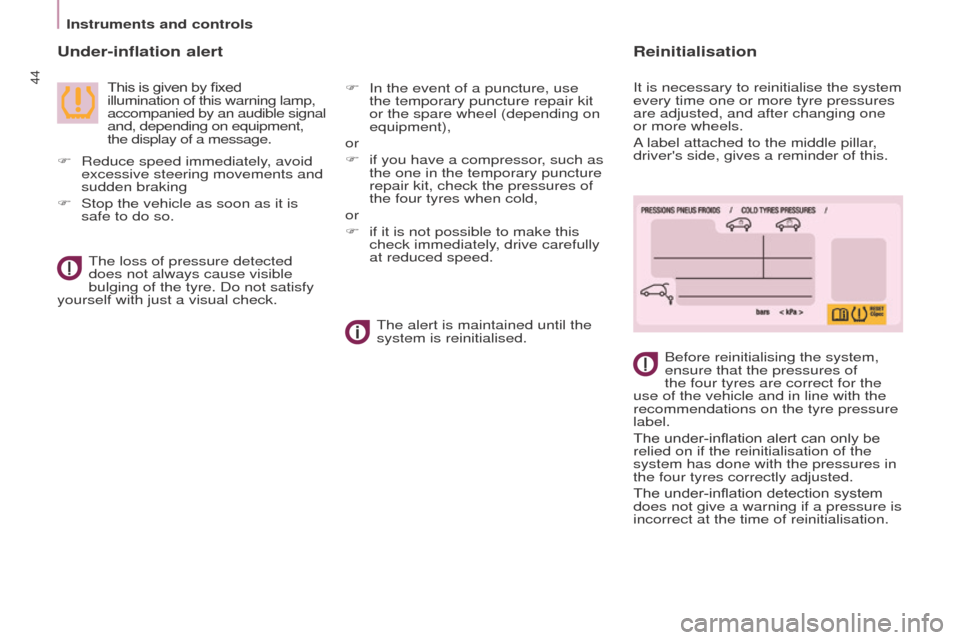
under-inflation alert
This is given by fixed
illumination of this warning lamp,
accompanied by an audible signal
and, depending on equipment,
the display of a message.Before reinitialising the system,
ensure that the pressures of
the four tyres are correct for the
use of the vehicle and in line with the
recommendations on the tyre pressure
label.
The under-inflation alert can only be
relied on if the reinitialisation of the
system has done with the pressures in
the four tyres correctly adjusted.
The under-inflation detection system
does not give a warning if a pressure is
incorrect at the time of reinitialisation.
The loss of pressure detected
does not always cause visible
bulging of the tyre. Do not satisfy
yourself with just a visual check.
The alert is maintained until the
system is reinitialised.
F
Reduce speed immediately
, avoid
excessive steering movements and
sudden braking
F
Stop the vehicle as soon as it is
safe to do so. F
In the event of a puncture, use
the temporary puncture repair kit
or the spare wheel (depending on
equipment),
or
F
if you have a compressor
, such as
the one in the temporary puncture
repair kit, check the pressures of
the four tyres when cold,
or
F
if it is not possible to make this
check immediately
, drive carefully
at reduced speed.
Reinitialisation
It is necessary to reinitialise the system
every time one or more tyre pressures
are adjusted, and after changing one
or more wheels.
A label attached to the middle pillar,
driver's side, gives a reminder of this.
Page 48 of 296
Instruments and controls
46
The new pressure settings registered
are considered to be reference values
by the system.The under-inflation alert is only
dependable if the system has
been reinitialised with all four tyres
inflated to the correct pressures.
Before doing anything to the
system, the pressures of the four
tyres must be checked and the
system reinitialised.
Snow chains
The system does not have to be
reinitialised after fitting or removing
snow chains.
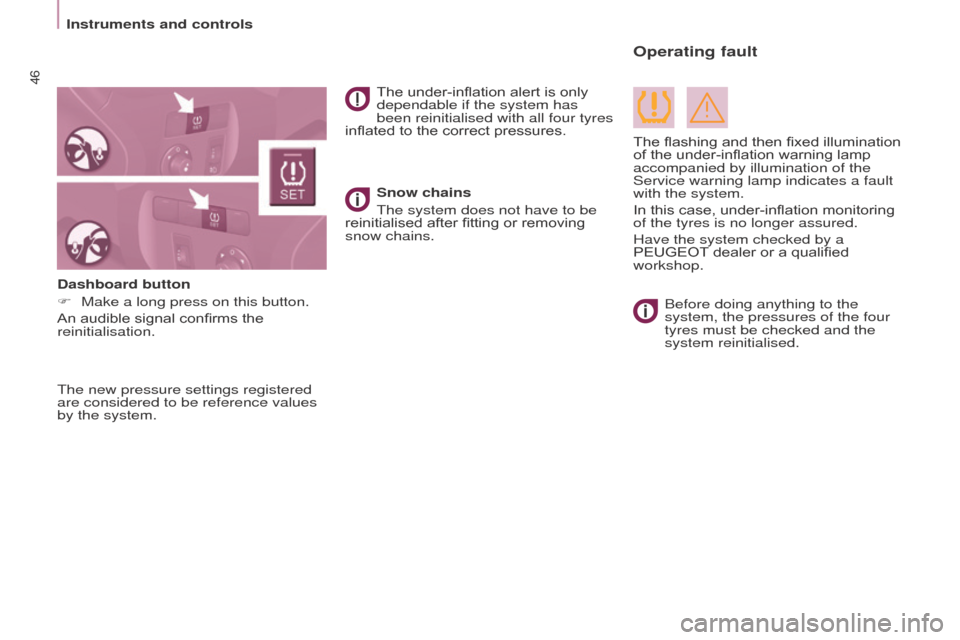
Dashboard button
F
Make a long press on this button.
An audible signal confirms the
reinitialisation.
operating fault
The flashing and then fixed illumination
of the under-inflation warning lamp
accompanied by illumination of the
Service warning lamp indicates a fault
with the system.
In this case, under-inflation monitoring
of the tyres is no longer assured.
Have the system checked by a
PEUGEOT dealer or a qualified
workshop.
Page 120 of 296
ABS
ABS
11 8
ANtI-LoCK BRAKINg SYSteM
(ABS / e BFD)
The ABS and eBFD (electronic brake
force distribution) systems improve the
stability and manoeuvrability of your
vehicle on braking, in particular on
poor or slippery surfaces.
The
ABS prevents locking of the
wheels, the
e BFD provides control of
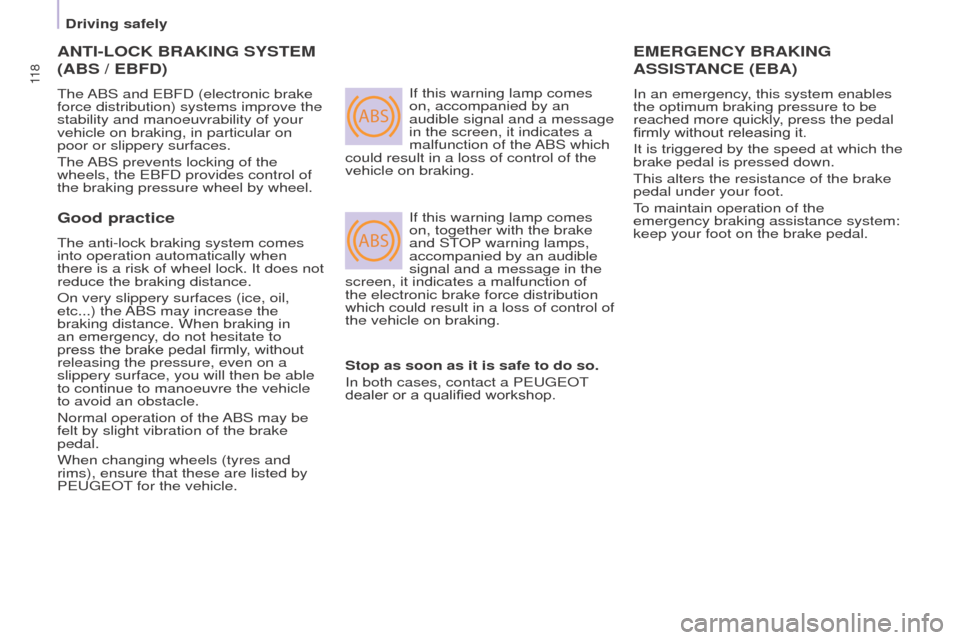
the braking pressure wheel by wheel. If this warning lamp comes
on, accompanied by an
audible signal and a message
in the screen, it indicates a
malfunction of the ABS which
could result in a loss of control of the
vehicle on braking.
If this warning lamp comes
on, together with the brake
and ST
o
P warning lamps,
accompanied by an audible
signal and a message in the
screen, it indicates a malfunction of
the electronic brake force distribution
which could result in a loss of control of
the vehicle on braking.
eMeRgeNCY BRAKIN g
ASSIS
t
ANC
e ( e BA)
In an emergency, this system enables
the optimum braking pressure to be
reached more quickly, press the pedal
firmly without releasing it.
It is triggered by the speed at which the
brake pedal is pressed down.
This alters the resistance of the brake
pedal under your foot.
To maintain operation of the
emergency braking assistance system:
keep your foot on the brake pedal.
good practice
The anti-lock braking system comes
into operation automatically when
there is a risk of wheel lock. It does not
reduce the braking distance.
o
n very slippery surfaces (ice, oil,
etc...) the ABS may increase the
braking distance. When braking in
an emergency, do not hesitate to
press the brake pedal firmly, without
releasing the pressure, even on a
slippery surface, you will then be able
to continue to manoeuvre the vehicle
to avoid an obstacle.
Normal operation of the ABS may be
felt by slight vibration of the brake
pedal.
When changing wheels (tyres and
rims), ensure that these are listed by
P
eugeo T for the vehicle. Stop as soon as it is safe to do so.
In both cases, contact a P
eugeo T
dealer or a qualified workshop.
Driving safely
Page 121 of 296
11 9
ANtI-SLIP R egu LAt I o N (ASR)
AND
DYNAMIC S t
ABILI
t Y
C
o N t R o L
(DSC)
These systems are linked and
complement the ABS.
The ASR system is very useful for
maintaining optimum drive and
avoiding losses of control of the vehicle
on acceleration.
The system optimises drive to prevent
the wheels skidding, by acting on the
brakes of the drive wheels and on the
engine. It also allows the directional
stability of the vehicle to be improved
on acceleration.
u
se the DSC to hold your course
without attempting to countersteer.
If there is a variation between the
trajectory followed by the vehicle and
that required by the driver, the DSC
system automatically acts on the
engine and the brake of one or more
wheels, in order to put the vehicle back
on course.
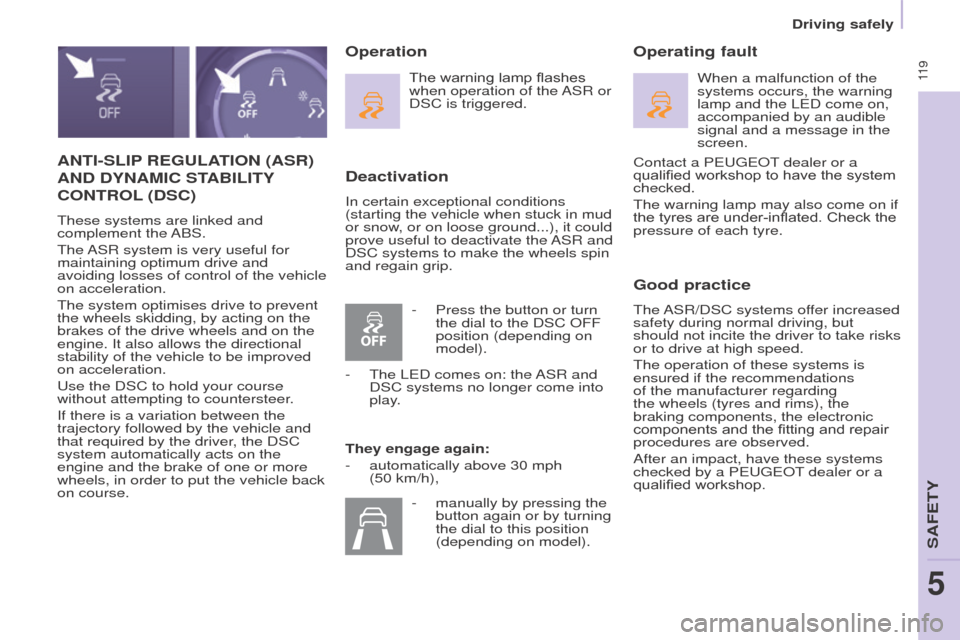
Deactivation
In certain exceptional conditions
(starting the vehicle when stuck in mud
or snow, or on loose ground...), it could
prove useful to deactivate the ASR and
DSC systems to make the wheels spin
and regain grip.
operating fault
g
ood practice
The ASR/DSC systems offer increased
safety during normal driving, but
should not incite the driver to take risks
or to drive at high speed.
The operation of these systems is
ensured if the recommendations
of the manufacturer regarding
the wheels (tyres and rims), the
braking components, the electronic
components and the fitting and repair
procedures are observed.
After an impact, have these systems
checked by a P eugeo T dealer or a
qualified workshop.
operation
The warning lamp flashes
when operation of the ASR or
DSC is triggered.
t
hey engage again:
-
automatically above 30 mph
(50 km/h), When a malfunction of the
systems occurs, the warning
lamp and the L
e D come on,
accompanied by an audible
signal and a message in the
screen.
-
Press the button or turn
the dial to the DSC
o FF
position (depending on
model).
-
The L
e D comes on: the ASR and
DSC systems no longer come into
play.
-
manually by pressing the
button again or by turning
the dial to this position
(depending on model). Contact a P
eugeo T dealer or a
qualified workshop to have the system
checked.
The warning lamp may also come on if
the tyres are under-inflated. Check the
pressure of each tyre.
Driving safely
SAFeTY
5