weight Peugeot Partner Tepee 2016 Owner's Manual
[x] Cancel search | Manufacturer: PEUGEOT, Model Year: 2016, Model line: Partner Tepee, Model: Peugeot Partner Tepee 2016Pages: 296, PDF Size: 10.76 MB
Page 14 of 296
12
Location
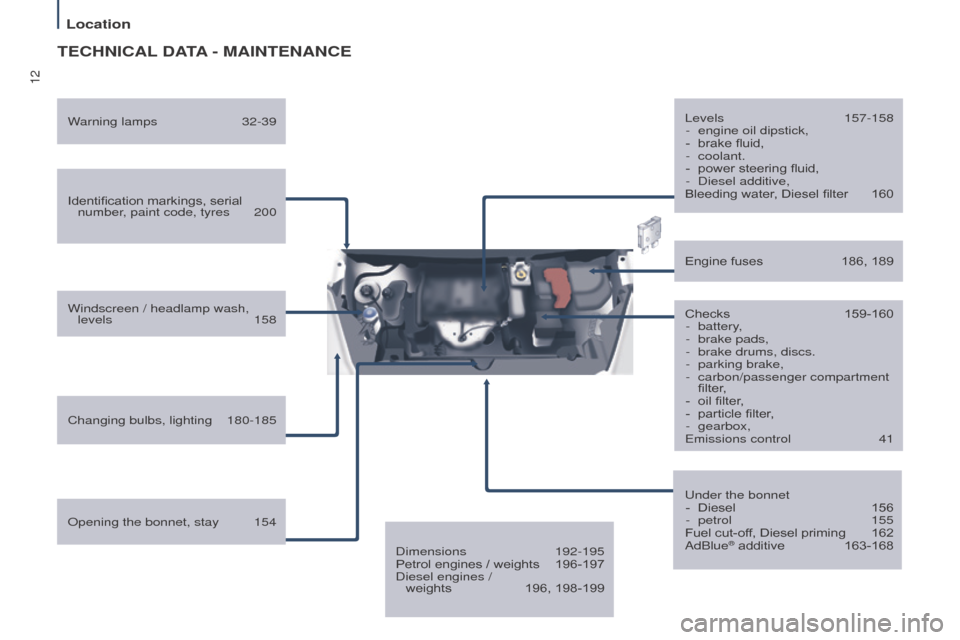
teCHNICAL DAtA - M AIN te NANC e
Identification markings, serial
number, paint code, tyres 200
Windscreen / headlamp wash, levels
158
Changing bulbs, lighting
180-185 Checks
159-160
-
battery
,
-
brake pads,
-
brake drums, discs.
-
parking brake,
-
carbon/passenger compartment
filter
,
-
oil filter
,
-
particle filter
,
-
gearbox,e
missions control
41
Engine fuses
186, 189
o
pening the bonnet, stay
154 Levels
157-158
-
engine oil dipstick,
-
brake fluid,
-
coolant.
-
power steering fluid,
-
Diesel additive,
Bleeding water
, Diesel filter 160
W arning lamps
32-39
u
nder the bonnet
-
Diesel
156
-
petrol
155
Fuel cut-of
f, Diesel priming
162
AdBlue® additive 163-168
Dimensions
192-195
Petrol engines / weights
196-197
Diesel engines /
weights
196, 198-199
Page 49 of 296
Instruments and controls
47
SeRVICe INDICAto R
This programmes service intervals
according to the use of the vehicle. More than 1 000 miles/km before the
next service is duee
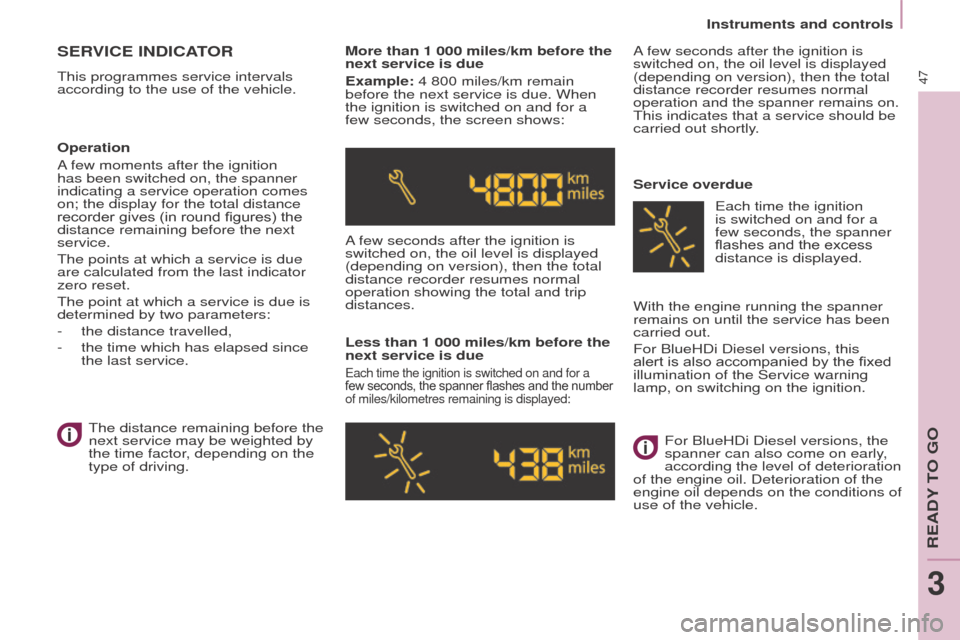
xample: 4 800 miles/km remain
before the next service is due. When
the ignition is switched on and for a
few seconds, the screen shows:
A few seconds after the ignition is
switched on, the oil level is displayed
(depending on version), then the total
distance recorder resumes normal
operation showing the total and trip
distances.
Less than 1 000 miles/km before the
next service is due
each time the ignition is switched on and for a
few seconds, the spanner flashes and the number
of miles/kilometres remaining is displayed:
A few seconds after the ignition is
switched on, the oil level is displayed
(depending on version), then the total
distance recorder resumes normal
operation and the spanner remains on.
This indicates that a service should be
carried out shortly.
Service overdue
o
peration
A few moments after the ignition
has been switched on, the spanner
indicating a service operation comes
on; the display for the total distance
recorder gives (in round figures) the
distance remaining before the next
service.
The points at which a service is due
are calculated from the last indicator
zero reset.
The point at which a service is due is
determined by two parameters:
-
the distance travelled,
-
the time which has elapsed since
the last service. The distance remaining before the
next service may be weighted by
the time factor
, depending on the
type of driving. With the engine running the spanner
remains on until the service has been
carried out.
For BlueHDi Diesel versions, this
alert is also accompanied by the fixed
illumination of the Service warning
lamp, on switching on the ignition.
e
ach time the ignition
is switched on and for a
few
seconds, the spanner
flashes and the excess
distance is displayed.
For BlueHDi Diesel versions, the
spanner can also come on early,
according the level of deterioration
of the engine oil. Deterioration of the
engine oil depends on the conditions of
use of the vehicle.
ReADY to go
3
Page 79 of 296
77
Seats
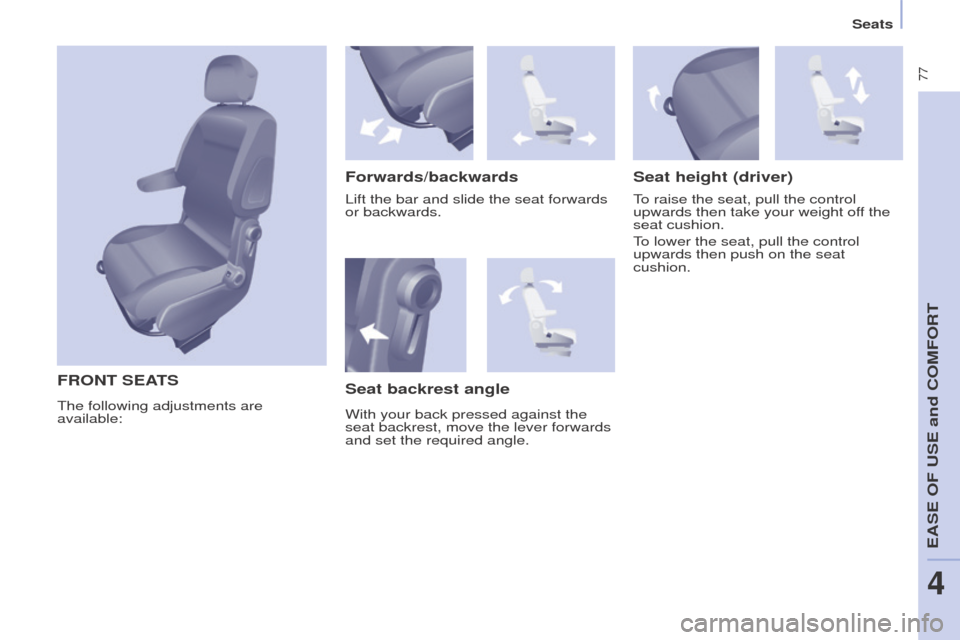
FRoNt SeAtS
Forwards/backwards Seat height (driver)
To raise the seat, pull the control
upwards then take your weight off the
seat cushion.
To lower the seat, pull the control
upwards then push on the seat
cushion.
Seat backrest angle
Lift the bar and slide the seat forwards
or backwards.
The following adjustments are
available: With your back pressed against the
seat backrest, move the lever forwards
and set the required angle.
eASe oF uSe and CoMFoRT
4
Page 97 of 296
95
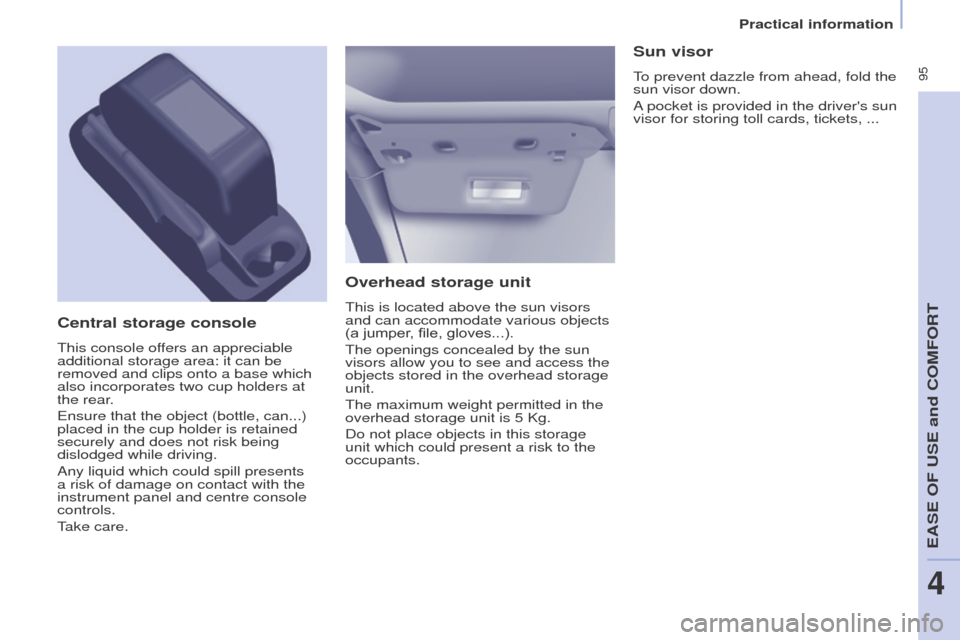
overhead storage unit
This is located above the sun visors
and can accommodate various objects
(a jumper, file, gloves...).
The openings concealed by the sun
visors allow you to see and access the
objects stored in the overhead storage
unit.
The maximum weight permitted in the
overhead storage unit is 5 Kg.
Do not place objects in this storage
unit which could present a risk to the
occupants.
Central storage console
This console offers an appreciable
additional storage area: it can be
removed and clips onto a base which
also incorporates two cup holders at
the rear.
e
nsure that the object (bottle, can...)
placed in the cup holder is retained
securely and does not risk being
dislodged while driving.
Any liquid which could spill presents
a risk of damage on contact with the
instrument panel and centre console
controls.
Take care.
Sun visor
To prevent dazzle from ahead, fold the
sun visor down.
A pocket is provided in the driver's sun
visor for storing toll cards, tickets, ...
eASe oF uSe and CoMFoRT
4
Practical information
Page 104 of 296
102
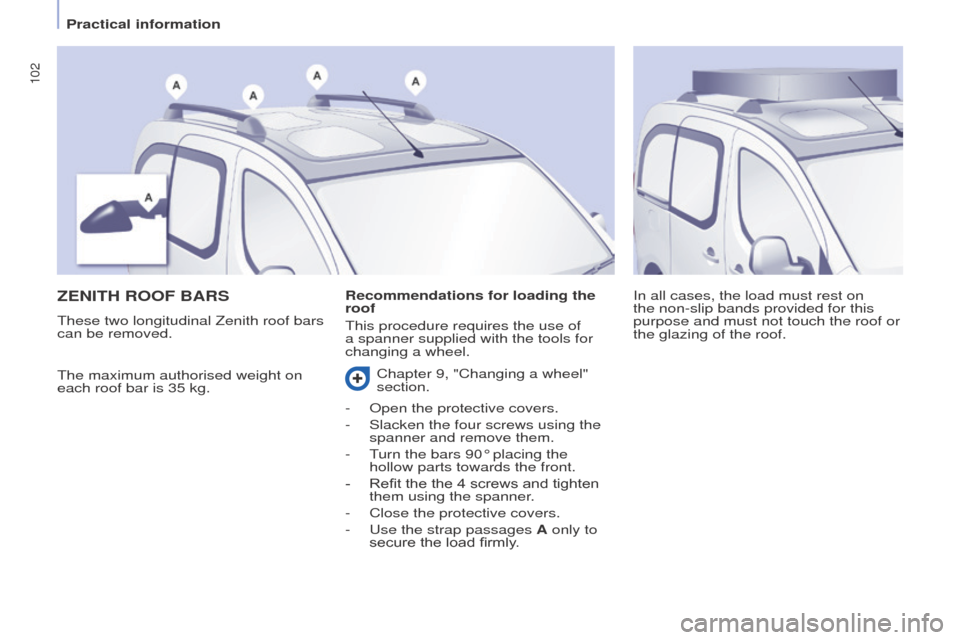
ZeNItH RooF BARS
The maximum authorised weight on
each roof bar is 35 kg.In all cases, the load must rest on
the non-slip bands provided for this
purpose and must not touch the roof or
the glazing of the roof.
Recommendations for loading the
roof
This procedure requires the use of
a spanner supplied with the tools for
changing a wheel.
These two longitudinal Zenith roof bars
can be removed.
Chapter 9, "Changing a wheel"
section.
-
o pen the protective covers.
-
Slacken the four screws using the
spanner and remove them.
-
T
urn the bars 90° placing the
hollow parts towards the front.
-
Refit the the 4 screws and tighten
them using the spanner
.
-
Close the protective covers.
-
u se the strap passages A only to
secure the load firmly.
Practical information
Page 105 of 296

103
exteRIoR RooF BARS
If you install transverse bars on these bars, refer to the weight values\
indicated
by the manufacturer but do not exceed: 75 kg.
eASe oF uSe and CoMFoRT
4
Practical information
Page 135 of 296
133
CARRYINg CHILDReN
g eneral points on child seats
Peugeot recommends that
children should travel in the rear
seats of your vehicle:
-
rearward facing
up to the age of 3,
-
forward facing
over the age of 3.
Although one of P
eugeo
T main
criteria when designing your vehicle,
the safety of your children also
depends on you.
*
The regulations on carrying children
are specific to each country
. Refer to
the legislation in force in your country.
For maximum safety, please observe
the following recommendations:
-
in accordance with
e
uropean
regulations, all children under the
age of 12 or less than one and
a half metres tall must travel in
approved child seats suited to
their weight, on seats fitted with a
seat belt or IS
o
FIX mountings*,
-
statistically
, the safest seats in
your vehicle for carrying children
are the rear seats,
-
a child weighing less than 9
kg
must travel in the rearward
facing position both in the front
and in the rear.
5
SAFeTY
Child safety
Page 143 of 296

141
LoCAtI o NS F o R CHILD S e At S S e C u R e D WI t H t H e S e At B e Lt
* A child seat with support leg must never be installed on an outer passeng\
er seat in row 2, unless you are able to install it
in line with the recommendations under "Installing a child seat with a support leg".
** A child seat with support leg must never be installed on a passenger seat\
in row 3.
In accordance with
e uropean regulations, this table indicates the options for installing child seats secured using a seat belt
and universally approved (a) according to the weight of the child and \
the seat in the vehicle.
u
:
seat suitable for the installation of a child seat secured using the sea\
t belt and universally approved, rearward facing
and/or forward facing. Seat(s)
W
eight of the child and indicative age
u
nder 13 kg
(groups 0 (b) and 0+)
u
p to approx
1 year
From 9 to 18 kg
(group 1)
1 to 3 years approx
From 15 to 25 kg
(group 2)
3 to 6 years approx
From 22 to 36 kg
(group 3)
6 to 10 years approx
Row 1 (c)(d) Passenger
seat
u
uuu
Row 2 (e)
(5 and 7 seats)
o
uter seats
u
*
u
*
u u
Centre seatuuuu
Row 3 (f) (g)
(7 seats) All seatsu
**
u
**
u u
5
SAFeTY
Child safety
Page 147 of 296
145
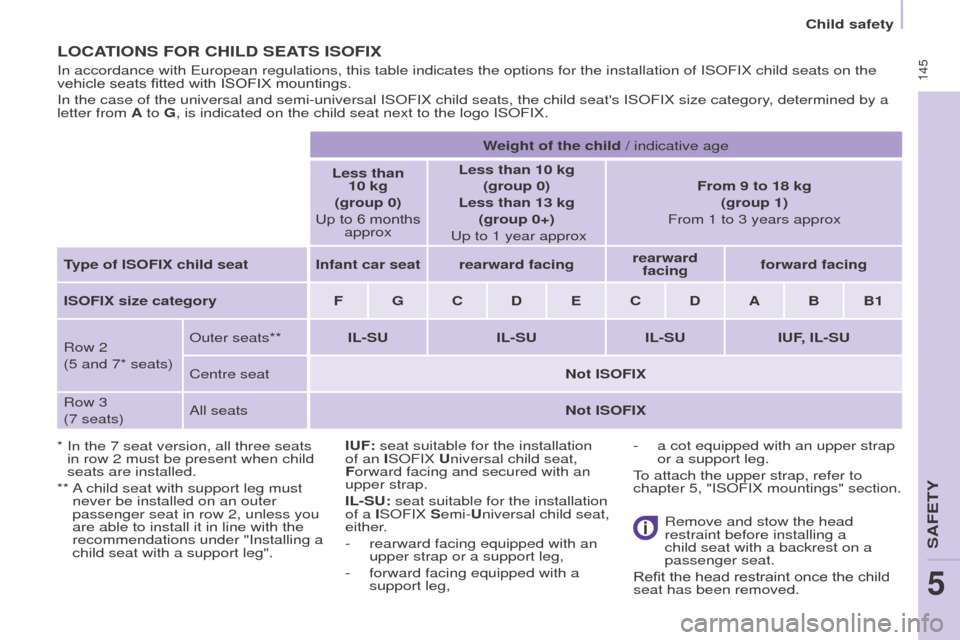
LoCAtI o NS F o R CHILD S e At S IS o FI x
* In the 7 seat version, all three seats
in row 2 must be present when child
seats are installed.
**
A
child seat with support leg must
never be installed on an outer
passenger seat in row 2, unless you
are able to install it in line with the
recommendations under "Installing a
child seat with a support leg".
In accordance with
e uropean regulations, this table indicates the options for the installati\
on of IS o FIX child seats on the
vehicle seats fitted with ISOFIX mountings.
In the case of the universal and semi-universal IS o FIX child seats, the child seat's IS o FIX size category, determined by a
letter from A to g , is indicated on the child seat next to the logo IS o FIX.
Weight of the child / indicative age
Less than 10 kg
(group 0)
Up to 6 months approx Less than 10 kg
(group 0)
Less than 13 kg (group 0+)
u p to 1 year approx
From 9 to 18 kg
(group 1)
From 1 to 3 years approx
type of
IS o FI x child seat Infant car seat rearward facing
rearward
facing forward facing
IS o FI x size category
F
gC DeC D A B B1
Row 2
(5 and 7* seats)
o
uter seats**
IL-S u
IL-S
u
IL-S
u
I
u F, IL-S u
Centre seat
Not IS
o FI x
Row 3
(7 seats)
All seats
Not
IS o FI xI
u F: seat suitable for the installation
of an IS o FIX u niversal child seat,
Forward facing and secured with an
upper strap.
IL-S
u : seat suitable for the installation
of a IS
o FIX Semi- u niversal child seat,
either.
-
rearward facing equipped with an
upper strap or a support leg,
-
forward facing equipped with a
support leg, Remove and stow the head
restraint before installin
g a
child seat with a backrest on a
passenger seat.
Refit the head restraint once the child
seat has been removed.
-
a cot equipped with an upper strap
or a support leg.
T
o attach the upper strap, refer to
chapter 5, "IS
o FIX mountings" section.
5
SAFeTY
Child safety
Page 150 of 296
148
towing a trailerFor more information about
weights and towed loads, refer to
chapter 9, "W
eights" section.
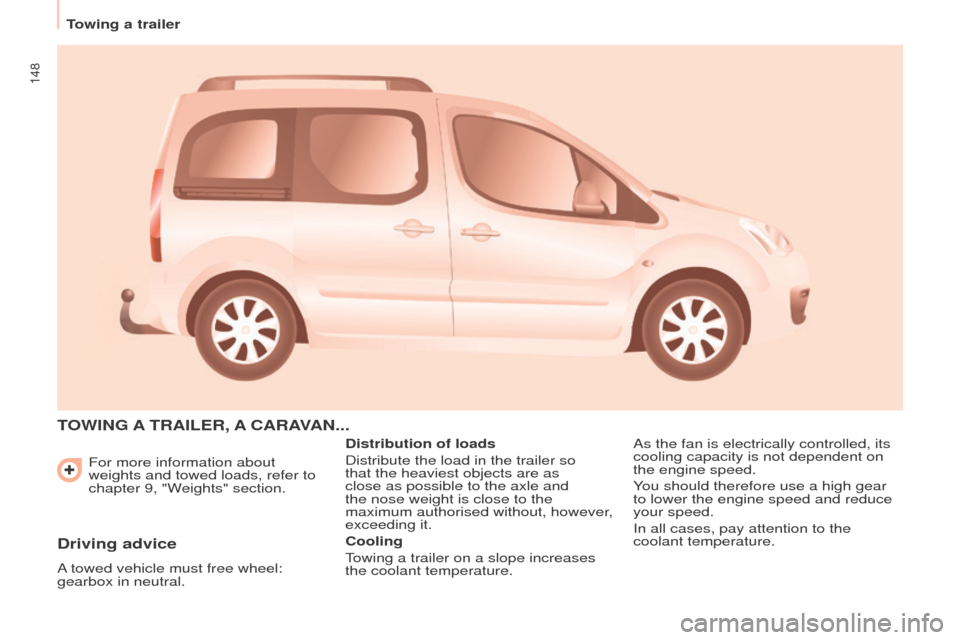
toWIN g A t RAIL e R , A CARA VAN ...
Distribution of loads
Distribute the load in the trailer so
that the heaviest objects are as
close as possible to the axle and
the nose weight is close to the
maximum authorised without, however,
exceeding it.
Cooling
Towing a trailer on a slope increases
the coolant temperature. As the fan is electrically controlled, its
cooling capacity is not dependent on
the engine speed.
You should therefore use a high gear
to lower the engine speed and reduce
your speed.
In all cases, pay attention to the
coolant temperature.
Driving advice
A towed vehicle must free wheel:
gearbox in neutral.