stop start Peugeot Partner Tepee 2017 User Guide
[x] Cancel search | Manufacturer: PEUGEOT, Model Year: 2017, Model line: Partner Tepee, Model: Peugeot Partner Tepee 2017Pages: 292, PDF Size: 10.49 MB
Page 57 of 292
55
Partner2VP_en_Chap03_Pret-a-partir_ed02-2016Partner2VP_en_Chap03_Pret-a-partir_ed02-2016
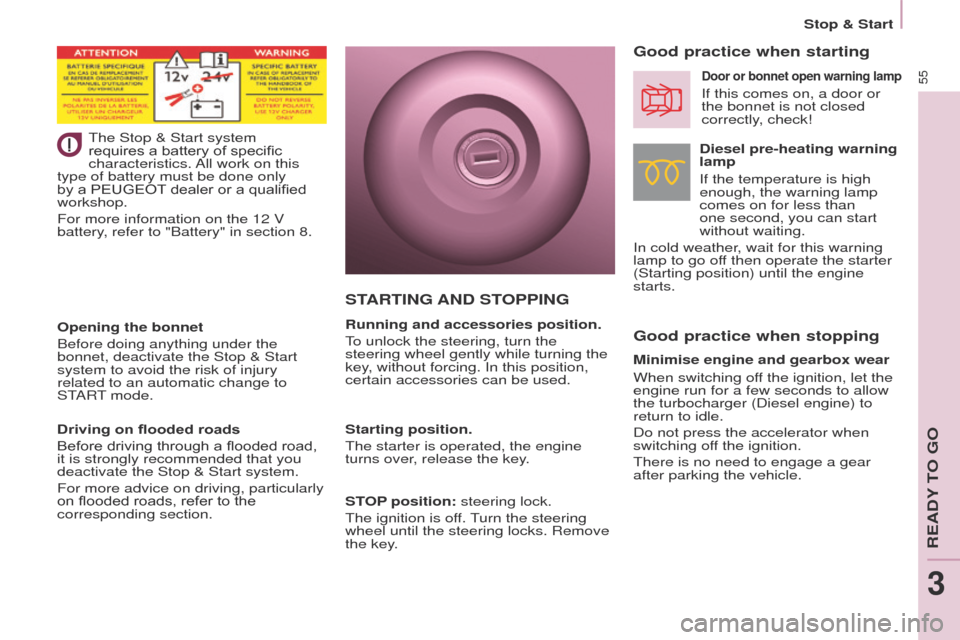
The Stop & Start system
requires a battery of specific
characteristics. All work on this
type of battery must be done only
by a PEUGEOT dealer or a qualified
workshop.
For more information on the 12 V
battery, refer to "Battery" in section 8.
Good practice when stopping Good practice when starting
Diesel pre-heating warning
lamp
If the temperature is high
enough, the warning lamp
comes on for less than
one
second, you can start
without waiting.
In cold weather, wait for this warning
lamp to go off then operate the starter
(Starting position) until the engine
starts.
Door or bonnet open warning lamp
If this comes on, a door or
the bonnet is not closed
correctly, check!
Minimise engine and gearbox wear
When switching off the ignition, let the
engine run for a few seconds to allow
the turbocharger (Diesel engine) to
return to idle.
Do not press the accelerator when
switching off the ignition.
There is no need to engage a gear
after parking the vehicle.
STARTING AND ST OPPING
Running and accessories position.
To unlock the steering, turn the
steering wheel gently while turning the
key, without forcing. In this position,
certain accessories can be used.
Starting position.
The starter is operated, the engine
turns over, release the key.
STOP position: steering lock.
The ignition is off. Turn the steering
wheel until the steering locks. Remove
the key.
Opening the bonnet
Before doing anything under the
bonnet, deactivate the Stop & Start
system to avoid the risk of injury
related to an automatic change to
START mode.
Driving on flooded roads
Before driving through a flooded road,
it is strongly recommended that you
deactivate the Stop & Start system.
For more advice on driving, particularly
on flooded roads, refer to the
corresponding section.
READY TO GO
3
Stop & Start
Page 59 of 292
57
Partner2VP_en_Chap03_Pret-a-partir_ed02-2016Partner2VP_en_Chap03_Pret-a-partir_ed02-2016
DRIVING RECOMMENDATIONS
Observe the driving regulations and
remain vigilant whatever the traffic
conditions.
Pay close attention to the traffic and
keep your hands on the wheel so that
you are ready to react at any time to
any eventuality.
As a safety precaution, the driver
must only carry out actions requiring
sustained attention when the vehicle is
stationary.
On a long journey, a break every two
hours is strongly recommended.
In difficult weather, drive smoothly,
anticipate the need to brake and
increase the distance from other
vehicles.
Driving on flooded roads
We strongly advise against driving
on flooded roads, as this could cause
serious damage to the engine or
gearbox, as well as to the electrical
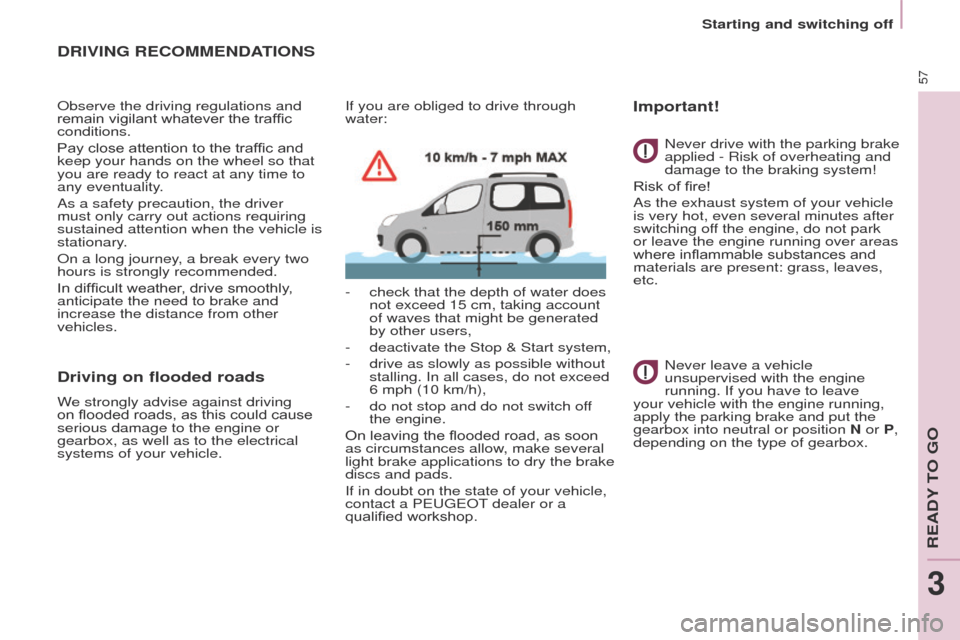
systems of your vehicle.If you are obliged to drive through
water:
-
check that the depth of water does
not exceed 15 cm, taking account
of waves that might be generated
by other users,
-
deactivate the Stop & Start system,
-
drive as slowly as possible without
stallin
g. In all cases, do not exceed
6 mph (10 km/h),
- do not stop and do not switch of f
the engine.
On leaving the flooded road, as soon
as circumstances allow, make several
light brake applications to dry the brake
discs and pads.
If in doubt on the state of your vehicle,
contact a PEUGEOT dealer or a
qualified workshop. Never drive with the parking brake
applied - Risk of overheating and
damage to the braking system!
Risk of fire!
As the exhaust system of your vehicle
is very hot, even several minutes after
switching off the engine, do not park
or leave the engine running over areas
where inflammable substances and
materials are present: grass, leaves,
etc.
Never leave a vehicle
unsupervised with the engine
running. If you have to leave
your vehicle with the engine running,
apply the parking brake and put the
gearbox into neutral or position N or P,
depending on the type of gearbox.
Important!
READY TO GO
3
Starting and switching off
Page 61 of 292
59
Partner2VP_en_Chap04_Ergonomie_ed02-2016
LED DAYTIME RUNNING LAMPS
Rear foglamps (amber,
2nd rotation of the ring
forwards).
Front foglamps (green,
1st
rotation of the ring
forwards). Rotate this ring forwards
to switch on and
rearwards to switch off.
Their state is confirmed by
the warning lamps in the
instrument panel. Do not forget to switch them off
when they are no longer needed.
Operation of the automatic illumination
of headlamps switches off the rear
foglamps, but the front foglamps
remain on.
To switch off the front and
rear foglamps, turn the
ring rearwards twice in
succession.
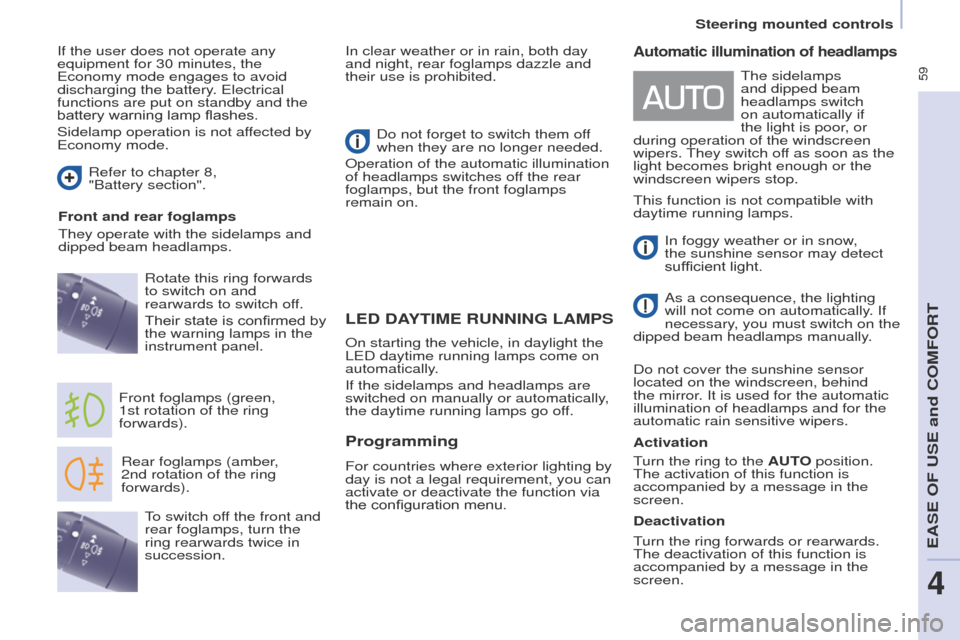
Automatic illumination of headlamps
In foggy weather or in snow,
the sunshine sensor may detect
sufficient light.
As a consequence, the lighting
will not come on automatically. If
necessary, you must switch on the
dipped beam headlamps manually.
Do not cover the sunshine sensor
located on the windscreen, behind
the mirror. It is used for the automatic
illumination of headlamps and for the
automatic rain sensitive wipers.
Activation The sidelamps
and dipped beam
headlamps switch
on automatically if
the light is poor, or
during operation of the windscreen
wipers. They switch off as soon as the
light becomes bright enough or the
windscreen wipers stop.
On starting the vehicle, in daylight the
LED daytime running lamps come on
automatically.
If the sidelamps and headlamps are
switched on manually or automatically,
the daytime running lamps go off.
Programming
For countries where exterior lighting by
day is not a legal requirement, you can
activate or deactivate the function via
the configuration menu.
If the user does not operate any
equipment for 30 minutes, the
Economy mode engages to avoid
discharging the battery. Electrical
functions are put on standby and the
battery warning lamp flashes.
Sidelamp operation is not affected by
Economy mode.
In clear weather or in rain, both day
and night, rear foglamps dazzle and
their use is prohibited.
Refer to chapter 8,
"Battery
section".
Front and rear foglamps
They operate with the sidelamps and
dipped beam headlamps.
Turn the ring to the AUTO position.
The activation of this function is
accompanied by a message in the
screen.
Deactivation
Turn the ring forwards or rearwards.
The deactivation of this function is
accompanied by a message in the
screen. This function is not compatible with
daytime running lamps.
Steering mounted controls
EASE OF USE and COMFORT
4
Page 160 of 292
158
Partner2VP_en_Chap07_Verification_ed02-2016Partner2VP_en_Chap07_Verification_ed02-2016
Cooling system
Only use the fluid recommended by the
manufacturer.
Otherwise, you risk seriously damaging
your engine.
When the engine is warm, the
temperature of the coolant is controlled
by the engine fan. As this fan can
operate with the ignition key removed
and because the cooling system is
pressurised, wait for at least one hour
after the engine has stopped before
carrying out any work.
Slacken the cap by 1/4 of a turn to
release the pressure to prevent any
risk of scalding. When the pressure
has dropped, remove the cap and top
up the level with coolant.
If fluid has to be added frequently,
this indicates a fault which must be
checked by a PEUGEOT dealer as
soon as possible.
Power steering fluid level
The vehicle must be parked on level
ground with the engine cold. Unscrew
the cap integrated with the gauge and
check the level which must be between
the MIN and MAX marks.In order to regenerate the filter, you
are advised to drive at a speed higher
than 40 mph (60 km/h) for at least five
minutes as soon as possible, when
traffic conditions permit (until the
message disappears and the service
warning lamp goes off).
During regeneration of the particle
emission filter, the noise of a relay
operating may be heard under the
dashboard.
If the message is still displayed and
if the service warning lamp remains
on, contact a PEUGEOT dealer or a
qualified workshop.
Topping up
The level must be between the MIN
and MAX marks on the expansion
bottle. If more than 1 litre of fluid is
required to top up the level, have
the system checked by a PEUGEOT
dealer or a qualified workshop.
Screenwash level
For best quality cleaning and for your
safety, we would advise that you use
products of the PEUGEOT range.
For optimum cleaning and to avoid
freezing, this fluid must not be topped
up or replaced with plain water.
Capacity of the screenwash reservoir:
approximately 3 litres.
Diesel additive level
(Diesel with particle
filter)
Topping up
This additive must be topped up by
a PEUGEOT dealer or a qualified
workshop without delay.
Waste products
Avoid prolonged contact of used oil
with the skin.
Brake fluid is harmful to health and
very corrosive.
Do not dispose of used oil, brake fluid
or coolant into drains or into the ground
but into the containers dedicated to this
use at a PEUGEOT dealer (France) or
an authorised waste disposal site.
The minimum level of this additive
is indicated by lighting of the service
warning lamp, accompanied by an
audible signal and a message in the
screen.
When this occurs with the engine
running it is due to the start of
saturation of the particle filter
(exceptionally prolonged urban type
driving conditions: low speed, long
traffic jams, ...).
Levels
Page 165 of 292
163
Partner2VP_en_Chap07_Verification_ed02-2016Partner2VP_en_Chap07_Verification_ed02-2016
DIESEL PRIMING PUMP
If you run out of fuel, it is necessary to
prime the fuel circuit.
Other HDi engines
- Fill the fuel tank with at least
five
litres of Diesel.
-
Squeeze and release the manual
priming pump, under the bonnet,
under the protective cover
.
-
Operate the starter until the engine
starts.
BlueHDi engine
- Fill the fuel tank with at least five
litres of Diesel.
-
Switch on the ignition (without
starting the engine).
-
W
ait around 6 seconds and switch
off the ignition.
-
Repeat the operation 10 times.
-
Operate the starter to run the
engine.
FUEL CUT- OFF
In a serious collision, a mechanism
automatically prevents fuel from
reaching the engine.
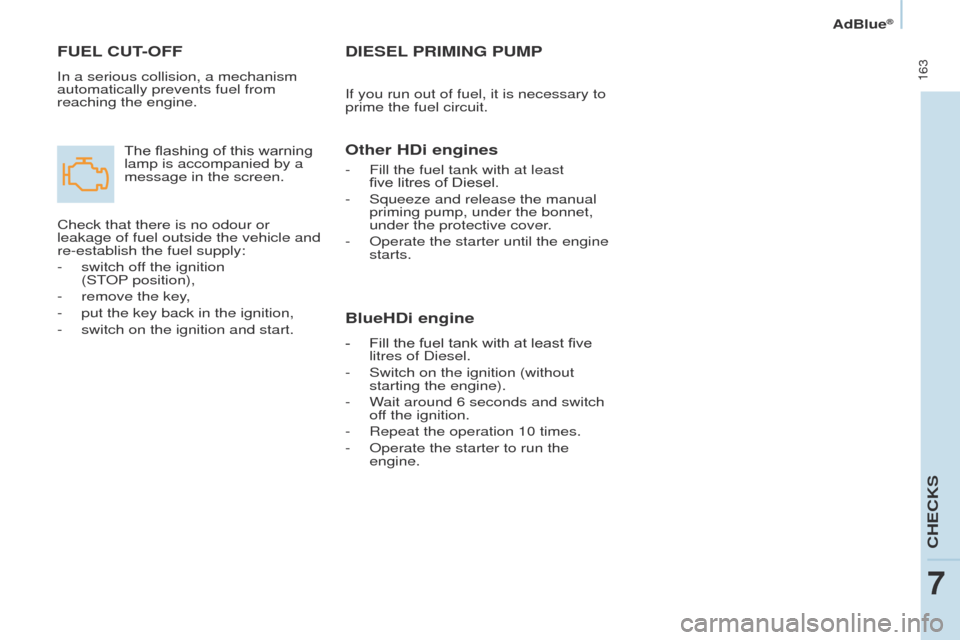
The flashing of this warning
lamp is accompanied by a
message in the screen.
Check that there is no odour or
leakage of fuel outside the vehicle and
re-establish the fuel supply:
-
switch of
f the ignition
(STOP
position),
-
remove the key
,
-
put the key back in the ignition,
-
switch on the ignition and start.
CHECKS
7
AdBlue®
Page 168 of 292
166
Partner2VP_en_Chap07_Verification_ed02-2016Partner2VP_en_Chap07_Verification_ed02-2016
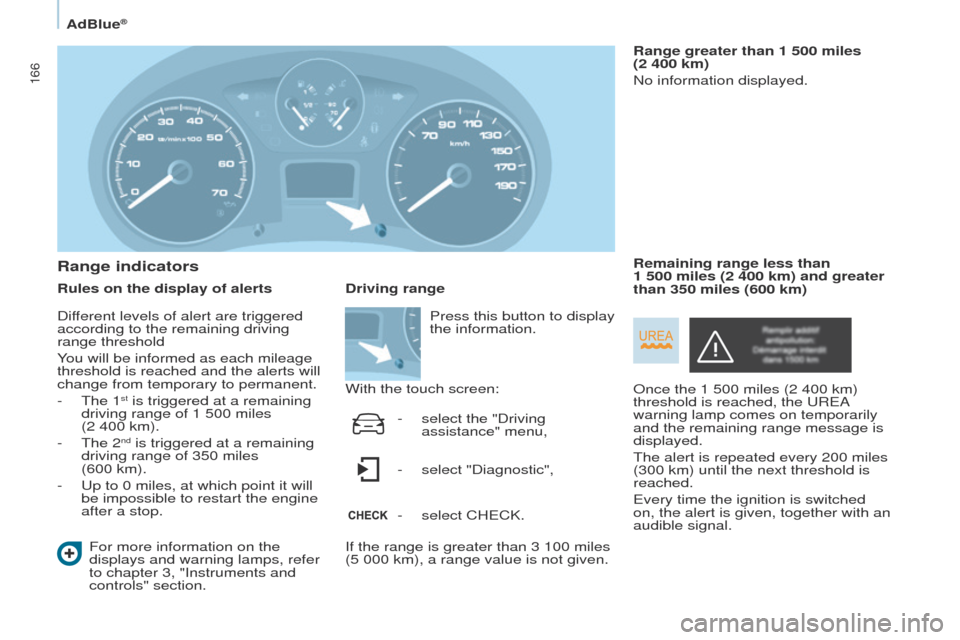
Range indicators
Rules on the display of alertsFor more information on the
displays and warning lamps, refer
to chapter 3, "Instruments and
controls" section. Range greater than 1 500 miles
(2 400 km)
No information displayed.
Once the 1 500 miles (2 400 km)
threshold is reached, the UREA
warning lamp comes on temporarily
and the remaining range message is
displayed.
The alert is repeated every 200 miles
(300 km) until the next threshold is
reached.
Every time the ignition is switched
on, the alert is given, together with an
audible signal. Remaining range less than
1
500 miles (2 400 km) and greater
than 350 miles (600 km)
Driving range
With the touch screen:
If the range is greater than 3 100 miles
(5 000 km), a range value is not given. Press this button to display
the information.
-
select the "Driving
assistance" menu,
-
select "Diagnostic",
-
select CHECK.
Dif
ferent levels of alert are triggered
according to the remaining driving
range threshold
You will be informed as each mileage
threshold is reached and the alerts will
change from temporary to permanent.
-
The 1st is triggered at a remaining
driving range of 1 500 miles
(2
400
km).
-
The 2nd is triggered at a remaining
driving range of 350 miles
(600
km).
-
Up to 0 miles, at which point it will
be impossible to restart the engine
after a stop.
AdBlue®
Page 172 of 292
170
Partner2VP_en_Chap08_Aide-rapide_ed02-2016
BATTERY
Before disconnecting the battery, you
must wait for 2 minutes after switching
off the ignition.
Never disconnect a terminal when the
engine is running.
Never charge a battery without first
disconnecting the terminals.
After every reconnection of the battery,
switch on the ignition and wait 1 minute
before starting to allow the electronic
systems to be initialised. If problems
remain after doing this, please contact
a PEUGEOT dealer or a qualified
workshop.
After changing bulbs, wait
approximately 3 minutes before
reconnecting the battery.
It is advisable to disconnect the
battery if the vehicle is not to be
used for a period of more than
one
month.
To charge the battery using
a battery charger
- Disconnect the battery .
-
Follow the instructions for use
given by the battery charger
manufacturer
.
-
Reconnect starting with the
negative (-) terminal.
-
Check that the terminals and
connectors are clean. If they are
covered with sulphate (white or
greenish deposit), disconnect them
and clean them.
To start the vehicle from
another battery
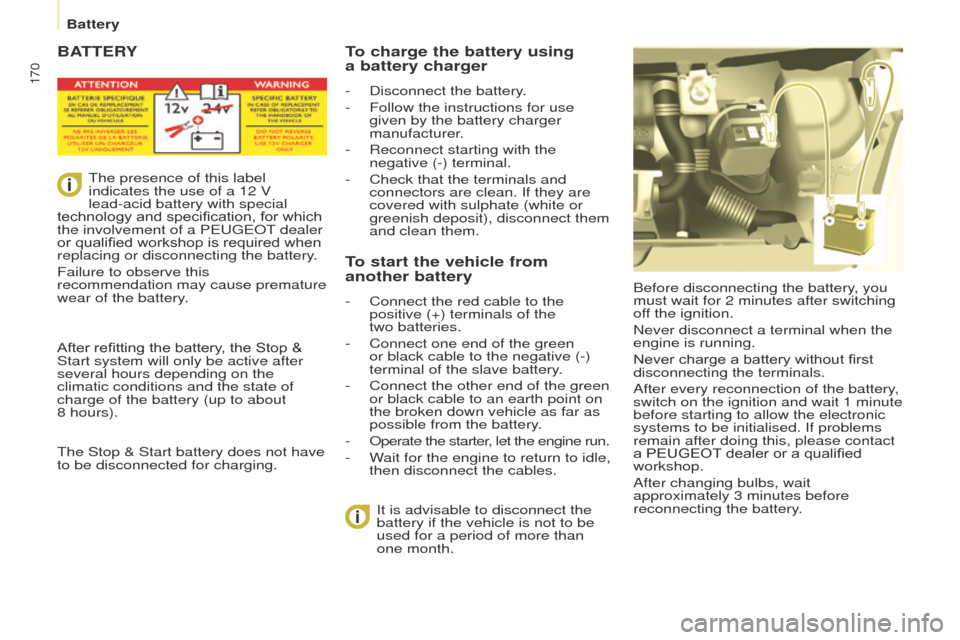
- Connect the red cable to the
positive (+) terminals of the
two batteries.
-
Connect one end of the green
or black cable to the negative (-)
terminal of the slave battery
.
-
Connect the other end of the green
or black cable to an earth point on
the broken down vehicle as far as
possible from the battery
.
-
Operate the starter
, let the engine run.
-
W
ait for the engine to return to idle,
then disconnect the cables.
The presence of this label
indicates the use of a 12 V
lead-acid battery with special
technology and specification, for which
the involvement of a PEUGEOT dealer
or qualified workshop is required when
replacing or disconnecting the battery.
Failure to observe this
recommendation may cause premature
wear of the battery.
After refitting the battery, the Stop
&
Start system will only be active after
several hours depending on the
climatic conditions and the state of
charge of the battery (up to about
8 hours).
The Stop & Start battery does not have
to be disconnected for charging.
Battery
Page 173 of 292
171
Partner2VP_en_Chap08_Aide-rapide_ed02-2016
ECONOMY MODE
After the engine has stopped, with
the key in the ignition position, certain
functions (windscreen wiper, electric
windows, courtesy lamps, audio
equipment, etc.) can only be used for a
cumulative duration of thirty minutes, to
prevent discharging of the battery.
Once the thirty minutes have elapsed,
the active functions are put on standby
and the battery warning lamp flashes
accompanied by a message in the
screen.
To resume the use of these functions
immediately, start the engine and let it
run for a few minutes.
The time available will then be double
the time for which the engine was left
running. However, this time will always
be between five and thirty minutes.
A flat battery will prevent the
engine from starting.
Battery
QUICK HELP
8
Page 201 of 292
199
Partner2VP_en_Chap09_Caract-technique_ed02-2016Partner2VP_en_Chap09_Caract-technique_ed02-2016
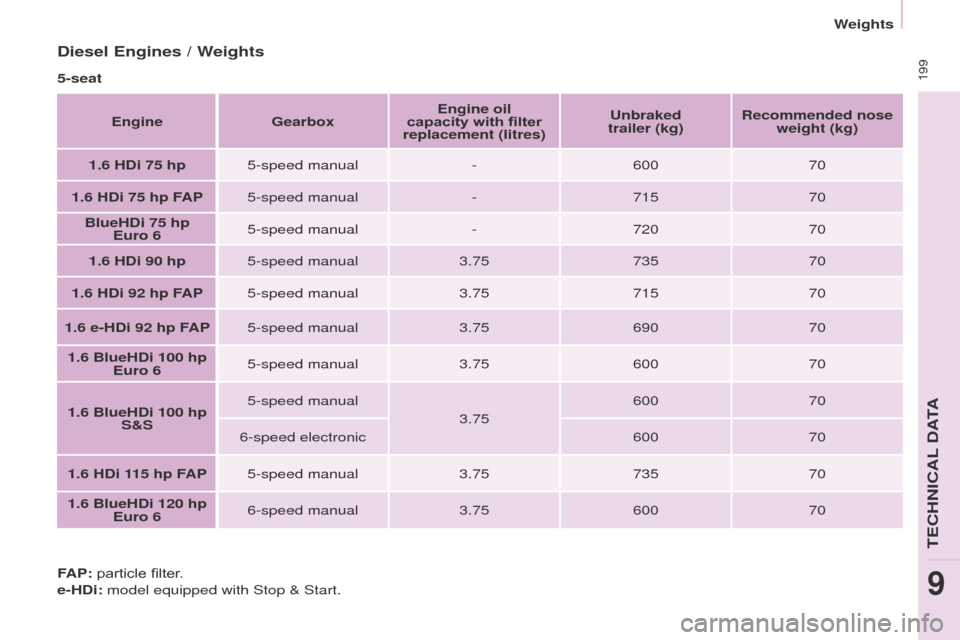
Diesel Engines / Weights
5-seatEngine Gearbox Engine oil
capacity with filter
replacement (litres) Unbraked
trailer (kg) Recommended nose
weight (kg)
1.6 HDi 75 hp 5-speed manual -600 70
1.6 HDi 75 hp FAP 5-speed manual -715 70
BlueHDi 75 hp Euro
65-speed manual
-720 70
1.6 HDi 90 hp 5-speed manual 3.75735 70
1.6 HDi 92 hp FAP 5-speed manual 3.75715 70
1.6 e-HDi 92 hp FAP 5-speed manual 3.75690 70
1.6 BlueHDi 100 hp Euro 6 5-speed manual
3.75600 70
1.6 BlueHDi 100 hp S&S 5-speed manual
3.75600
70
6-speed electronic 60070
1.6 HDi 115 hp FAP 5-speed manual 3.75735 70
1.6 BlueHDi 120 hp Euro 6 6-speed manual
3.75600 70
FAP: particle filter.
e-HDi: model equipped with Stop & Start.
TECHNICAL DATA
9
Weights
Page 202 of 292
200
Partner2VP_en_Chap09_Caract-technique_ed02-2016Partner2VP_en_Chap09_Caract-technique_ed02-2016
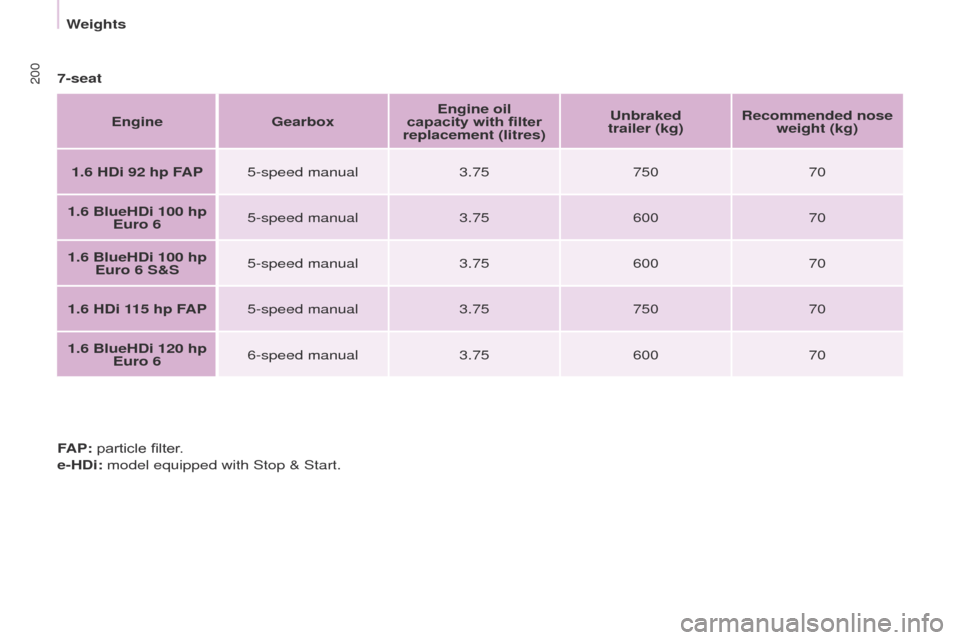
7-seatEngine Gearbox Engine oil
capacity with filter
replacement (litres) Unbraked
trailer (kg) Recommended nose
weight (kg)
1.6 HDi 92 hp FAP 5-speed manual 3.75750 70
1.6 BlueHDi 100 hp Euro 6 5-speed manual
3.75600 70
1.6 BlueHDi 100 hp Euro 6 S&S 5-speed manual
3.75600 70
1.6 HDi 115 hp FAP 5-speed manual 3.75750 70
1.6 BlueHDi 120 hp Euro 6 6-speed manual
3.75600 70
FAP: particle filter.
e-HDi: model equipped with Stop & Start.
Weights