tow Peugeot Partner Tepee 2017 Owner's Guide
[x] Cancel search | Manufacturer: PEUGEOT, Model Year: 2017, Model line: Partner Tepee, Model: Peugeot Partner Tepee 2017Pages: 292, PDF Size: 10.49 MB
Page 111 of 292
109
Partner2VP_en_Chap04_Ergonomie_ed02-2016Partner2VP_en_Chap04_Ergonomie_ed02-2016
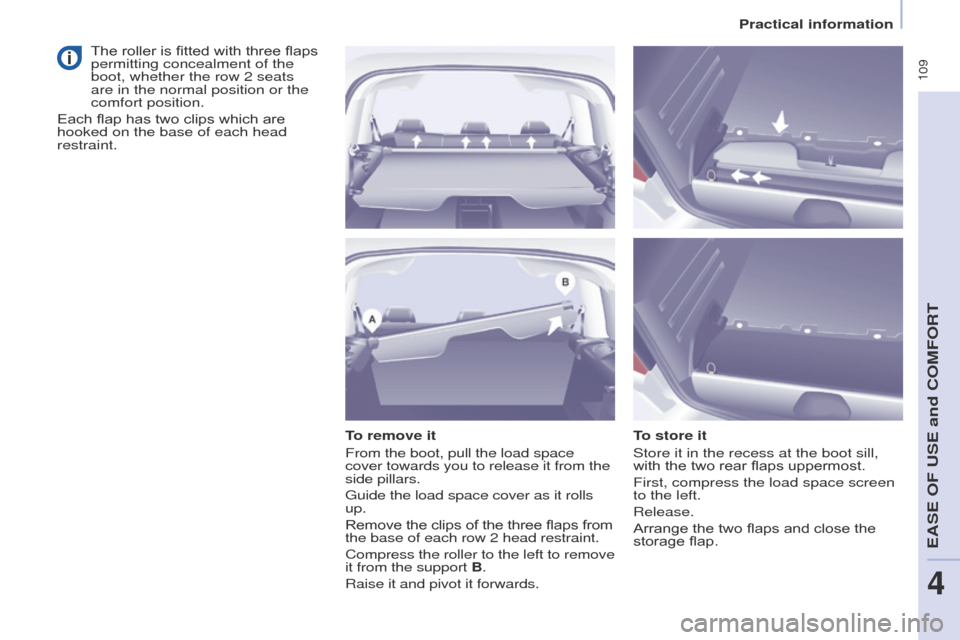
To remove it
From the boot, pull the load space
cover towards you to release it from the
side pillars.
Guide the load space cover as it rolls
up.
Remove the clips of the three flaps from
the base of each row 2 head restraint.
Compress the roller to the left to remove
it from the support B.
Raise it and pivot it forwards. To store it
Store it in the recess at the boot sill,
with the two rear flaps uppermost.
First, compress the load space screen
to the left.
Release.
Arrange the two flaps and close the
storage flap.
The roller is fitted with three flaps
permitting concealment of the
boot, whether the row 2 seats
are in the normal position or the
comfort position.
Each flap has two clips which are
hooked on the base of each head
restraint.
EASE OF USE and COMFORT
4
Practical information
Page 116 of 292
11 4
Partner2VP_en_Chap05_Securite_ed02-2016
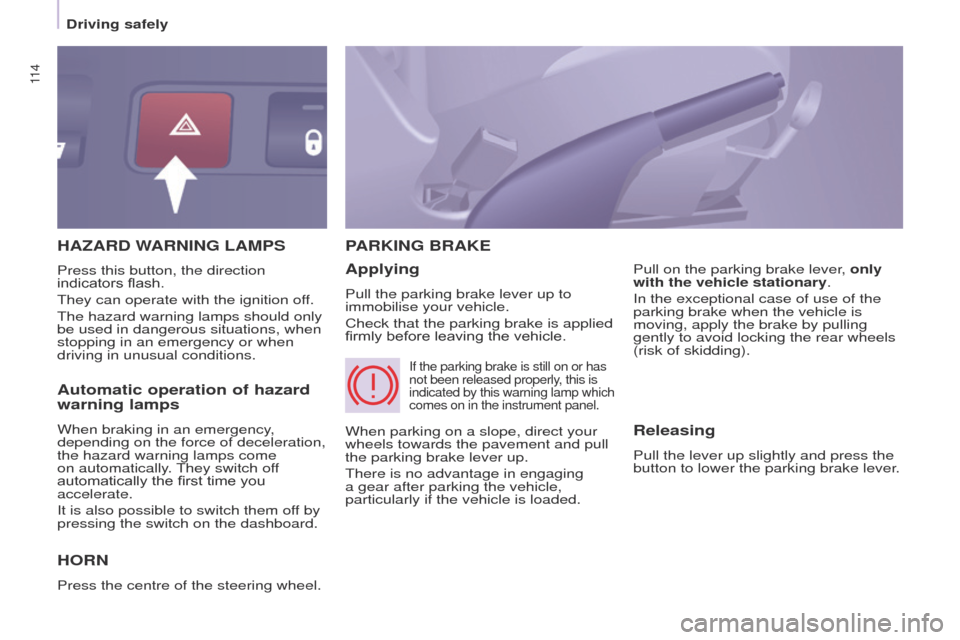
HAZARD WARNING LAMPS
H
ORN
Press the centre of the steering wheel.
PARKING BRAKE
Applying
Pull the parking brake lever up to
immobilise your vehicle.
Check that the parking brake is applied
firmly before leaving the vehicle. Pull on the parking brake lever, only
with the vehicle stationary.
In the exceptional case of use of the
parking brake when the vehicle is
moving, apply the brake by pulling
gently to avoid locking the rear wheels
(risk of skidding).
Press this button, the direction
indicators flash.
They can operate with the ignition off.
The hazard warning lamps should only
be used in dangerous situations, when
stopping in an emergency or when
driving in unusual conditions.
When parking on a slope, direct your
wheels towards the pavement and pull
the parking brake lever up.
There is no advantage in engaging
a gear after parking the vehicle,
particularly if the vehicle is loaded.
If the parking brake is still on or has
not been released properly, this is
indicated by this warning lamp which
comes on in the instrument panel.
Automatic operation of hazard
warning lamps
When braking in an emergency,
depending on the force of deceleration,
the hazard warning lamps come
on automatically. They switch off
automatically the first time you
accelerate.
It is also possible to switch them off by
pressing the switch on the dashboard.Releasing
Pull the lever up slightly and press the
button to lower the parking brake lever.
Driving safely
Page 118 of 292
11 6
Partner2VP_en_Chap05_Securite_ed02-2016
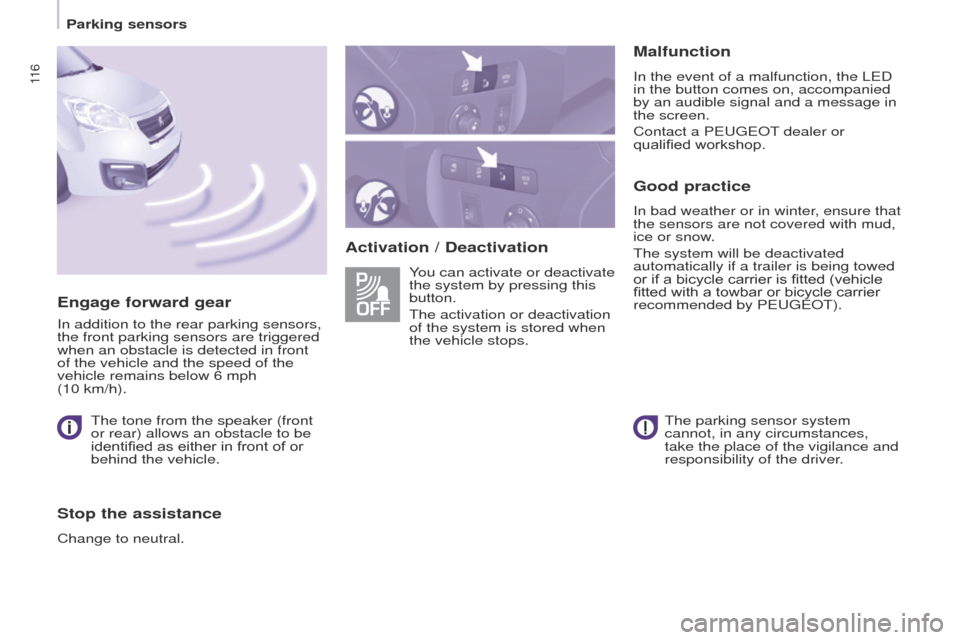
Activation / DeactivationMalfunction
In the event of a malfunction, the LED
in the button comes on, accompanied
by an audible signal and a message in
the screen.
Contact a PEUGEOT dealer or
qualified workshop.
Good practice
In bad weather or in winter, ensure that
the sensors are not covered with mud,
ice or snow.
The system will be deactivated
automatically if a trailer is being towed
or if a bicycle carrier is fitted (vehicle
fitted with a towbar or bicycle carrier
recommended by PEUGEOT).
You can activate or deactivate
the system by pressing this
button.
The activation or deactivation
of the system is stored when
the vehicle stops.
Engage forward gear
In addition to the rear parking sensors,
the front parking sensors are triggered
when an obstacle is detected in front
of the vehicle and the speed of the
vehicle remains below 6 mph
(10 km/h).
The tone from the speaker (front
or rear) allows an obstacle to be
identified as either in front of or
behind the vehicle.
Stop the assistance
Change to neutral. The parking sensor system
cannot, in any circumstances,
take the place of the vigilance and
responsibility of the driver.
Parking sensors
Page 127 of 292
125
Partner2VP_en_Chap05_Securite_ed02-2016
Operating faults
Sensor fault
The operation of the laser sensor may
suffer interference from accumulations
of dirt or misting of the windscreen.
In this case you are warned by the
display of a message.
Use the windscreen demisting
and regularly clean the area of the
windscreen in front of the sensor.Do not stick or otherwise fix any
object on the windscreen in front
of the sensor. System fault
In the event of a malfunction of the
system, you are warned by an audible
signal and the display of the message
"Automatic braking system fault".
Have the system checked by a
PEUGEOT dealer or a qualified
workshop.
In the event of an impact to
the windscreen at the sensor,
deactivate the system and contact
a PEUGEOT dealer or a qualified
workshop
to
have your windscreen
replaced.
Never try to remove, adjust or test
the sensor.
Only a PEUGEOT dealer or a
qualified workshop is able to work
on the system.
When towing a trailer or when the
vehicle is being towed, the system
must be deactivated.
Driving safely
SAFETY
5
Page 130 of 292
128
Partner2VP_en_Chap05_Securite_ed02-2016
128
Partner2VP_en_Chap05_Securite_ed02-2016
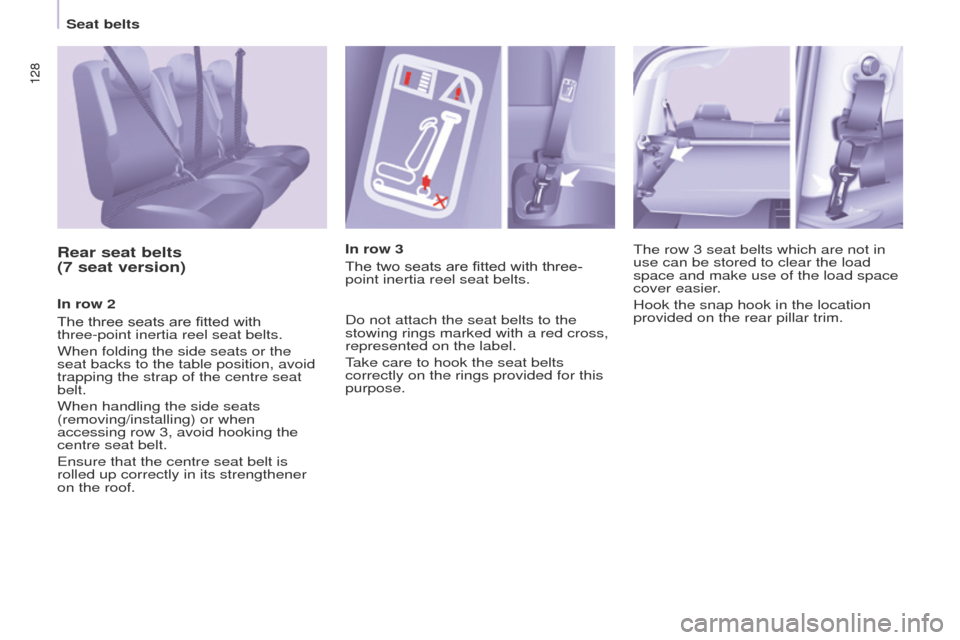
Rear seat belts
(7 seat version)
In row 2
The three seats are fitted with
three-point inertia reel seat belts.
When folding the side seats or the
seat backs to the table position, avoid
trapping the strap of the centre seat
belt.
When handling the side seats
(removing/installing) or when
accessing row 3, avoid hooking the
centre seat belt.
Ensure that the centre seat belt is
rolled up correctly in its strengthener
on the roof.In row 3
The two seats are fitted with three-
point inertia reel seat belts.
Do not attach the seat belts to the
stowing rings marked with a red cross,
represented on the label.
Take care to hook the seat belts
correctly on the rings provided for this
purpose.
The row 3 seat belts which are not in
use can be stored to clear the load
space and make use of the load space
cover easier.
Hook the snap hook in the location
provided on the rear pillar trim.
Seat belts
Page 131 of 292
129
Partner2VP_en_Chap05_Securite_ed02-2016
129
Partner2VP_en_Chap05_Securite_ed02-2016
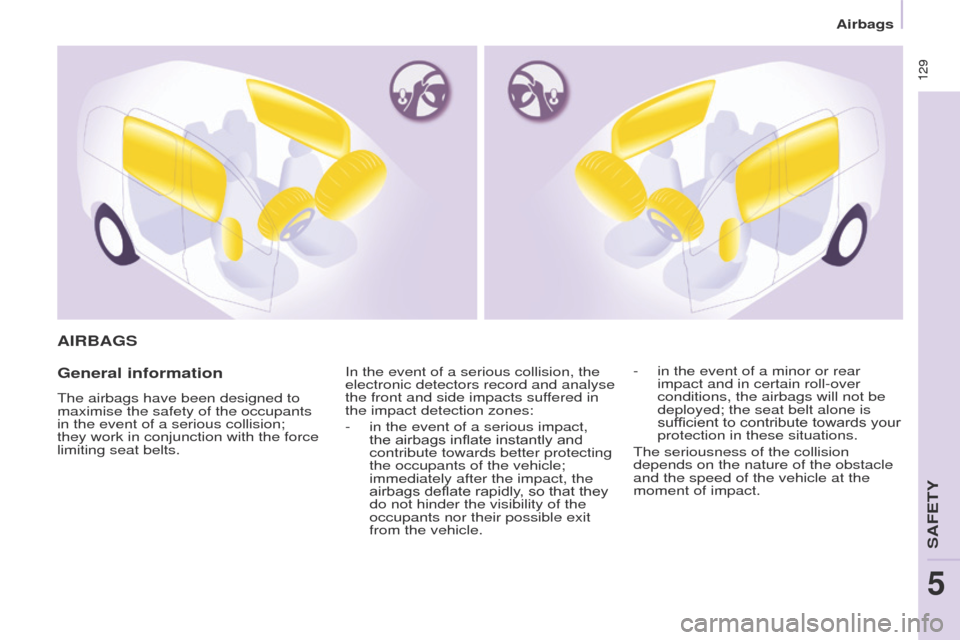
AIRBAGS
General information
The airbags have been designed to
maximise the safety of the occupants
in the event of a serious collision;
they work in conjunction with the force
limiting seat belts.In the event of a serious collision, the
electronic detectors record and analyse
the front and side impacts suffered in
the impact detection zones:
-
in the event of a serious impact,
the airbags inflate instantly and
contribute towards better protecting
the occupants of the vehicle;
immediately after the impact, the
airbags deflate rapidly
, so that they
do not hinder the visibility of the
occupants nor their possible exit
from the vehicle. -
in the event of a minor or rear
impact and in certain roll-over
conditions, the airbags will not be
deployed; the seat belt alone is
sufficient to contribute towards your
protection in these situations.
The seriousness of the collision
depends on the nature of the obstacle
and the speed of the vehicle at the
moment of impact.
SAFETY
5
Airbags
Page 133 of 292
131
Partner2VP_en_Chap05_Securite_ed02-2016
131
Partner2VP_en_Chap05_Securite_ed02-2016
Curtain airbags
This is a system which protects the
driver and passengers (with the
exception of the centre seat of row 2)
in the event of a serious side impact in
order to limit the risk of head injuries.
Each curtain airbag is incorporated in
the pillars and the upper part of the
passenger compartment.
Activation
It is triggered at the same time as the
corresponding lateral airbag in the
event of a serious side impact applied
to all or part of the side impact zone B,
perpendicular to the longitudinal
centreline of the vehicle on a horizontal
plane and directed from the outside
towards the inside of the vehicle.
The curtain airbag inflates between the
front or rear occupant of the vehicle
and the windows.
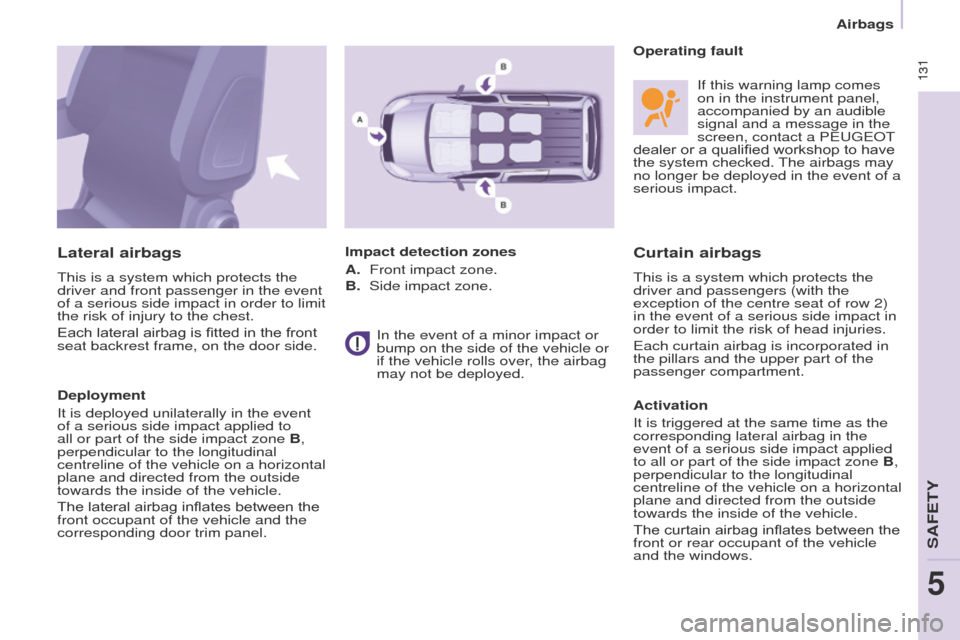
Lateral airbags
This is a system which protects the
driver and front passenger in the event
of a serious side impact in order to limit
the risk of injury to the chest.
Each lateral airbag is fitted in the front
seat backrest frame, on the door side.
Deployment
It is deployed unilaterally in the event
of a serious side impact applied to
all or part of the side impact zone
B,
perpendicular to the longitudinal
centreline of the vehicle on a horizontal
plane and directed from the outside
towards the inside of the vehicle.
The lateral airbag inflates between the
front occupant of the vehicle and the
corresponding door trim panel. Impact detection zones
A.
Front impact zone.
B. Side impact zone.Operating fault
If this warning lamp comes
on in the instrument panel,
accompanied by an audible
signal and a message in the
screen, contact a PEUGEOT
dealer or a qualified workshop to have
the system checked. The airbags may
no longer be deployed in the event of a
serious impact.
In the event of a minor impact or
bump on the side of the vehicle or
if the vehicle rolls over, the airbag
may not be deployed.
SAFETY
5
Airbags
Page 134 of 292
132
Partner2VP_en_Chap05_Securite_ed02-2016
132
Partner2VP_en_Chap05_Securite_ed02-2016
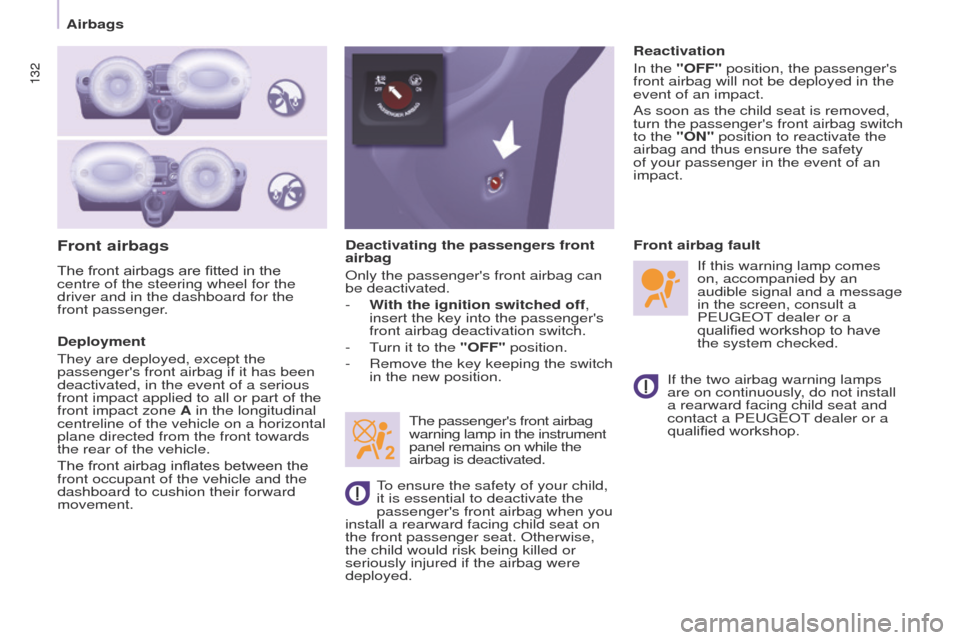
Front airbags
Deployment
They are deployed, except the
passenger's front airbag if it has been
deactivated, in the event of a serious
front impact applied to all or part of the
front impact zone A in the longitudinal
centreline of the vehicle on a horizontal
plane directed from the front towards
the rear of the vehicle.
The front airbag inflates between the
front occupant of the vehicle and the
dashboard to cushion their forward
movement.Deactivating the passengers front
airbag
Only the passenger's front airbag can
be deactivated.
-
W
ith the ignition switched off,
insert the key into the passenger's
front airbag deactivation switch.
- T urn it to the "OFF" position.
-
Remove the key keeping the switch
in the new position.
The passenger's front airbag
warning lamp in the instrument
panel remains on while the
airbag is deactivated. If the two airbag warning lamps
are on continuously, do not install
a rearward facing child seat and
contact a PEUGEOT dealer or a
qualified workshop.
Front airbag fault
To ensure the safety of your child,
it is essential to deactivate the
passenger's front airbag when you
install a rearward facing child seat on
the front passenger seat. Otherwise,
the child would risk being killed or
seriously injured if the airbag were
deployed. Reactivation
In the "OFF" position, the passenger's
front airbag will not be deployed in the
event of an impact.
As soon as the child seat is removed,
turn the passenger's front airbag switch
to the "ON" position to reactivate the
airbag and thus ensure the safety
of your passenger in the event of an
impact.
If this warning lamp comes
on, accompanied by an
audible signal and a message
in the screen, consult a
PEUGEOT dealer or a
qualified workshop to have
the system checked.
The front airbags are fitted in the
centre of the steering wheel for the
driver and in the dashboard for the
front passenger.
Airbags
Page 144 of 292
142
Partner2VP_en_Chap05_Securite_ed02-2016
142
Partner2VP_en_Chap05_Securite_ed02-2016
(a) Universal child seat: child seat
that can be installed in any vehicle
using the seat belt.
(b)
Group 0: from birth to 10 kg.
Cots and baby carriers cannot be
installed on the front passenger
seat or in row 3. When installed in
row 2, they may prevent the use of
one or more seat in this row
.
(c)
Refer to the legislation in force in
your country before installin
g your
child on this seat.
(d)
When a rearward facing child seat
is installed on a
front passenger
seat, the passenger's front airbag
must be deactivated. Otherwise,
the child would risk being
seriously injured or killed if the
airbag is deployed.
When a forward facing child seat
is installed on a
front passenger
seat, the passenger's front airbag
must remain active. Remove and stow the heads
restraint, before installing a child
seat with backrest on a passenger
seat.
Refit the head restraint once the child
seat has been removed.
(e)
When a child seat is installed at
the rear
, forward facing or rearward
facing, move the vehicle's seats
in the row in front forwards and
straighten their backrests to leave
enough space for the child seat or
the child's legs.
(f)
Put the backrests of the outer and
centre seats in row 2, located in
front of seat occupied by a child
seat, in the table position, or if this
is not sufficient, remove the seats in
row 2, so that the child seat or the
child's legs do not touch the seats in
row 2.
(g)
If the seats in row 3 are occupied,
do not leave a child seat installed
on the foldable row 2 seat, to allow
easy access to row 3.
Child safety
Page 145 of 292
143
Partner2VP_en_Chap05_Securite_ed02-2016
143
Partner2VP_en_Chap05_Securite_ed02-2016
ISOFIx MOUNTINGS
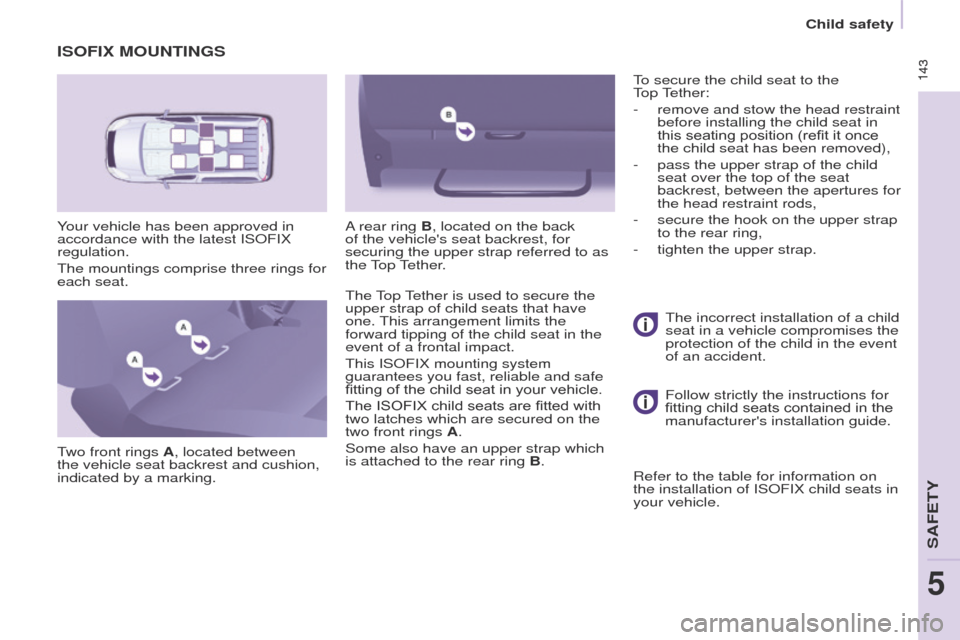
Your vehicle has been approved in
accordance with the latest ISOFIX
regulation.
The mountings comprise three rings for
each seat.
Two front rings A, located between
the vehicle seat backrest and cushion,
indicated by a marking.A rear ring B, located on the back
of the vehicle's seat backrest, for
securing the upper strap referred to as
the Top Tether.
The Top Tether is used to secure the
upper strap of child seats that have
one. This arrangement limits the
forward tipping of the child seat in the
event of a frontal impact.
This ISOFIX mounting system
guarantees you fast, reliable and safe
fitting of the child seat in your vehicle.
The ISOFIX child seats are fitted with
two latches which are secured on the
two front rings A.
Some also have an upper strap which
is attached to the rear ring B. Follow strictly the instructions for
fitting child seats contained in the
manufacturer's installation guide.
To secure the child seat to the
Top Tether:
-
remove and stow the head restraint
before installin
g the child seat in
this seating position (refit it once
the child seat has been removed),
-
pass the upper strap of the child
seat over the top of the seat
backrest, between the apertures for
the head restraint rods,
-
secure the hook on the upper strap
to the rear ring,
-
tighten the upper strap.
The incorrect installation of a child
seat in a vehicle compromises the
protection of the child in the event
of an accident.
Refer to the table for information on
the installation of ISOFIX child seats in
your vehicle.
SAFETY
5
Child safety