ignition Peugeot Partner Tepee 2017 Owner's Guide
[x] Cancel search | Manufacturer: PEUGEOT, Model Year: 2017, Model line: Partner Tepee, Model: Peugeot Partner Tepee 2017Pages: 292, PDF Size: 10.49 MB
Page 112 of 292
11 0
Partner2VP_en_Chap04_Ergonomie_ed02-2016Partner2VP_en_Chap04_Ergonomie_ed02-2016
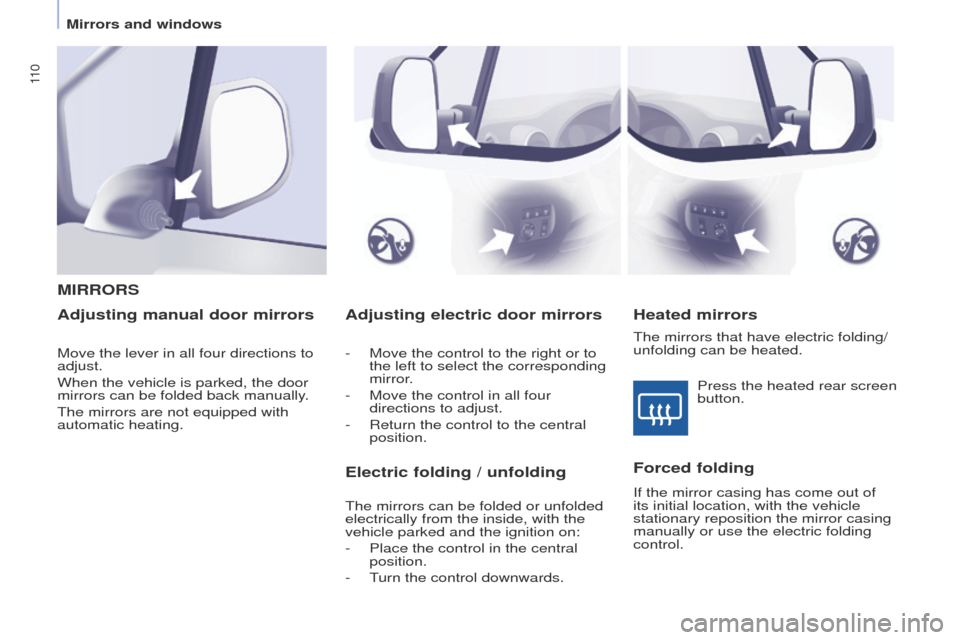
Adjusting electric door mirrors
- Move the control to the right or to
the left to select the corresponding
mirror.
-
Move the control in all four
directions to adjust.
-
Return the control to the central
position.
MIRRORS
Heated mirrors
Adjusting manual door mirrors
Forced folding
If the mirror casing has come out of
its initial location, with the vehicle
stationary reposition the mirror casing
manually or use the electric folding
control.Press the heated rear screen
button.
Move the lever in all four directions to
adjust.
When the vehicle is parked, the door
mirrors can be folded back manually.
The mirrors are not equipped with
automatic heating.
Electric folding / unfolding
The mirrors can be folded or unfolded
electrically from the inside, with the
vehicle parked and the ignition on:
-
Place the control in the central
position.
-
T
urn the control downwards. The mirrors that have electric folding/
unfolding can be heated.
Mirrors and windows
Page 114 of 292
11 2
Partner2VP_en_Chap04_Ergonomie_ed02-2016Partner2VP_en_Chap04_Ergonomie_ed02-2016
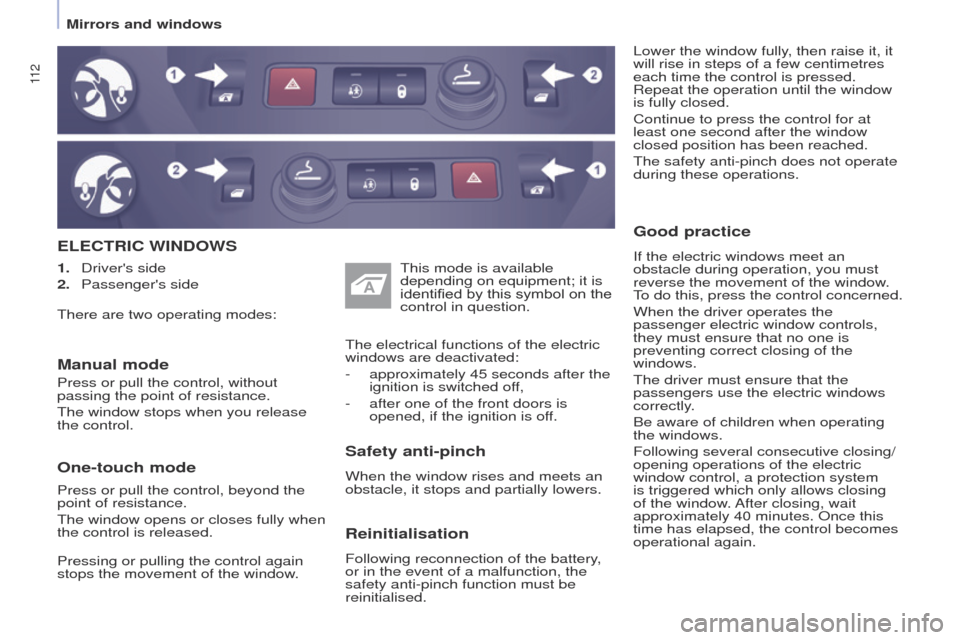
ELECTRIC WINDOWS
Lower the window fully, then raise it, it
will rise in steps of a few centimetres
each time the control is pressed.
Repeat the operation until the window
is fully closed.
Continue to press the control for at
least one second after the window
closed position has been reached.
The safety anti-pinch does not operate
during these operations.
Safety anti-pinch
When the window rises and meets an
obstacle, it stops and partially lowers.
Manual mode
This mode is available
depending on equipment; it is
identified by this symbol on the
control in question.
Good practice
If the electric windows meet an
obstacle during operation, you must
reverse the movement of the window.
To do this, press the control concerned.
When the driver operates the
passenger electric window controls,
they must ensure that no one is
preventing correct closing of the
windows.
The driver must ensure that the
passengers use the electric windows
correctly.
Be aware of children when operating
the windows.
Following several consecutive closing/
opening operations of the electric
window control, a protection system
is triggered which only allows closing
of the window. After closing, wait
approximately 40 minutes. Once this
time has elapsed, the control becomes
operational again.
1.
Driver's side
2.
Passenger's side
Reinitialisation
Following reconnection of the battery,
or in the event of a malfunction, the
safety anti-pinch function must be
reinitialised. The electrical functions of the electric
windows are deactivated:
-
approximately 45 seconds after the
ignition is switched of
f,
-
after one of the front doors is
opened, if the ignition is of
f.
There are two operating modes:
Press or pull the control, without
passing the point of resistance.
The window stops when you release
the control.
One-touch mode
Press or pull the control, beyond the
point of resistance.
The window opens or closes fully when
the control is released.
Pressing or pulling the control again
stops the movement of the window.
Mirrors and windows
Page 116 of 292
11 4
Partner2VP_en_Chap05_Securite_ed02-2016
HAZARD WARNING LAMPS
H
ORN
Press the centre of the steering wheel.
PARKING BRAKE
Applying
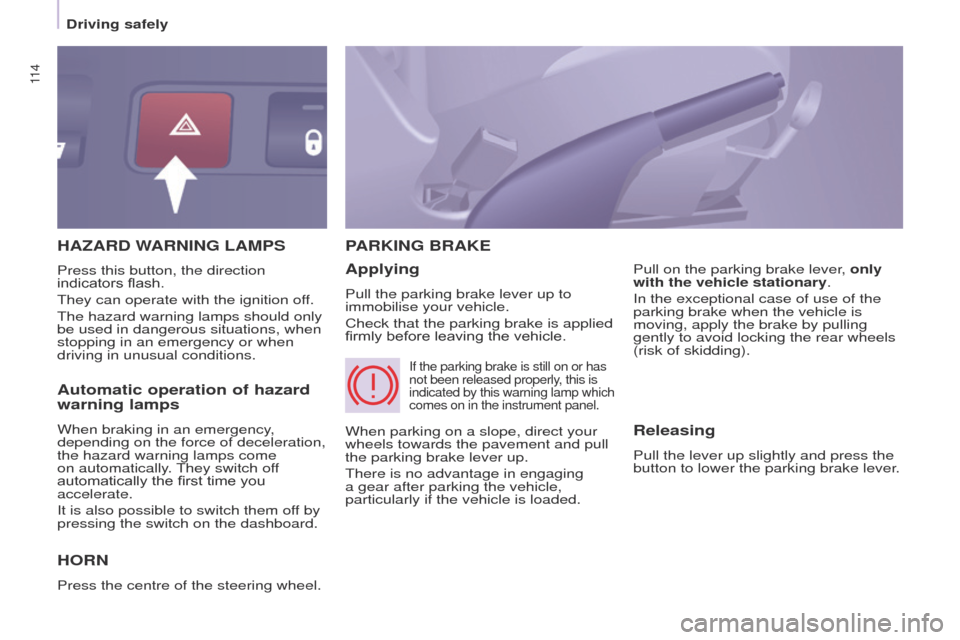
Pull the parking brake lever up to
immobilise your vehicle.
Check that the parking brake is applied
firmly before leaving the vehicle. Pull on the parking brake lever, only
with the vehicle stationary.
In the exceptional case of use of the
parking brake when the vehicle is
moving, apply the brake by pulling
gently to avoid locking the rear wheels
(risk of skidding).
Press this button, the direction
indicators flash.
They can operate with the ignition off.
The hazard warning lamps should only
be used in dangerous situations, when
stopping in an emergency or when
driving in unusual conditions.
When parking on a slope, direct your
wheels towards the pavement and pull
the parking brake lever up.
There is no advantage in engaging
a gear after parking the vehicle,
particularly if the vehicle is loaded.
If the parking brake is still on or has
not been released properly, this is
indicated by this warning lamp which
comes on in the instrument panel.
Automatic operation of hazard
warning lamps
When braking in an emergency,
depending on the force of deceleration,
the hazard warning lamps come
on automatically. They switch off
automatically the first time you
accelerate.
It is also possible to switch them off by
pressing the switch on the dashboard.Releasing
Pull the lever up slightly and press the
button to lower the parking brake lever.
Driving safely
Page 123 of 292
121
Partner2VP_en_Chap05_Securite_ed02-2016
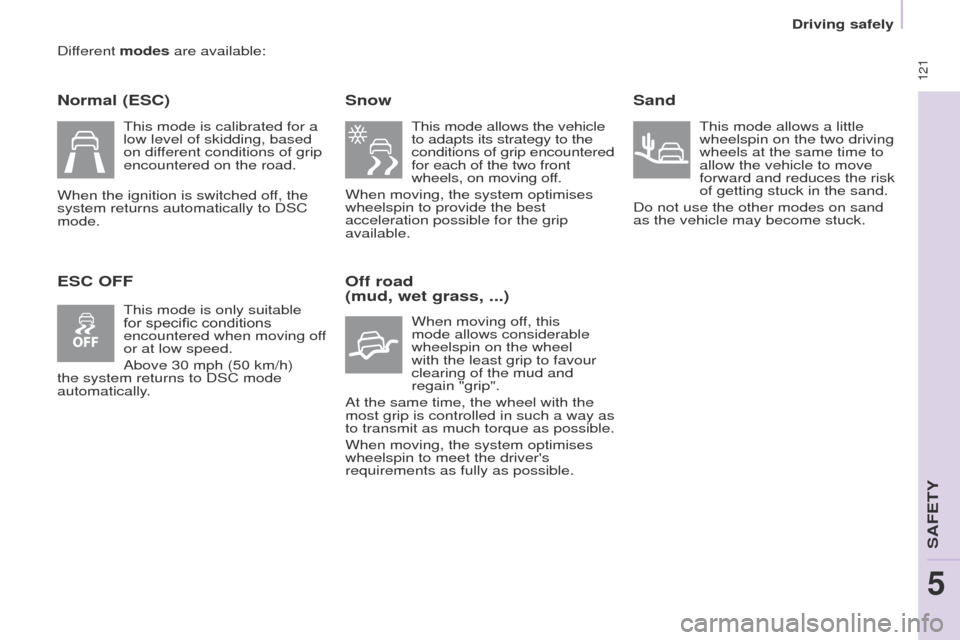
Different modes are available:
Normal (ESC)
ESC OFFSnow
This mode allows the vehicle
to adapts its strategy to the
conditions of grip encountered
for each of the two
front
wheels, on moving off.
When moving, the system optimises
wheelspin to provide the best
acceleration possible for the grip
available.
Off road
(mud, wet grass, ...)
When moving off, this
mode allows considerable
wheelspin on the wheel
with the least grip to favour
clearing of the mud and
regain "grip".
At the same time, the wheel with the
most grip is controlled in such a way as
to transmit as much torque as possible.
When moving, the system optimises
wheelspin to meet the driver's
requirements as fully as possible.
Sand
This mode allows a little
wheelspin on the two driving
wheels at the same time to
allow the vehicle to move
forward and reduces the risk
of getting stuck in the sand.
Do not use the other modes on sand
as the vehicle may become stuck.
This mode is calibrated for a
low level of skidding, based
on different conditions of grip
encountered on the road.
When the ignition is switched off, the
system returns automatically to DSC
mode.
This mode is only suitable
for specific conditions
encountered when moving off
or at low speed.
Above 30 mph (50 km/h)
the system returns to DSC mode
automatically.
Driving safely
SAFETY
5
Page 124 of 292
122
Partner2VP_en_Chap05_Securite_ed02-2016
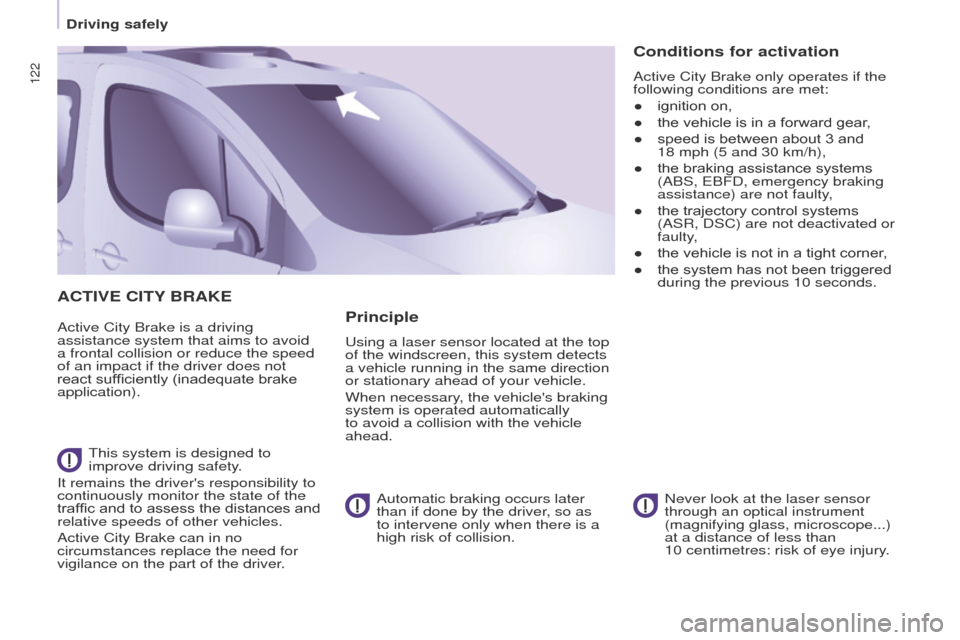
ACTIVE CITY BRAKE
Active City Brake is a driving
assistance system that aims to avoid
a frontal collision or reduce the speed
of an impact if the driver does not
react sufficiently (inadequate brake
application).
This system is designed to
improve driving safety.
It remains the driver's responsibility to
continuously monitor the state of the
traffic and to assess the distances and
relative speeds of other vehicles.
Active City Brake can in no
circumstances replace the need for
vigilance on the part of the driver. Never look at the laser sensor
through an optical instrument
(magnifying glass, microscope...)
at a distance of less than
10
centimetres: risk of eye injury.Principle
Using a laser sensor located at the top
of the windscreen, this system detects
a vehicle running in the same direction
or stationary ahead of your vehicle.
When necessary, the vehicle's braking
system is operated automatically
to avoid a collision with the vehicle
ahead.Automatic braking occurs later
than if done by the driver, so as
to intervene only when there is a
high risk of collision.
Conditions for activation
Active City Brake only operates if the
following conditions are met:
●
ignition on,
●
the vehicle is in a forward gear
,
●
speed is between about 3 and
18
mph (5 and 30 km/h),
●
the braking assistance systems
(ABS, EBFD, emergency braking
assistance) are not faulty
,
●
the trajectory control systems
(ASR, DSC) are not deactivated or
faulty
,
●
the vehicle is not in a tight corner
,
●
the system has not been triggered
during the previous 10 seconds.
Driving safely
Page 126 of 292
124
Partner2VP_en_Chap05_Securite_ed02-2016
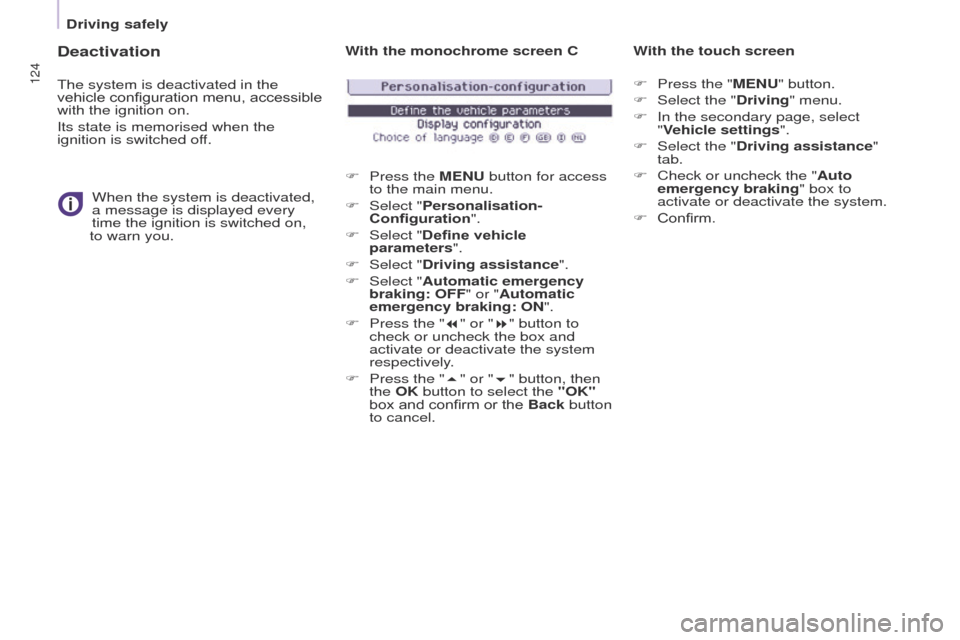
Deactivation
The system is deactivated in the
vehicle configuration menu, accessible
with the ignition on.
Its state is memorised when the
ignition is switched off.When the system is deactivated,
a message is displayed every
time the ignition is switched on,
to
warn you. With the monochrome screen C
F
Press the
MENU button for access
to the main menu.
F
Select "
Personalisation-
Configuration".
F
Select "
Define vehicle
parameters".
F
Select "
Driving assistance".
F
Select "
Automatic emergency
braking: OFF" or "Automatic
emergency braking: ON".
F
Press the "
7" or "8" button to
check or uncheck the box and
activate or deactivate the system
respectively.
F
Press the "
5" or "6" button, then
the OK button to select the "OK"
box and confirm or the Back button
to cancel. With the touch screen
F
Press the " MENU" button.
F Select the " Driving" menu.
F
In the secondary page, select
"
Vehicle settings".
F
Select the "
Driving assistance"
tab.
F
Check or uncheck the "
Auto
emergency braking" box to
activate or deactivate the system.
F
Confirm.
Driving safely
Page 129 of 292
127
Partner2VP_en_Chap05_Securite_ed02-2016Partner2VP_en_Chap05_Securite_ed02-2016
Recommendations for children:
-
use a suitable child seat if the
passenger is less than 12 years old
or shorter than one metre fifty
,
-
never allow a child to travel on
your lap, even with the seat belt
fastened. For more information on child
seats, refer to the "Child safety"
section of chapter 5.
Clean the seat belt straps with
soapy water or a textile cleaning
product, sold by PEUGEOT
dealers.
In accordance with current safety
regulations, your PEUGEOT dealer
can guarantee all work or any checks,
from testing to maintenance, on your
seat belt equipment.
Have the seat belts checked regularly
(even after a minor impact) by a
PEUGEOT dealer or a qualified
workshop: they must not show any
signs of wear, cutting or fraying
and they must not be converted or
modified.
The force limiter reduces the pressure
of the seat belt against the body of the
occupants.
The pretensioning seat belts are active
when the ignition is switched on.
The inertia reels are fitted with a device
which automatically locks the strap in
the event of a collision or emergency
braking or if the vehicle rolls over.
You can unfasten the seat belt by
pressing the red button on the buckle.
Guide the seat belt after unfastening.
The airbag warning lamp comes on
if the pretensioners are deployed.
Contact a PEUGEOT dealer or a
qualified workshop.
In order to be effective, a seat belt:
-
must restrain one person only
,
-
must not be twisted, check by
pullin
g in front of you with an even
movement,
-
must be tightened as close to the
body as possible.
The upper part of the seat belt should
be positioned in the hollow of the
shoulder
.
The lap part should be placed as low
as possible on the pelvis.
Do not interchange the seat belt
buckles as they will not fulfil their role
properly. If the seats are fitted with
armrests, the lap part of the seat belt
should always pass under the armrest.
Check that the seat belt is fastened
correctly by pulling the strap firmly.Front seat belts
The front seats are fitted with
pretensioners and force limiters.
Rear seat belts
(5 seat version)
The rear seats are fitted with
three-point inertia reel seat belts.
SAFETY
5
Seat belts
Page 132 of 292
130
Partner2VP_en_Chap05_Securite_ed02-2016
130
Partner2VP_en_Chap05_Securite_ed02-2016
Advice
Sit in a normal upright position.
Wear a correctly adjusted seat belt.
Do not allow anything to come between
the occupants and the airbags
(a child, pet, object...), do not attach or
fix anything near to the airbags or their
trajectories when inflating as this could
cause injuries when the airbags are
deployed.
Never modify the original definition of
your vehicle, particularly in the area
directly around the airbags.
After an accident or if the vehicle has
been stolen or broken into, have the
airbag systems checked.
All work on the airbag system must be
carried out by a PEUGEOT dealer or a
qualified workshop.
Even if all of the precautions
mentioned are observed, a risk of
injury or of minor burns to the head,
chest or arms when an airbag is
deployed cannot be ruled out. The bag
inflates almost instantly (within a few
milliseconds) then deflates within the
same time discharging the hot gas via
openings provided for this purpose.Front airbags
Do not drive holding the steering wheel
by its spokes or resting your hands on
the centre part of the wheel.
Passengers must not place their feet
on the dashboard.
Do not smoke as deployment of the
airbags can cause burns or the risk of
injury from a cigarette or pipe.
Never remove or pierce the steering
wheel or hit it violently.
Do not fit or attach anything to the
steering wheel or dashboard, this could
cause injuries with deployment of the
airbags.
Lateral airbags
Use only approved covers on the
seats, compatible with the deployment
the lateral airbags. For information
on the range of seat covers suitable
for your vehicle, you can contact a
PEUGEOT
dealer.
For more information on accessories,
refer to "Other accessories" in section 6.
Do not fix or attach anything to the seat
backs (clothing...). This could cause
injury to the chest or arms if the lateral
airbag is deployed.
Do not sit with the upper part of the
body any nearer to the door than
necessary.
Airbags only operate when the
ignition is switched on.
This equipment only operates once.
If a second impact occurs (during the
same or a subsequent accident), the
airbag will not operate.
The deployment of an airbag or airbags
is accompanied by a slight discharge
of smoke and a noise, due to the
activation of the pyrotechnic cartridge
incorporated in the system.
This smoke is not harmful, but
sensitive individuals may experience
some irritation.
The noise of the detonation may result
in a slight loss of hearing for a short
time.
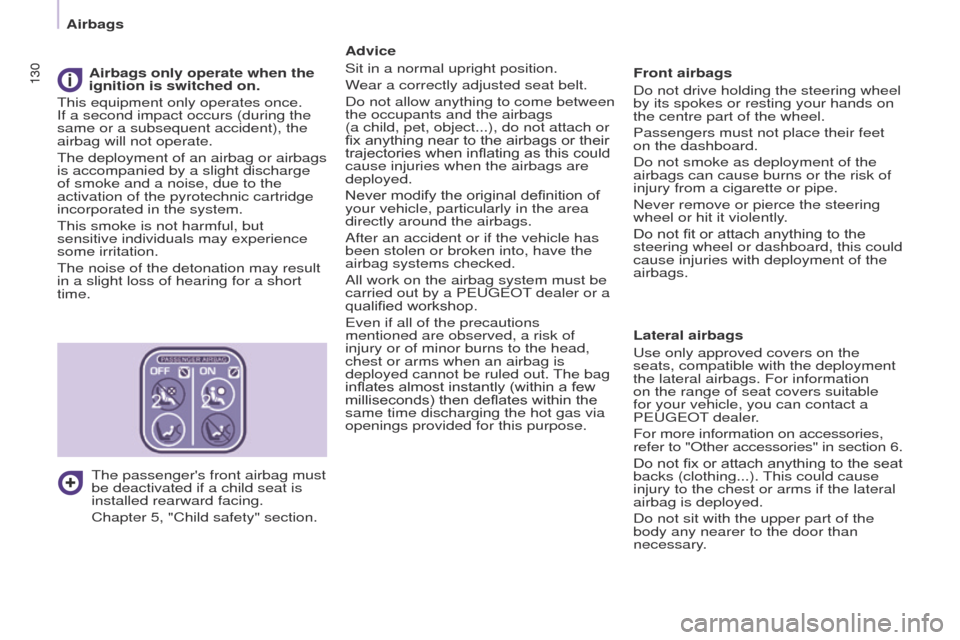
The passenger's front airbag must
be deactivated if a child seat is
installed rearward facing.
Chapter 5, "Child safety" section.
Airbags
Page 134 of 292
132
Partner2VP_en_Chap05_Securite_ed02-2016
132
Partner2VP_en_Chap05_Securite_ed02-2016
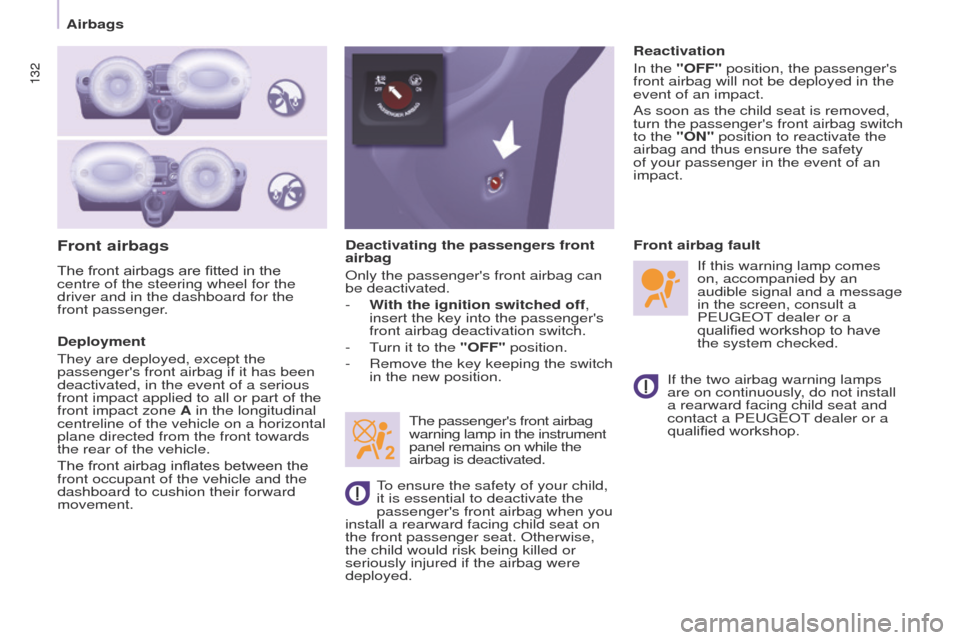
Front airbags
Deployment
They are deployed, except the
passenger's front airbag if it has been
deactivated, in the event of a serious
front impact applied to all or part of the
front impact zone A in the longitudinal
centreline of the vehicle on a horizontal
plane directed from the front towards
the rear of the vehicle.
The front airbag inflates between the
front occupant of the vehicle and the
dashboard to cushion their forward
movement.Deactivating the passengers front
airbag
Only the passenger's front airbag can
be deactivated.
-
W
ith the ignition switched off,
insert the key into the passenger's
front airbag deactivation switch.
- T urn it to the "OFF" position.
-
Remove the key keeping the switch
in the new position.
The passenger's front airbag
warning lamp in the instrument
panel remains on while the
airbag is deactivated. If the two airbag warning lamps
are on continuously, do not install
a rearward facing child seat and
contact a PEUGEOT dealer or a
qualified workshop.
Front airbag fault
To ensure the safety of your child,
it is essential to deactivate the
passenger's front airbag when you
install a rearward facing child seat on
the front passenger seat. Otherwise,
the child would risk being killed or
seriously injured if the airbag were
deployed. Reactivation
In the "OFF" position, the passenger's
front airbag will not be deployed in the
event of an impact.
As soon as the child seat is removed,
turn the passenger's front airbag switch
to the "ON" position to reactivate the
airbag and thus ensure the safety
of your passenger in the event of an
impact.
If this warning lamp comes
on, accompanied by an
audible signal and a message
in the screen, consult a
PEUGEOT dealer or a
qualified workshop to have
the system checked.
The front airbags are fitted in the
centre of the steering wheel for the
driver and in the dashboard for the
front passenger.
Airbags
Page 149 of 292
147
Partner2VP_en_Chap05_Securite_ed02-2016
147
Partner2VP_en_Chap05_Securite_ed02-2016
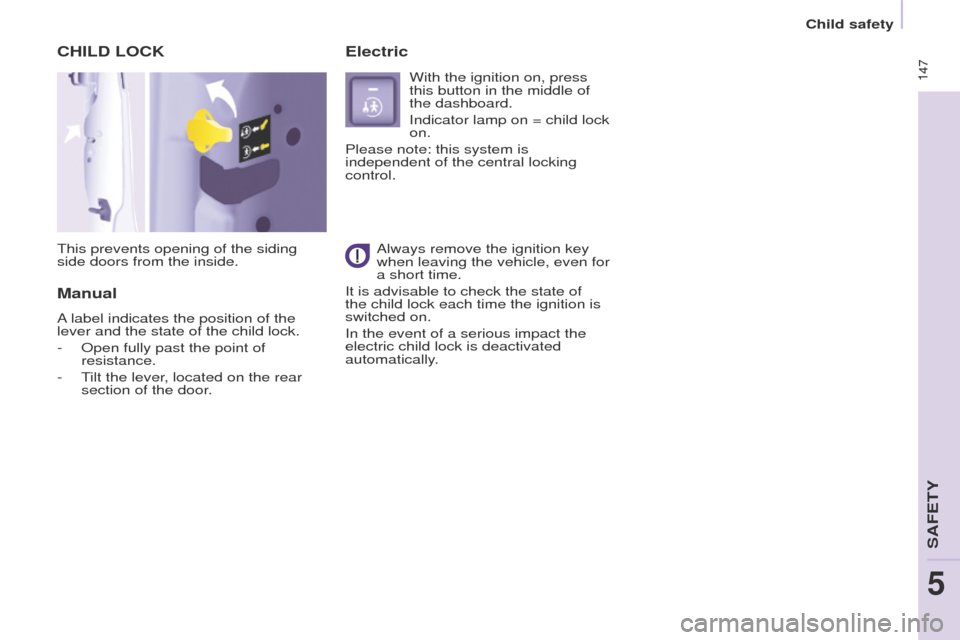
CHILD LOCK
This prevents opening of the siding
side doors from the inside.
ManualElectric
With the ignition on, press
this button in the middle of
the dashboard.
Indicator lamp on = child lock
on.
Please note: this system is
independent of the central locking
control.
Always remove the ignition key
when leaving the vehicle, even for
a short time.
It is advisable to check the state of
the child lock each time the ignition is
switched on.
In the event of a serious impact the
electric child lock is deactivated
automatically.
A label indicates the position of the
lever and the state of the child lock.
-
Open fully past the point of
resistance.
-
T
ilt the lever, located on the rear
section of the door.
SAFETY
5
Child safety