headlamp Peugeot Partner Tepee 2017 Owner's Manual
[x] Cancel search | Manufacturer: PEUGEOT, Model Year: 2017, Model line: Partner Tepee, Model: Peugeot Partner Tepee 2017Pages: 292, PDF Size: 10.49 MB
Page 7 of 292
5
Partner2VP_en_Chap01_vue-ensemble_ed02-2016
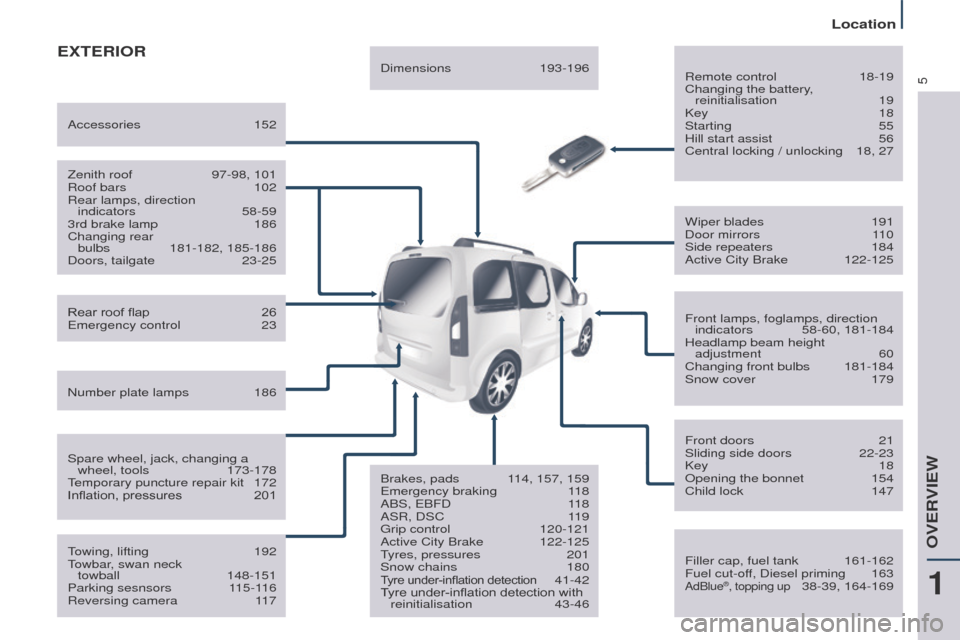
ExTERIOR
Remote control 18-19
Changing the battery ,
reinitialisation
19
Key
18
Starting
55
Hill start assist
56
Central locking / unlocking
18, 27
Filler cap, fuel tank
161-162
Fuel cut-of
f, Diesel priming
163AdBlue®, topping up 38-39, 164-169
Wiper blades
191
Door mirrors
1
10
Side repeaters
184
Active City Brake
122-125
Front lamps, foglamps, direction indicators
58-60, 181-184
Headlamp beam height adjustment
60
Changing front bulbs
181-184
Snow cover
179
Front doors
21
Sliding side doors
22-23
Key
18
Opening the bonnet
154
Child lock
147
T
owing, lifting
192
T
owbar, swan neck
towball
148-151
Parking sesnsors
1
15-116
Reversing camera
1
17
Rear roof flap
26
Emergency control
23
Spare wheel, jack, changing a wheel, tools
173-178
T
emporary puncture repair kit
172
Inflation, pressures
201
Zenith roof
97-98, 101
Roof bars
102
Rear lamps, direction
indicators
58-59
3rd brake lamp
186
Changing rear
bulbs
181-182, 185-186
Doors, tailgate
23-25
Accessories
152
Dimensions
193-196
Brakes, pads
1
14, 157, 159
Emergency braking
1
18
ABS, EBFD
1
18
ASR, DSC
1
19
Grip control
120-121
Active City Brake
122-125
T
yres, pressures
201
Snow chains
180Tyre under-inflation detection 41-42
T
yre under-inflation detection with reinitialisation
43-46
Number plate lamps
186
1
OVERVIEW
Location
Page 10 of 292
8
Partner2VP_en_Chap01_vue-ensemble_ed02-2016
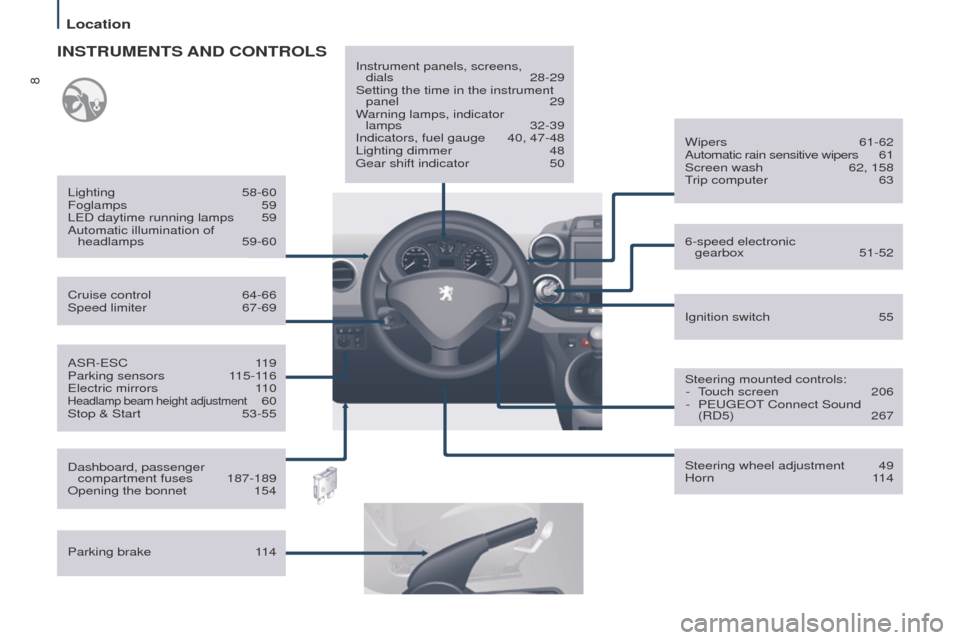
ASR-ESC 119
Parking sensors 1 15-116
Electric mirrors
1
10
Headlamp beam height adjustment 60
Stop & Start
53-55
Cruise control
64-66
Speed limiter
67-69
Lighting
58-60
Foglamps
59
LED daytime running lamps
59
Automatic illumination of headlamps
59-60
INSTRUMENTS AND
CONTROLS
Dashboard, passenger
compartment fuses 187-189
Opening the bonnet
154
Parking brake
1
14Instrument panels, screens,
dials 28-29
Setting the time in the instrument panel
29
W
arning lamps, indicator
lamps
32-39
Indicators, fuel gauge
40, 47-48
Lighting dimmer
48
Gear shift indicator
50
Wipers
61-62
Automatic rain sensitive wipers
6
1
Screen wash
62, 158
T
rip computer
63
Steering wheel adjustment
49
Horn 114
Ignition switch
55
6-speed electronic
gearbox 51-52
Steering mounted controls: -
T
ouch screen
206
-
PEUGEOT
Connect Sound
(RD5) 267
Location
Page 13 of 292
11
Partner2VP_en_Chap01_vue-ensemble_ed02-2016
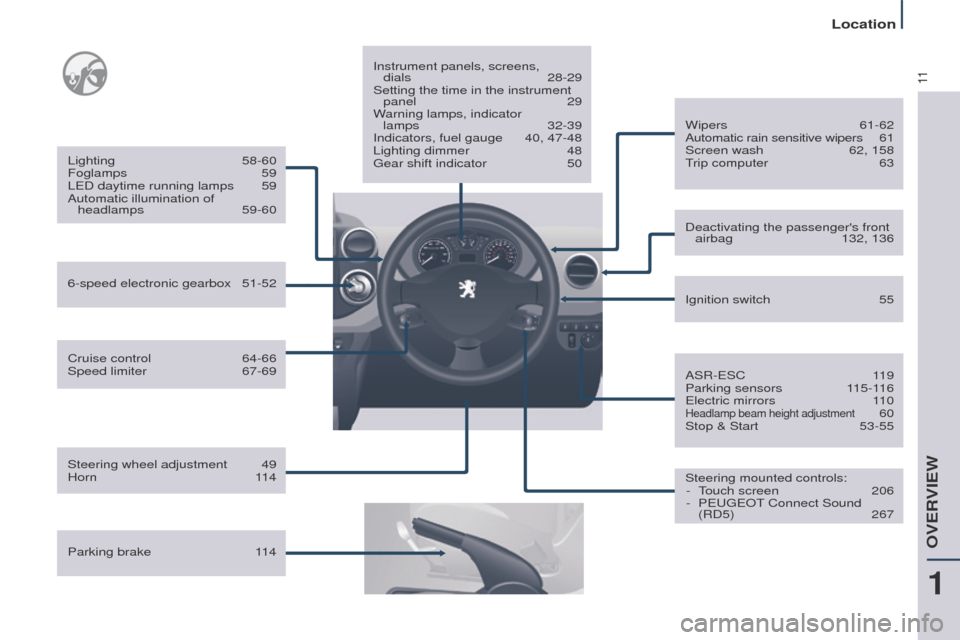
Cruise control 64-66
Speed limiter 67-69
Lighting
58-60
Foglamps
59
LED daytime running lamps
59
Automatic illumination of headlamps
59-60
Parking brake
1
14Instrument panels, screens,
dials 28-29
Setting the time in the instrument panel
29
W
arning lamps, indicator
lamps
32-39
Indicators, fuel gauge
40, 47-48
Lighting dimmer
48
Gear shift indicator
50
Steering wheel adjustment
49
Horn
114 Ignition switch
55
Wipers
61-62
Automatic rain sensitive wipers
6
1
Screen wash
62, 158
T
rip computer
63
Steering mounted controls: -
T
ouch screen
206
-
PEUGEOT
Connect Sound
(RD5)
267
Deactivating the passenger's front
airbag
132, 136
ASR-ESC
1
19
Parking sensors
1
15-116
Electric mirrors
1
10
Headlamp beam height adjustment 60
Stop & Start
53-55
6-speed electronic gearbox
51-52
1
OVERVIEW
Location
Page 15 of 292
13
Partner2VP_en_Chap01_vue-ensemble_ed02-2016
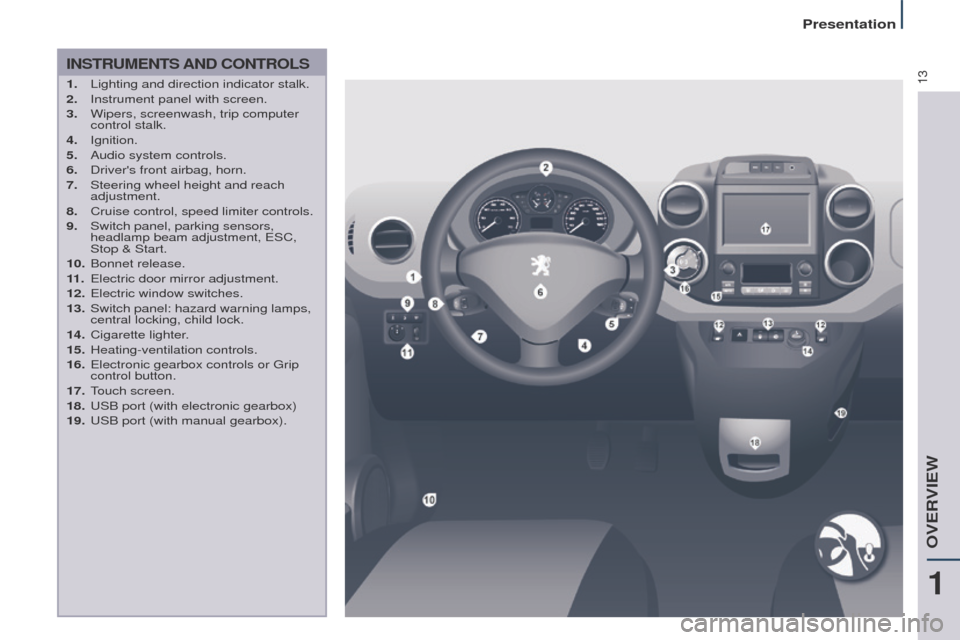
INSTRUMENTS AND CONTROLS
1. Lighting and direction indicator stalk.
2. Instrument panel with screen.
3.
Wipers, screenwash, trip computer
control stalk.
4.
Ignition.
5.
Audio system controls.
6.
Driver's front airbag, horn.
7.
Steering wheel height and reach
adjustment.
8.
Cruise control, speed limiter controls.
9.
Switch panel, parking sensors,
headlamp beam adjustment, ESC,
Stop & Start.
10.
Bonnet release.
11
.
Electric door mirror adjustment.
12.
Electric window switches.
13.
Switch panel: hazard warning lamps,
central locking, child lock.
14.
Cigarette lighter
.
15.
Heating-ventilation controls.
16.
Electronic gearbox controls or Grip
control button.
17.
T
ouch screen.
18.
USB port (with electronic gearbox)
19.
USB port (with manual gearbox).
1
OVERVIEW
Presentation
Page 16 of 292
14
Partner2VP_en_Chap01_vue-ensemble_ed02-2016
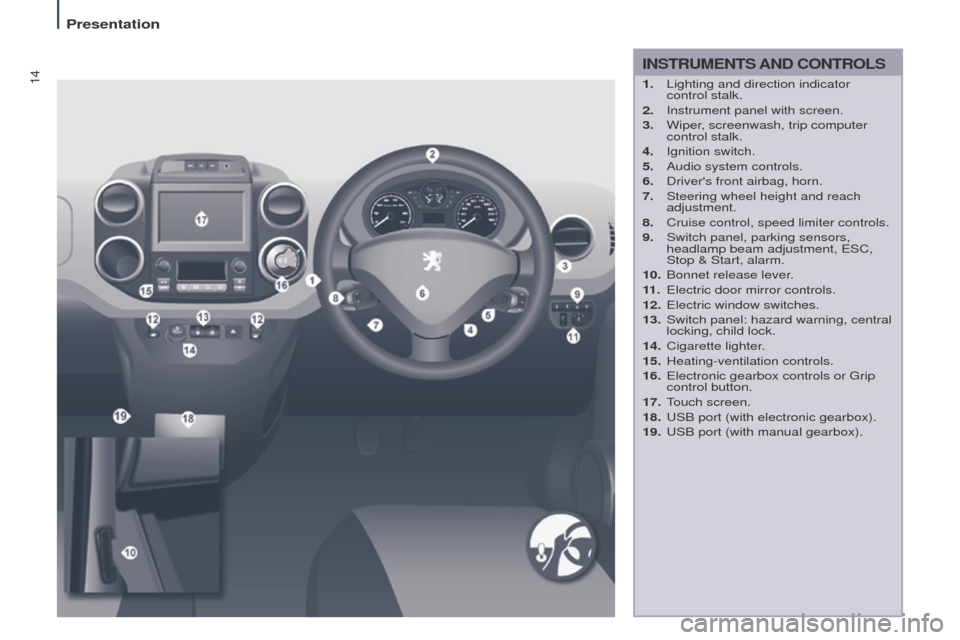
INSTRUMENTS AND CONTROLS
1. Lighting and direction indicator
control stalk.
2.
Instrument panel with screen.
3.
Wiper
, screenwash, trip computer
control stalk.
4.
Ignition switch.
5.
Audio system controls.
6.
Driver's front airbag, horn.
7.
Steering wheel height and reach
adjustment.
8.
Cruise control, speed limiter controls.
9.
Switch panel, parking sensors,
headlamp beam adjustment, ESC,
Stop & Start, alarm.
10.
Bonnet release lever
.
11 .
Electric door mirror controls.
12.
Electric window switches.
13.
Switch panel: hazard warning, central
locking, child lock.
14.
Cigarette lighter
.
15.
Heating-ventilation controls.
16.
Electronic gearbox controls or Grip
control button.
17.
T
ouch screen.
18.
USB port (with electronic gearbox).
19.
USB port (with manual gearbox).
Presentation
Page 18 of 292
16
Partner2VP_en_Chap02_eco-conduite_ed02-2016
Eco-driving is a range of everyday
practices that allow the motorist to
optimise their fuel consumption and
CO
2 emissions.
Eco-driving
Optimise the use of your
gearbox
With a manual gearbox, move off
gently and change up without waiting.
During acceleration change up early.
With an automatic or electronic
gearbox, give preference to automatic
mode and avoid pressing the
accelerator pedal heavily or suddenly.
The gear efficiency indicator invites
you to engage the most suitable gear:
as soon as the indication is displayed
in the instrument panel, follow it
straight away.
For vehicles fitted with an electronic
or automatic gearbox, this indicator
appears only in manual mode.
Drive smoothly
Maintain a safe distance between
vehicles, use engine braking rather
than the brake pedal, and press the
accelerator progressively. These
practices contribute towards a
reduction in fuel consumption and CO
2
emissions and also help to reduce the
background traffic noise.
If your vehicle has cruise control, make
use of the system at speeds above
25 mph (40 km/h) when the traffic is
flowing well.
Control the use of your
electrical equipment
Switch off the demisting and
defrosting controls, if not automatic.
Switch off the heated seat as soon as
possible.
Switch off the headlamps and front
foglamps when the level of light does
not require their use.
Avoid running the engine before
moving off, particularly in winter; your
vehicle will warm up much faster
while driving.
As a passenger, if you avoid
connecting your multimedia devices
(film, music, video game...), you
will contribute towards limiting the
consumption of electrical energy, and
so of fuel.
Disconnect your portable devices
before leaving the vehicle.
Before moving off, if the passenger
compartment is too warm, ventilate it
by opening the windows and air vents
before using the air conditioning.
Above 30 mph (50 km/h), close the
windows and leave the air vents open.
Remember to make use of equipment
that can help keep the temperature
in the passenger compartment down
(sunroof and window blinds...).
Switch off the air conditioning, unless
it has automatic regulation, as soon as
the desired temperature is attained.
Motoring & the Environment
Page 38 of 292
36
Partner2VP_en_Chap03_Pret-a-partir_ed02-2016Partner2VP_en_Chap03_Pret-a-partir_ed02-2016
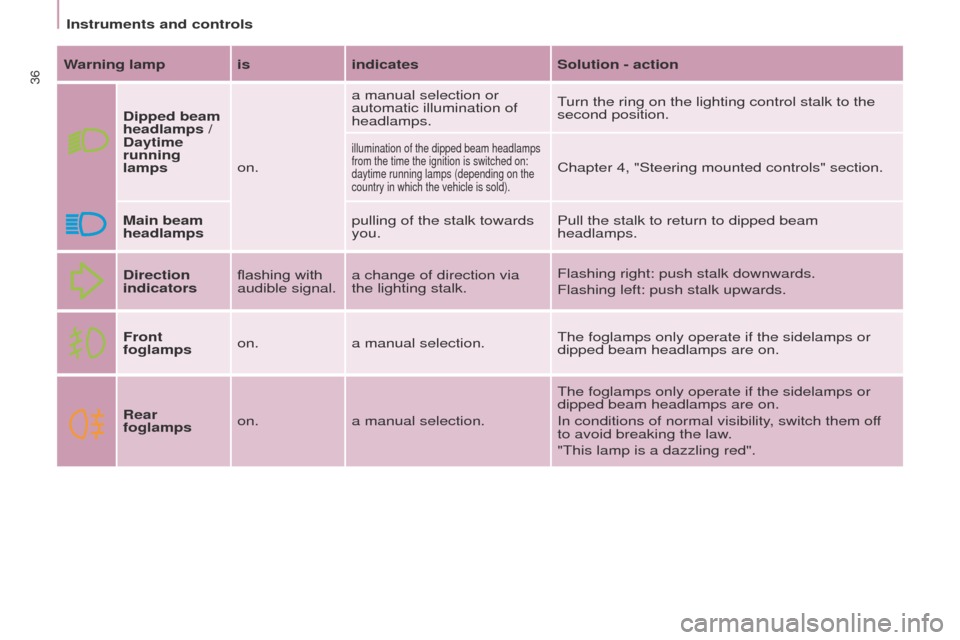
Warning lamp isindicatesSolution - action
Dipped beam
headlamps
/
Daytime
running
lamps on.a manual selection or
automatic illumination of
headlamps.
Turn the ring on the lighting control stalk to the
second position.
illumination of the dipped beam headlamps
from the time the ignition is switched on:
daytime running lamps (depending on the
country in which the vehicle is sold).
Chapter 4, "Steering mounted controls" section.
Main beam
headlamps pulling of the stalk towards
you.Pull the stalk to return to dipped beam
headlamps.
Direction
indicators flashing with
audible signal.a change of direction via
the lighting stalk. Flashing right: push stalk downwards.
Flashing left: push stalk upwards.
Front
foglamps on.
a manual selection. The foglamps only operate if the sidelamps or
dipped beam headlamps are on.
Rear
foglamps on.
a manual selection. The foglamps only operate if the sidelamps or
dipped beam headlamps are on.
In conditions of normal visibility, switch them off
to avoid breaking the law.
"This lamp is a dazzling red".
Instruments and controls
Page 60 of 292
58
Partner2VP_en_Chap04_Ergonomie_ed02-2016
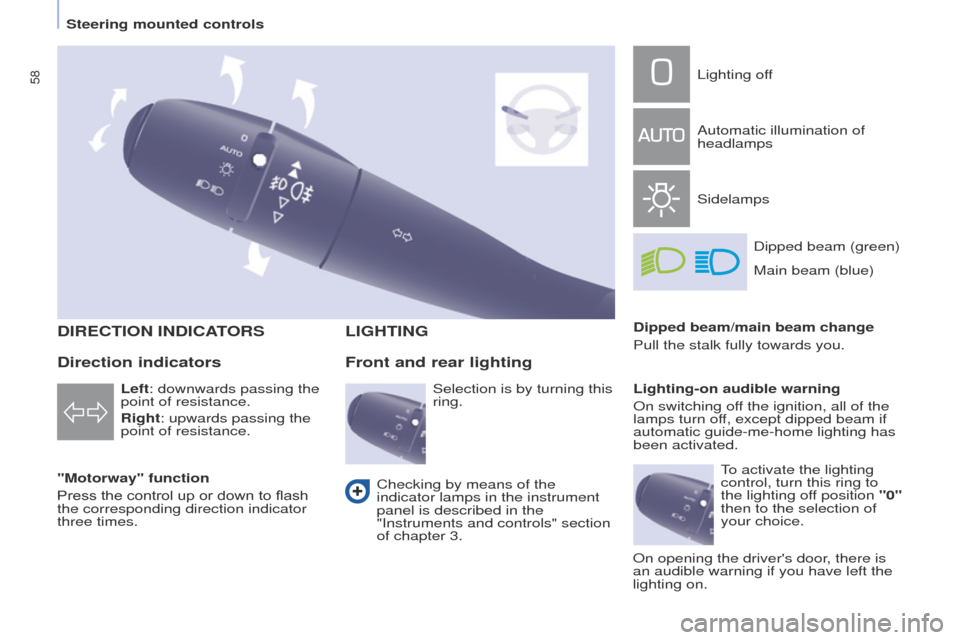
DIRECTION INDICATORS
"Motorway" function
Press the control up or down to flash
the corresponding direction indicator
three times.
LIGHTING
Left: downwards passing the
point of resistance.
Right: upwards passing the
point of resistance.
Front and rear lighting
Lighting off
Automatic illumination of
headlamps
SidelampsDipped beam (green)
Dipped beam/main beam change
Pull the stalk fully towards you.
Lighting-on audible warning
On switching off the ignition, all of the
lamps turn off, except dipped beam if
automatic guide-me-home lighting has
been activated.
Checking by means of the
indicator lamps in the instrument
panel is described in the
"Instruments and controls" section
of chapter 3.
Direction indicators
Selection is by turning this
ring. Main beam (blue)
To activate the lighting
control, turn this ring to
the lighting off position "0"
then to the selection of
your choice.
On opening the driver's door, there is
an audible warning if you have left the
lighting on.
Steering mounted controls
Page 61 of 292
59
Partner2VP_en_Chap04_Ergonomie_ed02-2016
LED DAYTIME RUNNING LAMPS
Rear foglamps (amber,
2nd rotation of the ring
forwards).
Front foglamps (green,
1st
rotation of the ring
forwards). Rotate this ring forwards
to switch on and
rearwards to switch off.
Their state is confirmed by
the warning lamps in the
instrument panel. Do not forget to switch them off
when they are no longer needed.
Operation of the automatic illumination
of headlamps switches off the rear
foglamps, but the front foglamps
remain on.
To switch off the front and
rear foglamps, turn the
ring rearwards twice in
succession.
Automatic illumination of headlamps
In foggy weather or in snow,
the sunshine sensor may detect
sufficient light.
As a consequence, the lighting
will not come on automatically. If
necessary, you must switch on the
dipped beam headlamps manually.
Do not cover the sunshine sensor
located on the windscreen, behind
the mirror. It is used for the automatic
illumination of headlamps and for the
automatic rain sensitive wipers.
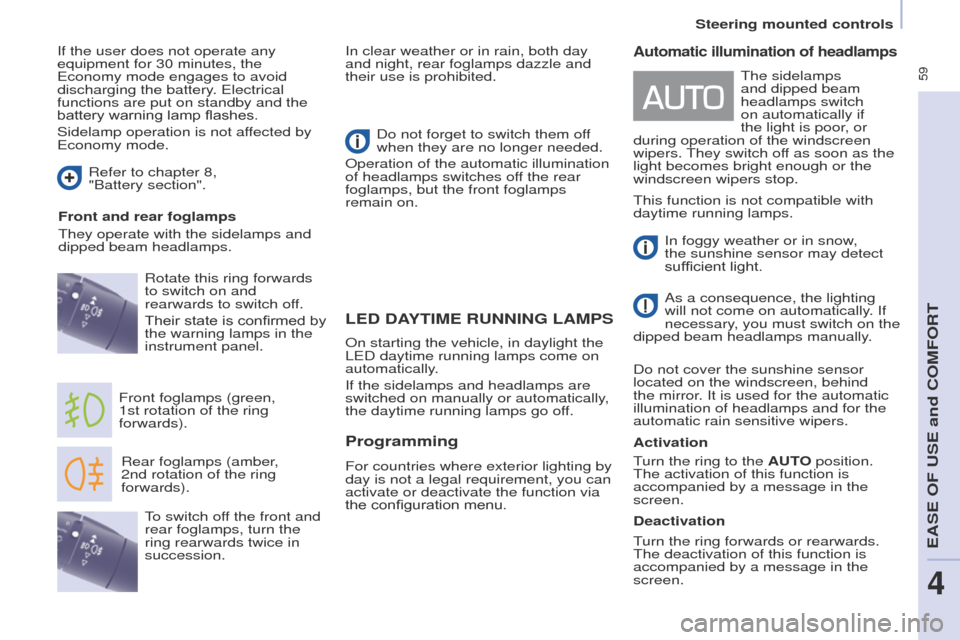
Activation The sidelamps
and dipped beam
headlamps switch
on automatically if
the light is poor, or
during operation of the windscreen
wipers. They switch off as soon as the
light becomes bright enough or the
windscreen wipers stop.
On starting the vehicle, in daylight the
LED daytime running lamps come on
automatically.
If the sidelamps and headlamps are
switched on manually or automatically,
the daytime running lamps go off.
Programming
For countries where exterior lighting by
day is not a legal requirement, you can
activate or deactivate the function via
the configuration menu.
If the user does not operate any
equipment for 30 minutes, the
Economy mode engages to avoid
discharging the battery. Electrical
functions are put on standby and the
battery warning lamp flashes.
Sidelamp operation is not affected by
Economy mode.
In clear weather or in rain, both day
and night, rear foglamps dazzle and
their use is prohibited.
Refer to chapter 8,
"Battery
section".
Front and rear foglamps
They operate with the sidelamps and
dipped beam headlamps.
Turn the ring to the AUTO position.
The activation of this function is
accompanied by a message in the
screen.
Deactivation
Turn the ring forwards or rearwards.
The deactivation of this function is
accompanied by a message in the
screen. This function is not compatible with
daytime running lamps.
Steering mounted controls
EASE OF USE and COMFORT
4
Page 62 of 292
60
Partner2VP_en_Chap04_Ergonomie_ed02-2016
If the sunshine sensor
does not function correctly,
the lighting comes on
accompanied by the service
warning lamp, an audible
signal and a message in the screen.
Contact a PEUGEOT dealer or a
qualified workshop.
Guide-me-home lighting
Keeping the dipped beam headlamps
on temporarily with the ignition off,
makes the driver's exit easier when the
light is poor.
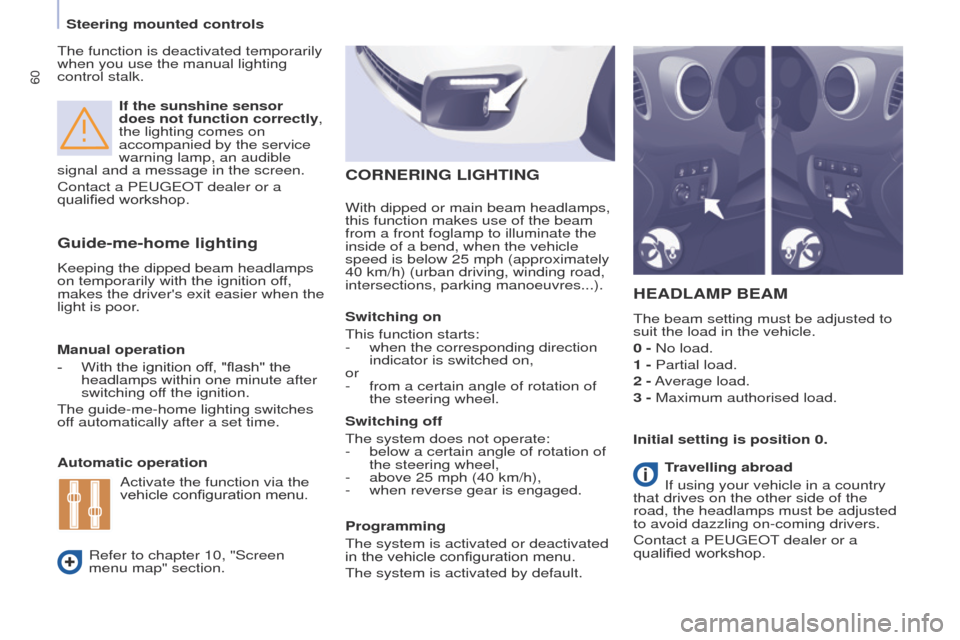
HEADLAMP BEAM
The beam setting must be adjusted to
suit the load in the vehicle.
0 - No load.
1 - Partial load.
2 - Average load.
3 - Maximum authorised load.
Manual operation
-
With the ignition of
f, "flash" the
headlamps within one minute after
switching off the ignition.
The guide-me-home lighting switches
off automatically after a set time.
Automatic operation
Refer to chapter 10, "Screen
menu map" section. Initial setting is position 0.
Activate the function via the
vehicle configuration menu. Programming
The system is activated or deactivated
in the vehicle configuration menu.
The system is activated by default. Switching off
The system does not operate:
-
below a certain angle of rotation of
the steering wheel,
-
above 25 mph (40 km/h),
-
when reverse gear is engaged.
Switching on
This function starts:
-
when the corresponding direction
indicator is switched on,
or
-
from a certain angle of rotation of
the steering wheel.
With dipped or main beam headlamps,
this function makes use of the beam
from a front foglamp to illu
minate the
inside of a bend, when the vehicle
speed is below 25 mph (approximately
40 km/h) (urban driving, winding road,
intersections, parking manoeuvres...).
CORNERING LIGHTING
Travelling abroad
If using your vehicle in a country
that drives on the other side of the
road, the headlamps must be adjusted
to avoid dazzling on-coming drivers.
Contact a PEUGEOT dealer or a
qualified workshop.
The function is deactivated temporarily
when you use the manual lighting
control stalk.
Steering mounted controls