maintenance Peugeot Partner Tepee 2017 Owner's Manual
[x] Cancel search | Manufacturer: PEUGEOT, Model Year: 2017, Model line: Partner Tepee, Model: Peugeot Partner Tepee 2017Pages: 292, PDF Size: 10.49 MB
Page 2 of 292
On-line handbook
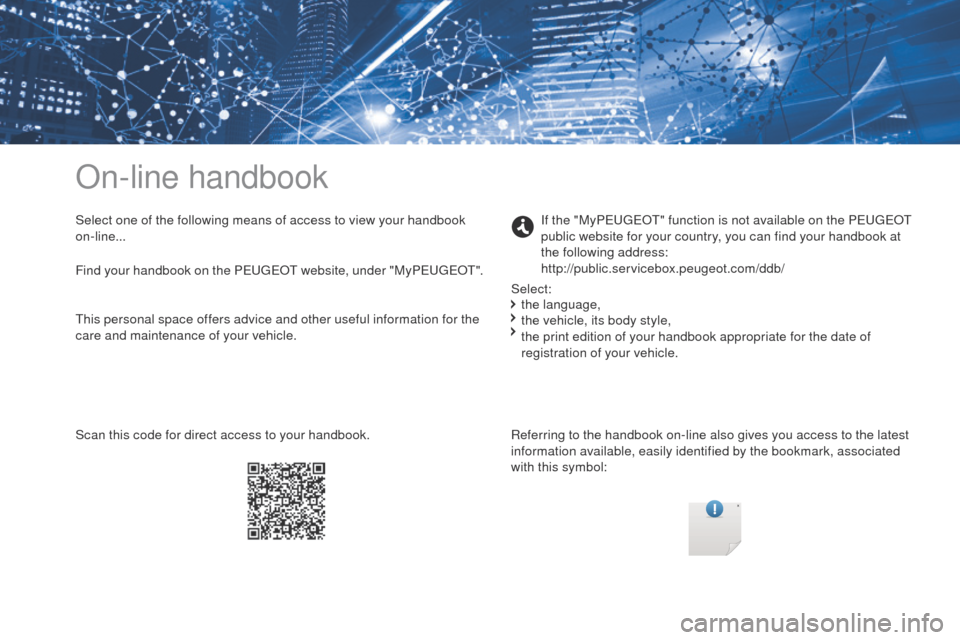
Select one of the following means of access to view your handbook
on-line...Referring to the handbook on-line also gives you access to the latest
information available, easily identified by the bookmark, associated
with this symbol:If the "MyPEUGEOT" function is not available on the PEUGEOT
public website for your country, you can find your handbook at
the following address:
http://public.servicebox.peugeot.com/ddb/
the language,
the vehicle, its body style,
the print edition of your handbook appropriate for the date of
registration of your vehicle.
Select:
Find your handbook on the PEUGEOT website, under "MyPEUGEOT".
Scan this code for direct access to your handbook. This personal space offers advice and other useful information for the
care and maintenance of your vehicle.
Page 4 of 292
2
Partner2VP_en_Chap00a_Sommaire_ed02-2016
Key 18
Alarm 20
Doors
21
T
ailgate 23
Rear roof flap
26
Central locking
27
Instrument panel
28
Date and time
29
W
arning lamps
32
Fuel gauge
40
Coolant
40
Under-inflation detection
41
Under-inflation detection with reinitialisation
43
Service indicator
47
Lighting dimmer
48
Steering wheel
adjustment
49
Manual gearbox
49
Gear shift indicator
50
6-speed electronic
gearbox
51
Stop & Start
53
Starting and stopping
55
Hill start assist
56
Driving
recommendations
57Lighting
58
Wipers
61
Trip computer
63
Cruise control
64
Speed limiter
67
Heating /
Air conditioning
manual
70
digital
72
Demisting and defrosting
75
Front seats
77
Rear bench seat
79
Rear seats
(5 seat version)
82
Rear seats
(7 seat version)
85
Modularity
92
Front fittings
94
Zenith roof
97
Roof bars
102
Courtesy lamps
103
Load space cover
(5 seat version)
104
Load space cover
(7 seat version)
108
Mirrors
110
Electric windows
1
12
READY TO GO
3.
18-57 SAFETY
5.
1
13-147
Exterior 5
Interior 6
left hand drive
6 right hand drive
7
Instruments and controls
8 left hand drive
8 right hand drive
10
T
echnical data - Maintenance
12
OVERVIEW
1.
4-14
General safety recommendations 113
Hazard warning lamps
1
14
Horn
114
Parking brake
1
14
Parking sensors
1
15
Reversing camera
1
17
Anti-lock braking system (ABS)
118
EBA
118
ASR and DSC
1
19
Grip control
120
Active City Brake
122
Seat belts
126
Airbags
129
Carrying children
133
Deactivating the passenger's front
airbag
136
Recommended seats
139
Installation
141
ISOFIX mountings
143
Recommended ISOFIX
seat
144
ISOFIXlocations
145
Child lock
147
EASE OF USE
and COMFORT
4.
58-112
ECO-DRIVING
2.
15-17
Environment 15
Eco-driving 16
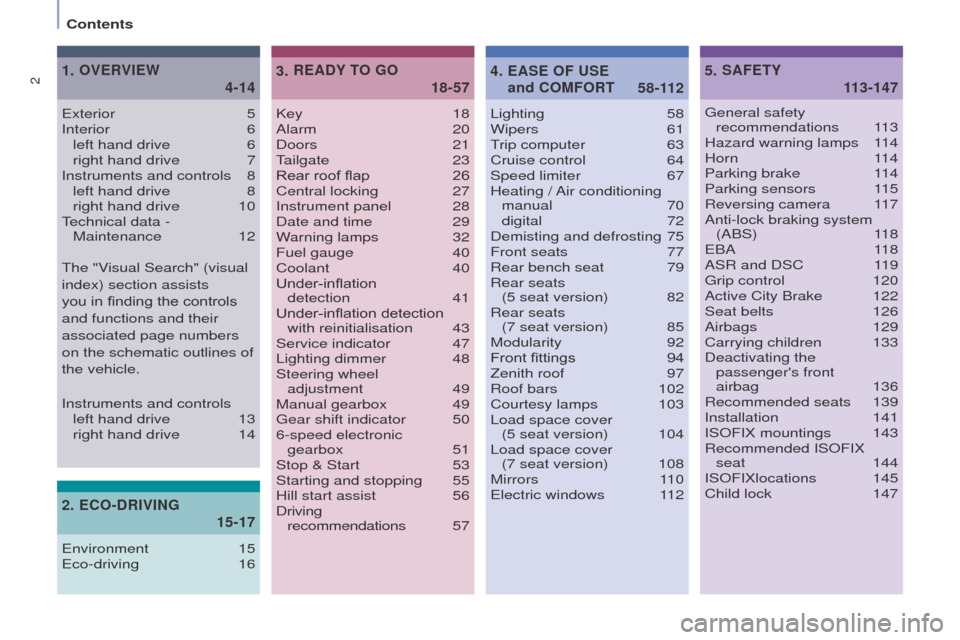
The "Visual Search" (visual
index) section assists
you in finding the controls
and functions and their
associated page numbers
on the schematic outlines of
the vehicle.
Instruments and controls
left hand drive
13 right hand drive
14
Contents
Page 19 of 292
17
Partner2VP_en_Chap02_eco-conduite_ed02-2016
Limit the causes of excess
consumption
Spread loads throughout the vehicle;
place the heaviest items in the bottom
of the boot, as close as possible to
the rear seats.
Limit the loads carried in the
vehicle and reduce wind resistance
(roof bars, roof rack, bicycle
carrier, trailer...). Use a roof box in
preference.
Remove roof bars and roof racks
after use.
At the end of winter, remove snow
tyres and refit your summer tyres.
Observe the recommendations
on maintenance
Check the tyre pressures regularly,
when cold, referring to the label in the
door aperture, driver's side.
Carry out this check in particular:
-
before a long journey
,
-
at each change of season,
-
after a long period out of use.
Don't forget the spare wheel and the
tyres on any trailer or caravan.
Have your vehicle serviced regularly
(engine oil, oil filter
, air filter, passenger
compartment filter...) and observe the
schedule of operations recommended
in the manufacturer's service schedule.
With a BlueHDi Diesel engine, if the
SCR system is faulty your vehicle
becomes polluting; go to a PEUGEOT
dealer or a qualified workshop without
delay to have the emissions of nitrogen
oxides brought back to the legal level. When refuelling, do not continue after
the third cut-off of the nozzle to avoid
any overflow.
At the wheel of your new vehicle,
it is only after the first 1 800 miles
(3 000 kilometres) that you will see
the fuel consumption settle down to
a consistent average.
2
ECO-DRIVING
Motoring & the Environment
Page 39 of 292
37
Partner2VP_en_Chap03_Pret-a-partir_ed02-2016Partner2VP_en_Chap03_Pret-a-partir_ed02-2016
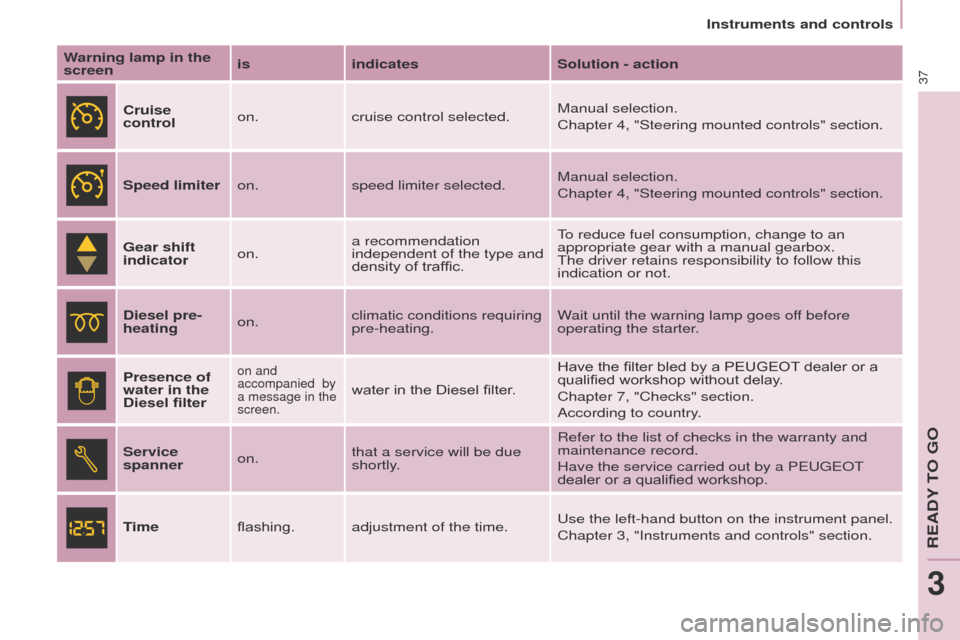
Warning lamp in the
screenis
indicates Solution - action
Cruise
control on.
cruise control selected. Manual selection.
Chapter 4, "Steering mounted controls" section.
Speed limiter on.speed limiter selected. Manual selection.
Chapter 4, "Steering mounted controls" section.
Gear shift
indicator on.a recommendation
independent of the type and
density of traffic. To reduce fuel consumption, change to an
appropriate gear with a manual gearbox.
The driver retains responsibility to follow this
indication or not.
Diesel pre-
heating on.climatic conditions requiring
pre-heating. Wait until the warning lamp goes off before
operating the starter.
Presence of
water in the
Diesel filter
on and
accompanied by
a message in the
screen.
water in the Diesel filter. Have the filter bled by a PEUGEOT dealer or a
qualified workshop without delay.
Chapter 7, "Checks" section.
According to country.
Service
spanner on.that a service will be due
shortly. Refer to the list of checks in the warranty and
maintenance record.
Have the service carried out by a PEUGEOT
dealer or a qualified workshop.
Time flashing.adjustment of the time. Use the left-hand button on the instrument panel.
Chapter 3, "Instruments and controls" section.
READY TO GO
3
Instruments and controls
Page 129 of 292
127
Partner2VP_en_Chap05_Securite_ed02-2016Partner2VP_en_Chap05_Securite_ed02-2016
Recommendations for children:
-
use a suitable child seat if the
passenger is less than 12 years old
or shorter than one metre fifty
,
-
never allow a child to travel on
your lap, even with the seat belt
fastened. For more information on child
seats, refer to the "Child safety"
section of chapter 5.
Clean the seat belt straps with
soapy water or a textile cleaning
product, sold by PEUGEOT
dealers.
In accordance with current safety
regulations, your PEUGEOT dealer
can guarantee all work or any checks,
from testing to maintenance, on your
seat belt equipment.
Have the seat belts checked regularly
(even after a minor impact) by a
PEUGEOT dealer or a qualified
workshop: they must not show any
signs of wear, cutting or fraying
and they must not be converted or
modified.
The force limiter reduces the pressure
of the seat belt against the body of the
occupants.
The pretensioning seat belts are active
when the ignition is switched on.
The inertia reels are fitted with a device
which automatically locks the strap in
the event of a collision or emergency
braking or if the vehicle rolls over.
You can unfasten the seat belt by
pressing the red button on the buckle.
Guide the seat belt after unfastening.
The airbag warning lamp comes on
if the pretensioners are deployed.
Contact a PEUGEOT dealer or a
qualified workshop.
In order to be effective, a seat belt:
-
must restrain one person only
,
-
must not be twisted, check by
pullin
g in front of you with an even
movement,
-
must be tightened as close to the
body as possible.
The upper part of the seat belt should
be positioned in the hollow of the
shoulder
.
The lap part should be placed as low
as possible on the pelvis.
Do not interchange the seat belt
buckles as they will not fulfil their role
properly. If the seats are fitted with
armrests, the lap part of the seat belt
should always pass under the armrest.
Check that the seat belt is fastened
correctly by pulling the strap firmly.Front seat belts
The front seats are fitted with
pretensioners and force limiters.
Rear seat belts
(5 seat version)
The rear seats are fitted with
three-point inertia reel seat belts.
SAFETY
5
Seat belts
Page 153 of 292
151
Partner2VP_en_Chap06_Accessoire_ed02-2016
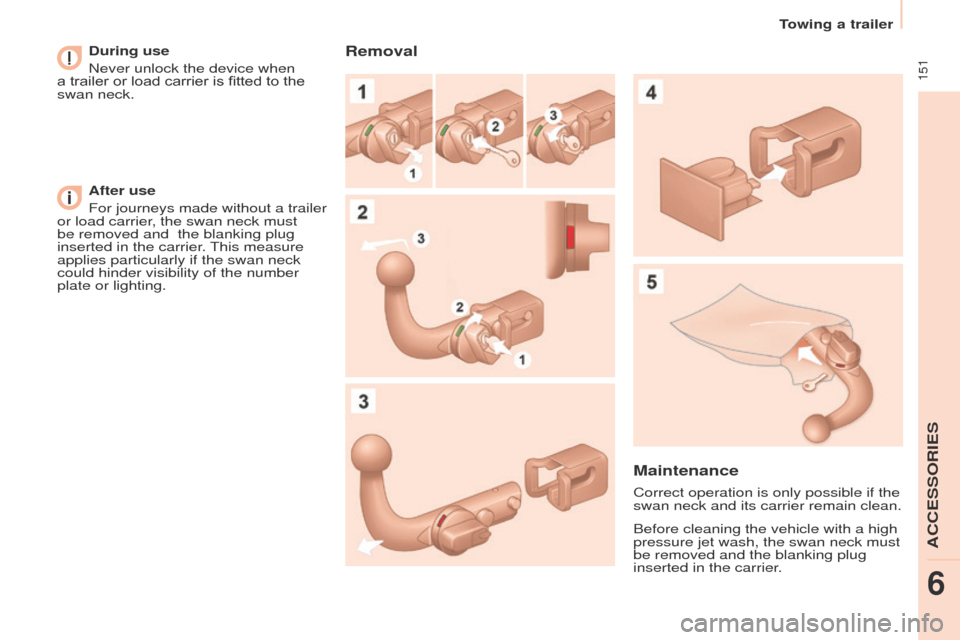
During use
Never unlock the device when
a trailer or load carrier is fitted to the
swan neck.
After use
For journeys made without a trailer
or load carrier, the swan neck must
be removed and
the blanking plug
inserted in the carrier. This measure
applies particularly if the swan neck
could hinder visibility of the number
plate or lighting.Removal
Maintenance
Correct operation is only possible if the
swan neck and its carrier remain clean.
Before cleaning the vehicle with a high
pressure jet wash, the swan neck must
be removed and the blanking plug
inserted in the carrier.
Towing a trailer
ACCESSORIES
6
Page 154 of 292
152
Partner2VP_en_Chap06_Accessoire_ed02-2016Partner2VP_en_Chap06_Accessoire_ed02-2016
OTHER ACCESSORIES
These accessories and parts, having
been tested and approved for reliability
and safety, are all adapted to your
vehicle. A wide range of recommended
accessories and genuine parts is
available.
A further range is also available,
structured around comfort, leisure and
maintenance:
Anti-theft alarm, window etching, first
aid kit, high visibility vest, front and
rear parking sensors, warning triangle,
security bolts for alloy wheels, ...
Seat covers compatible with airbags
for the front seats, bench seat, rubber
mats, carpet mats, snow chains, blinds,
tailgate bicycle carrier, ...
To prevent the mat from becoming
caught under the pedals:
-
ensure that the mat and its fixings
are positioned correctly
,
-
never fit one mat on top of another
.Audio equipment, hands-free kit,
speakers, CD changer, satellite
navigation system, USB box, Video kit,
...
Regardless of the audio and telematic
equipment offered on the market, the
technical constraints associated with
the fitting of equipment of these product
groups mean that the special features
of the equipment and its compatibility
with the capacities of your vehicle's
standard equipment must be taken into
account. Please ask a PEUGEOT dealer
for more information before fitting such
equipment.
Maximum weights on bars
-
T
ransverse bars on longitudinal
bars: 75 Kg (these bars are not
compatible with the Zénith roof).
Installing radiocommunication
transmitters
You are advised to contact a
PEUGEOT dealer before installing
accessory radiocommunication
transmitters with external aerial on
your vehicle.
The PEUGEOT dealer network
will inform you of the specification
(frequency band, maximum output
power, aerial position, specific
conditions of installation) of the
transmitters which can be fitted, in
accordance with the Motor Vehicle
Electromagnetic Compatibility
Directive (2004/104/EC). Front mud flaps, rear mud flaps,
15/17
inch alloy wheels, wheelarch
trim, leather steering wheel, ...
Screenwash, interior and exterior
cleaning and maintenance products,
spare bulbs, ...
The fitting of electrical equipment
or accessories which are not
recommended by PEUGEOT
may result in a failure of your vehicle's
electronic system. Please note this
specific warning. You are advised
to contact a dealer to be shown the
range of recommended equipment or
accessories.
Depending on the country in which
the vehicle is sold, it is compulsory
to have a high visibility vest, warning
triangle and spare bulbs available in
the vehicle.
Equipment
Page 155 of 292
153
Partner2VP_en_Chap07_Verification_ed02-2016Partner2VP_en_Chap07_Verification_ed02-2016
PEUGEOT & TOTAL,
A PARTNERSHIP TO DELIVER
BETTER PERFORMANCE!
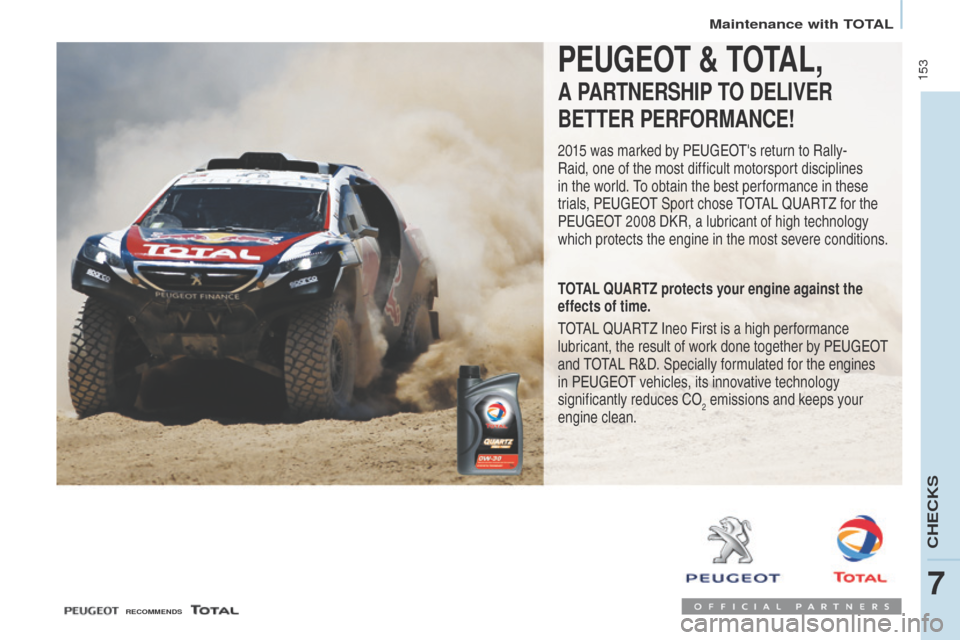
2015 was marked by PEUGEOT's return to Rally-
Raid, one of the most difficult motorsport disciplines
in the world. To obtain the best performance in these
trials, PEUGEOT Sport chose TOTAL QUARTZ for the
PEUGEOT 2008 DKR, a lubricant of high technology
which protects the engine in the most severe conditions.
TOTAL QUARTZ protects your engine against the
effects of time.
TOTAL QUARTZ Ineo First is a high performance
lubricant, the result of work done together by PEUGEOT
and TOTAL R&D. Specially formulated for the engines
in PEUGEOT vehicles, its innovative technology
significantly reduces CO
2 emissions and keeps your
engine clean.
RECOMMENDS
CHECKS
7
Maintenance with TOTAL
Page 159 of 292
157
Partner2VP_en_Chap07_Verification_ed02-2016Partner2VP_en_Chap07_Verification_ed02-2016
LEVELS
Oil change
This must be carried out at
the intervals specified in the
manufacturer's servicing schedule. Ask
for advice from a PEUGEOT dealer.
Remove the dipstick before filling.
Check the level after filling (never
exceed the max mark).
Refit the oil filler cap before closing the
bonnet.
Changing the brake fluid
The brake fluid must be changed at
the intervals stated, according to the
manufacturer's servicing schedule.
Use fluids recommended by the
manufacturer, which meet the
DOT4 standard.
The level must be between the MIN
and MAX marks on the reservoir.
If fluid has to be added frequently,
this indicates a fault which must be
checked by a PEUGEOT dealer or
a qualified workshop as soon as
possible.
Warning lamps
If you have to remove / refit the
engine style cover, handle it with
care to avoid damaging the fixing
clips.
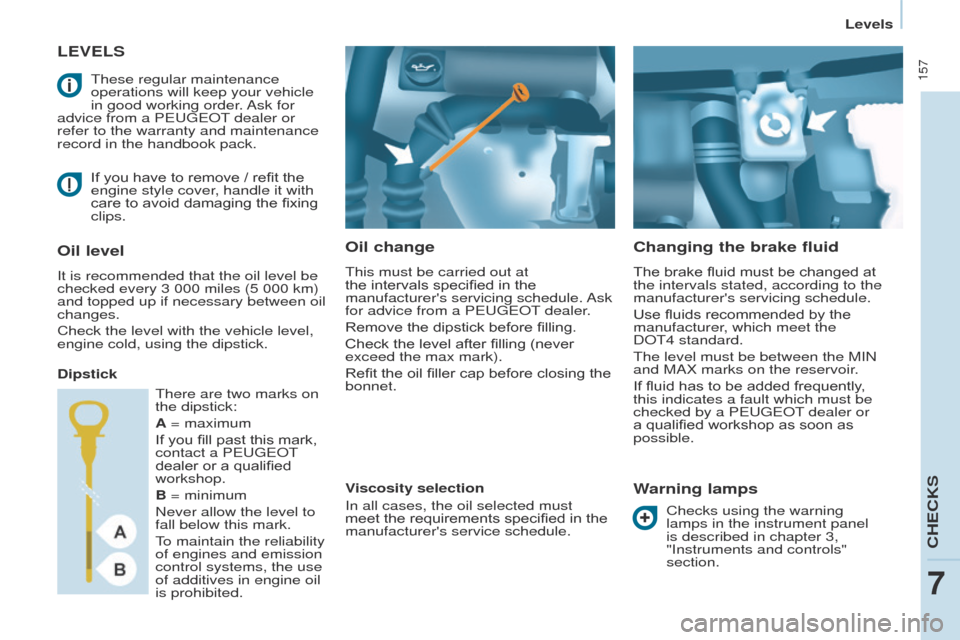
Oil level
It is recommended that the oil level be
checked every 3 000 miles (5 000 km)
and topped up if necessary between oil
changes.
Check the level with the vehicle level,
engine cold, using the dipstick.
Dipstick
Viscosity selection
In all cases, the oil selected must
meet the requirements specified in the
manufacturer's service schedule.
These regular maintenance
operations will keep your vehicle
in good working order. Ask for
advice from a PEUGEOT dealer or
refer to the warranty and maintenance
record in the handbook pack.
Checks using the warning
lamps in the instrument panel
is described in chapter 3,
"Instruments and controls"
section.
There are two marks on
the dipstick:
A = maximum
If you fill past this mark,
contact a PEUGEOT
dealer or a qualified
workshop.
B = minimum
Never allow the level to
fall below this mark.
To maintain the reliability
of engines and emission
control systems, the use
of additives in engine oil
is prohibited.
CHECKS
7
Levels
Page 161 of 292
159
Partner2VP_en_Chap07_Verification_ed02-2016Partner2VP_en_Chap07_Verification_ed02-2016
CHECKS
Carbon filter and passenger compartment filterParticle filter (Diesel)
Maintenance of the particle filter must
be carried out by a PEUGEOT dealer.
On acceleration after the vehicle has
been running for a prolonged period
at very low speed or at idle, you may,
in exceptional circumstances, notice
the emission of water vapour at the
exhaust. This water vapour does not
have any adverse effect on vehicle
handling or the environment.
Battery
At the start of summer or winter, have
your battery checked by a PEUGEOT
dealer or a qualified workshop.
Brake pads
Brake pad wear depends on the style
of driving, in particular for vehicles
which are used in town, over short
distances. It may be necessary to
check the thickness of the pads, even
between services.
Unless there is a leak on the circuit, a
drop in the brake fluid level indicates
that the brake pads are worn.
Brake disc / drum wear
For information on checking the brake
disc / drum wear, contact a PEUGEOT
dealer.
Parking brake
Where the parking brake travel is too great
or there is a reduction in the performance
of the system, the parking brake should be
adjusted, even between services.
Have the system checked by a PEUGEOT
dealer or a qualified workshop.
Oil filter
Change the filter regularly in
accordance with the manufacturer's
servicing schedule.
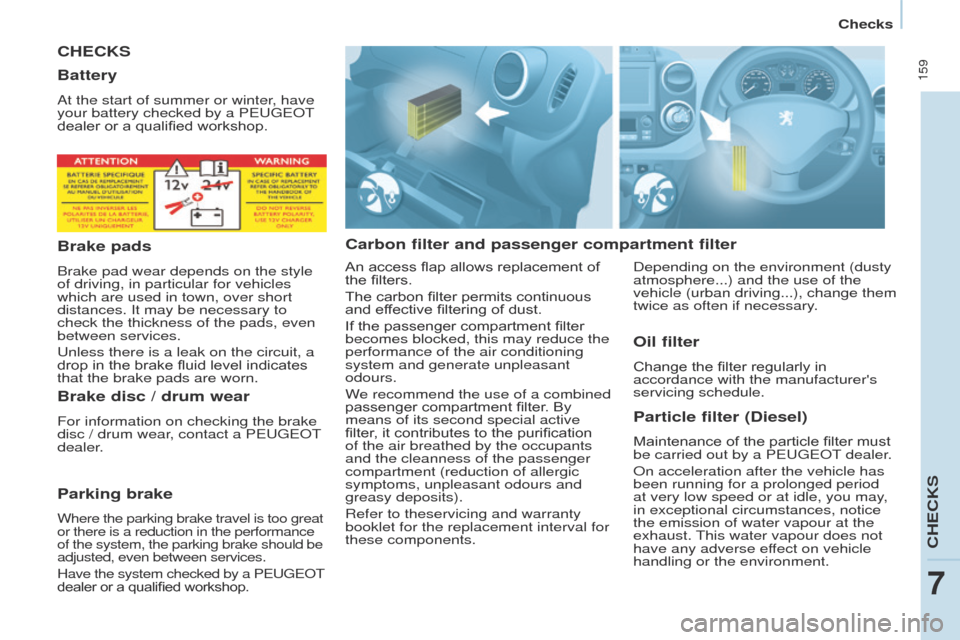
An access flap allows replacement of
the filters.
The carbon filter permits continuous
and effective filtering of dust.
If the passenger compartment filter
becomes blocked, this may reduce the
performance of the air conditioning
system and generate unpleasant
odours.
We recommend the use of a combined
passenger compartment filter. By
means of its second special active
filter, it contributes to the purification
of the air breathed by the occupants
and the cleanness of the passenger
compartment (reduction of allergic
symptoms, unpleasant odours and
greasy deposits).
Refer to theservicing and warranty
booklet for the replacement interval for
these components. Depending on the environment (dusty
atmosphere...) and the use of the
vehicle (urban driving...), change them
twice as often if necessary.
CHECKS
7
Checks