coolant level PONTIAC BONNEVILLE 1993 Owners Manual
[x] Cancel search | Manufacturer: PONTIAC, Model Year: 1993, Model line: BONNEVILLE, Model: PONTIAC BONNEVILLE 1993Pages: 322, PDF Size: 16.31 MB
Page 102 of 322
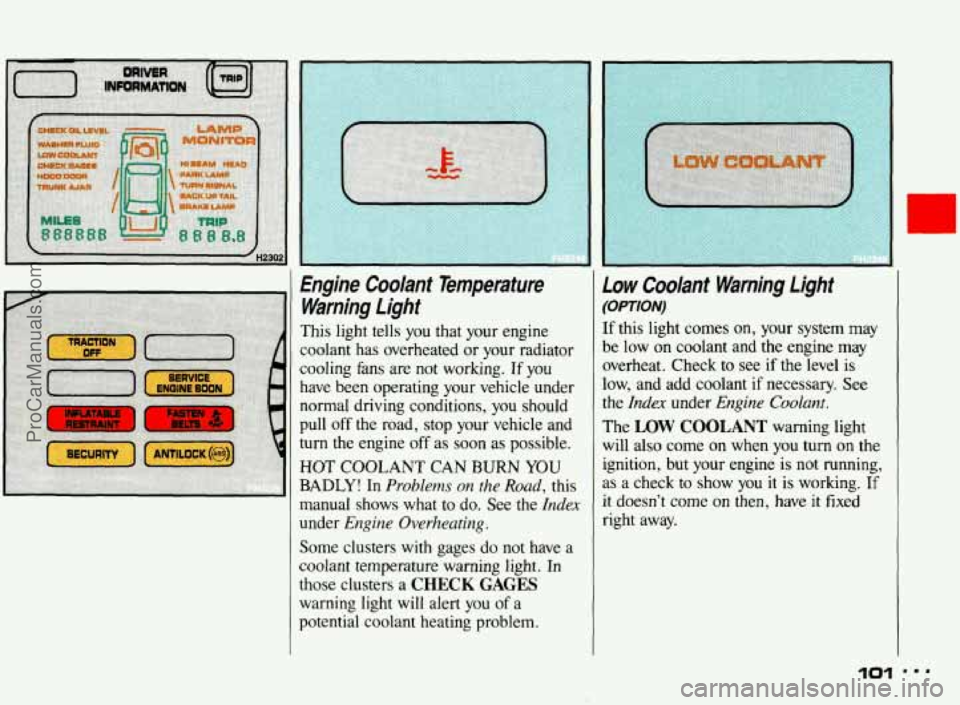
Engine Coolant Temperature Warning Light
This light tells you that your engine
coolant has overheated
or your radiator
cooling fans are
not working. If you
have been operating your vehicle under
normal driving conditions, you should
pull off the road, stop your vehicle and
turn the engine
off as soon as possible.
HOT
COOLANT CAN BURN YOU
BADLY!
In Problems on the Road, this
manual shows what to do. See the
Index
under Engine Overheating.
Some clusters with gages do not have a
coolant temperature warning light.
In
those clusters a CHECK GAGES
warning light will alert you of a
potential coolant heating problem.
Low Coolant Warning light
(OPT/ON)
If this light comes on, your system may
be low
on coolant and the engine may
overheat. Check to see
if the level is
low, and add coolant if necessary. See
the
Index under Engine Coolant.
The LOW COOLANT warning light
will also come on when
you turn on the
ignition, but your engine is not running,
as a check to show you it is working.
If
it doesn’t come on then, have it fixed
right away.
101
ProCarManuals.com
Page 112 of 322
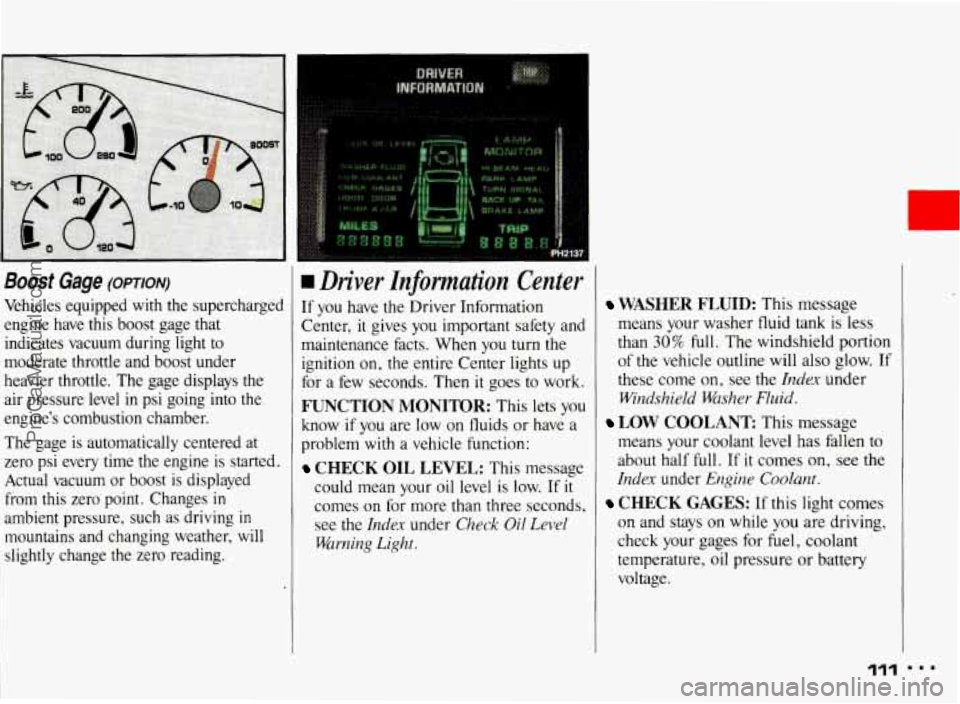
Boost Gage (OPTION)
Vehicles equipped with the supercharged
engine have this boost gage that indicates vacuum during light to
moderate throttle and boost under
heavier throttle. The gage displays the
air pressure level
in psi going into the
engine’s combustion chamber.
The gage is automatically centered at
zero psi
every time the engine is started.
Actual vacuum or boost
is displayed
from this zero point. Changes
in
ambient pressure, such as driving in
mountains and changing weather, will slightly change
the zero reading.
I
rn Driver Znformation Center
If you have the Driver Information
Center, it gives you important safety and
maintenance facts. When you turn the ignition on, the entire Center lights up
for a few seconds. Then it goes to work.
FUNCTION MONITOR: This lets you
know if you are low
on fluids or have a
problem with a vehicle function:
CHECK OIL LEVEL: This message
could mean your oil level is low. If
it
comes on for more than three seconds, see
the Index under Check Oil Level
Warning Light.
WASHER FLUID: This message
means your washer fluid tank is less
than
30% full. The windshield portion
of the vehicle outline will also glow. If
these come on, see the
Index under
Windshield Washer Fluid.
means your coolant level has fallen to
about half full. If it comes on,
see the
Index under Engine Coolant.
CHECK GAGES: If this light comes
on and stays on while
you are driving,
check your gages for fuel, coolant
temperature, oil pressure or battery
voltage.
LOW COOLANT This message
111
ProCarManuals.com
Page 117 of 322
Features & Controls
pH2119
Head-Up Display (omorq
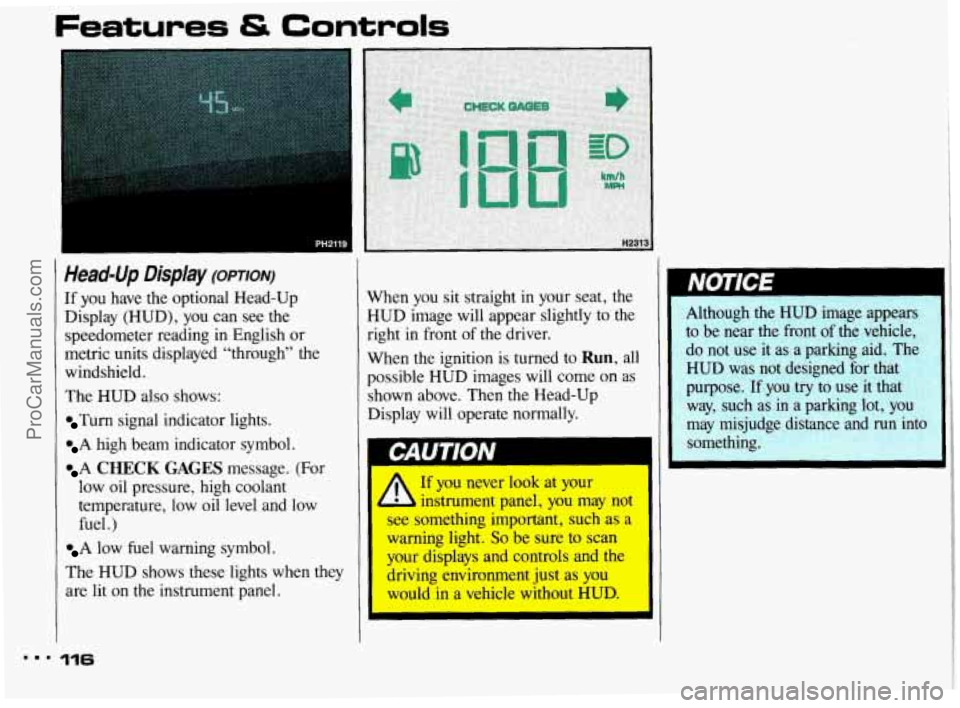
If you have the optional Head-Up
Display (HUD), you can see the
speedometer reading in English or
metric units displayed “through” the
windshield.
The HUD
also shows:
Turn signal indicator lights.
A high beam indicator symbol.
A CHECK GAGES message. (For
low oil pressure, high coolant
temperature, low oil level and low
fuel .)
A low fuel warning symbol.
The HUD shows these lights when they
are lit
on the instrument panel.
... 116
When you sit straight in your seat, the
HUD image will appear slightly to the
right in front
of the driver.
When the ignition is turned
to Run, all
possible HUD images will come on as
shown above. Then the Head-Up
Display will operate normally.
14
NOTEE
Although the HUD image appears
to be near the front
of the vehicle,
do not use it as a parking aid. The
HUD was not designed
for that
purpose.
If you try to use it that
way, such as in a parking lot,
you
may misjudge distance and run into
something.
If you never look at your
b instrument panel, you may not
see something important, such as a
warning light. So be sure to scan
your displays and controls and the
driving environment just
as you
would in a vehicle without
HUD.
ProCarManuals.com
Page 205 of 322
Problems on the Road
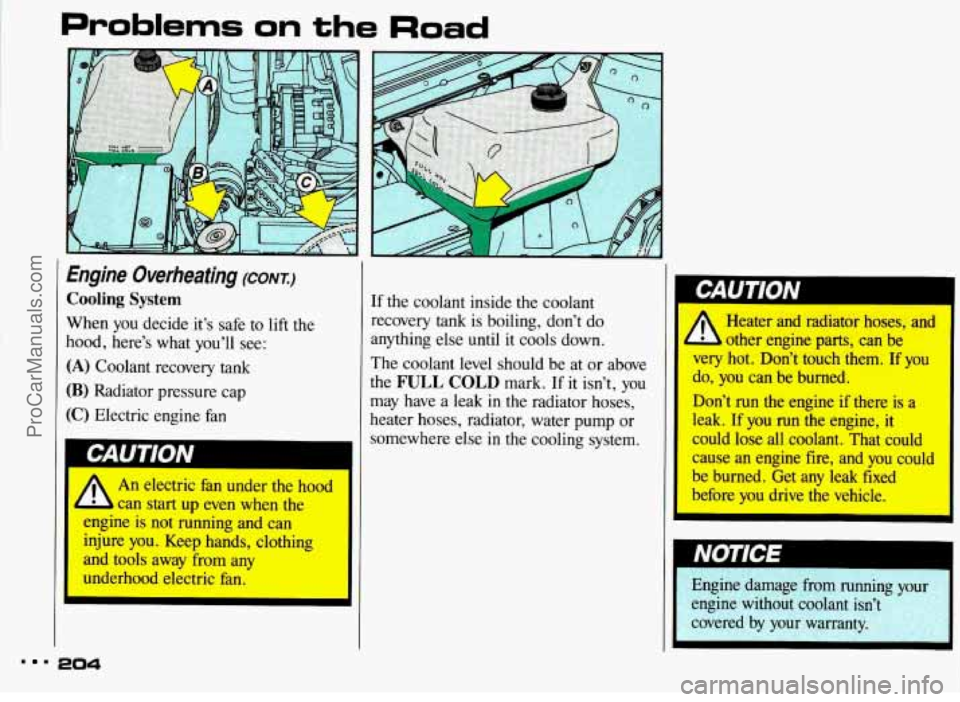
Engine Overheating (CONK)
Cooling System
When you decide it’s safe to
lift the
hood, here’s what you’ll see:
(A) Coolant recovery tank
(B) Radiator pressure cap
(C) Electric engine fan
An
electric fan under the hood
h can start up even when the
engine is not running and can
injure
you. Keep hands, clothing
and tools away from any
underhood electric fan.
If the coolant inside the coolant
recovery tank is boiling, don’t do
anything else
until it cools down.
The coolant level should be at or above
the
FULL COLD mark. If it isn’t, you
may have a leak
in the radiator hoses,
heater hoses, radiator, water pump or
somewhere else
in the cooling system.
I I 1 Heater and radiator hoses, anc
- other engine parts, can be
very hot. Don’t touch them.
If you
do, you can be burned.
Don’t run the engine if there is a
leak.
If you run the engine, it
could lose all coolant. That could
cause an engine fire, and you could
be burned. Get any leak fixed
before you drive the vehicle.
I
Engine damage from running your
engine without coolant isn’t
covered by your warranty.
.. . 204
ProCarManuals.com
Page 206 of 322
should be running. If it isn’t, your
vehicle needs service.
How
to Add Coolant to the Coolant
Recovery Tank:
If you haven’t found a problem yet, but
the coolant level isn’t up to the
FULL
COLD mark, add a 50/50 mixture of
clean water (preferably distilled) and a
proper antifreeze at the coolant recovery
tank. See the Index under Coolant for
more information about the proper
coolant mix.
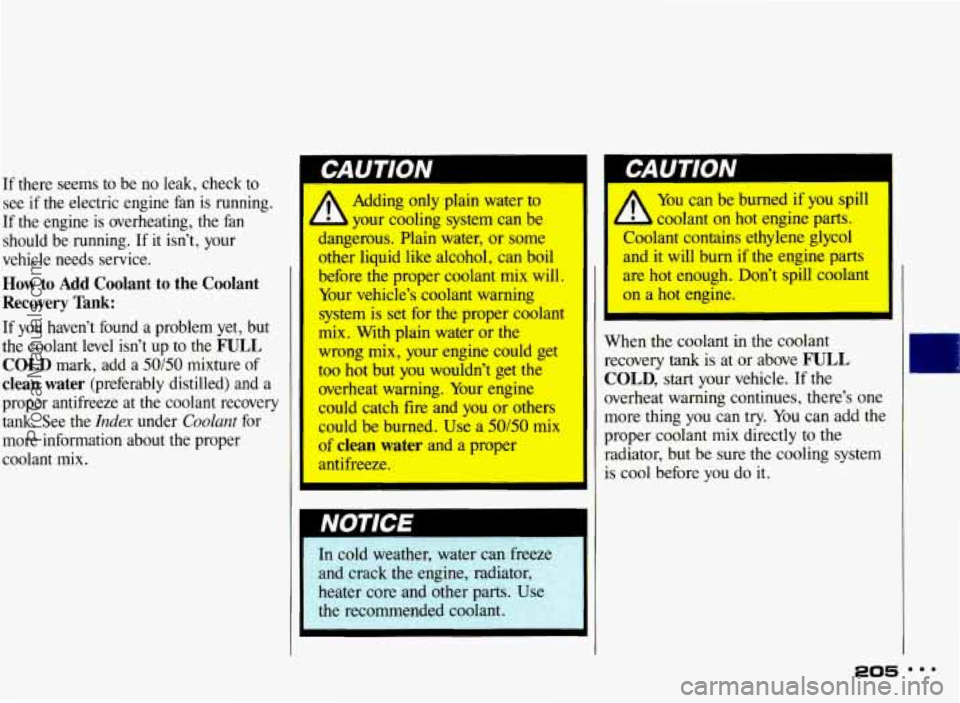
I b-Au I IUN If there seems to be no leak, check to
see
if the electric engine fan is running. Adding only plain water to
If the engine is overheating, the fan L your cooling system can be
dangerous. Plain water, or some
other liquid like alcohol, can boil
before the proper coolant
mix will.
Your vehicle’s coolant
warning
,k L
You can be burned if you spill
coolant on
hot engine parts.
Coolant contains ethylene glycol
and it will burn if the engine parts
are
hot enough. Don’t spill coolant
on a hot engine.
system is set for the proper coolant
I
mix. With plain water or the
too hot but you wouldn’t get the
overheat warning. Your engine
could catch fm and you or others
be Use a mix
of clean water and a proper
antifreeze. When
the coolant in the coolant
COLD, start your vehicle. If the
overheat warning continues, there’s one
proper coolant mix directly
to the
more
thing you can try. You can add the
radiator, but be sure the cooling system
is cool before
you do it.
wrong
mix, Your
engine could get recovery tank is at or above FULL
I
In cold weather, water can freeze II
and crack the engine, radiator,
heater core and other
parts. Use
the recommended coolant.
I
r
205 ”
ProCarManuals.com
Page 209 of 322
Problems on the Road
I Engine Overheating (CONT.)
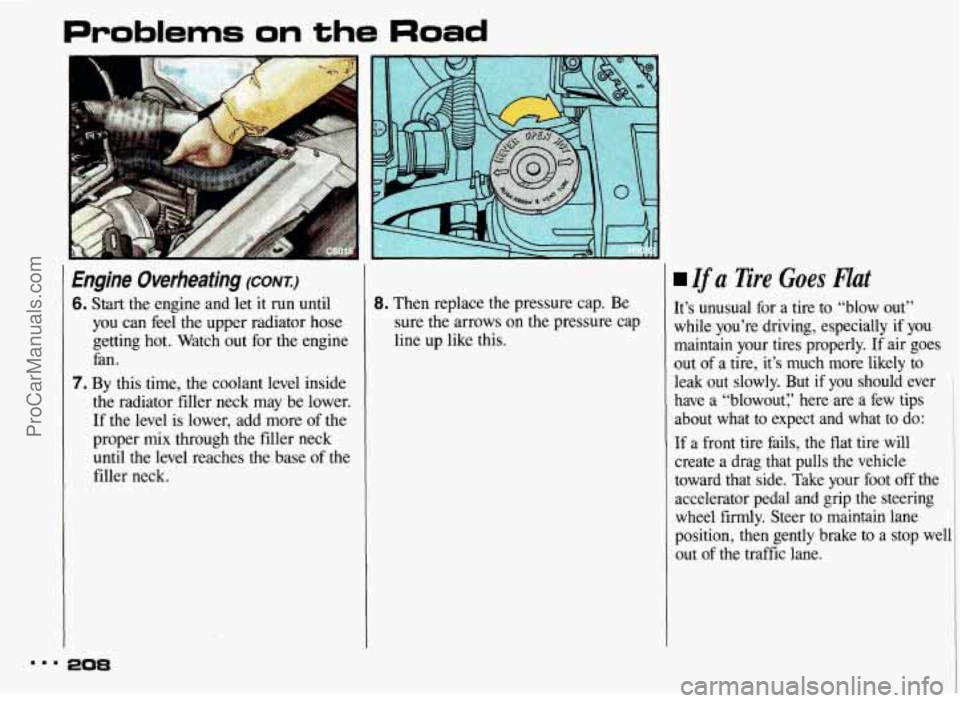
6. Start the engine and let it run until
you can feel the upper radiator hose
getting hot. Watch out for the engine
fan.
7. By this time, the coolant level inside
the radiator filler neck may be lower.
If the level is lower, add more of the
proper mix through the filler neck
until the level reaches the base of the
filler neck.
8. Then replace the pressure cap. Be
sure the arrows on the pressure cap
line up like this.
Ifa Tire Goes Flat
It’s unusual for a tire to “blow out”
while you’re driving, especially if you
maintain your tires properly. If air goes
out of a tire, it’s much more likely to
leak out slowly. But
if you should ever 1
have a “blowout:’ here are a few tips
about what to expect and what to do:
If a front tire fails, the flat tire will
create a drag that pulls
the vehicle
toward that side. Take your foot off the accelerator pedal and grip the steering
wheel firmly. Steer
to maintain lane
position,
then gently brake to a stop well
out of the traffic lane.
ProCarManuals.com
Page 222 of 322
Part 6
I .
COO25
Here you will find information
about the care of your Pontiac
. This
part begins with service and fuel
information. and then it
shows how
to check important fluid and
lubricant levels
. There is also
technical information about your
vehicle. and
a section devoted to its
appearance care
.
Service G Appearance Care
Service ............................. .................. 222
Fuel
......................................................... 222
Engineoil
...................................................... 231
HoodRelease
.................................................... 227
Aircleaner
..................................................... 233
TransaxleFluid
.................................................. 236
Enginecoolant
.................................................. 238
Power Steering Fluid
.............................................. 242
Windshield Washer Fluid
........................................... 242
Bulb Replacement
.............................................. 246
Loading Your Vehicle
............................................. 248
Appearance Care
................................................. 257
Vehicle Identification Number (VIN)
................................. 264
Add-on Electrical Equipment
....................................... 265
Fuses
& Circuit Breakers ........................................... 266
Capacities
& Specifications ......................................... 270
Normal Maintenance Replacement Parts
............................... 271
Fluids
& Lubricants ............................................... 272
Replacement Bulbs
................................................ 273
Brakes
......................................................... 243
Battery
.......................................................... 245
Windshield Wiper Blade Replacement
...................... ....... 248
Tires
.......................................................... 250
221 ...
ProCarManuals.com
Page 239 of 322
Service & Appearance Care
Automatic Transaxle Fluid (CONTJ
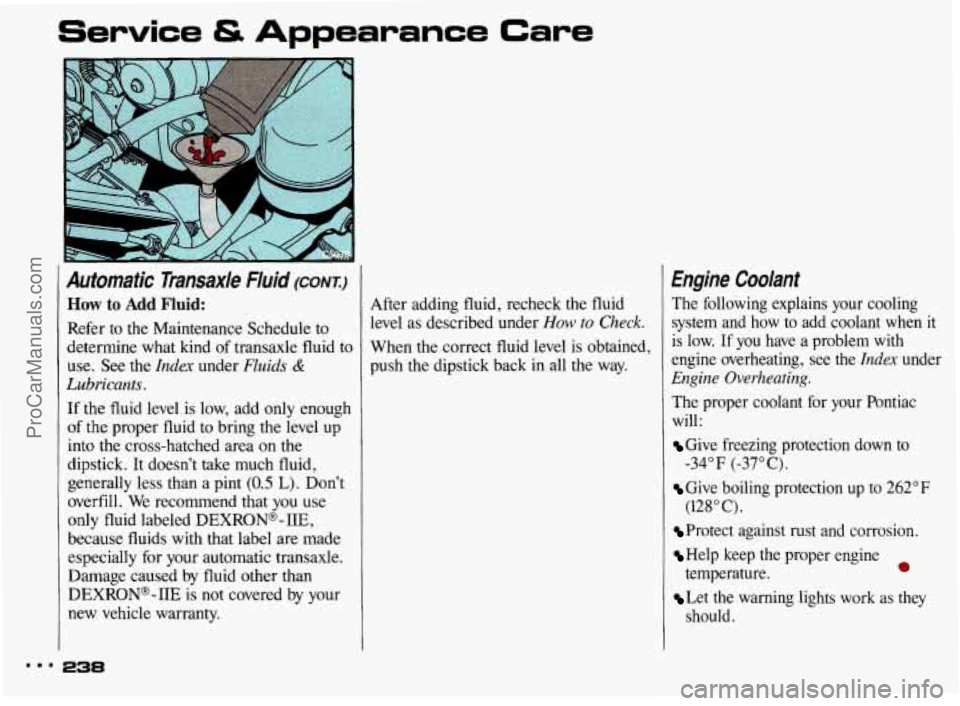
How to Add Fluid:
Refer to the Maintenance Schedule to
determine what kind
of transaxle fluid to
use. See the
Index under Fluids &
Lubricants.
If the fluid level is low, add only enough
of the proper fluid to bring
the level up
into the cross-hatched area on the
dipstick. It doesn't take much fluid,
generally less than a pint
(0.5 L). Don't
overfill. We recommend that you use
only fluid labeled DEXRON@-IIE,
because fluids with that label are made
especially for your automatic transaxle.
Damage caused by fluid other than
DEXRON@-IIE is not covered by your
new vehicle warranty. After adding
fluid, recheck the fluid
level as described under
How to Check.
When the correct fluid level is obtained,
push the dipstick back
in all the way.
Engine Coolant
The following explains your cooling
system and how to add coolant when
it
is low. If you have a problem with
engine overheating, see the Index under
Engine Overheating.
The proper coolant for your Pontiac
will:
Give freezing protection down to
Give boiling protection up to 262°F
Protect against rust and corrosion.
-34°F (-37°C).
(128" C).
Help keep the proper engine
temperature.
a
Let the warning lights work as they
should.
I.. 238
ProCarManuals.com
Page 241 of 322
Service & Appearance Care
A’
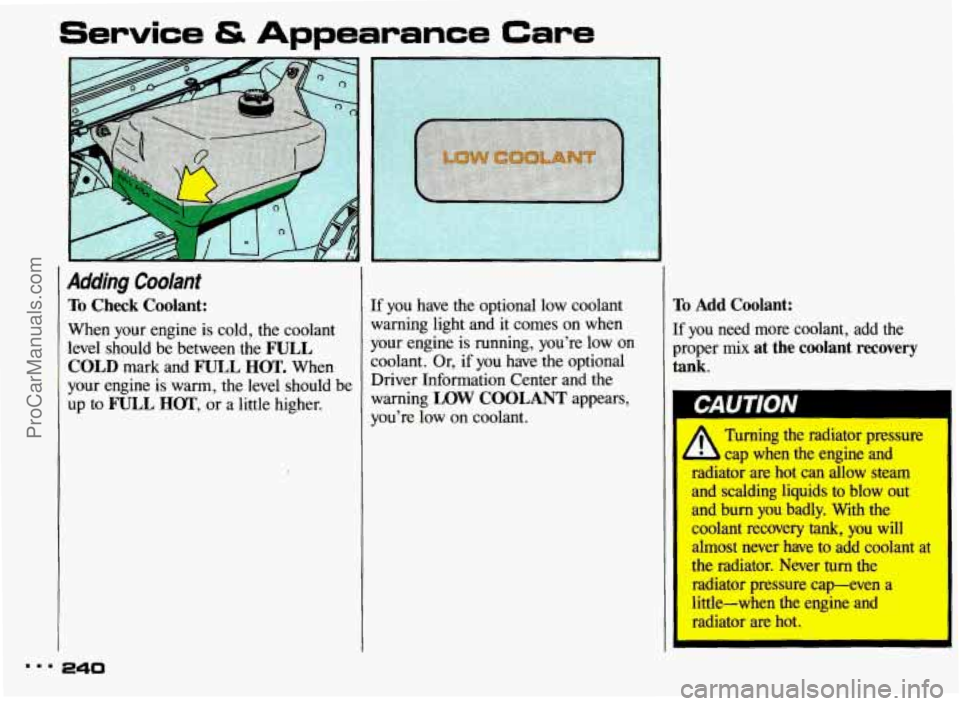
Adding Coolant
To Check Coolant:
When your engine is cold, the coolant
level should be between the
FULL
COLD mark and FULL HOT. When
your engine is warm, the level should be
up
to FULL HOT, or a little higher.
m.. 240
If you have the optional low coolant
warning light and it comes on when
your engine is running, you’re low on
coolant. Or, if you have the optional
Driver Information Center and the
warning
LOW COOLANT appears,
you’re low on coolant.
To Add Coolant:
If you need more coolant, add the
proper
mix at the coolant recovery
tank.
II Turning the radiator pressure 1
- 1 cap when the engine and
raalator are hot can allow steam
and scalding liquids to blow out
and bum
you badly. With the
coolant recovery
tank, you will
almost never have to add coolant at
the radiator. Never
turn the
radiator pressure cap-even a
little-when the engine and
radiator are hot.
ProCarManuals.com
Page 268 of 322
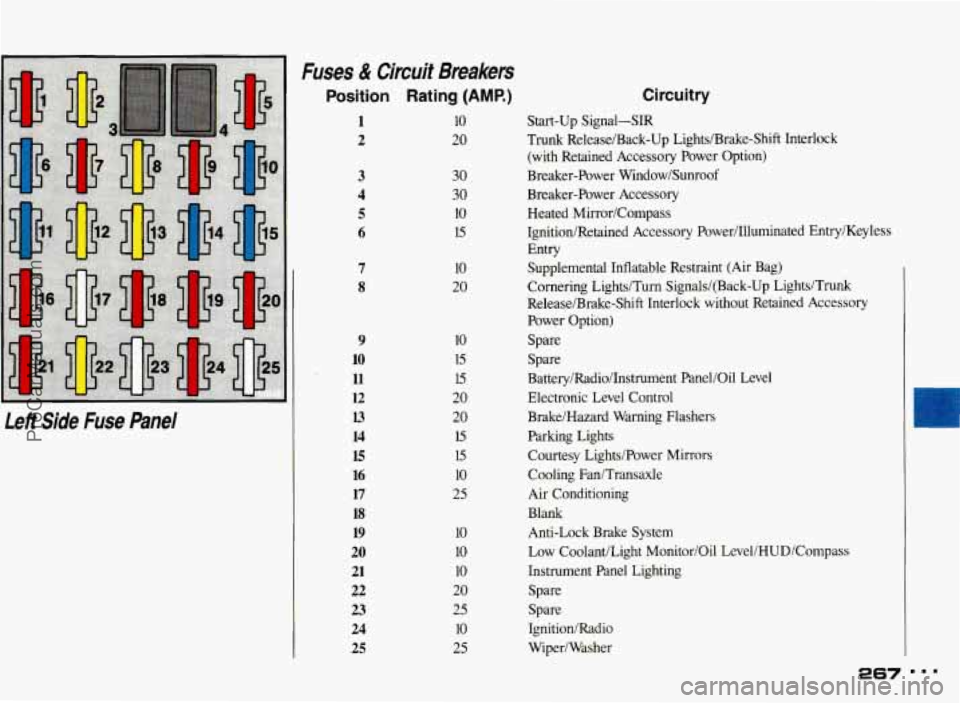
Left Side Fuse Panel Fuses
& Circuit Breakers
Position Rating (AMP.)
7
8
9
10
ll
12
13
14
15
16
17 18
19
20 21
22
23 24
25
10
20
30
30
10
15
10
20
10
15
15
20
20
15
15
10
25
10
10
10
20
25
10
25
Circuitry
Start-up Signal-SIR
Trunk Release/Back-Up Lights/Brake-Shift Interlock (with Retained Accessory Power Option)
Breaker-Power Window/Sunroof
Breaker-Power Accessory Heated Mirror/Compass
IgnitiodRetained Accessory Power/Illuminated EntryKeyless
Entry
Supplemental Inflatable Restraint (Air Bag)
Cornering Lights/Turn Signals/(Back-Up Lights/Trunk
Release/Brake-Shift Interlock without Retained Accessory Power Option)
Spare
Spare
Battery/Radio/Instrument Panel/Oil Level
Electronic Level Control
Brake/Hazard Warning Flashers Parking Lights Courtesy Lights/Power Mirrors
CooIing Fan/Transaxle
Air Conditioning
Blank Anti-Lock Brake System Low Coolant/Light Monitor/Oil Level/HUD/Compass
Instrument Panel Lighting Spare
Spare
IgnitiodRadio
WipedWasher
267
ProCarManuals.com