sensor PONTIAC BONNEVILLE 1993 Owners Manual
[x] Cancel search | Manufacturer: PONTIAC, Model Year: 1993, Model line: BONNEVILLE, Model: PONTIAC BONNEVILLE 1993Pages: 322, PDF Size: 16.31 MB
Page 26 of 322
..
A
d Q: When is an air bag expected to
inflate?
A: The air bag is designed to inflate in
x1210 I
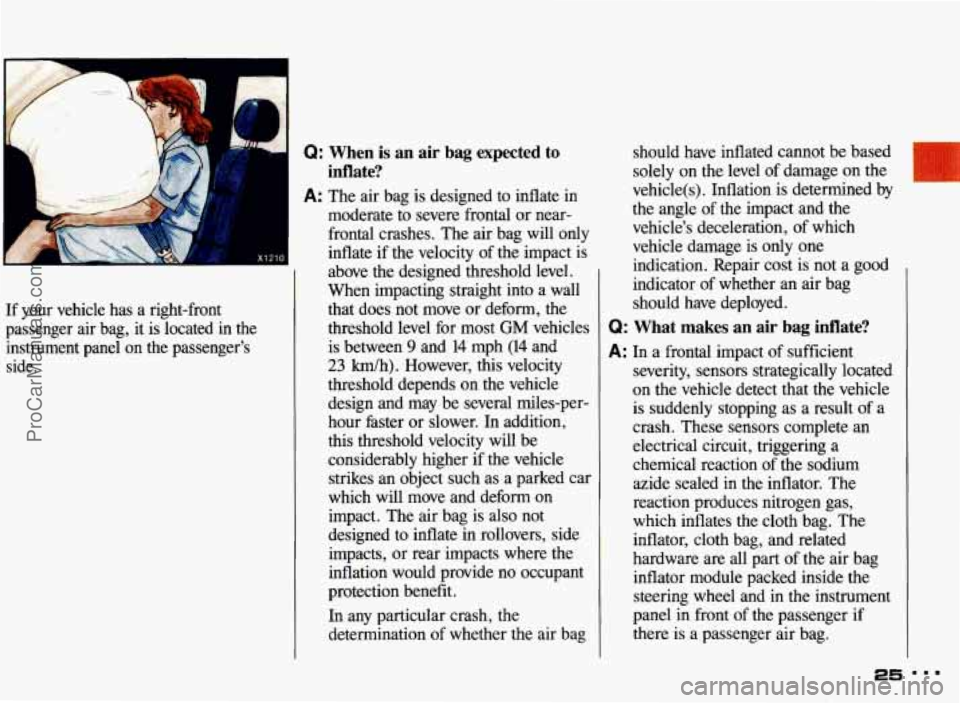
If your vehicle has a right-front
passenger air bag, it is located in the instrument panel on the passenger’s
side. moderate to severe
frontal or near-
frontal crashes. The air bag will only
inflate if the velocity
of the impact is
above the designed threshold level.
When impacting straight into a wall
that does not move or deform, the
threshold level for most
GM vehicles
is between
9 and 14 mph (14 and
23 km/h). However, this velocity
threshold depends on the vehicle
design and may be several miles-per-
hour faster or slower. In addition,
this threshold velocity will be
considerably higher
if the vehicle
strikes an object such as a parked car
which will move and deform on
impact. The air bag is also not
designed to inflate
in rollovers, side
impacts, or rear impacts where the
inflation would provide no occupant
protection benefit.
In any particular crash, the
determination of whether the air bag should
have inflated cannot be based
solely
on the level of damage on the
vehicle(s). Inflation is determined by
the angle of the impact and the
vehicle’s deceleration, of which
vehicle damage is
only one
indication. Repair cost is not a good
indicator of whether an air bag
should have deployed.
Q: What makes an air bag inflate?
A: In a frontal impact of sufficient
severity, sensors strategically located
on the vehicle detect that the vehicle
is suddenly stopping as
a result of a
crash. These sensors complete an
electrical circuit, triggering a
chemical reaction of the sodium
azide sealed in the inflator. The
reaction produces nitrogen gas,
which inflates the cloth bag. The
inflator, cloth bag, and related
hardware are all part of the air bag
inflator module packed inside the
steering wheel and in the instrument
panel in front of the passenger if
there is a passenger air bag.
26 DDD
ProCarManuals.com
Page 66 of 322
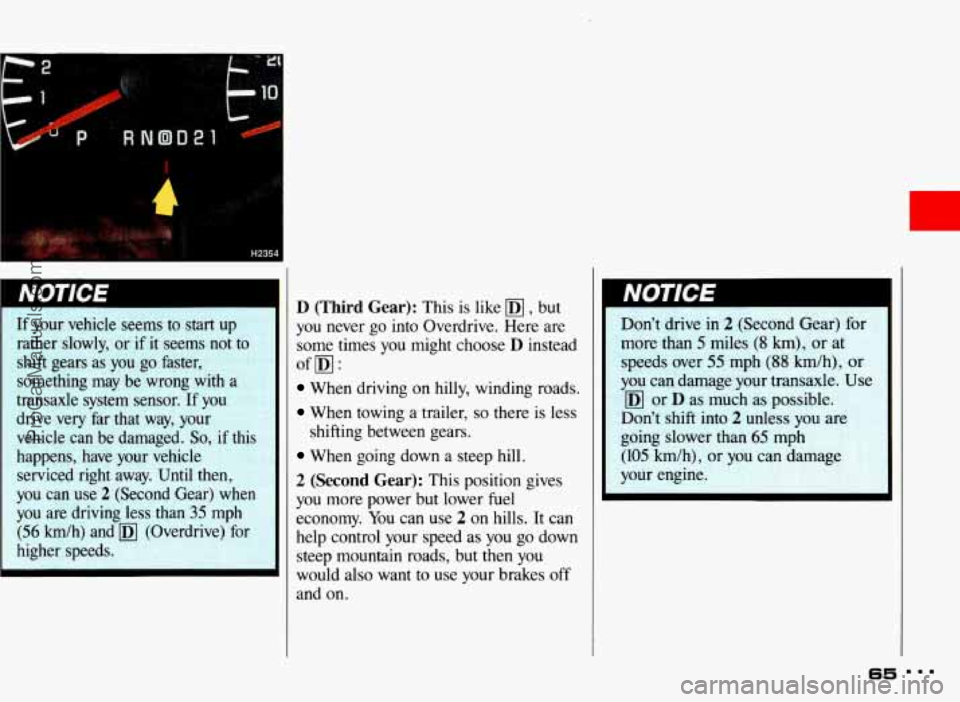
If your vehicle seems to start up
rather slowly, or if it seems not to
shift gears
as you go faster,
something may be wrong with a
transaxle system sensor. If you
drive very far that way, your
vehicle can be damaged.
So, if this
happens, have your vehicle
serviced right away. Until
then,
you can use 2 (Second Gear) when
vou are driving less than
35 mDh
i56 km/h) anza (0
higher speeds.
D (Third Gear): This is like , but
you never go into Overdrive. Here are
some times you might choose
D instead
When driving on hilly, winding roads.
When towing a trailer, so there is less
When going down a steep hill.
2 (Second Gear): This position gives
you more power but lower fuel
economy.
You can use 2 on hills. It can
help control your speed as you go down
steep mountain roads, but then you
would also want to use your brakes
off
and on.
ofm:
shifting between gears.
r
Don't drive in 2 (Second Gear) for I
more than 5 miles (8 km), or at
speeds over
55 mph (88 km/h), or
you
can damage your transaxle. Use
or
D as much as possible.
Don't shift into
2 unless you are
going slower than
65 mph
(105 km/h), or you can damage
your engine.
65 mmm
ProCarManuals.com
Page 84 of 322
Daytime Running Lights
(CANADA ONLY)
The Canadian federal government has
decided that Daytime Running Lights (DRL) are a useful feature,
in that DRL
can make your vehicle more visible
to
pedestrians and other drivers during
daylight hours. DRL are required
on
new vehicles sold in Canada.
Your DRL work
with a light sensor on
top of the instrument panel. Don't cover
it up. The low beam headlights will
come on at reduced brightness
in
daylight when:
The ignition is on
The headlight switch is off, and
The transaxle is not in P (Park). At
dusk, the exterior lights will come on
automatically and the low beams will
change
to full brightness. At dawn, the
exterior lights will go out and the low
beams
will change to the reduced
brightness of DRL
(if the headlight
switch
is off)..
Of course, you may still turn on the
headlights any time
you need to.
To idle your vehicle
with the DRL off,
shift the transaxle into
P (Park). The
DRL will stay off until you shift out of
P (Park).
At night, you can turn off all exterior
lights
when you are in P (Park) by
moving the Twilight Sentinel control all
the way past
MIN to turn it off, if it was
on.
If it was off, move the control to the
right to turn
it on, then back off. The
lights will come back on
when you put
the transaxle
in gear.
I
r
Headlight High-Low Beam
Changer
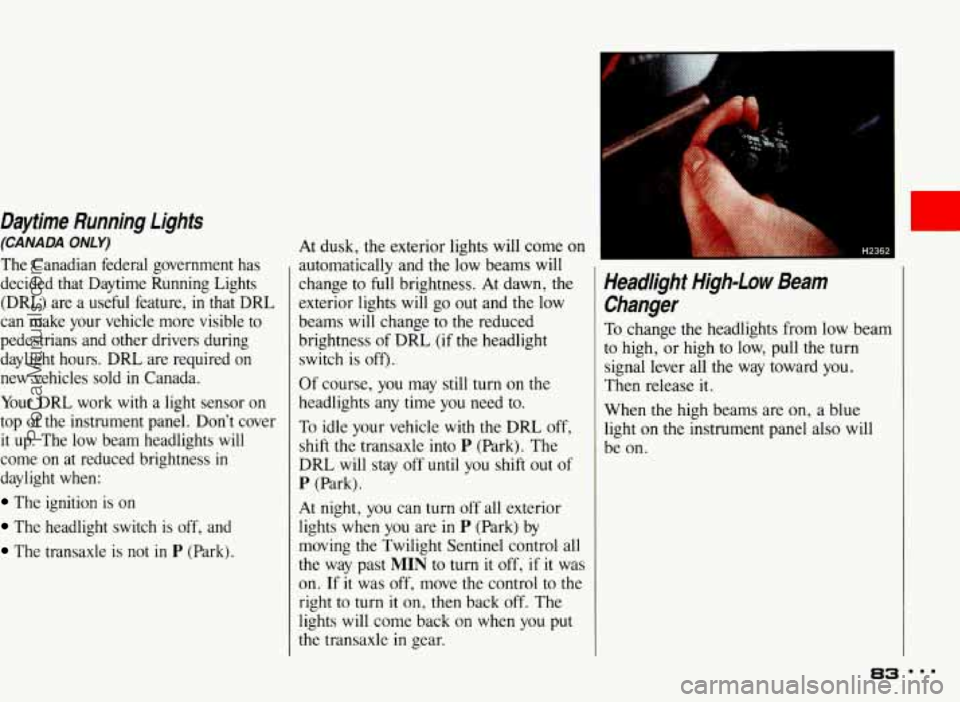
To change the headlights from low beam
to high, or high
to low, pull the turn
signal lever all the way toward you.
Then release it.
When the high beams are
on, a blue
light
on the instrument panel also will
be
on.
83 ...
ProCarManuals.com
Page 85 of 322
Features & Controls
Instrument Panel Intensity Control
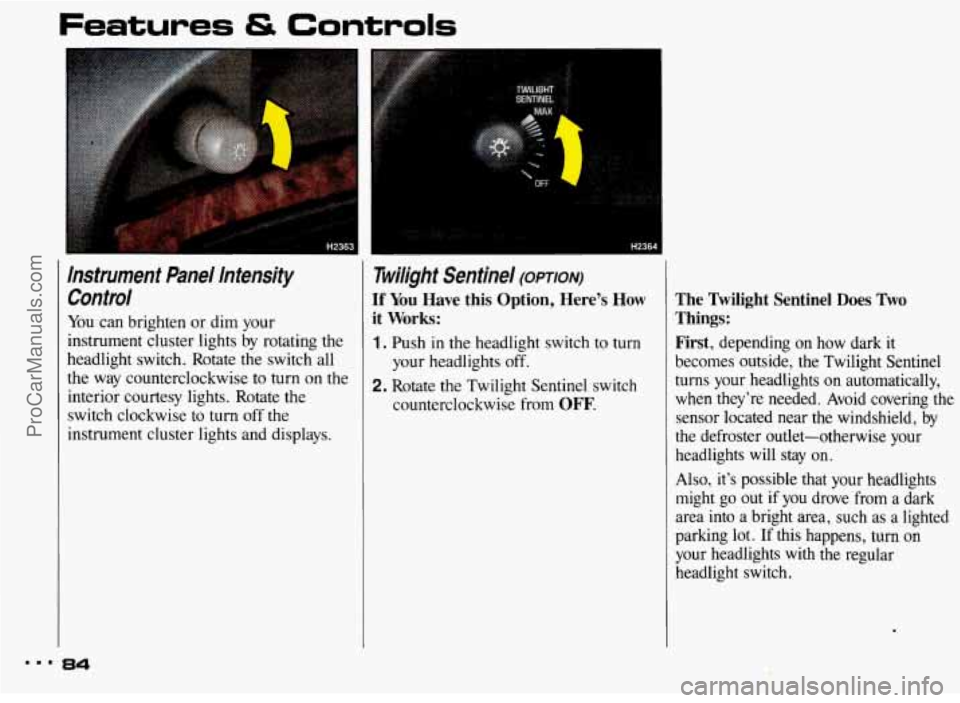
You can brighten or dim your
instrument cluster lights by rotating the
headlight switch. Rotate the switch all
the way counterclockwise to turn on the
interior courtesy lights. Rotate the
switch clockwise to turn off the
instrument cluster lights and displays.
~ Twilight Sentinel (opTIoN)
If You Have this Option, Here’s How
1. Push in the headlight switch to turn
2. Rotate the Twilight Sentinel switch
l it Works:
your headlights off.
counterclockwise from
OFF.
The Twilight Sentinel Does Two
Things: First,
depending on how dark it
becomes outside, the Twilight Sentinel
turns your headlights on automatically,
when they’re needed. Avoid covering the
sensor located near the windshield, by
the defroster outlet-otherwise your
headlights will
stay on.
Also, it’s possible that your headlights might go out if you drove from a dark
area into
a bright area, such as a lighted
parking lot. If this happens, turn on
your headlights with the regular
headlight switch.
mmm 84
ProCarManuals.com
Page 96 of 322
r
The Instrument &ne/-
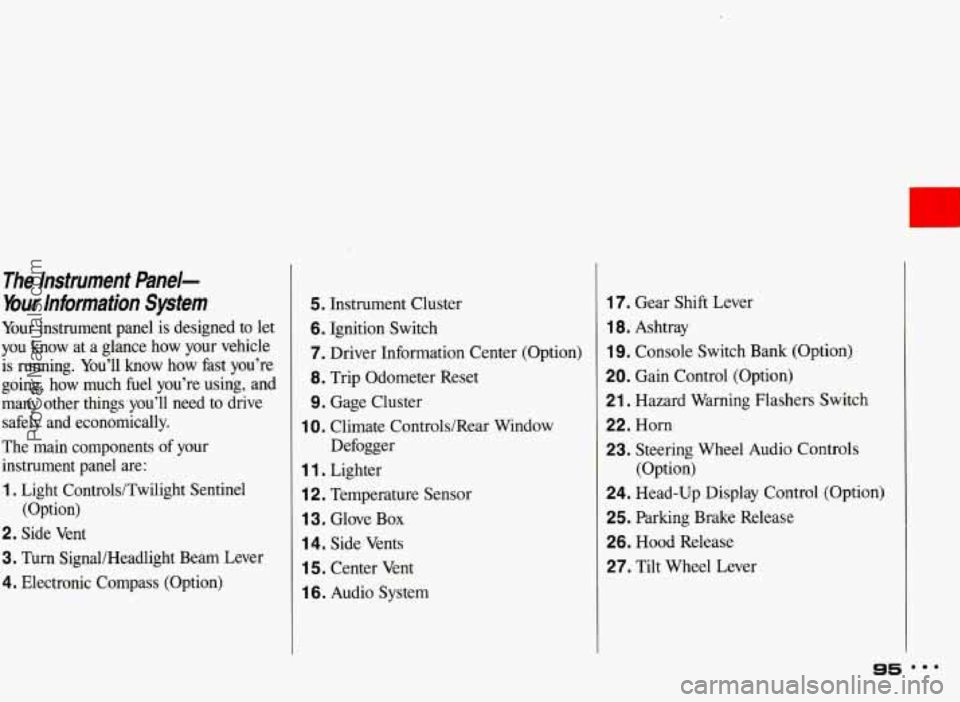
bur Information System
Your instrument panel is designed to let
you know at a glance how your vehicle
is running. You’ll know how fast you’re
going, how much fuel you’re using, and
many other things you’ll need to drive
safely and economically.
The main components of your
instrument panel are:
1. Light Controls/Twilight Sentinel
2. Side Vent
3. Turn SignaUHeadlight Beam Lever
4. Electronic Compass (Option) (Option)
5. Instrument Cluster
6. Ignition Switch
7. Driver Information Center
(Option)
8. Trip Odometer Reset
9. Gage Cluster
Defogger
1 0. Climate Controls/Rear Window
1 1 . Lighter
i 2. Temperature Sensor
1 3. Glove Box
14. Side Vents
1 5. Center Vent
1 6. Audio System
17. Gear Shift Lever
1 8. Ashtray
19. Console Switch Bank (Option)
20. Gain Control (Option)
21. Hazard Warning Flashers Switch
22. Horn
23. Steering Wheel Audio Controls
24. Head-Up Display Control (Option)
25. Parking Brake Release
26. Hood Release
27. Tilt Wheel Lever (Option)
95 mmm
ProCarManuals.com
Page 126 of 322
Extended Idling with Electronic Rear Venfs
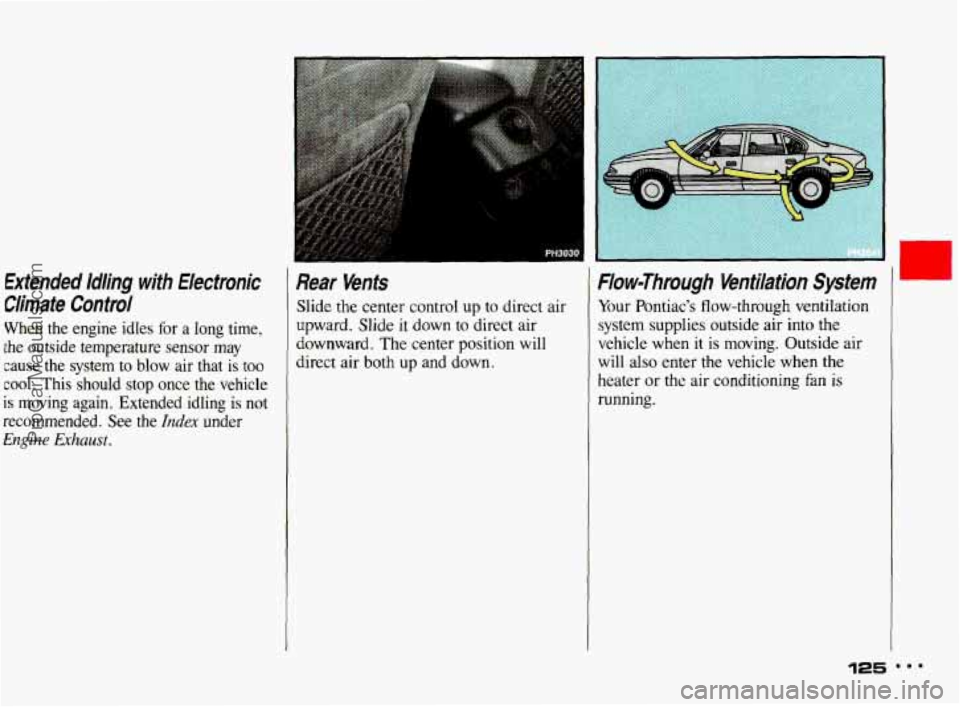
Ciimate Control Slide the center control up to direct air
When the engine idles for
a long time, Upward.
Slide it down to direct air
the outside temperature sensor
may
cool. This should stop once the vehicle
cause the system to blow air that is too direct air both UP and dOwn.
downward.
The center position will
recommended. See
the Index under
is moving again. Extended idling is not
Engine Exhaust.
Flow-Through Ventilation System
Your Pontiac's flow-through ventilation
system supplies outside air into the
vehicle when it is moving. Outside air
will also enter the vehicle when the
heater or the air conditioning
fan is
running.
125
ProCarManuals.com
Page 226 of 322
Fuels in Foreign Countries
tf you plan on driving in another
country outside the
U.S. or Canada,
unleaded fuel may be hard to find.
Do not use leaded gasoline. If you use
even one tankful, your emission controls
won’t work well or at all. With
continuous use, spark plugs can get
fouled, the exhaust system can corrode,
and your engine oil can deteriorate
quickly. Your vehicle’s oxygen sensor
will be damaged. All of that means
costly repairs that wouldn’t be covered
by your warranty. To
check on fuel availability, ask an auto
club, or contact a major oil company
that does business in the country where
you’ll be driving.
You can also write us at the following
address for advice. Just tell us where
you’re going and give your Vehicle
Identification Number (VIN).
General Motors
of Canada Ltd.
International
Export Sales
P. 0. Box 828
Oshawa, Ontario L1H 7N1, Canada
Fuel Door Lock (omoN)
On SSE and SSEi models equipped with
the Theft-Deterrent System option,
the
fuel door is locked and unlocked
together with the power door locks.
Therefore, to unlock the fuel filler door,
you may use the outside door key lock,
the inside power door lock button, or
the Remote Keyless Entry key chain
transmitter.
To unlock the fuel door, just
unlock the driver’s door.
225
ProCarManuals.com