check engine PONTIAC BONNEVILLE 1994 User Guide
[x] Cancel search | Manufacturer: PONTIAC, Model Year: 1994, Model line: BONNEVILLE, Model: PONTIAC BONNEVILLE 1994Pages: 290, PDF Size: 14.75 MB
Page 103 of 290
Features & Controls
Oi/ Pressure Gage (OPTION)
(CONK)
Driving your vehicle with low oil
pressure can cause extensive engine
damage.
Ih
I I NOTICE:
I
Damage to your engine from
neglected oil problems can be costly
and is not covered by your warranty.
. . . 102
lo
il
s:
a
ir
SI
H230!
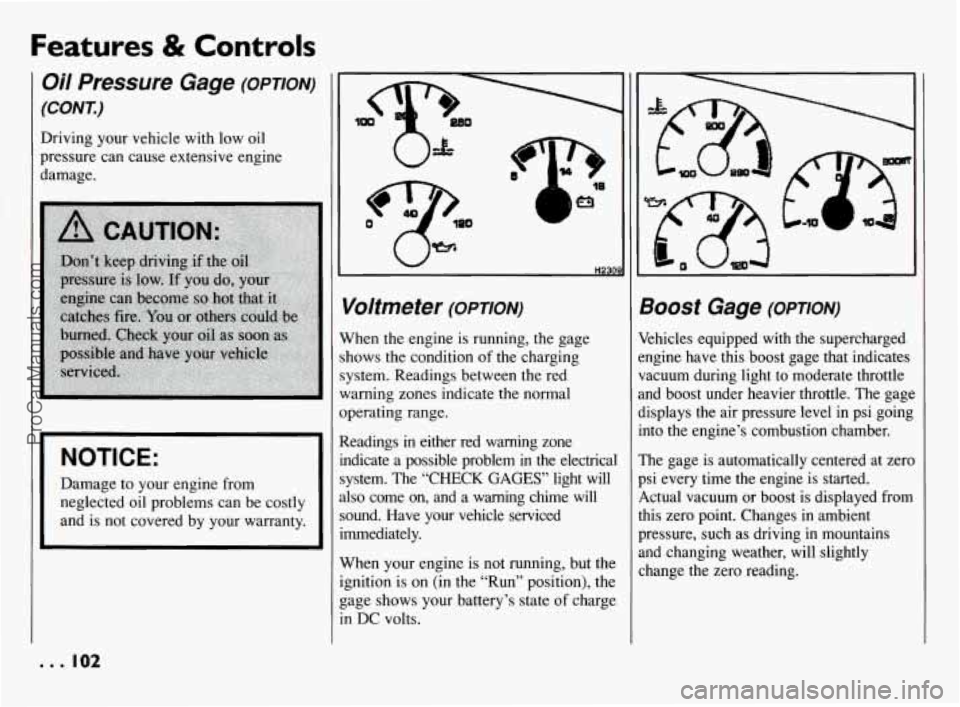
Voltmeter (omoN)
Vhen the engine is running, the gage
hows the condition of the charging
ystem. Readings between the red
Iarning zones indicate the normal
perating range.
Leadings
in either red warning zone
ldicate
a possible problem in the electrical
ystem. The “CHECK
GAGES’ light will
lso come on, and a warning chime will
ound. Have your vehcle serviced
mediately.
Vhen your engine is not running, but the
pition is on (in the “Run” position), the
age shows your battery’s state
of charge
I DC volts.
300St Gage (OPTION)
khicles equipped with the supercharged
ngine have this boost gage that indicates
acuum during light to moderate throttle
nd boost under heavier throttle. The gage
isplays the air pressure level in psi going
]to the engine’s combustion chamber.
‘he gage is automatically centered at zero
si every time the engine is started.
,ctual vacuum or boost is displayed from
lis zero point. Changes in ambient
ressure, such as driving in mountains
nd changing weather, will slightly
hange the zero reading.
ProCarManuals.com
Page 121 of 290
Comfort Controls 8i Audio Systems
Audio Systems (CONT.)
NOTICE: c’
Before you add any sound
equipment to your vehicle
-- like a
tape player,
CB radio, mobile
telephone or two-way radio
-- be
sure you can add what you want.
If
you can, it’s very important to do it
properly. Added sound equipment
may interfere with the operation
of
your vehicle’s engine, Delco@ radio
or other systems, and even damage
them. And, your vehicle’s systems
may interfere with the operation
of
sound equipment that has been
added improperly.
So, before adding sound equipment,
check with your dealer and be sure
to check Federal rules covering
mobile radio and telephone units.
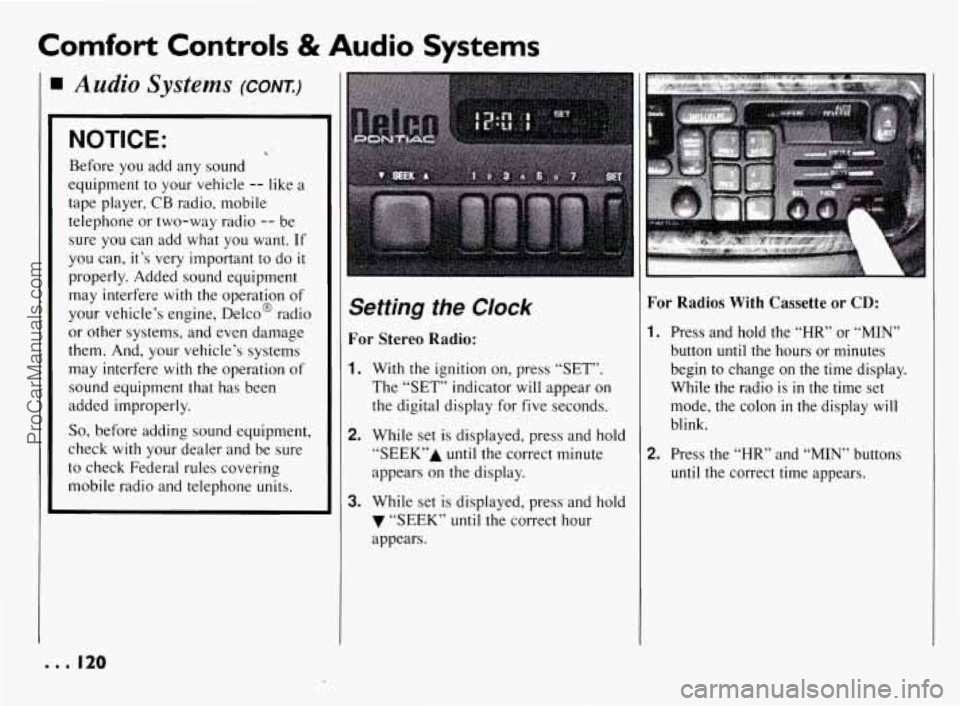
Setting the Clock
For Stereo Radio:
1. With the ignition on, press “SET”.
The “SET” indicator will appear on
the digital display for five seconds.
2. While set is displayed, press and hold
“SEEK7’A until the correct minute
appears on the display.
3. While set is displayed, press and hold
7 “SEEK” until the correct hour
appears.
For Radios With Cassette or CD:
I. Press and hold the “HR” or “MIN”
button until the hours or minutes
begin to change on the time display.
While the radio is
in the time set
mode, the colon
in the display will
blink.
2. Press the “HR” and “MIN” buttons
until the correct time appears.
e.. I20
ProCarManuals.com
Page 153 of 290
Your Driving and the Road
H Freeway Driving (CONK)
along the entrance ramp, you should
begin to check traffic. Try to determine
where you expect to blend with the flow.
Try
to merge into the gap at close to the
prevailing speed. Switch on your turn
signal, check your mirrors and glance
over your shoulder as often as necessary.
Try to blend smoothly with the traffic
flow.
Once you are
on the freeway, adjust your
speed to the.posted limit or to the
prevailing rate if it’s slower. Stay in the
right lane unless
you want to pass.
Before changing lanes, check your
mirrors. Then use your turn signal.
Just before you leave the lane, glance
quickly over your shoulder to make sure
there isn’t another vehicle in your “blind”
spot.
Once you are moving
on the freeway,
make certain you allow a reasonable
following distance. Expect to move
slightly slower at night.
When you want to leave the freeway,
move to the proper lane well
in advance.
If you miss your exit do not, under any
,.. 152
circumstances, stop and back up. Drive on
to the next exit.
The exit ramp can be curved, sometimes
quite sharply.
The exit speed
is usually posted.
Reduce your speed according to your
speedometer, not to your sense of motion.
After driving for any distance at higher
speeds, you may tend to think
you are
going slower than you actually are.
Before Leaving on a
Long Trip
Make sure you’re ready. Try to be well
rested.
If you must start when you’re not
fresh
-- such as after a day’s work --
don’t plan to make too many miles that
first part
of the journey. Wear comfortable
clothing and shoes you can easily drive
in.
Is your vehicle ready for a long trip? If
you keep it serviced and maintained, it’s
ready to go. If it needs service, have it
done before starting out. Of course, you’ll
find experienced and able service experts
in Pontiac dealerships all across North America. They’ll
be ready and willing to
help if you need it.
Here are some things
you can check
before a trip:
0 Windshield Washer Fluid: Is the
reservoir full? Are all windows clean
inside and outside?
0 Wiper Blades: Are they in good
shape?
0 Fuel. Engine Oil. Other Fluids: Have
you checked all levels?
0 Lights: Are they all working? Are the
lenses clean?
Tires: They are vitally important to a
safe, trouble-free trip.
Is the tread
good enough for long-distance
driving? Are the tires all inflated to
the recommended pressure?
0 Weather Forecasts: What’s the weather outlook along your route?
Should you delay your trip a short
time to avoid a major storm system?
Maps: Do you have up-to-date maps?
ProCarManuals.com
Page 163 of 290
Your Driving and the Road
Driving with a Trailer
(CONT.)
Following Distance
Stay at least twice as far behind the
vehicle ahead as you would when driving
your vehicle without a trailer. This can
help you avoid situations that require
heavy braking and sudden turns.
Passing
You’ll need more passing distance up
ahead when you’re towing a trailer. And,
because you’re a good deal longer, you’ll
need to
go much farther beyond the
passed vehicle before you can return to
your lane.
Backing Up
Hold the bottom of the steering wheel
with one hand. Then, to move the trailer
to the left, just move that hand to the left.
To move the trailer to the right, move
your hand to the right. Always back up
slowly and,
if possible, have someone
guide you.
Making Turns
When you’re turning with a trailer, make
wider turns than normal. Do this
so your
trailer won’t strike soft shoulders, curbs,
road signs, trees, or other objects. Avoid
jerky or sudden maneuvers. Signal well
in
advance.
Turn Signals When Towing a Trailer
When you tow a trailer, your vehicle has
to have a different turn signal flasher and
extra wiring. The green arrows on your
instrument panel will flash whenever you
signal a turn or lane change. Properly
hooked up, the trailer lights will also
flash, telling other drivers you’re about to
turn, change lanes or stop.
When towing a trailer, the green arrows
on your instrument panel will flash for
turns even if the bulbs on the trailer are
burned out. Thus, you may think drivers
behind you are seeing your signal when
they are not. It’s important to check
occasionally to be sure the trailer bulbs
are still working. Your
vehicle has bulb warning lights.
When you plug trailer lights into your
vehicle’s lighting system, its bulb warning
lights may not let
you know if one of your
lights goes out.
So, when you have trailer
lights plugged
in, be sure to check your
vehicle and trailer lights from time
to time
to be sure they’re all working. Once you
disconnect the trailer lights, the bulb
warning lights again can tell you if one
of
your vehicle lights is out.
Driving On Grades
Reduce speed and shift to a lower gear
before you start down a long or steep
downgrade. If you don’t shift down, you
might have to use your brakes
so much
that they would get hot and no longer
work well.
On a long uphill grade, shift down to “D”
(Drive) and reduce your speed to around
45 mph (70 km/h) to reduce the
possibility
of engine and transaxle
overheating.
Parking on Hills
You really should not park your vehicle,
with a trailer attached, on a hill. If
something goes wrong, your rig could
. 162
ProCarManuals.com
Page 164 of 290
Parking on Hills
You really should not park your vehicle,
with a trailer attached, on a hill.
If
something goes wrong, your rig could
start to move. People can be injured, and
both your vehicle and the trailer can be
damaged.
But if you ever have to park your rig on a
hill, here’s how to do it:
1.
2.
3.
4.
5.
Apply your regular brakes, but don’t
shift into
“P” (Park) yet.
Have someone place chocks under the
trailer wheels.
When the wheel chocks are in place,
release the regular brakes until the chocks absorb the load.
Reapply the regular brakes. Then
apply your parking brake, and then shift to
“F”’ (Park).
Release the regular brakes.
When You Are Ready to Leave After
Parking
on a Hill
1.
2.
3.
4.
Apply your regular brakes and hold
the pedal down while you:
0 Start your engine;
Shift into a gear; and
0 Release the parking brake.
Let up on the brake pedal.
Drive slowly until the trailer is clear
of the chocks.
Stop and have someone pick up and
store the chocks.
Maintenance When Trailer Towing
Your vehicle will need service more often
when you’re pulling a trailer.
See the
Maintenance Schedule for more
on this.
Things that are especially important in
trailer operation are automatic transaxle
fluid (don’t overfill), engine oil, belt(s),
cooling system, and brake adjustment,
Each
of these is covered in this manual,
and the Index will help you find them
quickly. If you’re trailering, it’s a good
idea to review these sections before. you
start your trip.
Check periodically to
see that all hitch
nuts and bolts are tight.
,j.;
i .a
1. i
,
.?.
163...
ProCarManuals.com
Page 169 of 290
Problems on the Road
To Jump Start Your
Pontiac: (CONK)
You could be injured if the vehicles
roll. Set the parking brake firmly
on each vehicle. Put an automatic
transaxle
in “P” (Park) or a manual
transaxle
in “N” (Neutral).
3. Turn off the ignition on both vehicles.
Turn
off all lights that aren’t needed,
and radios. This will avoid sparks and
help save both batteries. And
it could
save your radio!
NOTICE:
~ ~~ ~~
If you leave your radio on, it could be
badly damaged. The repairs wouldn’t
be covered by your warranty.
4. Open the hoods and locate the batteries.
5. Find the positive (+) and negative (-)
terminals on each battery.
Check that
the jumper cables don’t
have loose or missing insulation. If
they do, you could get a shock. The
vehicles could be damaged, too.
Before you connect the cables, here
are some basic things you should
know. Positive
(+) will go to positive
(+) and negative (-) will go to negative
(-) or a metal engine part. Don’t
connect
(+) to (-) or you’ll get a short
that would damage the battery and maybe other parts, too.
. . 168
ProCarManuals.com
Page 179 of 290
Problems on the Ro,ad
... .
I
Cooling System (CONT.)
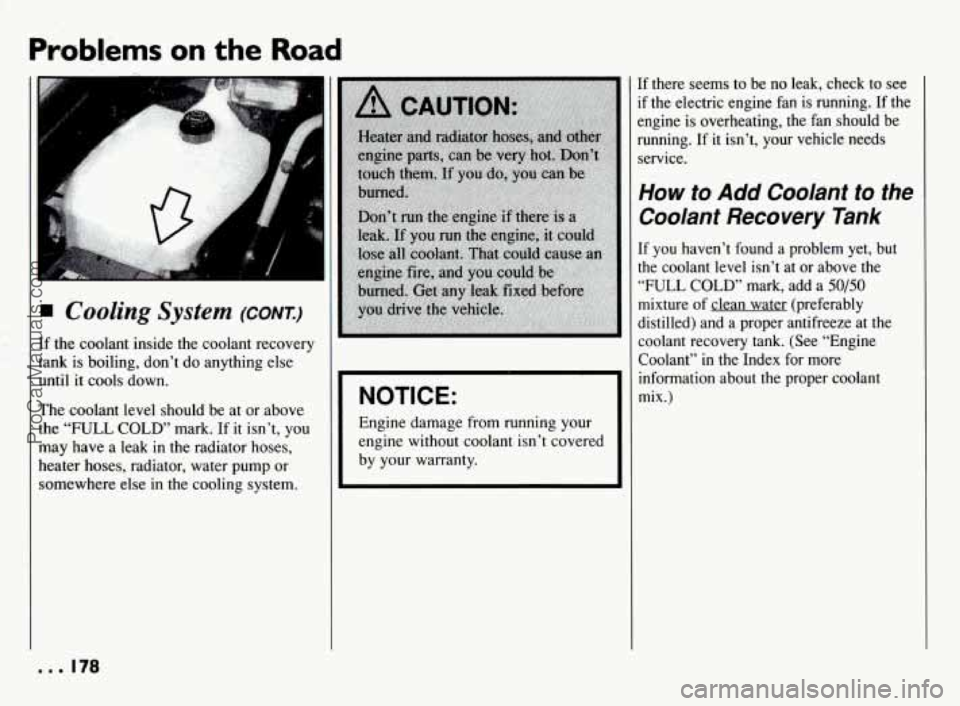
If the coolant inside the coolant recovery
tank is boiling, don’t do anything else
until it cools down.
The coolant level should be at or above
the “FULL COLD’ mark. If
it isn’t, you
may have a leak
in the radiator hoses,
heater hoses, radiator, water pump or
somewhere else in the cooling system.
NOTICE:
Engine damage from running your
engine without coolant isn’t covered
by your warranty.
If there seems to be no leak, check to see
if the electric engine fan is running. If the
engine
is overheating, the fan should be
running. If it isn’t, your vehicle needs
service.
How to Add Coolant to the
Coolant Recovery Tank
If you haven’t found a problem yet, but
the coolant level isn’t
at or above the
“FULL COLD’ mark, add
a 50/50
mixture of clean water (preferably
distilled) and
a proper antifreeze at the
coolant recovery tank. (See “Engine Coolant”
in the Index for more
information about the proper coolant
mix.)
... 178
ProCarManuals.com
Page 197 of 290

Service & Appearance Care
MTBE is “methyl tertiary-butyl ether.”
Fuel that is no more than 15% MTBE is
fine
for your vehicle.
Ethanol is ethyl or grain alcohol.
Properly-blended fuel that is no more
than
10% ethanol is fine for your vehicle
Methanol is methyl or wood alcohol.
NOTICE:
Fuel that is more than 5% methanol
is bad for your vehicle. Don’t use it.
It can corrode metal parts
in your
fuel system and also damage plastic
and rubber parts. That damage
wouldn’t be covered under your
warranty. And even at
5% or less,
there must be “cosolvents” and
corrosion preventers
in this fuel to
help avoid these problems.
Gasolines for Cleaner Air
Your use of gasoline with deposit control
additives will help prevent deposits from
forming in your engine and fuel system.
That helps keep your engine
in tune and
your emission control system working
properly. It’s good for your vehicle, and
you’ll be doing your part for cleaner air.
Many gasolines are now blended with
oxygenates. General Motors recommends
that you use gasolines with these blending
materials, such as MTBE and ethanol. By
doing so, you can help clean the air,
especially
in those parts of the country
that have high carbon monoxide levels.
In addition, some gasoline suppliers are
now producing reformulated gasolines.
These gasolines are specially designed to
reduce vehicle emissions. General Motors recommends that you use reformulated
gasoline. By doing
so, you can help clean
the air, especially
in those parts of the
country that have high ozone levels.
You should ask your service station
operators
if their gasolines contain deposit
control additives and oxygenates, and if
they have been reformulated to reduce
vehicle emissions.
r
Countries
If you plan on driving in another country
outside the
U.S. or Canada, unleaded fuel
may ‘be hard to find.
Do not use leaded
gasoline. If you use even one
tankful, your
emission controls won’t work well
or at
all. With continuous use, spark plugs can
get fouled, the exhaust system can corrode,
and your engine
oil can deteriorate quickly.
Your vehicle’s oxygen sensor
will be
damaged. All of that means costly repairs
that wouldn’t be covered by your warranty.
To check on fuel availability, ask an auto
club,
or contact a major oil company that
does business
in the country where you’ll
be driving.
. . 196
ProCarManuals.com
Page 204 of 290
n
D
~~ ~~~ ~~ ~ ~~~~ ~ ~ ~
Engine Accessory Belt
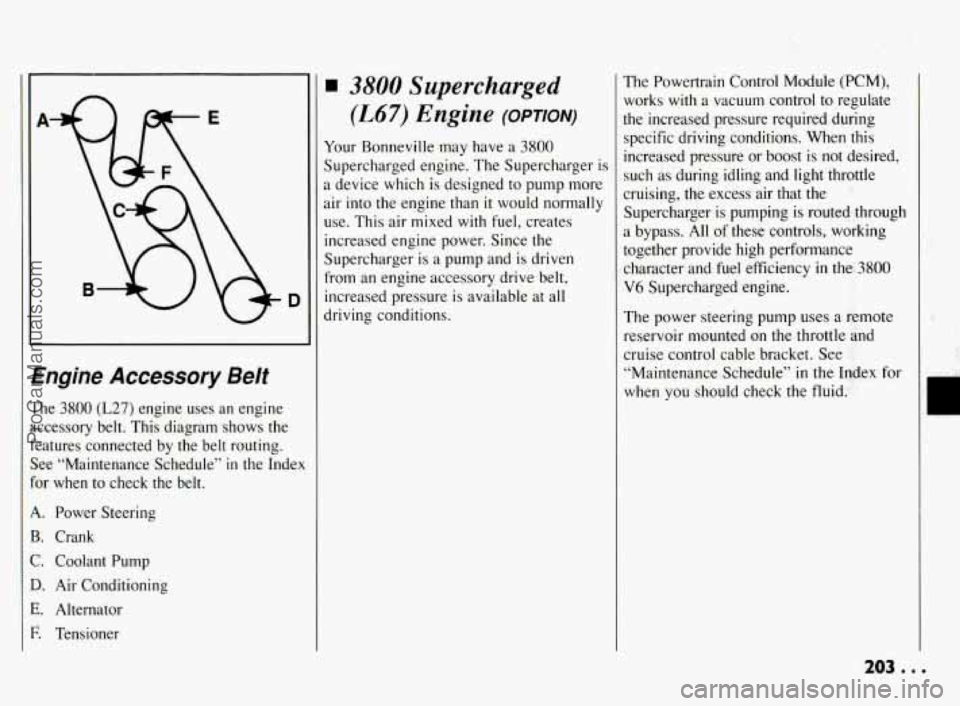
The 3800 (L27) engine uses an engine
accessory belt. This diagram shows the
features connected by the belt routing.
See “Maintenance Schedule’’
in the Index
for when to check the belt.
A. Power Steering
B. Crank
C. Coolant Pump
D. Air Conditioning
E. Alternator
F. Tensioner
3800 Supercharged
(L67) Engine (OPTION)
Your Bonneville may have a 3800
Supercharged engine. The Supercharger is
a device which is designed to pump more
air into the engine than
it would normally
use. This air mixed
with fuel, creates
increased engine power. Since the
Supercharger is a pump and is driven
from an engine accessory drive belt,
increased pressure is available at all
driving conditions, The Powertrain Control
Module
(PCM),
works with a vacuum control to regulate
the increased pressure required during
specific driving conditions. When this
increased pressure or boost is
not desired,
such as during idling and light throttle
cruising, the excess air that the
’
Supercharger is pumping is routed,through
a bypass. All of these controls, working
together provide high performance
character and fuel efficiency
in the3800
V6 Supercharged engine.
The power steering pump uses a Remote
reservoir mounted on the throttle wd
cruise control cable bracket. See
“Maintenance Schedule”
in the Index for
when you should check the fluid:
ProCarManuals.com
Page 205 of 290
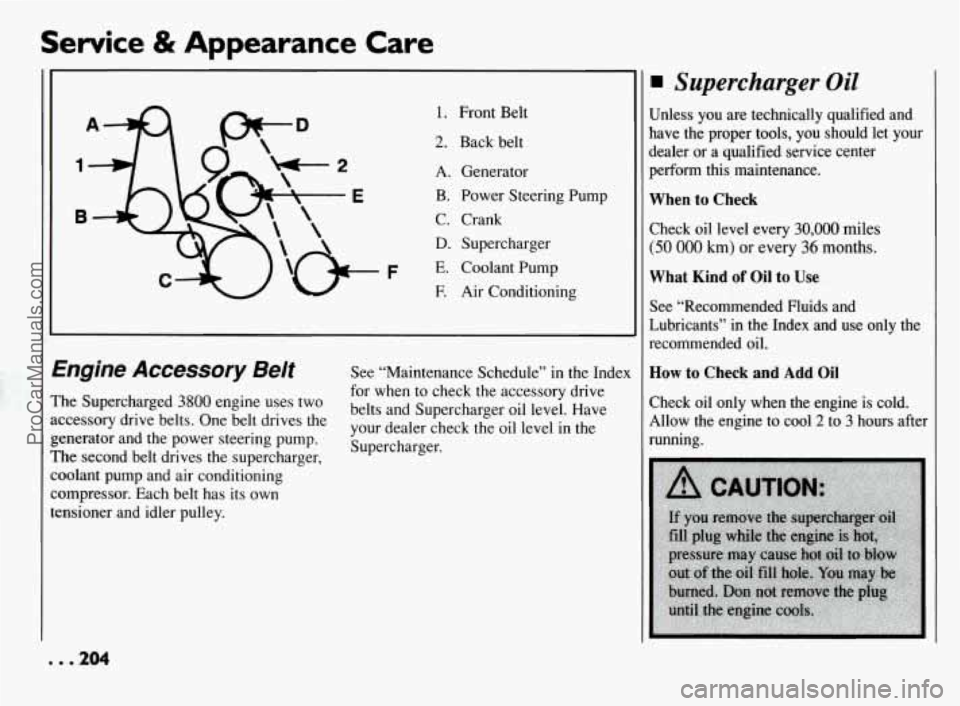
Service & Appearance Care
F
1.
2.
A.
B.
C.
D.
E.
E
Front Belt
Back belt
Generator
Power Steering Pump
Crank Supercharger
Coolant Pump
Air Conditioning
tngine Accessory Belt
‘he Supercharged 3800 engine uses two
ccessory drive belts. One belt drives the
enerator and the power steering pump.
‘he second belt drives the supercharger,
oolant pump and air conditioning
ompressor. Each belt has its own
msioner and idler pulley.
. . 204
See “Maintenance Schedule” in the Index
for when to check the accessory drive
belts and Supercharger oil level. Have
your dealer check the oil level in the
Supercharger.
Supercharger Oil
Unless you are technically qualified and
have the proper tools, you should let your
dealer or a qualified service center
perform this maintenance.
When to Check
Check oil level every 30,000 miles
(50 000 km) or every 36 months.
What Kind of Oil to Use
See “Recommended Fluids and
Lubricants” in the Index and use only the
recommended oil.
How to Check and Add Oil
Check oil only when the engine is cold.
Allow the engine to cool
2 to 3 hours after
running.
ProCarManuals.com