check engine light PONTIAC BONNEVILLE 1994 User Guide
[x] Cancel search | Manufacturer: PONTIAC, Model Year: 1994, Model line: BONNEVILLE, Model: PONTIAC BONNEVILLE 1994Pages: 290, PDF Size: 14.75 MB
Page 153 of 290
Your Driving and the Road
H Freeway Driving (CONK)
along the entrance ramp, you should
begin to check traffic. Try to determine
where you expect to blend with the flow.
Try
to merge into the gap at close to the
prevailing speed. Switch on your turn
signal, check your mirrors and glance
over your shoulder as often as necessary.
Try to blend smoothly with the traffic
flow.
Once you are
on the freeway, adjust your
speed to the.posted limit or to the
prevailing rate if it’s slower. Stay in the
right lane unless
you want to pass.
Before changing lanes, check your
mirrors. Then use your turn signal.
Just before you leave the lane, glance
quickly over your shoulder to make sure
there isn’t another vehicle in your “blind”
spot.
Once you are moving
on the freeway,
make certain you allow a reasonable
following distance. Expect to move
slightly slower at night.
When you want to leave the freeway,
move to the proper lane well
in advance.
If you miss your exit do not, under any
,.. 152
circumstances, stop and back up. Drive on
to the next exit.
The exit ramp can be curved, sometimes
quite sharply.
The exit speed
is usually posted.
Reduce your speed according to your
speedometer, not to your sense of motion.
After driving for any distance at higher
speeds, you may tend to think
you are
going slower than you actually are.
Before Leaving on a
Long Trip
Make sure you’re ready. Try to be well
rested.
If you must start when you’re not
fresh
-- such as after a day’s work --
don’t plan to make too many miles that
first part
of the journey. Wear comfortable
clothing and shoes you can easily drive
in.
Is your vehicle ready for a long trip? If
you keep it serviced and maintained, it’s
ready to go. If it needs service, have it
done before starting out. Of course, you’ll
find experienced and able service experts
in Pontiac dealerships all across North America. They’ll
be ready and willing to
help if you need it.
Here are some things
you can check
before a trip:
0 Windshield Washer Fluid: Is the
reservoir full? Are all windows clean
inside and outside?
0 Wiper Blades: Are they in good
shape?
0 Fuel. Engine Oil. Other Fluids: Have
you checked all levels?
0 Lights: Are they all working? Are the
lenses clean?
Tires: They are vitally important to a
safe, trouble-free trip.
Is the tread
good enough for long-distance
driving? Are the tires all inflated to
the recommended pressure?
0 Weather Forecasts: What’s the weather outlook along your route?
Should you delay your trip a short
time to avoid a major storm system?
Maps: Do you have up-to-date maps?
ProCarManuals.com
Page 163 of 290
Your Driving and the Road
Driving with a Trailer
(CONT.)
Following Distance
Stay at least twice as far behind the
vehicle ahead as you would when driving
your vehicle without a trailer. This can
help you avoid situations that require
heavy braking and sudden turns.
Passing
You’ll need more passing distance up
ahead when you’re towing a trailer. And,
because you’re a good deal longer, you’ll
need to
go much farther beyond the
passed vehicle before you can return to
your lane.
Backing Up
Hold the bottom of the steering wheel
with one hand. Then, to move the trailer
to the left, just move that hand to the left.
To move the trailer to the right, move
your hand to the right. Always back up
slowly and,
if possible, have someone
guide you.
Making Turns
When you’re turning with a trailer, make
wider turns than normal. Do this
so your
trailer won’t strike soft shoulders, curbs,
road signs, trees, or other objects. Avoid
jerky or sudden maneuvers. Signal well
in
advance.
Turn Signals When Towing a Trailer
When you tow a trailer, your vehicle has
to have a different turn signal flasher and
extra wiring. The green arrows on your
instrument panel will flash whenever you
signal a turn or lane change. Properly
hooked up, the trailer lights will also
flash, telling other drivers you’re about to
turn, change lanes or stop.
When towing a trailer, the green arrows
on your instrument panel will flash for
turns even if the bulbs on the trailer are
burned out. Thus, you may think drivers
behind you are seeing your signal when
they are not. It’s important to check
occasionally to be sure the trailer bulbs
are still working. Your
vehicle has bulb warning lights.
When you plug trailer lights into your
vehicle’s lighting system, its bulb warning
lights may not let
you know if one of your
lights goes out.
So, when you have trailer
lights plugged
in, be sure to check your
vehicle and trailer lights from time
to time
to be sure they’re all working. Once you
disconnect the trailer lights, the bulb
warning lights again can tell you if one
of
your vehicle lights is out.
Driving On Grades
Reduce speed and shift to a lower gear
before you start down a long or steep
downgrade. If you don’t shift down, you
might have to use your brakes
so much
that they would get hot and no longer
work well.
On a long uphill grade, shift down to “D”
(Drive) and reduce your speed to around
45 mph (70 km/h) to reduce the
possibility
of engine and transaxle
overheating.
Parking on Hills
You really should not park your vehicle,
with a trailer attached, on a hill. If
something goes wrong, your rig could
. 162
ProCarManuals.com
Page 169 of 290
Problems on the Road
To Jump Start Your
Pontiac: (CONK)
You could be injured if the vehicles
roll. Set the parking brake firmly
on each vehicle. Put an automatic
transaxle
in “P” (Park) or a manual
transaxle
in “N” (Neutral).
3. Turn off the ignition on both vehicles.
Turn
off all lights that aren’t needed,
and radios. This will avoid sparks and
help save both batteries. And
it could
save your radio!
NOTICE:
~ ~~ ~~
If you leave your radio on, it could be
badly damaged. The repairs wouldn’t
be covered by your warranty.
4. Open the hoods and locate the batteries.
5. Find the positive (+) and negative (-)
terminals on each battery.
Check that
the jumper cables don’t
have loose or missing insulation. If
they do, you could get a shock. The
vehicles could be damaged, too.
Before you connect the cables, here
are some basic things you should
know. Positive
(+) will go to positive
(+) and negative (-) will go to negative
(-) or a metal engine part. Don’t
connect
(+) to (-) or you’ll get a short
that would damage the battery and maybe other parts, too.
. . 168
ProCarManuals.com
Page 204 of 290
n
D
~~ ~~~ ~~ ~ ~~~~ ~ ~ ~
Engine Accessory Belt
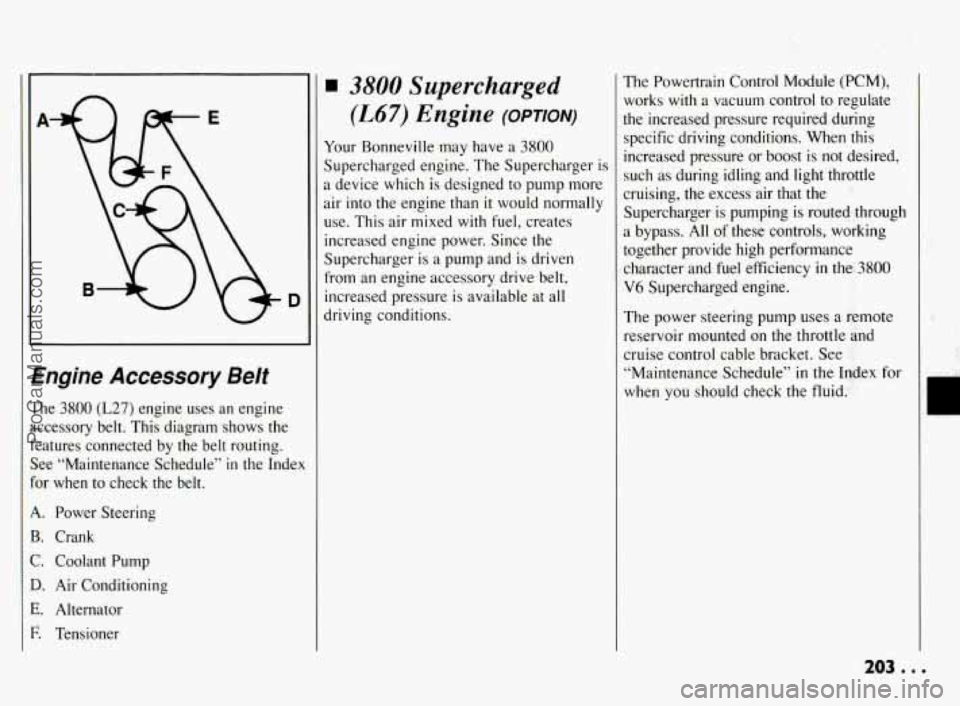
The 3800 (L27) engine uses an engine
accessory belt. This diagram shows the
features connected by the belt routing.
See “Maintenance Schedule’’
in the Index
for when to check the belt.
A. Power Steering
B. Crank
C. Coolant Pump
D. Air Conditioning
E. Alternator
F. Tensioner
3800 Supercharged
(L67) Engine (OPTION)
Your Bonneville may have a 3800
Supercharged engine. The Supercharger is
a device which is designed to pump more
air into the engine than
it would normally
use. This air mixed
with fuel, creates
increased engine power. Since the
Supercharger is a pump and is driven
from an engine accessory drive belt,
increased pressure is available at all
driving conditions, The Powertrain Control
Module
(PCM),
works with a vacuum control to regulate
the increased pressure required during
specific driving conditions. When this
increased pressure or boost is
not desired,
such as during idling and light throttle
cruising, the excess air that the
’
Supercharger is pumping is routed,through
a bypass. All of these controls, working
together provide high performance
character and fuel efficiency
in the3800
V6 Supercharged engine.
The power steering pump uses a Remote
reservoir mounted on the throttle wd
cruise control cable bracket. See
“Maintenance Schedule”
in the Index for
when you should check the fluid:
ProCarManuals.com
Page 206 of 290
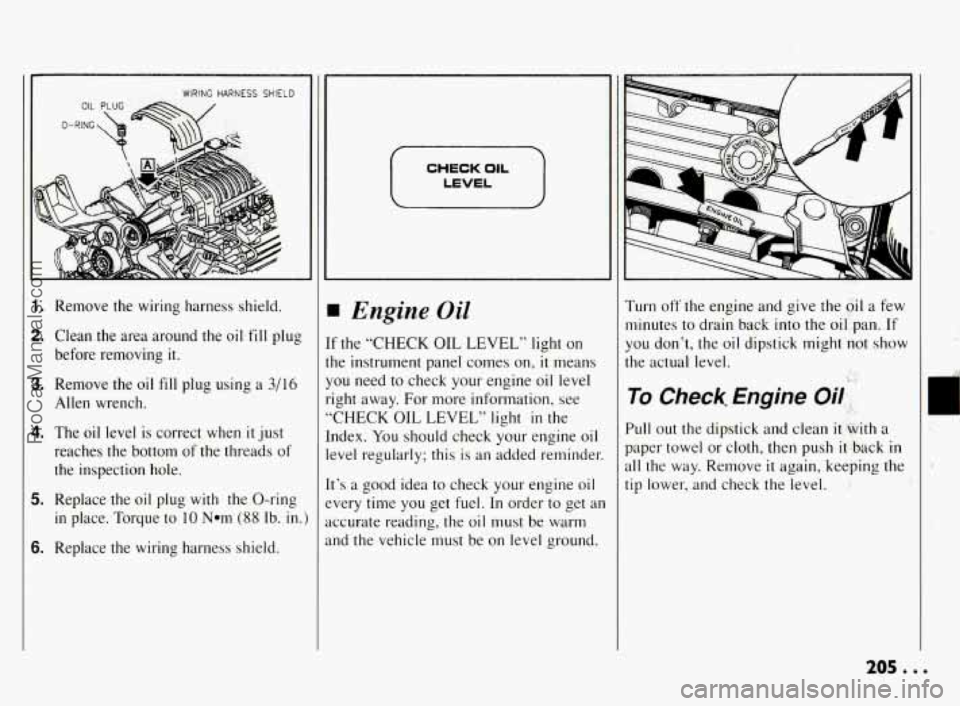
WIRING HARNESS SHIELD I
Remove the wiring harness shield.
Clean the area around the oil
fill plug
before removing it.
Remove the oil fill plug using a
3/16
Allen wrench.
The oil level is correct when
it just
reaches the bottom of the threads
of
the inspection hole.
Replace the oil plug with the O-ring
in place. Torque to
10 Nom (88 Ib. in.)
Replace the wiring harness shield.
I
I
tl
Y
r
6
1f
I1
e
a
LC
a
CHECK OIL
LEVEL
Engine Oil
f the “CHECK OIL LEVEL” light on
he instrument panel comes on,
it means
‘ou need to check your engine oil level
ight away. For more information, see
CHECK OIL LEVEL” light
in the
ndex.
You should check your engine oil
:vel regularly; this is an added reminder.
t’s a good idea to check your engine oil
very time you get fuel. In order
to get an
ccurate reading, the oil must be warm
nd the vehicle must be on level ground. Turn off the engine and
give
the oil a few
minutes to drain back into the
oil pan. If
you don’t, the oil dipstick might not show
the actual level.
To Check, Engine Oil ., I’ .
Pull out the dipstick and clean it %with a
paper towel or cloth, then push
it back in
all the way. Remove
it again, keeping the
tip lower, and check the level.
r
205 .
ProCarManuals.com
Page 214 of 290
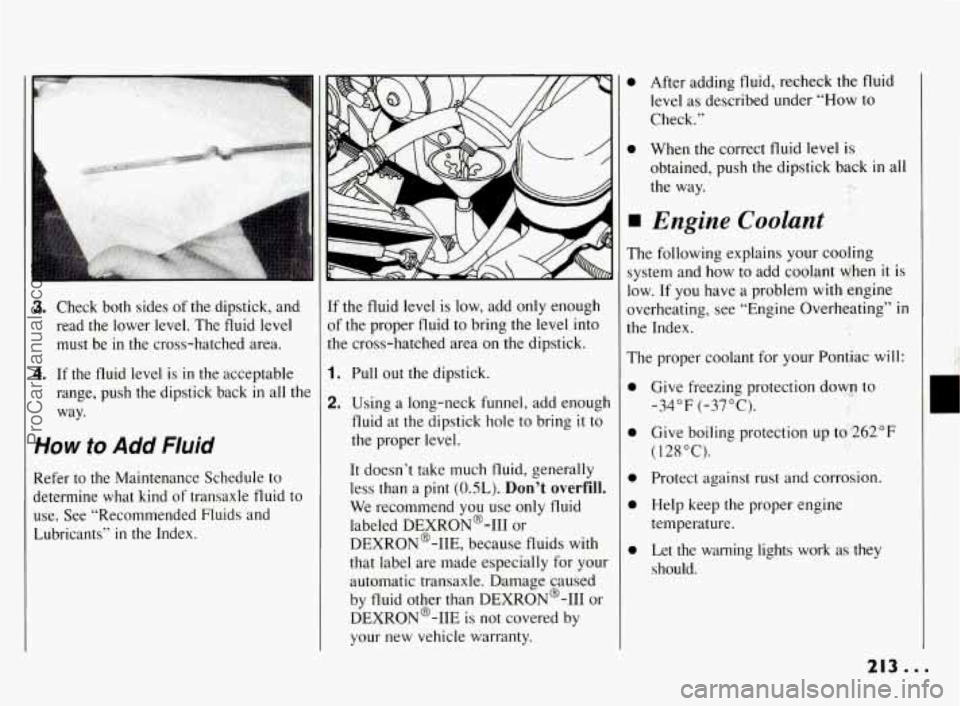
3. Check both sides of the dipstick, and
read the lower level. The fluid level must be in the cross-hatched area.
4. If the fluid level is in the acceptable
range, push the dipstick back in all the
way.
How to Add Fluid
Refer to the Maintenance Schedule to
determine what kind of transaxle fluid to
use. See “Recommended Fluids and
Lubricants’’
in the Index. If
the fluid level is low, add only enough
of the proper fluid to bring the level into
the cross-hatched area on the dipstick.
1. Pull out the dipstick.
2. Using a long-neck funnel, add enough
fluid at the dipstick hole to bring
it to
the proper level.
It doesn’t take much fluid, generally
less than a pint
(OSL). Don’t overfill.
We recommend you use only fluid
labeled DEXR0N’-I11
or
DEXRON@-IIE, because fluids with
that label are made especially for your
automatic transaxle. Damage caused
by fluid other than DEXRON@-I11 or
DEXR0N’-IIE is not covered by your new vehicle warranty.
0 After adding fluid, recheck the fluid
level as described under “How to
Check.”
0 When the correct fluid level is
obtained, push the dipstick back in all
the way. ..
Engine Coolant
The following explains your cooling
system and how to add coolant when
it is
1.0~. If
you have a problem with engine
overheating, see “Engine Overheating” in
the Index.
The proper coolant for your Pontiac will:
0
0
0
0
0
Give freezing protection down to
-34°F (-37°C).
Give boiling protection up to
,262”F
( 128 “C).
Protect against rust and corrosion.
Help keep the proper engine
temperature.
Let the warning lights work as they should.
r
213...
ProCarManuals.com
Page 262 of 290
~~
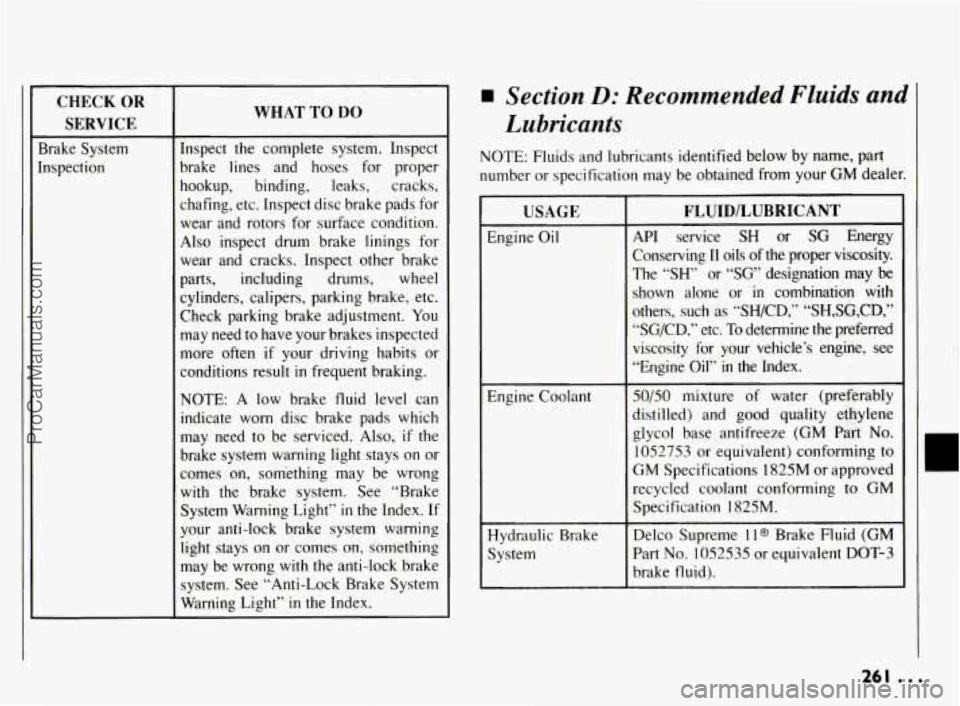
~~ CHECK OR
SERVICE
Brake System
[nspection
WHAT TO DO
Inspect the complete system. Inspect
brake lines and hoses for proper
hookup, binding, leaks, cracks,
chafing, etc. Inspect disc brake pads for
wear and rotors for surface condition.
Also inspect drum brake linings for
wear and cracks. Inspect other brake
parts, including drums, wheel
cylinders, calipers, parking brake, etc.
Check parking brake adjustment. You
may need to have your brakes inspected
more often
if your driving habits or
conditions result
in frequent braking.
NOTE: A low brake fluid level can
indicate worn disc brake pads which
may need to be serviced.
Also, if the
brake system warning light stays on or
comes on, something may be wrong with the brake system. See “Brake
System Warning Light”
in the Index. If
your anti-lock brake system warning
light stays on or comes on, something
may be wrong with the anti-lock brake
system. See “Anti-Lock
Brake System
Warning Light”
in the Index.
Section D: Recommended Fluids and
Lubricants
NOTE: Fluids and lubricants identified below by name, part
number or specification may be obtained from your GM dealer.
USAGE
Engine Oil
Engine Coolant
Hydraulic Brake System
FLUID/LUBRICANT
API service SH or SG Energy
Conserving
I1 oils of the proper viscosity.
The
“SH’ or “SG’ designation may be
shown alone or in combination with
others, such as “SH/CD,” “SH,SG,CD,”
“SG/CD,” etc.
To determine the preferred
viscosity for your vehicle’s engine,
see
“Engine Oil” in the Index.
50/50 mixture of water (preferably
distilled) and good quality ethylene
glycol base antifreeze (GM Part
No.
1052753 or equivalent) conforming to
GM Specifications 1825M or approved
recycled coolant conforming
to GM
Specification 1825M.
Delco Supreme ll@ Brake Fluid (GM
Part
No. 1052535 or equivalent DOT-3
brake fluid).
261 ...
ProCarManuals.com
Page 280 of 290
Index
Ass Warning Light ............. 98
Accessory Outlet ................ 85
Adding Brake Fluid
................. 218
Electrical Equipment
. . 85. 120. 237
Engine Coolant
.............. 214
Engine Oil
.................. 206
Power Steering Fluid
......... 2 16
Sound Equipment ............ 120
Transaxle Fluid
.............. 2 13
Windshield Washer Fluid
...... 217
Adjustable Support Seat
............ 9
Air Bag ........................ 20
Air Cleaner Filter
........... 209. 243
Air Conditioner
............. 112. 115
Air Conditioner Refrigerant ....... 242
Air Inflator System
.............. 182
Alcohol. Driving Under the
Influence of
.................. 135
Alcohol
in Gasoline ............. 195
Aluminum Wheels
Cleaning
................... 233
Removing
.................. 185
Antenna Fixed
....................... 134
Power
..................... 135
Antifreeze
......... 178. 179. 214. 261
Anti-Lock Brake System (ABS)
... 142
Warning Light
................ 98
Appearance Care and Materials .... 229 Armrest.
Storage
................ 82
Ashtrays & Lighter ........... 83. 84
AM/FM Stereo Radio
......... 12 I
AM/FM Stereo Radios
with Optional Features
....... 122
Cassette Player
.............. 125
Compact Disc Player
......... 126
Gain Control
................ 132
Graphic Equalizer
............ 125
Hearing Damage Warning
..... 119
Radio Reception.
Understanding
....... 133
Radio THEFTLOCK Feature
................... 128
Steering Wheel Controls
....... 13 I
Adding Fluid ................ 2 13
Checking Fluid
.............. 21 1
Audio Systems ................. 1 19
Care of Audio Systems .... 133. 134
“’6. *
Setting the Clock ............. 120
Automatic Transaxle
Shifting
..................... 56
Battery
...................... 220
Jump Starting
............... 167
Battery Warning Light
............ 95
Blizzard
...................... 156
Block Heater. Engine
......... 55. 208
Boost Gage
.................... 102
“Blowout.’. Tire
................ 182 Brake System
Warning Light
Anti-Lock Brake System
....... 98
Standard Brakes .............. 97
Anti-Lock .................. 142
Fluid
.................. 2261 17.
Master Cylinder
............. 217
Parking
..................... 61
Replacement ................ 219
Warning Light
................ 97
Wear Indicators-Front Brakes
.................... 218
Braking
....................... 141
Braking
in Emergencies .......... 144
Braking Technique
.............. 141
“Break-In.
.. New Vehicle .......... 52
Buckling Up (see “Safety Belts”)
Bulb Replacement
Brakes
Headlight
............... 220. 244
Taillight
................ 221. 244
Bulbs. Replacement
............. 244
Capacities and Specifications
.... 242
Carbon Monoxide in
Exhaust
............... 65.66. 157
Card Holder .................... 80
Cassette Tape Player (see “Audio
Center Front Lap Belt (see “Safety Belts”)
Center Passenger Position
......... 25
Systems”)
ProCarManuals.com
Page 281 of 290
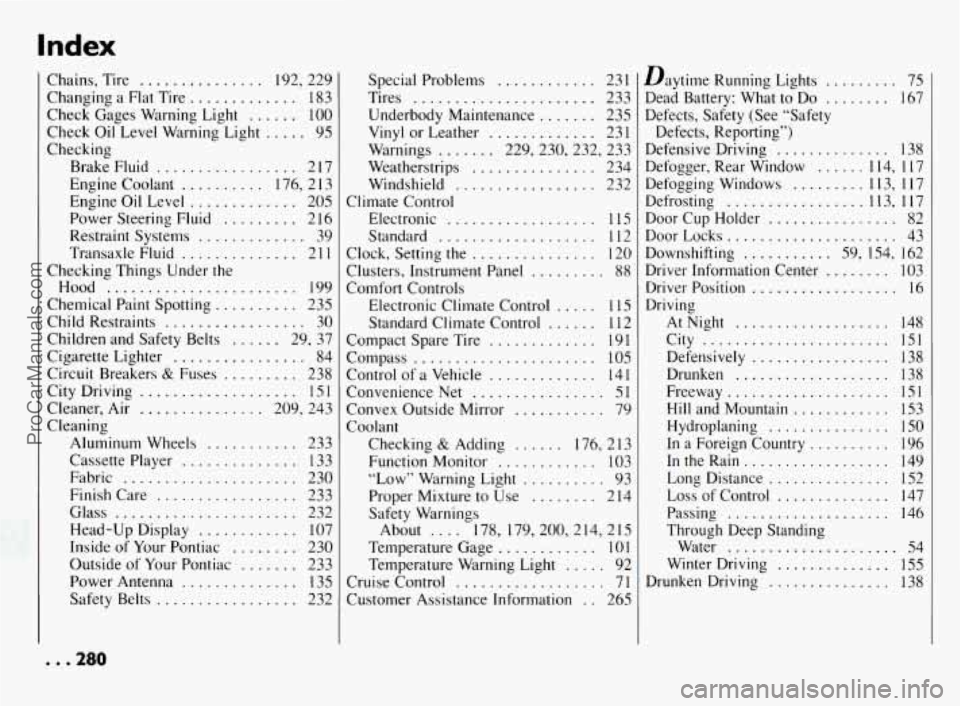
Chains. Tire ............... 192. 229
Changing a Flat Tire
............. 183
Check Gages Warning Light
...... 100
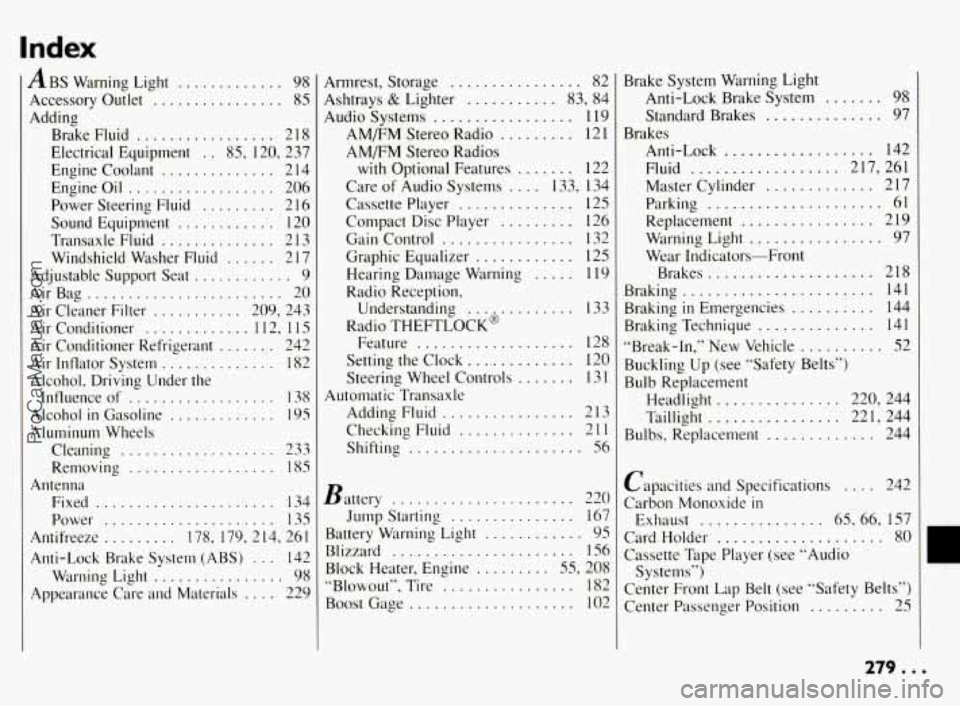
Check Oil Level Warning Light ..... 95
Checking
Brake Fluid
................. 217
Engine Coolant
.......... 176. 2 13
Engine Oil Level
............. 205
Power Steering Fluid
......... 216
Restraint Systems
............. 39
Transaxle Fluid
.............. 2 1 1
Checking Things Under the
Hood
....................... 199
Chemical Paint Spotting
.......... 235
Child Restraints
................. 30
Children and Safety Belts
...... 29. 37
Cigarette Lighter
................ 84
Circuit Breakers
& Fuses ......... 238
City Driving
................... 15 1
Cleaner. Air ............... 209. 243
Cleaning
Aluminum Wheels
........... 233
Cassette Player
.............. 133
Fabric
..................... 230
Finish Care
................. 233
Glass
...................... 232
Head-Up Display
............ 107
Inside of Your Pontiac ........ 230
Outside of Your Pontiac
....... 233
Power Antenna
.............. 135
Safety Belts
................. 232 Special Problems
............ 23 I
Tires ...................... 233
Vinyl or Leather
............. 231
Warnings
....... 229. 230. 232. 233
Weatherstrips
............... 234
Windshield
................. 232
Electronic
.................. 1 15
Standard ................... 1 12
Clock. Setting the
............... 120
Clusters. Instrument Panel
......... 88
Comfort Controls Electronic Climate Control
..... 115
Standard Climate Control ...... I12
Compact Spare Tire
............. 19 1
Compass ...................... 105
Control of a Vehicle ............. 141
Convenience Net
................ 51
Convex Outside Mirror ........... 79
Coolant
Checking
& Adding ...... 176. 2 13
Function Monitor
............ 103
Underbody Maintenance ....... 235
Climate Control
“Low” Warning Light
.......... 93
Proper Mixture to Use
........ 214
Safety Warnings About
.... 178. 179.200.214. 215
Temperature Gage
............ 10 1
Cruise Control .................. 71
Customer Assistance Information
. . 265
Temperature Warning Light
..... 92 Daytime
Running Lights
......... 75
Dead Battery: What to Do ........ 167
Defects. Safety (See “Safety
Defensive Driving
.............. 138
Defogger. Rear Window
...... I 14. 1 17
Defogging Windows
......... 1 13. I 17
Defrosting ................. 1 13. 1 17
Door Cup Holder ................ 82
Door Locks
..................... 43
Downshifting
........... 59. 154. 162
Driver Information Center ........ 103
Driver Position
.................. 16
Driving
AtNight
................... 148
City
....................... 151
Defensively ................. 138
Drunken ................... 138
Freeway
.................... 151
Hill and Mountain ............ 153
Defects.
Reporting”)
Hydroplaning
............... 1 SO
In a Foreign Country .......... 196
In the Rain
.................. 149
Long Distance
............... 152
Loss of Control .............. 147
Passing
.................... 146
Through Deep Standing Water
..................... 54
Drunken Driving
............... 138
Winter Driving
.............. 155
ProCarManuals.com
Page 282 of 290
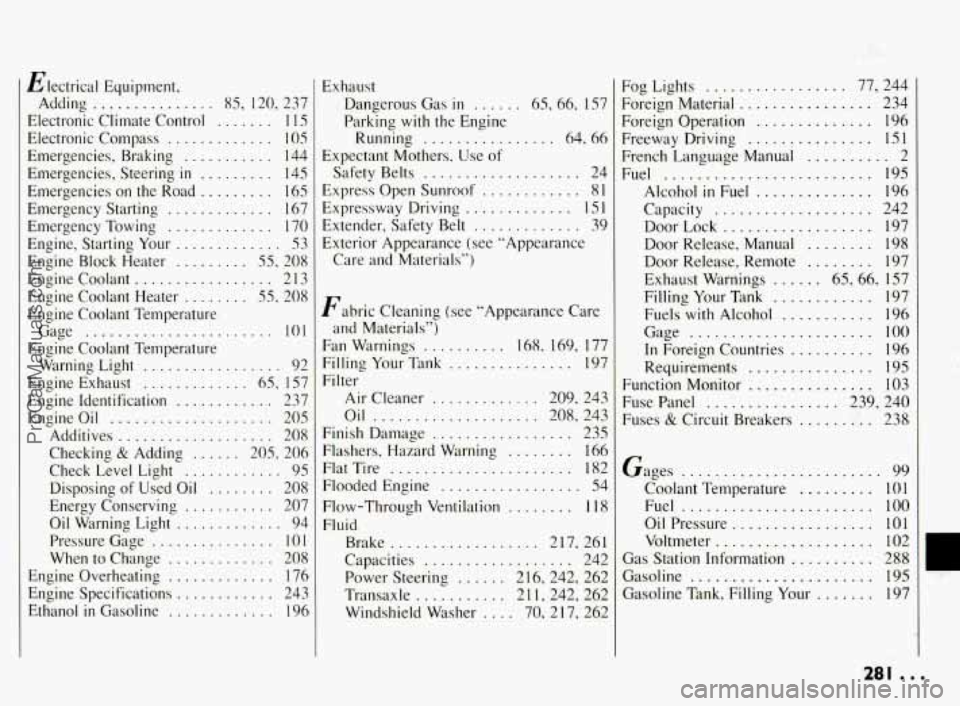
Electrical Equipment.
Adding
............... 85. 120. 237
Electronic Climate Control
....... 1 15
Electronic Compass
............. 105
Emergencies. Braking
........... 144
Emergencies. Steering
in ......... 145
Emergencies on the Road
......... 165
Emergency Starting
............. 167
Emergency Towing
............. I70
Engine. Starting Your
............. 53
Engine Block Heater
......... 55. 208
Engine Coolant
................. 2 13
Engine Coolant Heater
........ 55. 208
Engine Coolant Temperature
Gage
....................... 101
Engine Coolant Temperature
Warning Light
................. 92
Engine Exhaust ............. 65. 157
Engine Identification
............ 237
Engine Oil
.................... 205
Additives
................... 208
Checking
& Adding ...... 205. 206
Disposing of Used Oil
........ 208
Energy Conserving
........... 207
Oil Warning Light
............. 94
Check Level Light
............ 95
Pressure Gage
............... 10 1
When to Change ............. 208
Engine Overheating
............. 176
Engine Specifications
............ 243
Ethanol
in Gasoline ............. 196 Exhaust
Dangerous Gas
in ...... 65.66. 157
Parking with the Engine
Running
................ 64. 66
Expectant Mothers. Use of
Safety Belts
................... 24
Express Open Sunroof
............ 81
Expressway Driving ............. I5 1
Exterior Appearance (see “Appearance
Extender. Safety
Belt
............. 39
Care and Materials”)
Fabric Cleaning (see “Appearance Care
Fan Warnings
.......... 168. 169. 177
Filling Your Tank
............... 197
Filter
Air Cleaner
............. 209. 243
Oil
.................... 208. 243
Flashers. Hazard Warning
........ 166
Flat Tire ...................... 182
Flooded Engine ................. 54
Flow-Through Ventilation
........ I 18
Fluid
Brake
.................. 217. 261
Capacities
.................. 242
Transaxle
........... 2 11. 242. 262
Windshield Washer
.... 70. 2 17. 262
and
Materials”)
Finish Damage
................. 235
Power Steering
...... 2 16. 242. 262 Fog
Lights
................. 77. 244
Foreign Material
................ 234
Foreign Operation
.............. 196
Freeway Driving ............... 151
French Language Manual .......... 2
Fuel ......................... 195
Alcohol in Fuel .............. 196
Capacity ................... 242
Door Lock
.................. 197
Door Release. Manual
........ 198
Door Release. Remote
........ 197
Exhaust Warnings ...... 65. 66. 157
Filling Your Tank
............ 197
Fuels
with Alcohol ........... 196
Gage ...................... 100
In Foreign Countries .......... 196
Requirements ............... 195
Function Monitor
............... 103
Fuse Panel
................ 239. 240
Fuses
& Circuit Breakers ......... 238
Gages
........................ 99
Coolant Temperature ......... 101
Fuel ....................... 100
Oil Pressure ................. 101
Voltmeter ................... 102
Gas Station Information
.......... 288
Gasoline
...................... 195
Gasoline Tank. Filling Your
....... 197
281 ...
ProCarManuals.com