engine PONTIAC BONNEVILLE 1994 Owner's Manual
[x] Cancel search | Manufacturer: PONTIAC, Model Year: 1994, Model line: BONNEVILLE, Model: PONTIAC BONNEVILLE 1994Pages: 290, PDF Size: 14.75 MB
Page 96 of 290
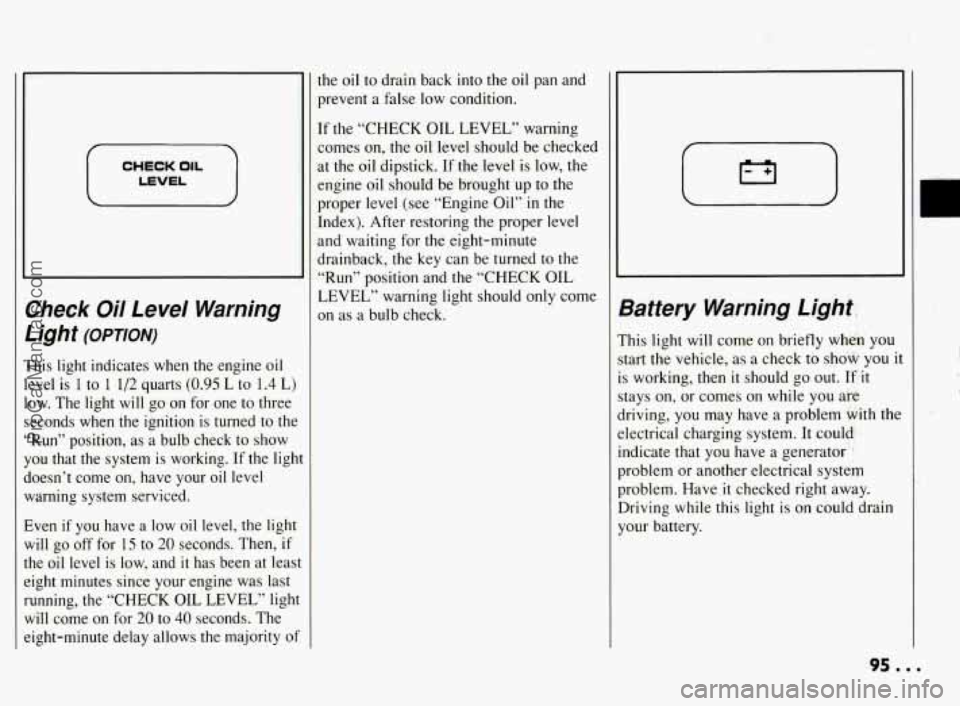
CHECK OIL
I LEVEL I
:heck Oil Level Warning
Light
(OPTION)
’his light indicates when the engine oil
:vel
is 1 to 1 1/2 quarts (0.95 L to 1.4 L)
3w. The light will go on for one to three
econds when the ignition is turned to the
Run” position, as a bulb check to show
ou that the system is working. If the light
oesn’t come on, have your oil level
vlarning system serviced.
:veri if you have a low oil level, the light
dl go off for 15 to 20 seconds. Then, if
le oil level is low, and it has been at least
ight minutes since your engine was last
unning, the “CHECK OIL LEVEL” light
dl come on for 20 to 40 seconds. The
ight-minute delay allows the majority of the oil
to drain back into the oil pan and
prevent a false
low condition.
If the “CHECK
OIL LEVEL” warning
comes
on, the oil level should be checked
at the oil dipstick. If the level is low, the
engine oil should be brought up to the
proper
level (see “Engine Oil” in the
Index). After restoring the proper level
and waiting for the eight-minute
drainback, the key can be turned to
the
“Run” position and the “CHECK OIL
LEVEL” warning light should only come
on as a bulb check.
3attery Warning Light..:
This light will come on briefly whm you
start the vehicle, as a check to show you
i
is working, then it should go out. IF it
stays on, or comes on while you ai-6,
driving,
you may have a problem Gith thc
electrical charging system. It could
indicate that you have a generator
”
problem or another electrical system
problem. Have
it checked right away.
Driving while this light
is on could drain
your battery.
c
95.0.
ProCarManuals.com
Page 97 of 290
Features & Controls
Battery Warning Light
(CONT.)
If you must drive a short distance with the
light
on, be certain to turn off all your
accessories, such as
the radio and climate
control system.
Some clusters with gages do not have a
battery warning light. They have
a
“CHECK GAGES” warning to indicate a
problem. Vehicles with the supercharged
engine also have a similar battery warning
light.
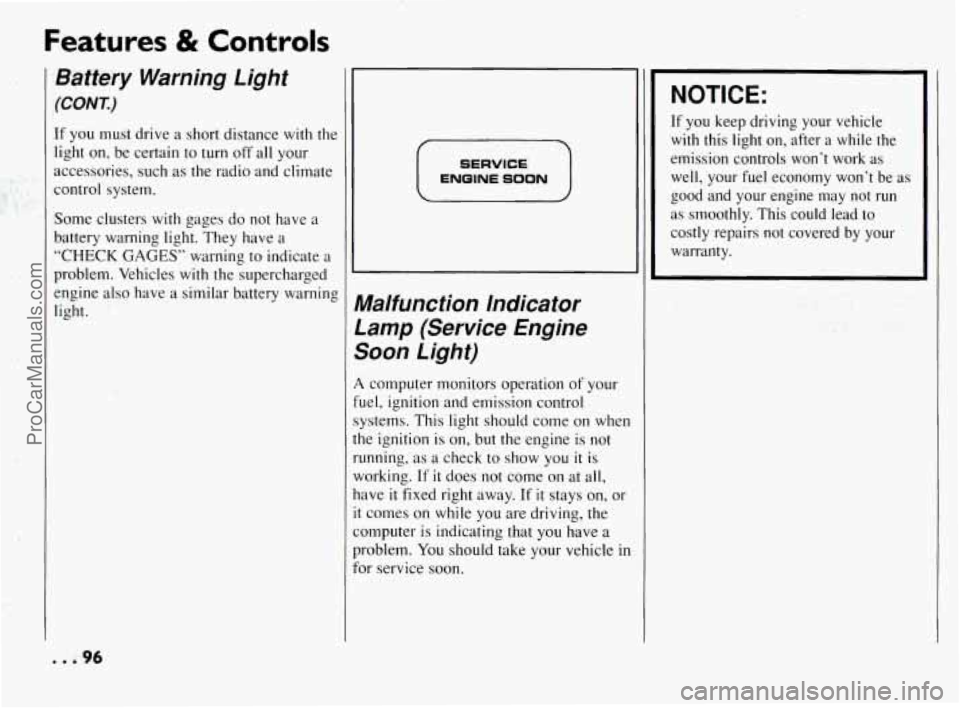
SERVICE
ENGINE SOON
Malfunction Indicator
.amp (Service Engine
Soon Light)
1 computer monitors operation of your
uel, ignition and emission control
ystems. This light should come on when
he ignition is on, but the engine is not
unning, as a check
to show you it is
iorking. If
it does not come on at all,
ave
it fixed right away. If it stays on, or
: comes on while you are driving, the
omputer is indicating that you have
a
roblem. You should take your vehicle in
x- service soon.
NOTICE:
If you keep driving your vehicle
with this light on, after a while the
emission controls won’t work as
well,
your fuel economy won’t be as
good and your engine may not
run
as smoothly. This could lead to
costly repairs not covered by your
warranty.
... 96
ProCarManuals.com
Page 99 of 290
Features & Controls
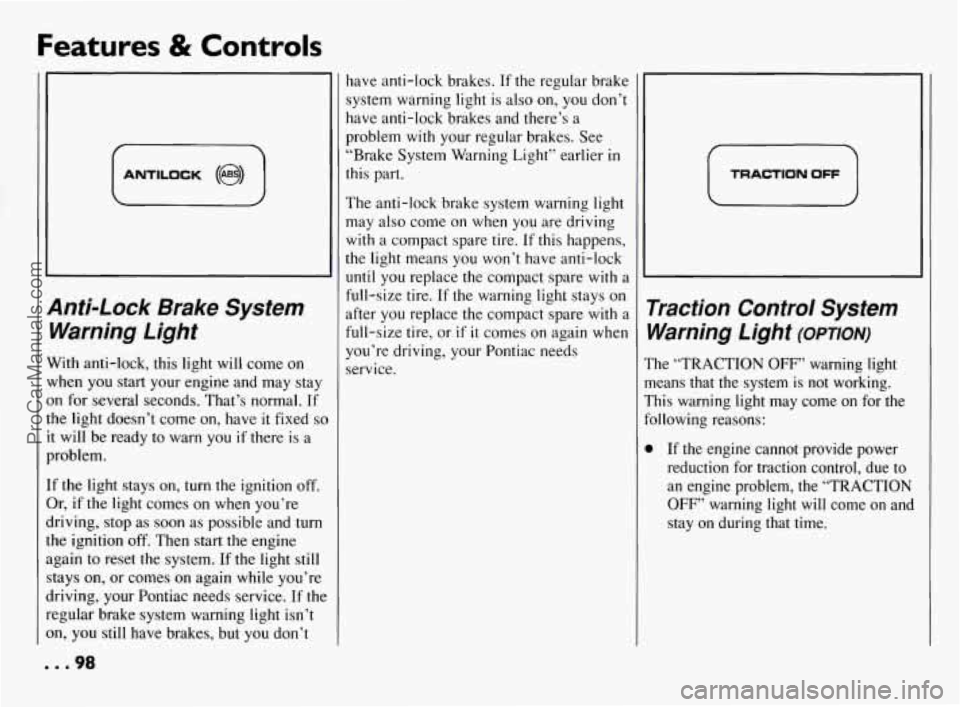
rn ANTILOCK (@)
Anti-Lock Brake System Warning Light
With anti-lock, this light will come on
when you start your engine and may stay
on for several seconds. That’s normal. If
the light doesn’t come on, have it fixed
so
it will be ready to warn you if there is a
problem.
If the light stays on, turn the ignition off.
Or, if the light comes on when you’re
driving, stop as soon as possible and turn
the ignition
off. Then start the engine
again to reset the system. If the light still
stays on, or comes on again while you’re
driving, your Pontiac needs service. If the
regular brake system warning light isn’t
on, you still have brakes, but you don’t have anti-lock brakes.
If the regular brake
system warning light is also on, you don’t
have anti-lock brakes and there’s a
problem
with your regular brakes. See
“Brake System Warning Light” earlier
in
this part.
The anti-lock brake system warning light
may also come on when
you are driving
with a compact spare tire. If this happens,
the light means you won’t have anti-lock
until you replace the compact spare with a
full-size tire. If the warning light stays on
after you replace the compact spare with a
full-size tire, or
if it comes on again when
you’re driving, your Pontiac needs
service.
i TRACTION OFF
Traction Control System Warning Light
(omoN)
The “TRACTION OFF” warning light
means that the system is not working.
This warning light may come on for the
following reasons:
0 If the engine. cannot provide power
reduction for traction control, due to
an engine problem, the “TRACTION
OFF” warning light will come on and
stay on during that time.
... 98
ProCarManuals.com
Page 101 of 290
Features & Controls
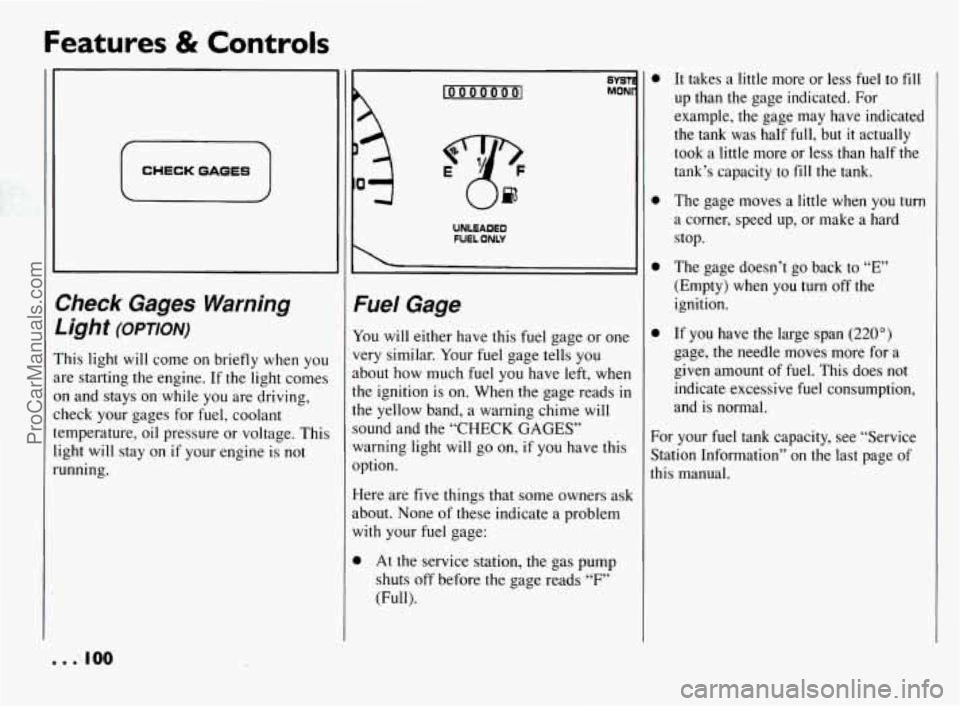
CHECK GAGES
>heck Gages Warning
Jght
(OPTION)
‘his light will come on briefly when you
re starting the engine. If the light comes
n and stays on while you are driving,
heck your gages for fuel, coolant
:mperature, oil pressure or voltage. This
ght will stay on
if your engine is not
Inning.
loooooool
8YST MONl
UNLEADED
FUEL ONLY
Fuel Gage
You will either have this fuel gage or one
very similar.
Your fuel gage tells you
about how much fuel you have left, when
the ignition is on. When the gage reads in
the yellow band, a warning chime will
sound and the
“CHECK GAGES”
warning light will
go on, if you have this
option.
Here are five things that some owners ask
about. None
of these indicate a problem
with your fuel gage:
0 At the service station, the gas pump
shuts off before the gage reads
“F”
(Full).
It takes a little more or less fuel to fill
up than the gage indicated. For
example, the gage may have indicated
the tank was half full, but
it actually
took a little more or less than half the
tank’s capacity to
fill the tank.
The gage moves a little when you
turn
a corner, speed up, or make a hard
stop.
The gage doesn’t go back to
“E”
(Empty) when you turn off the
ignition.
If you have the large span
(220”)
gage, the needle moves more for a
given amount of fuel. This does not
indicate excessive fuel consumption,
and is normal.
For your fuel tank capacity, see “Service
Station Information” on the last page of
this manual.
.e 100
ProCarManuals.com
Page 102 of 290
HOTCOOLANTCANBURNYOU BADLY!
In “Problems on the Road”, this manual
shows what to
do. See “Engine
Overheating”
in the Index.
H2a
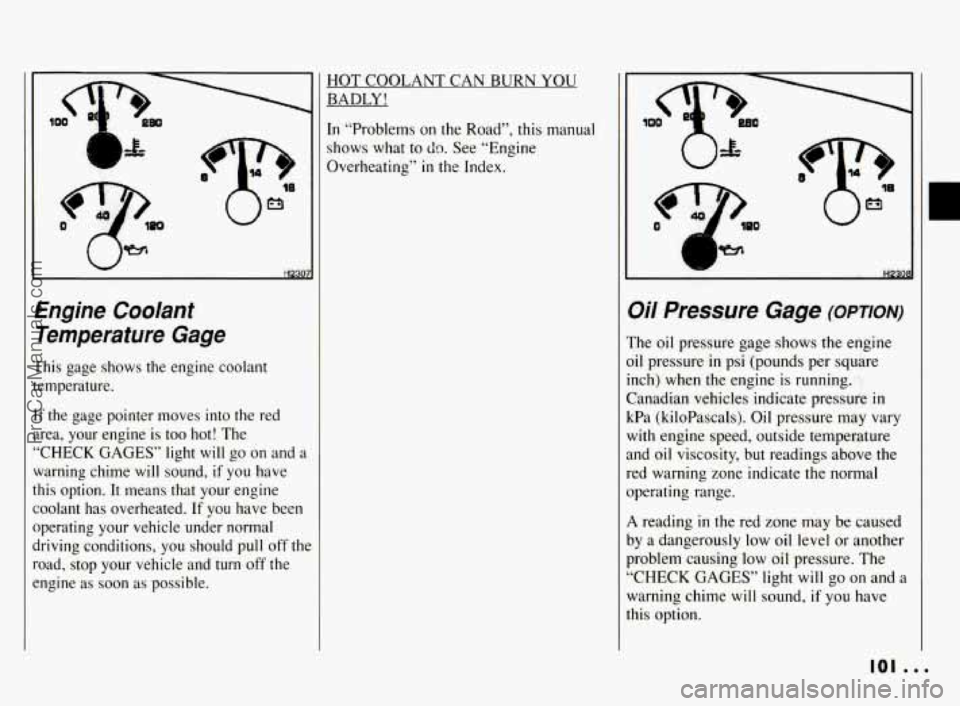
Engine Coolant
Temperature Gage
This gage shows the engine coolant
temperature.
If the gage pointer moves into the red
area, your engine is too hot! The
“CHECK GAGES” light
will go on and a
warning chime will sound, if you have
this option.
It means that your engine
coolant has overheated.
If you have been
operating your vehicle under normal
driving conditions, you should pull off
thc
road, stop your vehicle and turn off the
engine
as soon as possible.
Oil Pressure Gage (omom-)
The oil pressure gage shows the engine
oil pressure
in psi (pounds per square
inch) when the engine is running.
Canadian vehicles indicate pressure
in
kPa (kiloPascals). Oil pressure may vary
with engine speed, outside temperature
and oil viscosity, but readings above the
red warning zone indicate the normal
operating range.
A reading in the red zone may be caused
by a dangerously
low oil level or another
problem causing low oil pressure. The
“CHECK GAGES” light
will go on and a
warning chime will sound,
if you have
this option.
101 ...
ProCarManuals.com
Page 103 of 290
Features & Controls
Oi/ Pressure Gage (OPTION)
(CONK)
Driving your vehicle with low oil
pressure can cause extensive engine
damage.
Ih
I I NOTICE:
I
Damage to your engine from
neglected oil problems can be costly
and is not covered by your warranty.
. . . 102
lo
il
s:
a
ir
SI
H230!
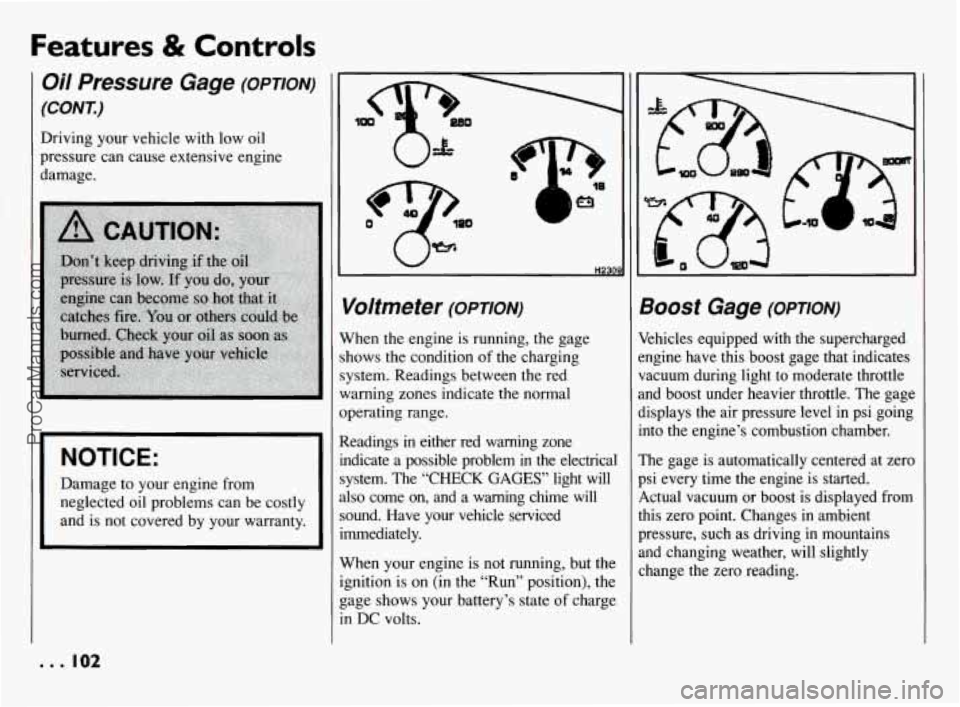
Voltmeter (omoN)
Vhen the engine is running, the gage
hows the condition of the charging
ystem. Readings between the red
Iarning zones indicate the normal
perating range.
Leadings
in either red warning zone
ldicate
a possible problem in the electrical
ystem. The “CHECK
GAGES’ light will
lso come on, and a warning chime will
ound. Have your vehcle serviced
mediately.
Vhen your engine is not running, but the
pition is on (in the “Run” position), the
age shows your battery’s state
of charge
I DC volts.
300St Gage (OPTION)
khicles equipped with the supercharged
ngine have this boost gage that indicates
acuum during light to moderate throttle
nd boost under heavier throttle. The gage
isplays the air pressure level in psi going
]to the engine’s combustion chamber.
‘he gage is automatically centered at zero
si every time the engine is started.
,ctual vacuum or boost is displayed from
lis zero point. Changes in ambient
ressure, such as driving in mountains
nd changing weather, will slightly
hange the zero reading.
ProCarManuals.com
Page 109 of 290
Features & Controls
Head-Up Display
(OPTION) (CONI)
When you sit straight in your seat, the
HUD image
will appear directly in front
of the driver.
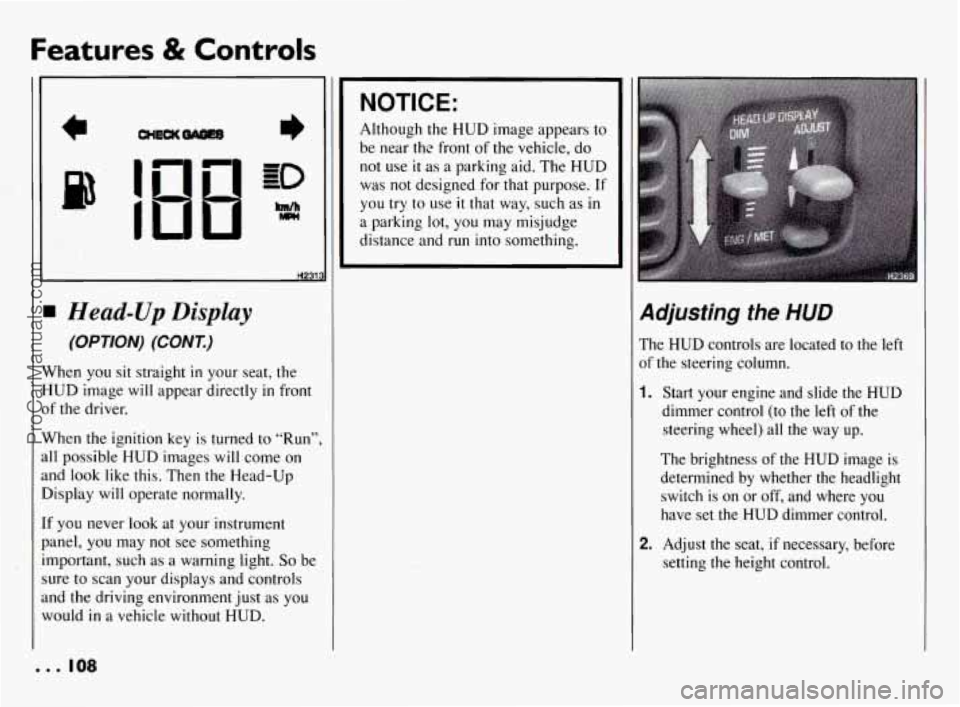
When the ignition key is turned
to “Run”,
all possible HUD images will come
on
and look like this. Then the Head-Up
Display will operate normally.
If you never
look at your instrument
panel,
you may not see something
important, such as a warning light.
So be
sure
to scan your displays and controls
and the driving environment just as you
would
in a vehicle without HUD.
NOTICE:
Although the HUD image appears to
be near thc front
of the vehicle, do
not use it as a parking aid. The HUD
was
not designed for that purpose. If
you try to use it that way, such as in
a parking lot, you may misjudge
distance and run into something.
Adjusting the HUD
The HUD controls are located to the left
of
the steering column.
1. Start your engine and slide the HUD
dimmer control (to the left of the
steering wheel) all the way up.
The brightness of the HUD image is
determined by whether the headlight
switch is on or off, and where you
have set
the HUD dimmer control.
2. Adjust the seat, if necessary, before
setting
the height control.
. .. 108
ProCarManuals.com
Page 113 of 290
Comfort Controls & Audio Systems
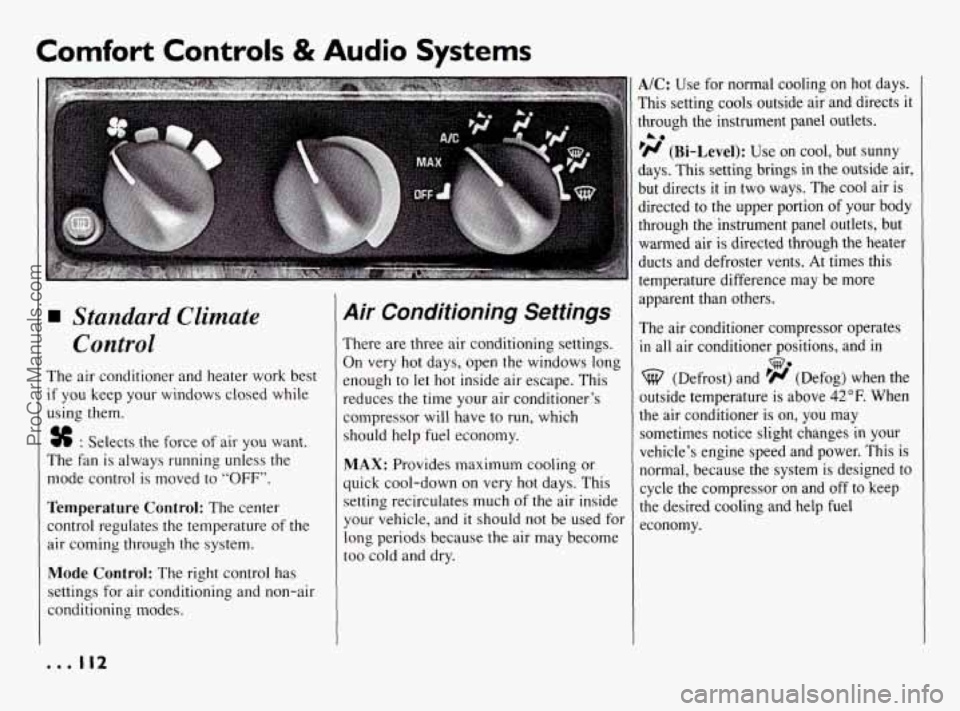
Standard Climate
Control
The air conditioner and heater work best
if you keep your windows closed while
using them.
% : Selects the force of air you want.
The fan is always running unless the
mode control is moved to
“OFF”.
Temperature Control: The center
control regulates the temperature of the
air coming through the system.
Mode Control: The right control has
settings for air conditioning and non-air
conditioning modes.
Air Conditioning Settings
There are three air conditioning settings.
On very hot days, open the windows long
enough
to let hot inside air escape. This
reduces the time your air conditioner’s
compressor will have to run, which
should help fuel economy.
MAX: Provides maximum cooling or
quick cool-down
on very hot days. This
setting recirculates much of the air inside
your vehicle, and
it should not be used for
long periods because the air may become
too cold and dry.
A/C: Use for normal cooling on hot days.
This setting cools outside air and directs
it
through the instrument panel outlets.
‘H (Bi-Level): Use on cool, but sunny
days. This setting brings in the outside air,
but directs it in two ways. The cool air is
directed to the upper portion
of your body
through the instrument panel outlets, but
warmed air
is directed through the heater
ducts and defroster vents. At times this
temperature difference may be more
apparent than others.
The air conditioner compressor operates
in all air conditioner positions, and in
A0
we
(Defrost) and ’# (Defog) when the
outside temperature is above
42°F. When
the air conditioner is on,
you may
sometimes notice slight changes
in your
vehicle’s engine speed and power. This is
normal, because the system is designed to
cycle the compressor
on and off to keep
the desired cooling and help fuel
economy.
... 112
ProCarManuals.com
Page 114 of 290
Non-Air Conditioning
Settings
A0
r/ (Vent): This setting brings in the
outside air and directs
it to the upper
portion of your body through the
instrument panel outlets.
’N (Heat): This setting directs warmed
air through the heater ducts. Some warm
air is diverted to the windshield to
minimize fogging.
The air conditioner compressor doesn’t
run in the non-air conditioning settings.
This reduces engine load, resulting
in
improved fuel economy. If the non-air
conditioning settings do not maintain the
comfort of the air inside your vehicle,
move the selector to
“MAX” or “A/,”. If
your windows fog up, move the mode
selector tow (Defrost) or
“A/C”.
0
Defrosting
The %? (Defrost) setting directs most air
through the defroster vents, and some
through the heater ducts. Use this when
you have fog or ice on the windshield.
When it’s
42°F or warmer outside, you’ll
get cooled air.
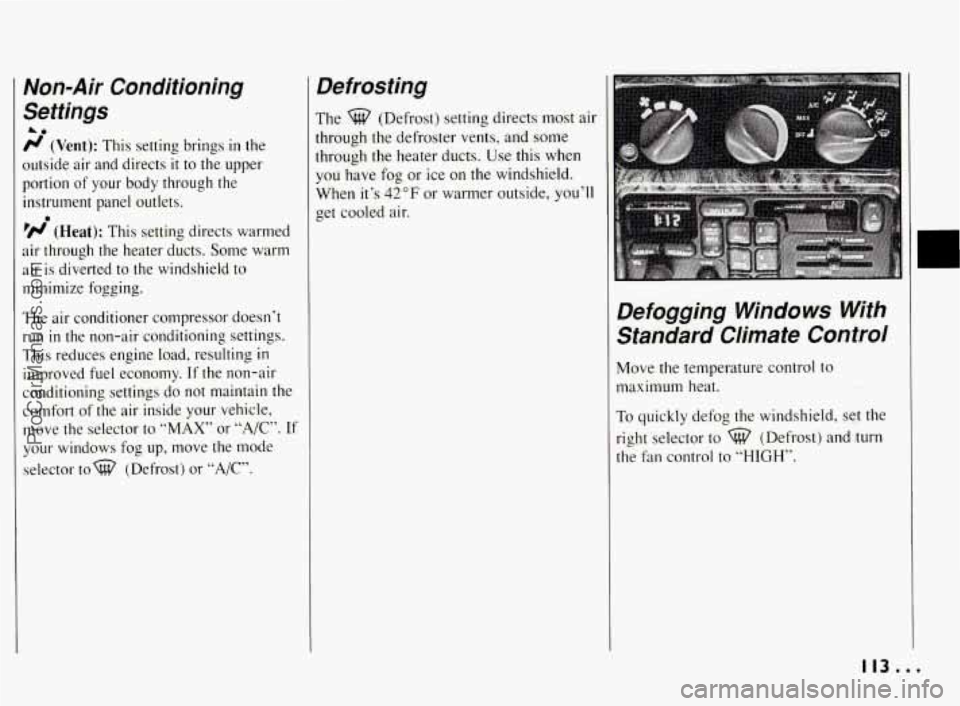
Defogging Windows With Standard Climate Control
Move the temperature control to
maximum heat.
To quickly defog the windshield, set the
right selector to
%? (Defrost) and turn
the fan control to “HIGH’’.
113...
ProCarManuals.com
Page 117 of 290
Comfort Controls & Audio Systems
0
0 0
Electronic Climate Control
(OPTION)
When the engine is cold, the “AUTO’
blower is delayed/reduced until warm
air is available. Immediately selecting
90°F farenheit will NOT get the car
warmer any sooner than selecting
75
“AUTO”. The “DEFROST” blower
speed starts low to reduce windshield
fogging from any snow on the hood as
you start driving. The blower will
increase briefly after short stops when
the car had been turned
off to reduce
any stuffy feeling.
The A/C will only work when the
outside temperature gets above
42°F.
A “click” noise means the A/C
compressor is turned on. Besides
cooling, this is used to dehumidify and
filter the air for inside the car.
A hot, sunny parking lot or city traffic
will cause the system to start
re-circulating A/C air for quicker
cooling. The system is more efficient
by cooling the air already inside the
car.
EZ-Kool Glass is very effective in
filtering out the sun’s heat.
0 The direction of the cold A/C air can
be controlled by adjusting the outlets
in the dash. Aiming them just over
your shoulder will benefit both front
and rear passengers. Back-seat
passengers can also redirect airflow at
the rear of center console.
The air conditioner compressor operates
in all “AUTO” setting positions, and in
%? (Defrost) when the outside
temperature is above
42°F. When the air
conditioner is on, you may sometimes
notice slight changes in your vehicle’s
engine speed and power. This is normal,
because the system
is designed to cycle
the compressor on and off to keep the
desired cooling and help fuel economy.
TEMP: Sets the interior temperature you
want. The temperature you set will be
displayed on the digital screen.
Once you set the temperature, the system
will try to maintain the set temperature,
whether or not
you are using the heating
or cooling controls. But
if you set the
temperature for
60°F ( 16°C) or 90°F
(32”C), the fan will stay on “HI” speed
unless you select a different speed.
AUTO: To allow the system to
automatically control the temperature, air
Jistribution and fan speed:
1. Set the temperature you want with the
“TEMP” switch.
2. Press the “AUTO” switch.
EXT. TEMP: Press to have the exterior
temperature displayed
on the digital
screen (unless the system is off). Press
again to return to the inside temperature
setting. When the system is off, the
outside temperature will be displayed.
Use the following controls when “AUTO’
is not desired.
% : Sets the fan speed. Press the top of
the switch to raise the fan speed, the
bottom of the switch to lower the fan
speed.
“F/C: Press this to read the temperature in
degrees Fahrenheit or Celsius.
OFF: Shuts the system off. The outside
temperature will be displayed. Air
will
still flow through your vehicle if it is
moving. Also, the system will try to
maintain the temperature you set, but,may
... 116
ProCarManuals.com