sensor PONTIAC BONNEVILLE 1994 Owners Manual
[x] Cancel search | Manufacturer: PONTIAC, Model Year: 1994, Model line: BONNEVILLE, Model: PONTIAC BONNEVILLE 1994Pages: 290, PDF Size: 14.75 MB
Page 25 of 290
Seats & Restraint Systems
How The Air Bag System
Works (CONK)
e
e
Your vehicle is equipped with a
diagnostic module, which records
information about the air bag system.
The module records information about
the readiness of the system, when the
sensors are activated and whether the
driver’s safety belt was in use.
Let only qualified technicians work on
your air bag system. Improper service
can mean that your air bag system
won’t work properly. See your dealer
for service.
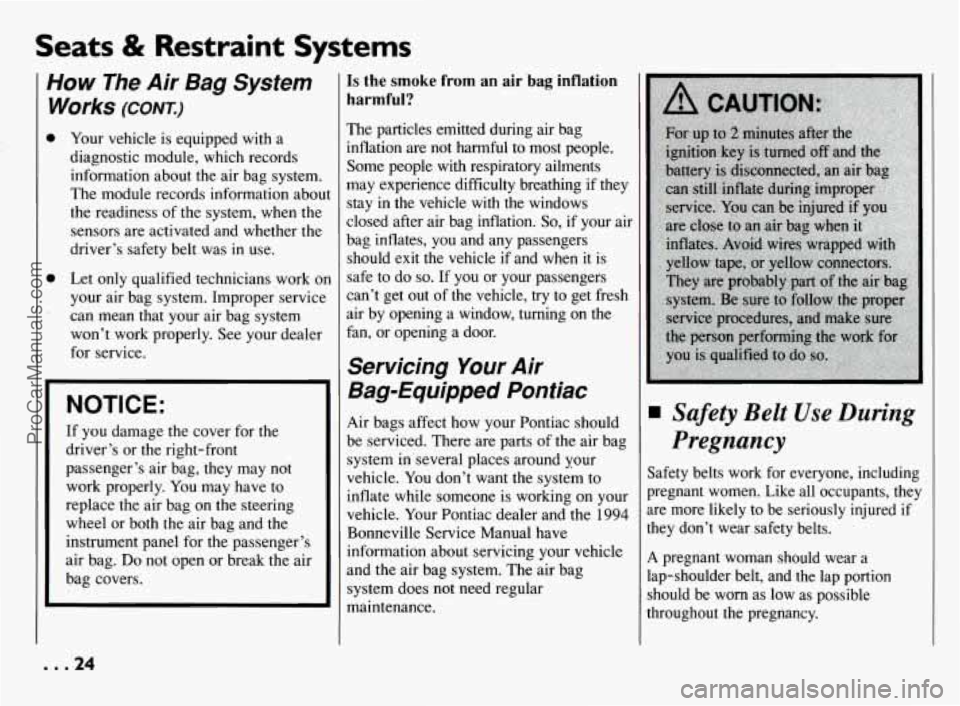
NOTICE:
If you damage the cover for the
driver’s or
the right-front
passenger’s air bag, they may not
work properly. You may have to
replace the air bag on the steering
wheel or both the air bag and the
instrument panel for the passenger’s
air bag.
Do not open or break the air
bag covers.
Is the smoke from an air bag inflation
harmful?
The particles emitted during air bag
inflation are not harmful to most people.
Some people with respiratory ailments
may experience difficulty breathing if they
stay
in the vehicle with the windows
closed after air bag inflation.
So, if your air
bag inflates,
you and any passengers
should exit the vehicle
if and when it is
safe to
do so. If you or your passengers
can’t get out of
the vehicle, try to get fresh
air by opening a window, turning on the
fan, or opening a door.
Servicing Your Air
Bag-Equipped Pontiac
Air bags affect how your Pontiac should
be serviced. There are parts of the air bag
system in several places around xour
vehicle. You don’t want the system to
inflate while someone is working on your
vehicle. Your Pontiac dealer and the
1994
Bonneville Service Manual have
information about servicing your vehicle
and the air bag system. The air bag
system does not need regular
maintenance.
Safety Belt Use During
Pregnancy
Safety belts work for everyone, including
pregnant women. Like all occupants, they
are more likely to be seriously injured if
they don’t wear safety belts.
A pregnant woman should wear a
lap-shoulder belt, and the lap portion should be worn as low as possible
throughout the pregnancy.
... 24
ProCarManuals.com
Page 60 of 290
I NOTICE: I
Damage to your transaxle caused by
shifting out of
“P” (Park) or “N”
(Neutral) with the engine racing
isn’t covered by your warranty.
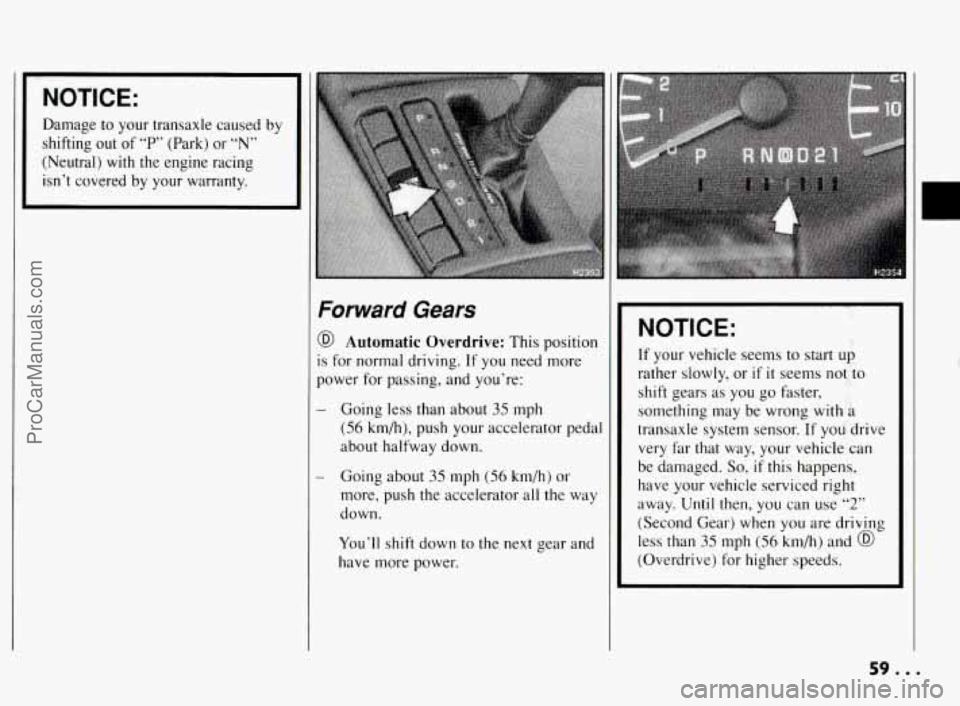
Forward Gears
Automatic Overdrive: This position
IS for normal driving. If you need more
power for passing, and you’re:
- Going less than about 35 mph
(56 km/h), push your accelerator pedal
about halfway down.
- Going about 35 mph (56 km/h) or
more, push the accelerator all the
way
down.
You’ll shift down to the next gear and
have more power.
NOTICE:
If your vehicle seems to start up
rather slowly, or if it seems not to
shift gears as you go faster,
something
may be wrong with a
transaxle system sensor. If
you drive
very far that way, your vehicle can
be damaged.
So, if this happens,
have your vehicle serviced right
away.
Until then, you can use “2”
(Second Gear) when you are driving
less than
35 mph (56 km/h) and @
(Overdrive) for higher speeds.
L
ProCarManuals.com
Page 75 of 290
Features & Controls
Passing Another Vehicle While Using Cruise
Control
Use the accelerator pedal to increase your
speed. When you take your foot off the
pedal, your vehicle will
slow down to the
cruise control speed
you set earlier.
Using Cruise Control on
Hills
How well your Cruise Control will work
on hills depends upon your speed, load,
and the steepness of the hills. When going
up steep hills, you may have to step on
the accelerator pedal to maintain your
speed. When going downhill, you may
have to brake or shift to a lower gear to
keep
your speed down. Of course,
applying the brake takes you out
of
Cruise Control. Many drivers find this to
be too much trouble and don't use Cruise
Control on steep hills.
To Get Out of Cruise
Control
There are two ways to turn off the Cruise
Control:
0 Step lightly on the brake pedal; OR
0 Move the Cruise switch to "OFF".
Cruise Control with
Traction Control Activated
When the Traction Control System is
turned on and becomes activated by
sensors,
it will automatically turn off the
cruise control. See "Traction Control
System"
in the Index.
To Erase Speed Memory
When you turn off the Cruise Control or
the ignition, or shift into "P7 (Park), your
cruise control set speed memory is erased.
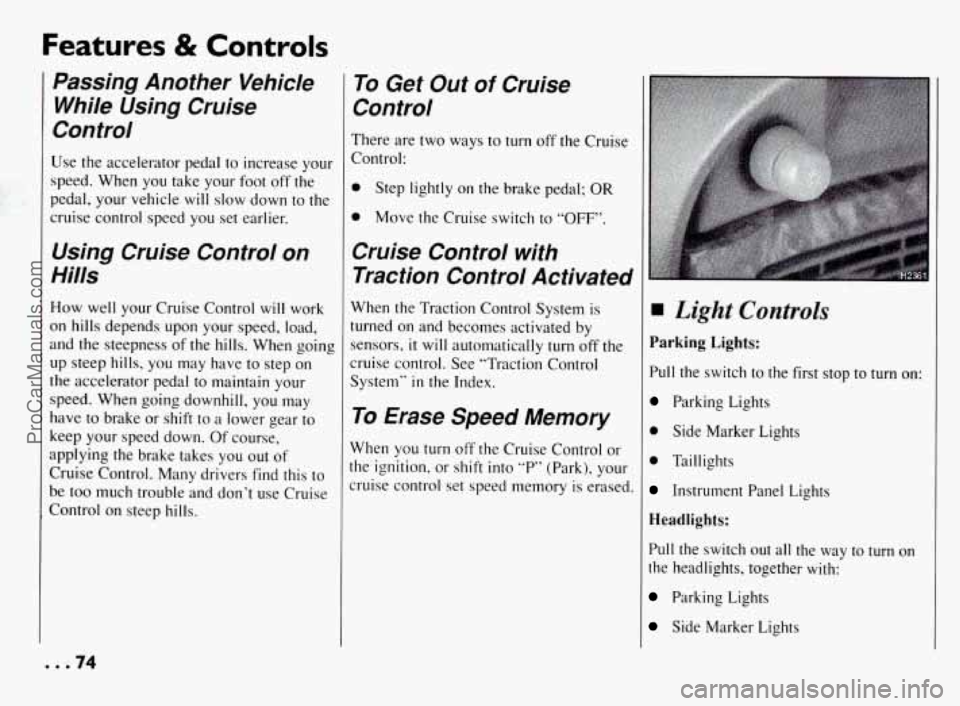
Light Controls
Parking Lights:
Pull the switch to the first stop to turn on:
Parking Lights
0 Side Marker Lights
0 Taillights
Instrument Panel Lights
Headlights:
Pull the switch out all the way to turn on
the headlights, together with:
Parking Lights
Side Marker Lights
ProCarManuals.com
Page 76 of 290
0 Taillights
0 Instrument Panel Lights
Push the switch
in all the way to turn all
the lights off.
Operation of Lights
Although your vehicle’s lighting system
(headlights, parking lights, fog lamps,
side marker lights and taillights) meets all
applicable federal lighting requirements,
certain states and provinces may apply
their own lighting regulations that may
require special attention before you
operate these lights.
For example, some jurisdictions may
require that you operate your fog lamps
only when your lower beam headlights
are also on, or that headlights be turned
on whenever you must use your
windshield wipers. In addition, most
jurisdictions prohibit driving solely
with
parking lights, especially at dawn or dusk.
It is recommended that you check with
your own state or provincial highway
authority for applicable lighting
regulations.
Lights On Reminder
[f you open the driver’s door while
leaving the lights on, you will hear a
warning tone.
Daytime Running Lights
(Canada Only)
The Canadian Federal Government has
decided that Daytime Running Lights
(DRL) are a useful feature,
in that DRL
can make your vehicle more visible to
pedestrians and other drivers during
daylight hours. DRL are required on new
vehicles sold
in Canada.
Your DRL work with a light sensor on top
of the instrument panel. Don’t cover it up.
The low beam headlights will come on at
reduced brightness
in daylight when:
0 The igdition is on
The headlight switch is off, and
The transaxle is not in “P” (Park).
4t dusk, the exterior lights will come on
mtornatically and the low beams will
:hange to full brightness. At dawn, the
:xterior lights will go out and the low
beams will change to the reduced
brightness of DRL (if the headlight switch
is off).
Of course, you may still turn on the
headlights any time you need to.
To idle your vehicle with the DRL ,off,
shift the transaxle into “P’ (Park). The
DRL will stay off until you shift out of
“P” (Park).
At night, you can turn off all exterior
lights when you are
in “P” (Park) by
moving the Twilight Sentinel control all
[he way past
“MIN” to turn it off, if it was
m. If it was off, move the control to the
right to turn it on, then back off. The
lights will come back on when you put
the transaxle
in gear.
75.0.
ProCarManuals.com
Page 78 of 290
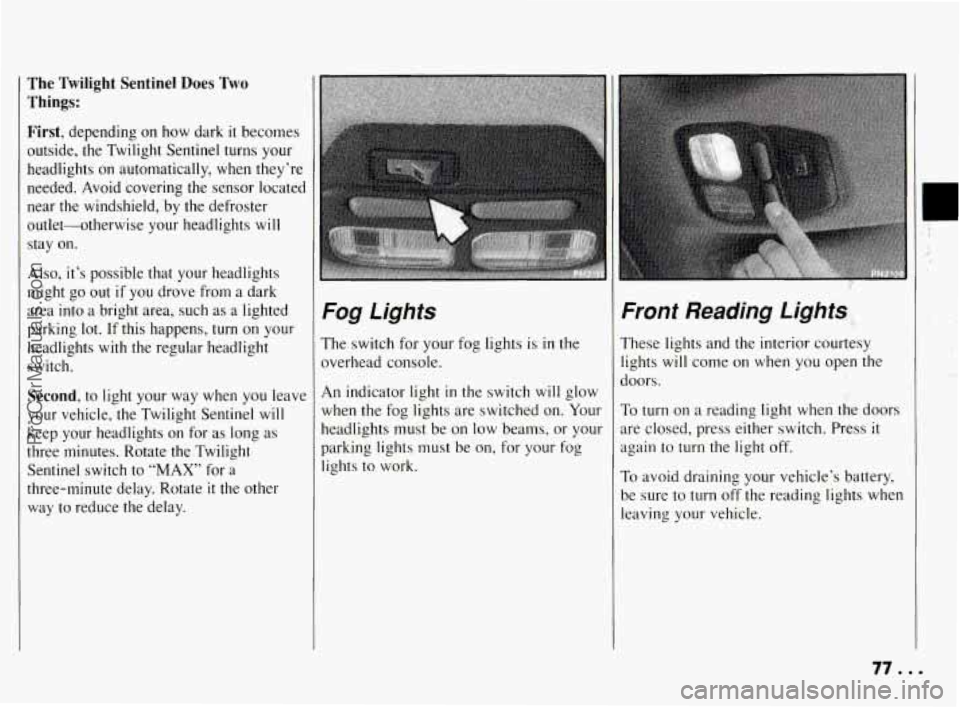
The Twilight Sentinel Does Two
Things:
First, depending on how dark it becomes
outside, the Twilight Sentinel turns your
headlights
on automatically, when they’re
needed. Avoid covering the sensor located
near the windshield, by the defroster
outlet-otherwise your headlights will stay on.
Also, it’s possible that your headlights
might go
out if you drove from a dark
area into a bright area, such as a lighted
parking lot. If this happens,
turn on your
headlights with the regular headlight
switch.
Second, to light your way when you leave
your vehicle, the Twilight Sentinel will
keep your headlights on for as
long as
three minutes. Rotate the Twilight Sentinel switch
to “MAX” for a
three-minute delay. Rotate it the other
way to reduce the delay.
Fog Lights
The switch for your fog lights is in the
overhead console.
An indicator light in the switch will glow
when the fog lights are switched on. You]
headlights must be on low beams, or
you
parking lights must be on, for your fog
lights
to work.
kont Reading Lights,
?hese lights and the interior courtesy
ights
will come on when you open the
loors.
To turn on a reading light when the doors
Ire closed, press either switch. Press it
igain
to turn the light off.
To avoid draining your vehicle’s battery,
)e sure to turn off the reading lights when
eaving your vehicle.
L
77.0.
ProCarManuals.com
Page 88 of 290
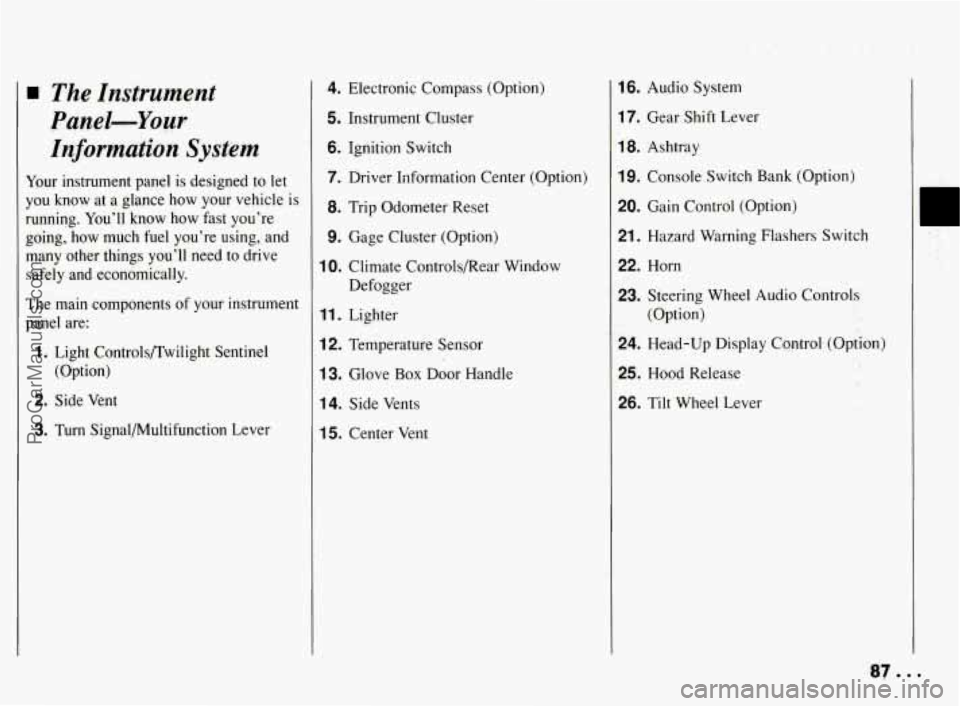
The Instrument
Panel-Your
Information System
Your instrument panel is designed to let
you
know at a glance how your vehicle is
running.
You’ll know how fast you’re
going, how much fuel you’re using, and
many other things you’ll need to drive
safely and economically;
.. .L .
The main components of your instrument
panel are:
1. Light Controls/Twilight Sentinel
(Option)
2. Side Vent
3. Turn Signal/Multifunction Lever
4. Electronic Compass (Option)
5. Instrument Cluster
6. Ignition Switch
7. Driver Information Center (Option)
8. Trip Odometer Reset
9. Gage Cluster (Option)
10. Climate Controls/Rear Window
Defogger
11. Lighter
12. Temperature Sensor
13. Glove Box Door Handle
14. Side Vents
15. Center Vent
16. Audio System
17. Gear Shift Lever
18. Ashtray
19. Console Switch Bank (Option)
20. Gain Control (Option)
21. Hazard Warning Flashers Switch
22. Horn
23. Steering Wheel Audio Controls
(Option)
24. Head-Up Display Cqntrol. (Option)
25. Hood Release
26. Tilt Wheel Lever
I
ProCarManuals.com
Page 118 of 290
not be able to if it’s very warm or cold
outside.
ECON: Use in cold or cool weather. This
saves fuel because the air conditioner
compressor doesn’t run. But this setting
doesn’t remove humidity from the air.
(Defrost): Press this to remove fog
or ice from the windshield. It will start at
the mediumhigh fan speed, but you can
select another speed
if you want. It’s a
good idea to remove any ice or snow from
the hood and from the air inlet between
the hood and windshield.
(Rear Window Defogger): Press tc
warm the defogger grid on the rear
window. On some models, the outside
rearview mirrors are also warmed. The
rear window defogger will turn off
automatically after about 10 minutes of
use. If you turn it on again, the defogger
will operate for about five minutes only.
You can also turn the defogger off by
turning off the ignition or pressing the
switch again.
Do not attach a temporary vehicle licensc
across the defogger grid on the rear
window.
NOTICE:
Don’t use a razor blade or
something else sharp on the inside
of the rear window.
If you do, you
could cut or damage the warming
grid, and the repairs wouldn’t be
covered by your warranty.
Extended Idling With
Electronic Climate Control
When the engine idles for a long time, the
outside temperature sensor may cause the
system to blow air that is too cool.
This
should stop once the vehicle is moving
again. Extended idling is not
recommended, See “Engine Exhaust’’
in
the Index.
11/...
ProCarManuals.com
Page 197 of 290

Service & Appearance Care
MTBE is “methyl tertiary-butyl ether.”
Fuel that is no more than 15% MTBE is
fine
for your vehicle.
Ethanol is ethyl or grain alcohol.
Properly-blended fuel that is no more
than
10% ethanol is fine for your vehicle
Methanol is methyl or wood alcohol.
NOTICE:
Fuel that is more than 5% methanol
is bad for your vehicle. Don’t use it.
It can corrode metal parts
in your
fuel system and also damage plastic
and rubber parts. That damage
wouldn’t be covered under your
warranty. And even at
5% or less,
there must be “cosolvents” and
corrosion preventers
in this fuel to
help avoid these problems.
Gasolines for Cleaner Air
Your use of gasoline with deposit control
additives will help prevent deposits from
forming in your engine and fuel system.
That helps keep your engine
in tune and
your emission control system working
properly. It’s good for your vehicle, and
you’ll be doing your part for cleaner air.
Many gasolines are now blended with
oxygenates. General Motors recommends
that you use gasolines with these blending
materials, such as MTBE and ethanol. By
doing so, you can help clean the air,
especially
in those parts of the country
that have high carbon monoxide levels.
In addition, some gasoline suppliers are
now producing reformulated gasolines.
These gasolines are specially designed to
reduce vehicle emissions. General Motors recommends that you use reformulated
gasoline. By doing
so, you can help clean
the air, especially
in those parts of the
country that have high ozone levels.
You should ask your service station
operators
if their gasolines contain deposit
control additives and oxygenates, and if
they have been reformulated to reduce
vehicle emissions.
r
Countries
If you plan on driving in another country
outside the
U.S. or Canada, unleaded fuel
may ‘be hard to find.
Do not use leaded
gasoline. If you use even one
tankful, your
emission controls won’t work well
or at
all. With continuous use, spark plugs can
get fouled, the exhaust system can corrode,
and your engine
oil can deteriorate quickly.
Your vehicle’s oxygen sensor
will be
damaged. All of that means costly repairs
that wouldn’t be covered by your warranty.
To check on fuel availability, ask an auto
club,
or contact a major oil company that
does business
in the country where you’ll
be driving.
. . 196
ProCarManuals.com