check engine PONTIAC BONNEVILLE 1995 User Guide
[x] Cancel search | Manufacturer: PONTIAC, Model Year: 1995, Model line: BONNEVILLE, Model: PONTIAC BONNEVILLE 1995Pages: 338, PDF Size: 16.19 MB
Page 112 of 338
Clean the inside of the windshield as needed to remove
any dirt or film that reduces the sharpness or clarity of
the
HUD image.
Spray household glass cleaner on a
soft, clean cloth.
Wipe the HUD lens gently, then dry it. Do not spray
cleaner directly on the lens, because the cleaner fluid
could leak inside the unit if you do.
If you can’t see the HUD image when the ignition
is on,
check to see if
The headlamps are on?
Anything is covering the HUD unit?
0 The HUD dimmer control is adjusted correctly?
0 The HUD image is adjusted to the proper height?
A fuse in the fuse panel may be blown. See “Fuses
If the HUD image is not clear it could be too bright,
move the
HUD dimmer control further downward. You
may need to clean the windshield and HUD lens.
Your windshield is part
of the HUD system. If you ever
have to have a new windshield, be sure to get one
designed
for HUD. If you don’t, the HUD image may
look blurred and out of focus.
and Circuit Breakers”
in the Index.
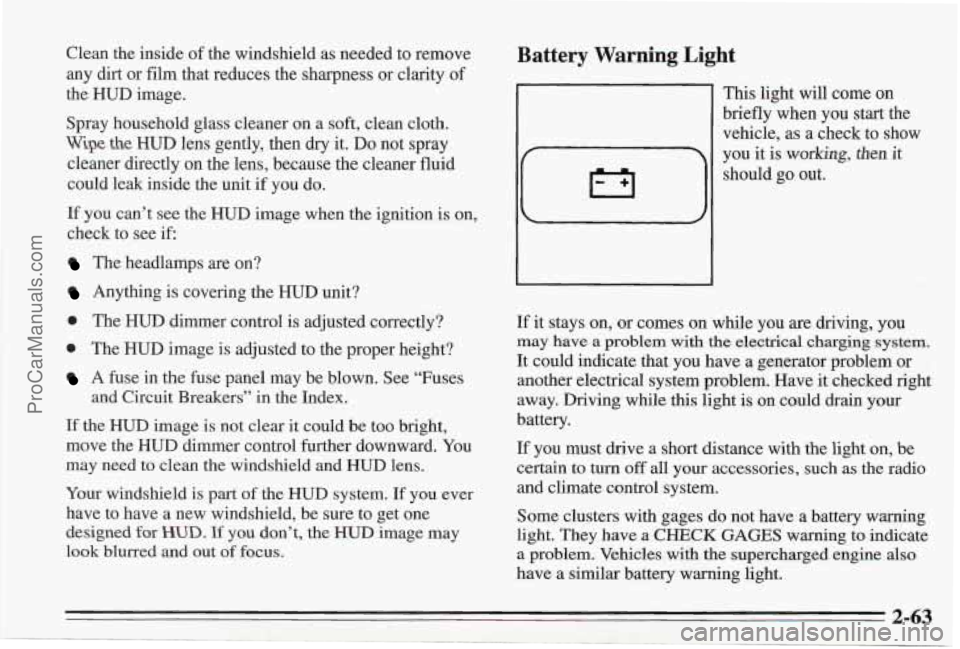
Battery Warning Light
This light will come on
briefly when you start the
vehicle, as a check to show
If it stays on, or comes on while you are dnving, you
may have a problem with the electrical charging system.
It could indicate that you have a generator problem or
another electrical system problem. Have it checked right
away. Driving while this light
is on could drain your
battery.
If you must drive a short distance with the light on, be
certain to turn
off all your accessories, such as the radio
and climate control system.
Some clusters with gages do not have a battery
warning
light. They have a CHECK GAGES warning to indicate
a problem. Vehicles with the supercharged engine also
have a similar battery warning light.
2-63
ProCarManuals.com
Page 113 of 338
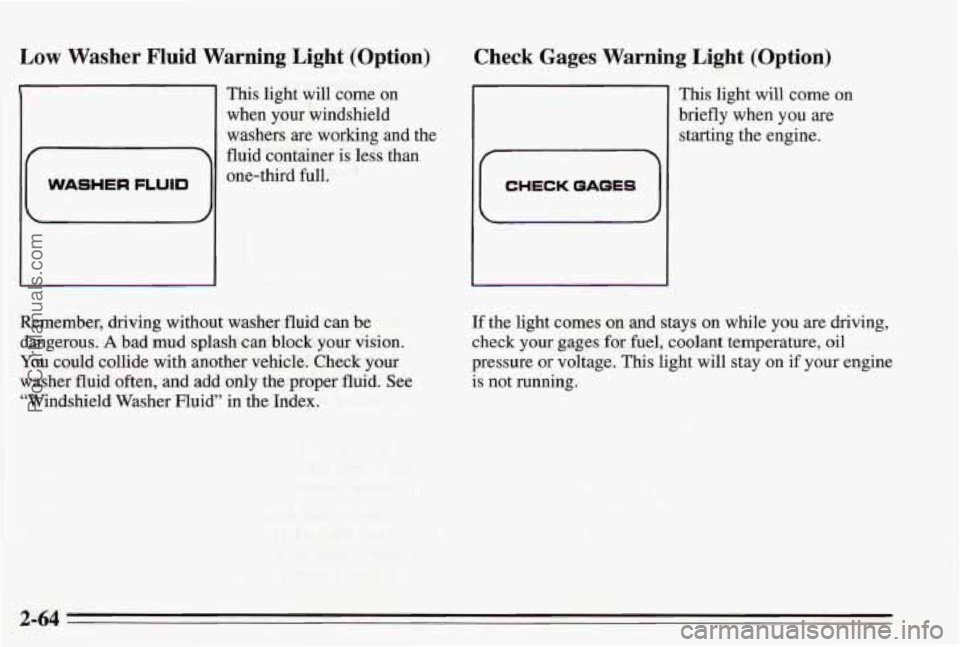
Low Washer Fluid Warning Light (Option)
E
WASHER FLUID
This light will come on
when your windshield
washers
are working and the
fluid container is less than
one-third full.
Check Gages Warning Light (Option)
11 This light will come on
brieflywhen you are
starting the engine.
CHECK QAQES
Remember, driving without washer fluid can be
dangerous.
A bad mud splash cm block your vision.
You could collide with another vehicle. Check your
washer fluid often, and add only the proper fluid. See
“Windshield Washer Fluid” in the Index.
If the light comes on and stays on while you are driving,
check
your gages for fuel, coolant temperature, oil
pressure or voltage. This light will stay on if your engine
is not running.
2-64
ProCarManuals.com
Page 114 of 338
Fuel Gage
Your fuel gage tells you about how much fuel you have
left, when the ignition is on. When the gage reads in the
yellow band, a warning chime will sound and the
CHECK GAGES warning light will go on, if you have
this option.
Here are five things that some owners ask about. None
of these show
a problem with your fuel gage:
0
0
0
0
0
At the service station, the gas pump shuts off before
the gage reads full.
It takes a little more or less fuel to
fill up than the
gage indicated. For example, the gage may have
indicated the tank was half full, but it actually took a
little more or less than half the tank's capacity to fill
the tank.
The gage moves a little when
you turn a corner,
speed up, or make a hard stop.
The gage doesn't go back to empty when you turn
off
the ignition.
If you have the large span (220") gage, the needle
moves more for
a given amount of fuel. This does
not indicate excessive fuel consumption, and is
normal.
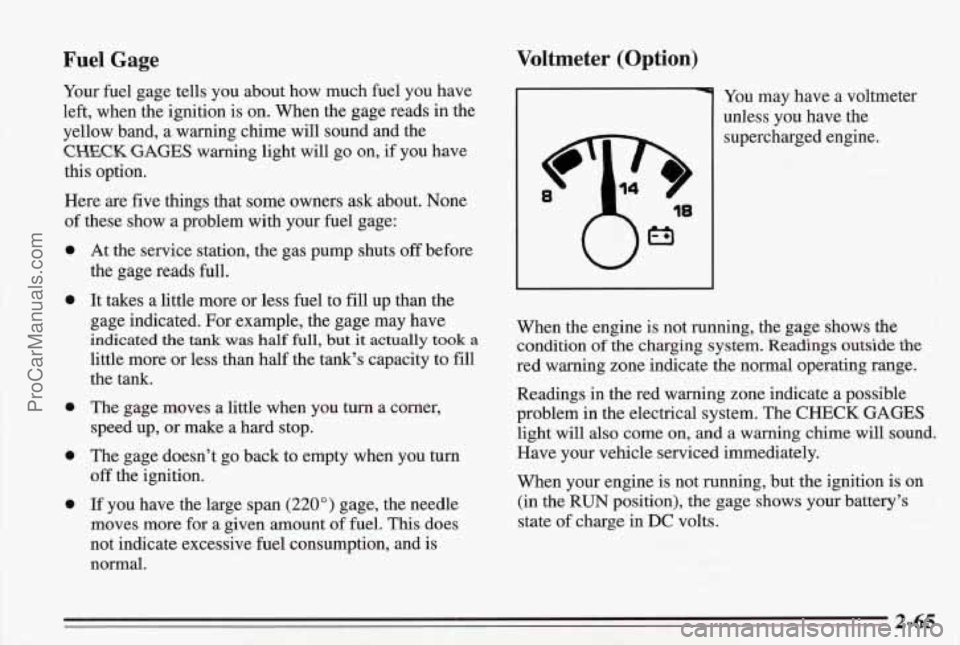
Voltmeter (Option)
You may have a voltmeter
unless you have the
supercharged engine.
When the engine is not running, the gage shows the
condition
of the charging system. Readings outside the
red warning zone indicate the normal operating range.
Readings in the red warning zone indicate a possible
problem in the electrical system. The
CHECK GAGES
light will also come on, and a warning chime will sound.
Have your vehicle serviced immediately.
When your engine is not running, but the ignition is on
(in the RUN position),
the gage shows your battery's
state of charge in
DC volts.
2-65
ProCarManuals.com
Page 115 of 338
Boost Gage (Option)
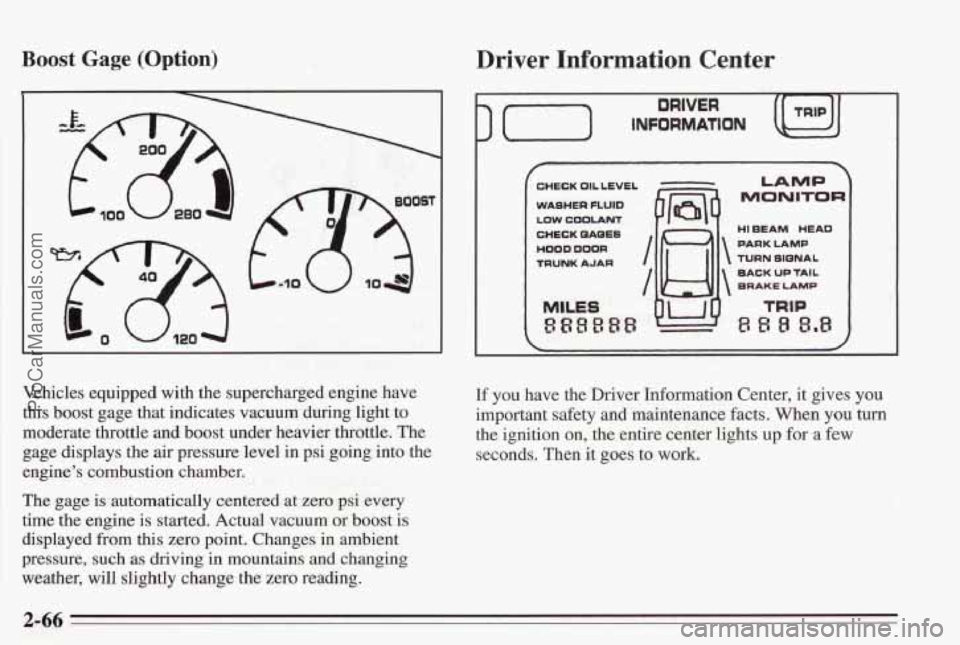
Vehicles equipped with the supercharged engine have
this boost gage that indicates vacuum during light to
moderate throttle and boost under heavier throttle. The
gage displays the air pressure level in psi going into the
engine’s combustion chamber.
The gage is automatically centered at zero psi every
time the engine is started. Actual vacuum or
boost is
displayed from this zero point. Changes in ambient
pressure, such
as driving in mountains and changing
weather, will slightly change the zero reading.
Driver Information Center
) (-) INFORMATION
DRIVER
CHECK OIL LEVEL
WASHER
FLUID
LOW COOLANT
CHECK QAQES
HOOD DOOR
TRUNK AJAR
MILES
888888
I /w
7
LAMP
MONITOR
HI EEAM HEAD
PARK LAMP
TURN SIQNAL
BACK
UP TAIL
BRAKE LAMP
If you have the Driver Information Center, it gives you
important safety and maintenance facts. When you turn
the ignition on, the entire center lights
up for a few
seconds. Then it goes to work.
2-66
ProCarManuals.com
Page 116 of 338
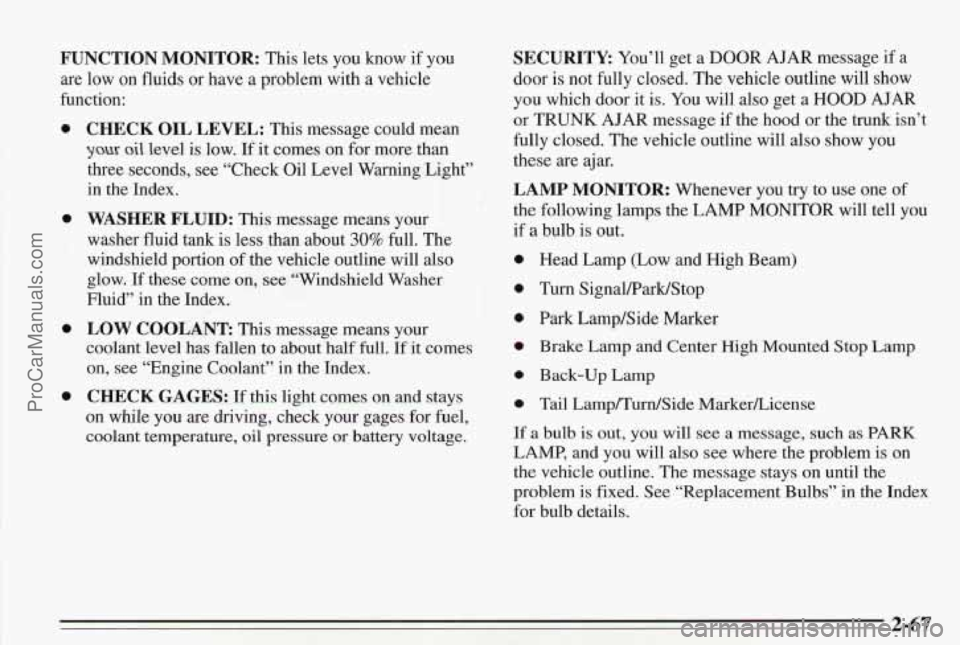
FUNCTION MONITOR: This lets you know if you
are low on fluids or have a problem with a vehicle
function:
0
0
0
0
CHECK OIL LEVEL: This message could mean
you oil level is low. If it comes on for more than
three seconds, see “Check Oil Level Warning Light”
in the Index.
WASHER FLUID: This message means your
washer fluid tank is less than about
30% full. The
windshield portion of the vehicle outline will also
glow.
If these come on, see “Windshield Washer
Fluid” in the Index.
LOW COOLANT This message means your
coolant level has fallen
to about half full. If it comes
on, see “Engine Coolant”
in the Index.
CHECK GAGES: If this light comes on and stays
on while you are driving, check your gages for fuel,
coolant temperature,
oil pressure or battery voltage.
SECURITY: You’ll get a DOOR AJAR message if a
door
is not fully closed. The vehicle outline will show
you which door it is.
You will also get a HOOD AJAR
or TRUNK AJAR message if the hood or the trunk isn’t
fully closed. The vehicle outline will also show you
these are ajar.
LAMP MONITOR: Whenever you try to use one of
the following lamps the LAMP MONITOR will tell you
if
a bulb is out.
Head Lamp (Low and High Beam)
Turn SignaWarWStop
Park Lamp/Side Marker
Brake Lamp and Center
High Mounted Stop Lamp
Back-up Lamp
Tail Lamp/Turn/Side MarkerLicense
If
a bulb is out, you will see a message, such as PARK
LAMP, and you will also see where the problem is on
the vehicle outline. The message stays on until the
problem is fixed. See “Replacement Bulbs” in the Index
for bulb details.
2-67
ProCarManuals.com
Page 139 of 338
Understanding Radio Reception
FM Stereo
FM Stereo will give you the best sound, but FM signals
will reach only about
10 to 40 miles (16 to 65 km). Tall
buildings or
hills can interfere with FM signals, causing
the sound to
come and go.
AM
The range for most AM stations is greater than for Fpv3[,
especially at night. The longer range, however, can
cause stations to interfere with each other.
AM can also
pick up noise from things like storms and power lines.
To lower this noise,
try reducing the treble level.
AM Stereo
Your Delco@ system may be able to receive C-Qum@
stereo broadcasts. Many AM stations around the country
use C-Quam
to produce stereo, though some do not.
C-Quam@
is a registered trademark of Motorola, Inc. If
your Delco system can get C-Quam signals, your stereo
indicator light will come on when you are receiving it.
Be aware that hearing damage from loud noise is almost
undetectable until it
is too late. Your hearing can adapt
to higher volumes of sound. Sound that seems normal
can be loud and harmful to your hearing.
Take
precautions by adjusting the volume control on your
radio to a safe sound level before your hearing adapts to
it.
To help avoid hearing loss or damage:
0 Adjust the volume control to the lowest setting.
Increase volume slowly until you hear comfortably
and clearly.
NOTICE:
Before you add any sound equipment to your
vehicle -- like a tape player, CB radio, mobile
telephone or two-way radio -- be sure you can
add what you want.
If you can, it's very
important
to do it properly. Added sound
equipment may interfere with the operation
of
your vehicle's engine, Delco radio or other
systems, and even damage them. And, your
vehicle's systems may interfere with the
operation of sound equipment that has been
added improperly.
So, before adding sound equipment, check with
your dealer and be
sure to check Federal rules
covering mobile radio and telephone units.
3-18
ProCarManuals.com
Page 164 of 338
Once you are moving on the freeway, make certain you
allow a reasonable following distance. Expect to move
slightly slower
at night.
When you want to leave the freeway, move to the proper
lane well in advance.
If you miss your exit do not, under
any circumstances, stop and back up. Drive on to the
next exit.
The exit ramp can be curved, sometimes quite sharply.
The exit speed is usually posted.
Reduce your speed according to your speedometer, not
to your sense
of motion. After driving for any distance
at higher speeds, you may tend to think you are going
slower than you actually are.
Before Leaving on a Long Trip
Make sure you’re ready. Try to be well rested. If you
must start when you’re not fresh
-- such as after a day’s
work
-- don’t plan to make too many miles that first part
of the journey. Wear comfortable clothing and shoes you
can easily drive in.
Is your vehicle ready for a long trip? If you keep it
serviced and maintained, it’s ready to go. If it needs
service, have
it done before starting out. Of course,
you’ll find experienced and able service experts in Pontiac dealerships
all across North America. They’ll be
ready and willing to help if you need it.
Here are some things you can check before a trip:
0
0
0
e
0
0
0
Windshield Washer Fluid: Is the reservoir full? Are
all windows clean inside and outside?
Wiper Blades: Are they in good shape?
Fuel, Engine Oil, Other Fluids: Have you checked
all levels?
Lamps: Are they all working? Are the lenses clean?
Tires: They are vitally important to a safe,
trouble-free trip.
Is the tread good enough for
long-distance driving? Are the tires all inflated
to the
recommended pressure?
Weather Forecasts: What’s the weather outlook
along your route? Should you delay your trip a short
time to avoid a major storm system?
Maps: Do you have up-to-date maps?
4-21
ProCarManuals.com
Page 165 of 338
Highway Hypnosis
Is there actually such a condition as “highway
hypnosis”?
Or is it just plain falling asleep at the wheel?
Call
it highway hypnosis, lack of awareness, or
whatever.
There is something about an easy stretch
of road with the
same scenery, along with the hum
of the tires on the road,
the drone
of the engine, and the rush of the wind against
the vehicle that can make you sleepy. Don’t let it happen
to you!
If it does, your vehicle can leave the road in less
than a second, and you could crash and be injured.
What can you do about highway hypnosis? First, be
aware that it can happen.
Then here are some tips:
Make sure your vehicle is well ventilated, with a
comfortably cool interior.
0 Keep your eyes moving. Scan the road ahead and to
the sides. Check your rearview mirrors and
your
instruments frequently.
If you get sleepy, pull off the road into a rest, service,
or parking area and take a nap, get some exercise, or
both. For safety, treat drowsiness
on the highway as
an emergency.
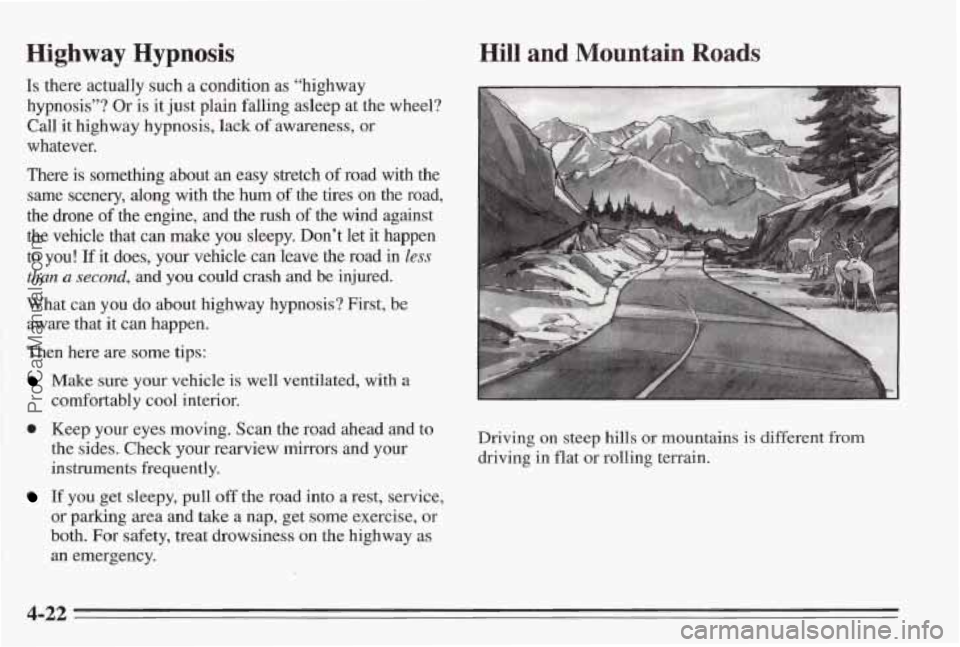
Hill and Mountain Roads
Driving on steep hills or mountains is different from
driving in flat or rolling terrain.
4-22
ProCarManuals.com
Page 166 of 338
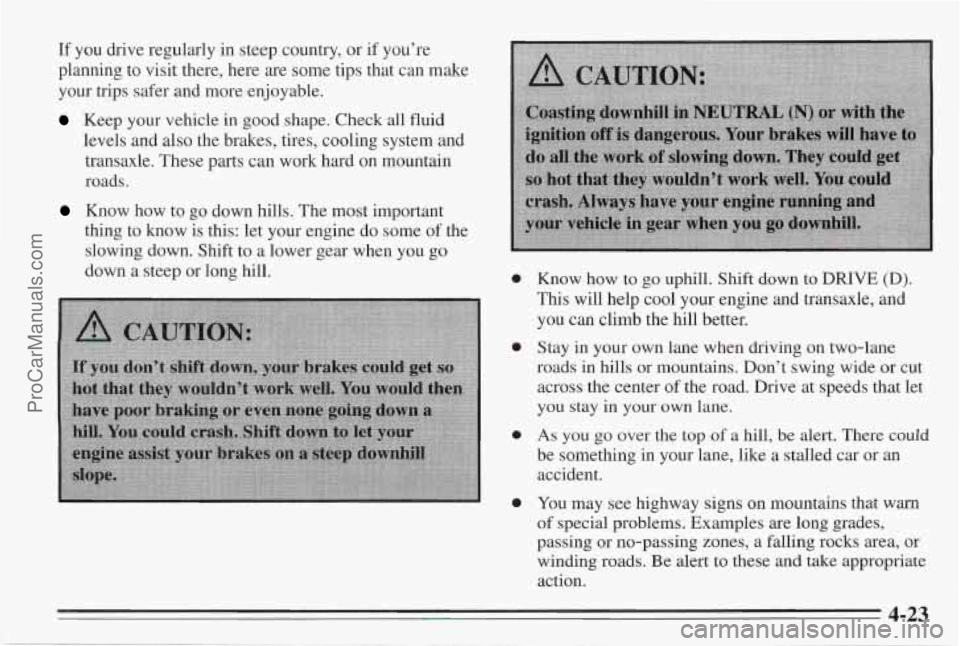
If you drive regularly in steep country, or if you’re
planning to visit there, here are some tips that can make
your trips safer and more enjoyable.
Keep your vehicle in good shape. Check all fluid
levels and also the brakes, tires, cooling system and
transaxle. These parts can work hard on mountain
roads.
Know how to go down hills. The most important
thing to know is this: let your engine
do some of the
slowing down. Shift to
a lower gear when you go
down a steep or long hill.
a
a
0
a
Know how to go uphill. Shift down to DRIVE (D).
This will help cool your engine and transaxle, and
you can climb the hill better.
Stay in your own lane when driving
on two-lane
roads
in hills or mountains. Don’t swing wide or cut
across the center of the road. Drive at speeds that let
you stay in your
own lane.
As you go over the top of a hill, be alert. There could
be something in your lane, like a stalled car or an
accident.
You may see highway signs on mountains that
warn
of special problems. Examples are long grades,
passing or no-passing
zones, a faIIing rocks area, or
winding
roads. Be alert to these and take appropriate
action.
4-23
ProCarManuals.com
Page 178 of 338
Making Thms
NOTICE:
Making very sharp turns while trailering could cause the trailer to come in contact with the vehicle. Your vehicle could be damaged. Avoid
making very sharp turns while trailering.
When you’re turning with a trailer, make wider turns
than normal.
Do this so your trailer won’t strike soft
shoulders, curbs, road signs, trees, or other objects.
Avoid jerky or sudden maneuvers. Signal well in
Tldvance.
’Ibrn Signals When Towing a Trailer
When you tow a trailer, your vehicle has to have a
different turn signal flasher and extra wiring. The green
arrows on your instrument panel will flash whenever
you signal a turn or lane change. Properly hooked up,
the trailer lamps will also flash, telling other drivers
you’re about to turn, change lanes or stop.
When towing a trailer, the green arrows on your
instrument panel will flash for turns even if the bulbs on
the trailer are burned out.
Thus, you may think drivers behind
you are seeing your signal when they are not. It’s
important to check occasionally to be sure the trailer
bulbs are still working.
Your vehicle has bulb warning lights. When you plug a
trailer lighting system into your vehicle’s lighting
system, its bulb warning lights may not let you know if
one of your lamps goes out.
So, when you have a trailer
lighting system plugged in, be sure to check your
vehicle and trailer lamps from time to time to be sure
they’re all working. Once you disconnect the trailer lamps, the bulb warning lights again can tell you if one
of your vehicle larnps is out.
Driving On Grades
Reduce speed and shift to a lower gear before you start
down a long or steep downgrade.
If you don’t shift
down, you might have to use your brakes
so much that
they would get hot and
no longer work well.
On a long uphill grade, shift down to DRIVE (@) and
reduce your speed to around 45 mph (70 kmph) to
reduce the possibility of engine and transaxle
overheating.
ProCarManuals.com