sensor PONTIAC BONNEVILLE 1996 Owners Manual
[x] Cancel search | Manufacturer: PONTIAC, Model Year: 1996, Model line: BONNEVILLE, Model: PONTIAC BONNEVILLE 1996Pages: 387, PDF Size: 18.71 MB
Page 28 of 387
0 Your vehicle is equipped with a crash sensing and
diagnostic module, which records information about
the air bag system. The module records information
about the readiness of the system, when the sensors
are activated and driver’s safety belt usage at deployment.
Let only qualified technicians work on your air bag
system. Improper service can mean that your air bag
system won’t work properly. See your dealer for
service.
NOTICE:
If you damage the cover for the driver’s or the
right front passenger’s air bag, they may not
work properly. You may have to replace the air
bag module in the steering wheel or both the air
bag module and the instrument panel for the
right front passenger’s air bag.
Do not open or
break the air bag covers.
Servicing Your Air Bag-Equipped Pontiac
Air bags affect how your Pontiac should be serviced.
There are parts of the air bag system in several places
around your vehicle. You don’t want the system to
inflate while someone is working
on your vehicle. Your
Pontiac dealer and the Bonneville Service Manual have
information about servicing your vehicle and the air bag
system.
To purchase a service manual, see “Service and
Owner Publications” in the Index.
For up to 10 seconds after the ignition key is
turned off and the battery is disconnected, an air
bag can still. inflate during improper service. You
can be injured if you are close to an air bag when
it inflates. Avoid wires wrapped with yellow tape
or yellow connectors. They are probably part
of
the air bag system. Be sure to ‘follow proper
service procedures,’and make sure the person
performing work for you is qualified to do
so.
The air bag system does not need regular maintenance.
ProCarManuals.com
Page 74 of 387
NOTICE:
Damage to your transaxle caused by shifting out
of
PARK (P) or NEUTRAL (N) with the engine
racing isn’t covered by your warranty.
AUTOMATIC OVERDRIVE
(D): This position is for
normal driving. If you need more power for passing,
and you’re:
- Going less than about 35 mph (56 km/h), push your
- Going about 35 mph (56 h/h) or more, push the
You’ll shift down to the next gear and have more power.
accelerator pedal about halfway down.
accelerator
all the way down.
NOTICE:
If your vehicle seems to start up rather slowly, or
if it seems not to shift gears as you
go faster,
something may be wrong with
a transaxle system
sensor.
If you drive very far that way, your
vehicle can be damaged.
So, if this happens, have
your, vehicle serviced right away. Until then,
you
can use SECOND (2) when you are driving less
than
35 mph (56 kdh) and AUTOMATIC
OVERDRIVE
(0) for higher speeds.
DRIVE (D): This position
is also used for normal
driving, however, it offers more power
and lower fuel
economy than AUTOMATIC
OVERDRIVE (@).
Here are some times you might choose DRIVE (D)
instead of AUTOMATIC OVERDRIVE (@):
- When driving on hilly, winding roads
- When towing a trailer, so there is less shifting
between gears
- When going down a steep hill
ProCarManuals.com
Page 93 of 387
Daytime Running Lamps
Daytime Running Lamps (Dm) can make it easier for
others to see the front of your vehicle during the day.
DRL can be helpful in many different driving
conditions, but they can
be especially helpful in the
short periods after dawn and before sunset.
A light sensor on top of the instrument panel monitors
the exterior light level for the operation
of DlU and
twilight sentinel,
so .be sure it isn’t covered. The DRL
system will make your low-beam headlamps come on at
a reduced brightness when:
The ignition is on,
0 The headlamp switch is OFF and
The transaxle is not in PARK (P).
When the DRL are on, only your low-beam headlamps
will
be on. The taillamps, sidemarker and other lamps
won’t be on.
Your instrument panel won’t be lighted either.
When it’s
dark enough outside, your low-beam
headlamps
will change to full brightness. The other
lamps that come on with your headlamps will also come
on. When it’s bright
enough outside, the regular lamps
will
go off, and your low-beam headlamps change to the
reduced brightness
of DRL.
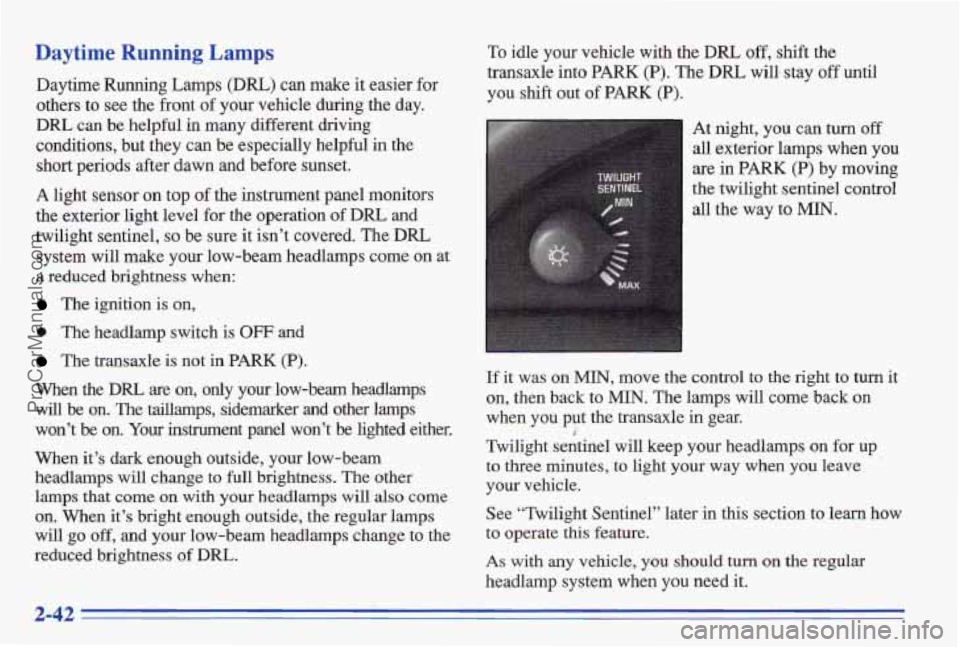
To idle your vehicle with the DIU off, shift the
transaxle into
PARK (P). The DRL will’ stay off until
YOU Shift Out Qf PARK (P).
At night, you can turn off
all exterior lamps when you
are in PARK (P) by moving
the twilight sentinel control
all the way to
MIN.
If it was on MIN, move the control to the right to turn it
on, then back to
“4. The lamps will come back on
when you put the transaxle
in gear.
Twilight sentinel will keep your headlamps on for up to three minutes, to light your way when you leave
YOU vehicle.
See “Twilight Sentinel” later
in this section to learn how
to operate this feature.
As with any vehicle, you should turn on the regular
headlamp system when you need it.
3
2-42
ProCarManuals.com
Page 114 of 387
Safety Belt Reminder Light
When the key is turned to RUN or START, a chime will
come on for about eight seconds to remind people to
fasten their safety belts.
’
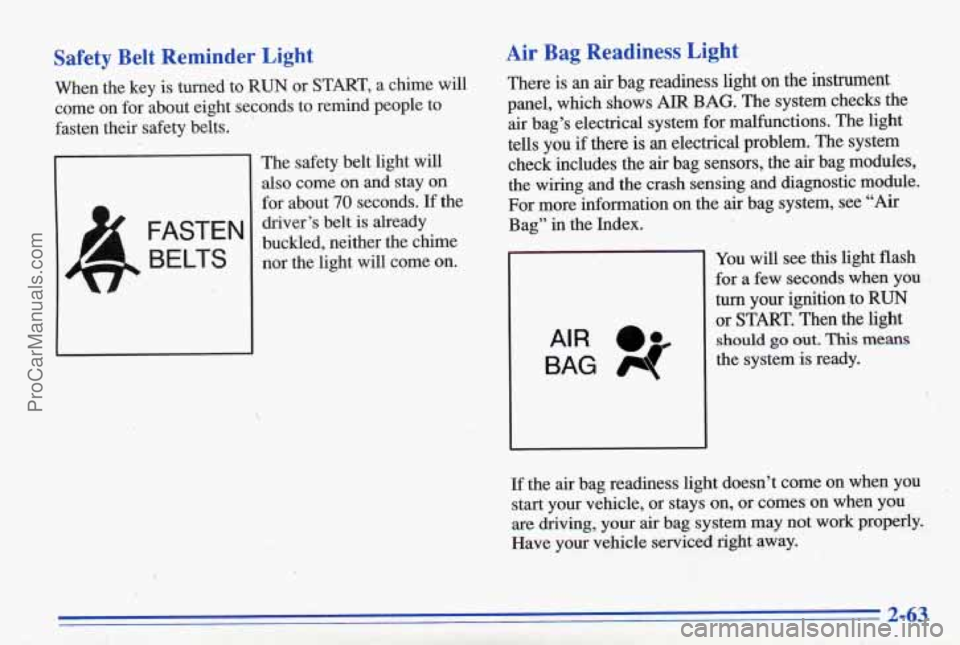
The safety belt light will
also come
on and stay on
for about 70 seconds. If the
driver’s belt
is already
buckled, neither the chime nor the light will come on.
Air Bag Readiness Light
There is an air bag readiness light on the instrument
panel, which shows
AIR BAG. The system checks the
air bag’s electrical system for malfunctions. The light
tells you
if there is an electrical problem. The system
check includes the
air bag sensors, the air bag moduIes,
the wiring and the crash sensing ahd diagnostic module.
For more infomation on the air bag system, see “Air
Bag” in the Index.
BAG 4
AIR @a
You will see this light flash
for a few seconds when you
turn your ignition to ,RUN
or STmT. Then the light
should go out. This means
the system is ready.
If the air bag readiness light doesn’t come on when you
start your vehicle, or stays on, or comes on when you
are driving, your air bag system may not work properly.
Have your vehicle serviced right away.
ProCarManuals.com
Page 140 of 387
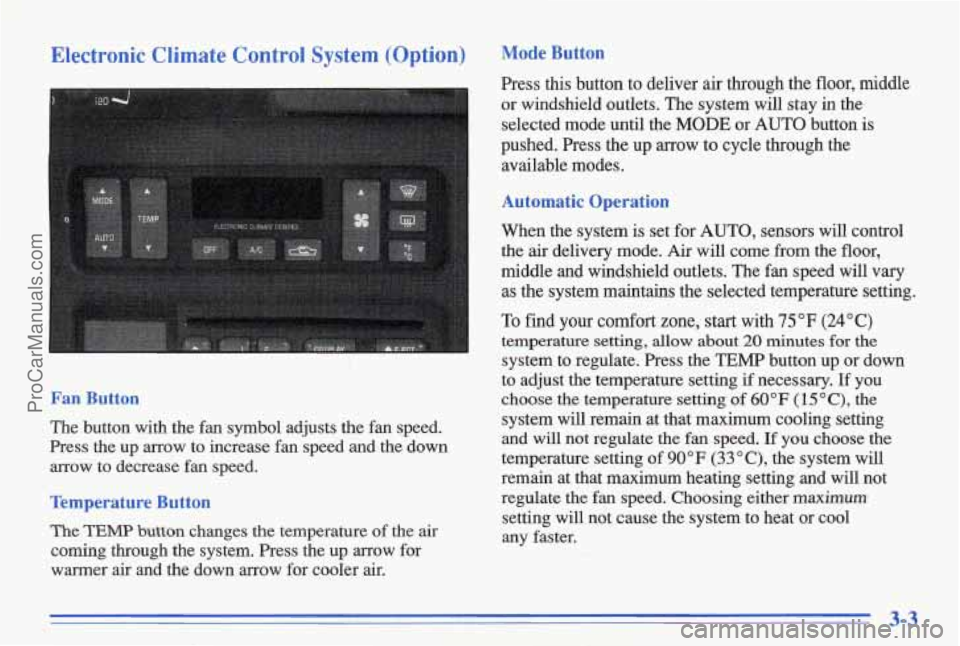
Electronic Climate Control System (Option)
Fan Button
The button with the fan symbol adjusts the fan speed.
Press the up arrow to increase fan speed and the down
arrow to decrease fan speed.
Temperature Button
The TEMP button changes the temperature of the air
coming through the system. Press the up arrow for
warmer air and the down arrow for cooler air.
Mode Button
Press this button to deliver air through the floor, middle
or windshield outlets. The system will stay in the
selected mode until the
MODE or AUTO button is
pushed. Press the up
arrow to cycle through the
available modes.
Automatic Operation
When the system is set for AUTO, sensors will control
the
air delivery mode. Air will come from the floor,
middle and windshield outlets. The fan speed will vary
as the system maintains the selected temperature setting.
To find your comfort zone, start with 75°F (24°C)
temperature setting, allow about 20 minutes for the
system to regulate. Press the TEMP button up or down
to adjust the temperature setting
if necessary. If you
choose the temperature setting
of 60°F (15 "C), the
system
will remain at that maximum cooling setting
and
will not regulate the fan speed. If you choose the
temperature setting of
90°F (33 O C), the system will
remain at that maximum heating setting and will not
regulate the fan speed. Choosing either
maximum
setting will not cause the system to heat or cool
any faster.
3-3
ProCarManuals.com
Page 141 of 387
Pressing the AUTO button will display the requested
temperature, fan speed'and
air delivery mode for five
seconds, then change to display the outside air
temperature. Be careful not to put anything over the
sensor located in the middle
of the instrument panel near
the windshield, or over the sensor
in the gnlle above the
radio. These sensors are used by the automatic system to
regulate temperature.
The exterior temperature display sensor is in front
of the
car, near the radiator. This displayed temperature is most
accurate when the vehicle
is moving. During stops, or
while idling, the display shows the previous driving
temperature for best system control.
To avoid blowing cold air in cold weather, the system
will delay turning
on the fan until warm air is available.
The length
of delay depends on outside air temperature,
engine coolant temperature, and time since the engine
was last started. Pushing the
fan button will override this
delay and change the fan to a selected single speed.
If you leave your vehicle, the system will remember the
control setting the next time you start your engine.
Manual Operation
You may also manually adjust the delivery mode or
fan speed.
'!! HEAT: Manually selecting HEAT by cycling
through the
MODE settings will deliver air to the floor
outlets.
+# DEFOG: Manually selecting DEFOG by cycling
through the
MODE settings will deliver air to the floor
and windshield outlets.
12 BI-LEVEL: Manually selecting BI-LEVEL by
cycling through the MODE setting will deliver warm air
to the floor and cooler air to the middle instrument panel outlets.
OFF: Press this button to turn the system off. Fresh air
will continue to flow through the vehicle, and the
system
will try to maintain the previously set
temperature. The outside temperature will show in the
display when the system
is OFF.
w.
ProCarManuals.com
Page 144 of 387
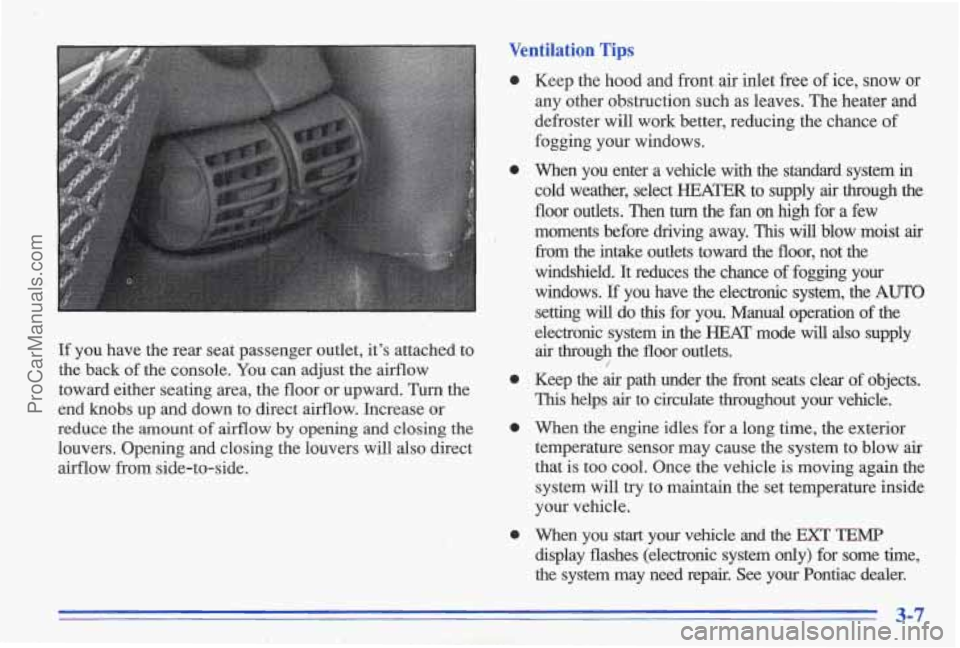
If you have the rear seat passenger outlet, it's attached to
the back
of the console. You can adjust the airflow
toward either seating area, the floor or upward. Turn the
end
knobs up and down to direct airflow. Increase or
reduce
the amount of airflow by opening and closing the
louvers. Opening and closing the louvers will also direct airflow from side-to-side.
Ventilation Tips
0 Keep the hood and front air inlet free of ice, snow or
any other obstruction such as leaves. The heater and
defroster will work better, reducing the chance of
fogging your windows.
0 When you enter a vehicle with the standard system in
cold weather, select
HEATER to supply air through the
floor outlets. Then
turn the fan on high for a few
moments before driving away. This will blow moist air
from the intake outlets toward the floor, not the
windshield. It reduces
the chance of fogging your
windows. If you have the electronic system, the AUTO
setting will do this for you. Manual operation of the
electronic system in the
HEAT' mode will also supply
air through the floor outlets.
0 Keep the air path under the front seats clear of objects.
This helps air to circulate throughout your vehicle.
0 When the engine idles for a long time, the exterior
temperature sensor may cause the system to blow
air
that is too cool. Once the vehicle is moving again the
system will
try to maintain the set temperature inside
your vehicle.
display flashes (electronic system only) for some time,
the system may need repair. See
your Pontiac dealer.
/
0 When you start your vehicle and the EXT TEMP
ProCarManuals.com
Page 379 of 387
Inspections Brake System
................................. 7-40
Exhaust Systems ............................. 7-40
Front-Wheel-Drive Axle Boot .................. 7-40
Front-Wheel-Drive Axle Seal ................... 7-40
Radiator and Heater Hose ...................... 7-40
Suspension ..................................... 7-40
Brightness Control ............................ 2-44
Cleaning .................................... 6-52
Cluster ..................................... 2-58
Steering .................................... 7-40
Throttle Linkage .............................. 7-40
Instrument Panel ............................... 2-56 .9
FuseBlock ................................... 6-59
InteriorLamps ................................. 2-4
Jack. Tire .....
Jump Starting ...
Key Lock Cylinders Service ..................... 7-37
Key Reminder Warning .......................... 2-1 8
Keys .......................................... 2-1
]Labels Certification ................................. 4-30
Certification/”ire ................................ 4-30
Service Parts Identification ..................... 6-57
Tire-Loading Information ....................... 4-30
Vehicle Identification Number ................... 6-57
Courtesy .................................... 2-44
Lamps ......................................... 2-41
...................................... 2-44
Monitor Message ............................. 2-80
ClnReminder ...........I....................,. 2-41
Leaving Your Vehicle ............................. 2-6
Leaving Your Vehicle with the Engine Running ....... 2-29
Light Sensor, Twilight Sentinel .......... ; ......... 2-43
Lighter ........................................ 2-53
Lights
i
Level Control, Electronic ......................... 4-31
Air Bag Readiness ........................ 1-17, 2-63
Anti-Lock Brake System Warning ............ 2-66, 4-6
Brake System Warning ......................... 2-65
Check Gages ................................... 2-74
Engine Oil Pressure Light ...................... 2-71
LOW Coolant Warning ......................... 2-68
Low Washer Fluid ............................ 2-74
Safety Belt Reminder .................. .’ ... 1-5, 2-63
Traction Control System Warning ............ 2-67. 4-8
Traction Off Warning ...................... 2-67, 4-8 Loading Your Vehicle ................ ..... 4-30
Anti-Lockout Feature .......................... 2-6
Automatic Door .. ; ............................. 2-4
. Battery Warning .............................. 2-64
Check Engine ................................. 2-69
Interior ..................................... 2-44
. Oil Level Warning ............ 8. ............... 2-72
Locks
Door ........................................ 2-3
FuelDoor .................................... 6-4
Key Lock Cylinder Service ...................... 7-37
PowerDoor ................................... 2-4 Rear Door Security ............................. 2-6
Steering Column Lock Check ................... 7-39
Tkunk ...................................... 2-11
Law Coolant Message .......................... .’2-79
. L .. .. I .. ....... . - .. ..._. .. , ProCarManuals.com