warning PONTIAC BONNEVILLE 1996 Owners Manual
[x] Cancel search | Manufacturer: PONTIAC, Model Year: 1996, Model line: BONNEVILLE, Model: PONTIAC BONNEVILLE 1996Pages: 387, PDF Size: 18.71 MB
Page 4 of 387
How to Use This Manual
Many people read their owner’s manual from beginning
to end when they first receive their new vehicle. If you
do this,
it will help you learn about the features and
controls for your vehicle.
In this manual, you’ll find that
pictures and words work together to explain things quickly.
Index
A good place to look for what you need is the Index in
the back of the manual. It’s an alphabetical list of all
that’s in the manual, and the page number where you’ll
find
it.
Safety Warnings and Symbols
You will find a number of safety cautions in this book.
We
use a box and the word CAUTION to tell you about
things that could hurt you if you were to ignore the
warning.
/1 CAUTIGN:
These mean there is something that could hurt
you or other people.
In the caution area, we tell you what the hazard is. Then
we tell you what to
do to help avoid or reduce the
hazard. Please read these cautions.
If you don’t, you or
others could be hurt.
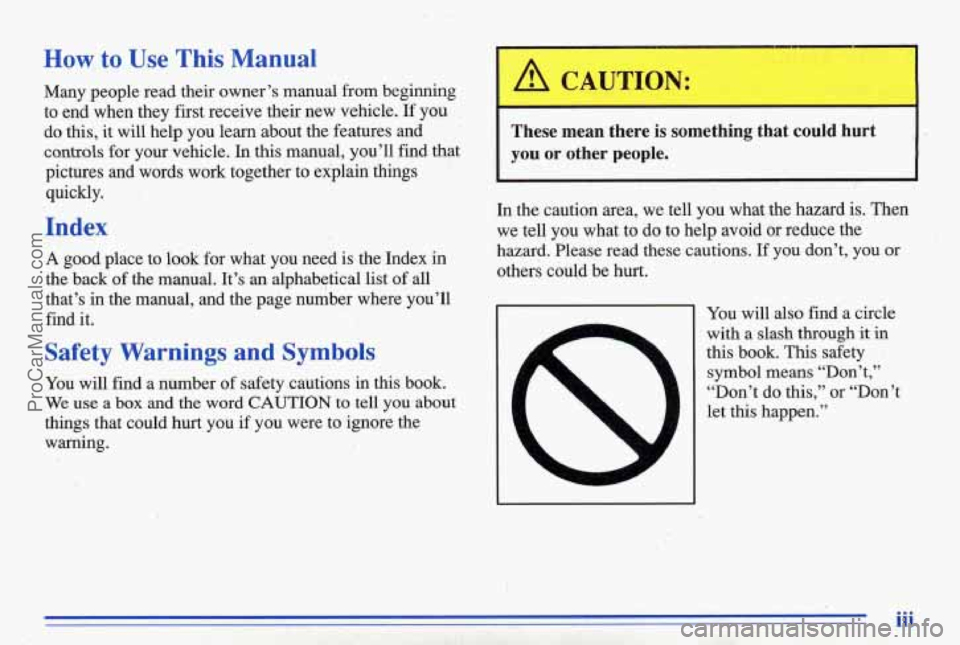
You will also find
a circle
with a slash through
it in
this book. This safety
symbol means “Don’t,’’
“Don’t do this,”
or “Don’t
let this happen.”
iii
ProCarManuals.com
Page 5 of 387
Vehicle Damage Warnings In the notice =ea, we tell you about something that can
damage your vehicle. Mafly times, this damage would
Also, in this book you will find these notices: not be covered by your warranty, and it could be costly
But the notice will tell you what to do to help avoid the
damage.
"When
you read other manuals, you might see CAUTION
and NOTICE warnings in different colors or in differat
words. 1
You'll also see warning labels on your vehicle. They use
the same words, CAUTION or NOTICE.
NOTICE:
These mean there is something that could
damage your vehicle.
iv
ProCarManuals.com
Page 6 of 387
Vehicle Symbols
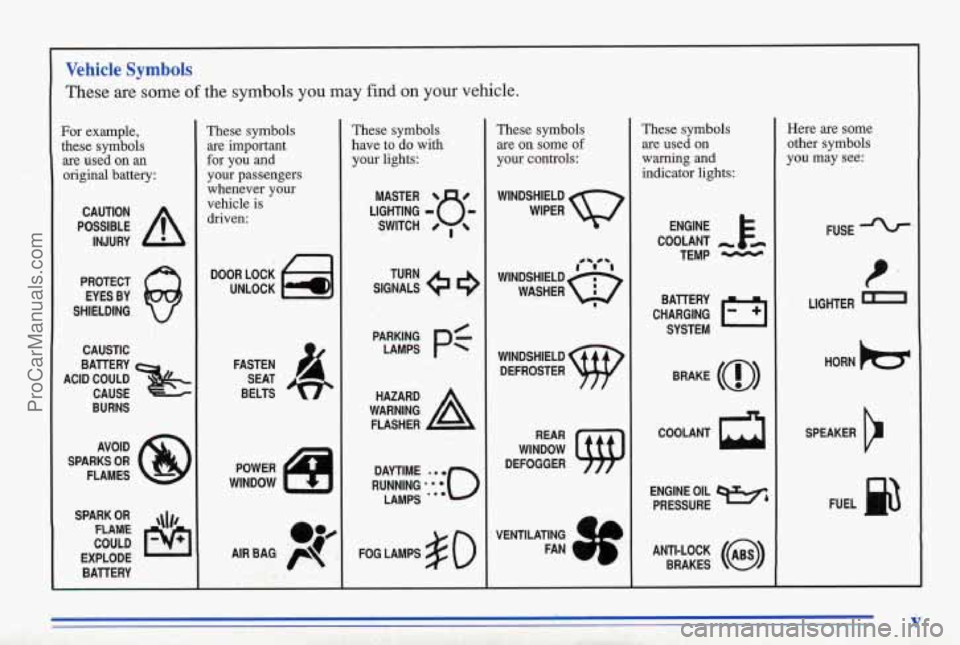
These are some of the symbols you may find on your vehicle.
For example, these symbols are used on
an
original battery:
POSSIBLE A
CAUTION
INJURY
PROTECT EYES BY
SHIELDING
CAUSTIC
BURNS AVOID
SPARKS
OR
FLAMES
SPARK
OR ,\I/,
COULD
RAM€
EXPLODE BATTERY
These symbols are
important
for you and
your passengers whenever your
vehicle
is
driven:
f-l DOOR LOCK
UNLOCK
FASTEN SEAT
BELTS
e?
AIR BAG p
These symbols
have to do with your lights:
SIGNALS e
TURN
PARKING
p$ LAMPS
FOG LAMPS
$0
These symbols are on some of
your controls:
WIPER Q
WINDSHIELD
DEFROSTER
VENTILATING
FAN - )
These symbols are used on
warning
and
indicator lights:
ENGINE
COOLANT
- e-
TEMP -
CHARGING I-1
BATTERY
SYSTEM
BRAKE
(0)
COOLANT a
ENGINE OIL e,
PRESSURE
ANTI~LOCK (@)
BRAKES
Here are some
other symbols
you
may see:
FUSE
LIGHTER
m
HORN )tr
SPEAKER
b
FUEL p3
v
ProCarManuals.com
Page 52 of 387
Section 2 Features and Controls
Here you can learn about the many standard and
optional features on your Pontiac, and information on
starting, shifting and braking.
Also explained are the
instrument panel and the warning systems that tell you
if
everything is working properly -- and what to do if you
have a problem.
Keys
A CAUTION:
-
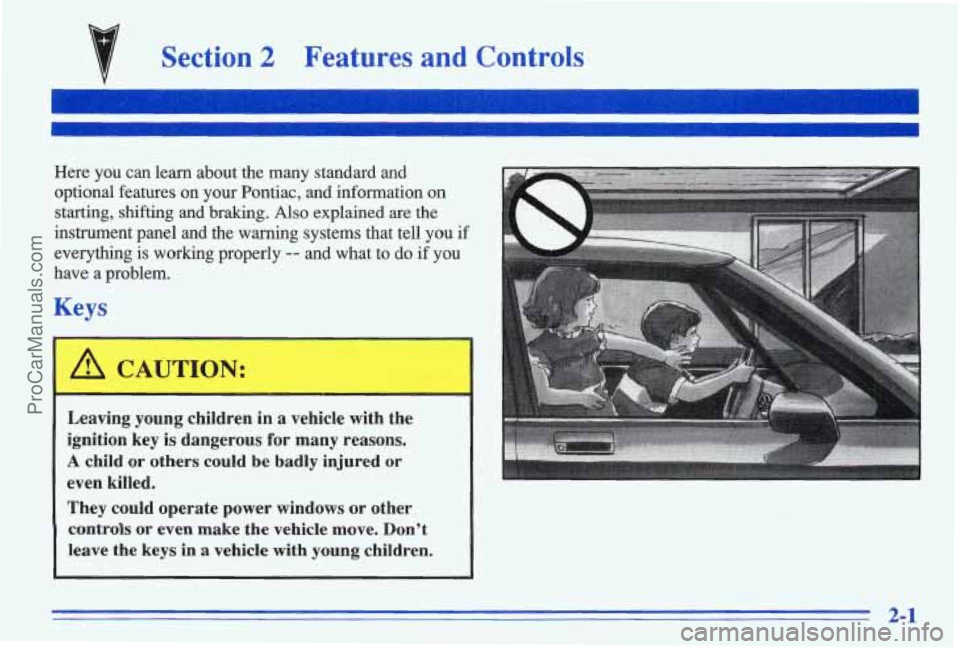
Leaving young children in a vehicle with the
ignition key
is dangerous for many reasons.
A child or others could be badly injured or
even killed.
They could operate power windows or other
controls or even make the vehicle move. Don’t
leave the keys in
a vehicle with young children.
2-1
ProCarManuals.com
Page 68 of 387
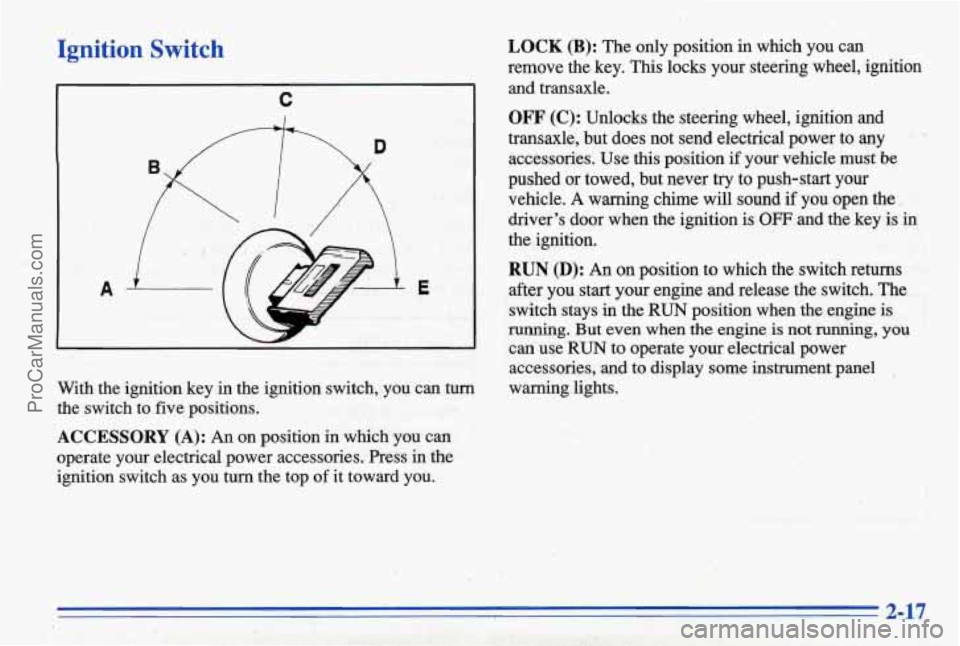
Ignition Switch
C
With the ignition key in the ignition switch, you can turn
the switch to five positions.
ACCESSORY (A): An on position in which you can
operate your electrical power accessories. Press in the
ignition switch
as you turn the top of it toward you.
LOCK (B): The only position in which you can
remove the key. This locks your steering wheel, ignition
and transaxle.
OFF (C): Unlocks the steering wheel, ignition and
transaxle, but does not send electrical power to any
accessories.
Use this position if yoUr vehicle must be
pushed or towed, but never try to push-start your
vehicle.
A warning chime will sound if you open the,.
driver's door when the ignition is
OFF and the key is in
the ignition.
RUN (D): An on position to which the switch returns
after you start your engine and release the switch. The
switch stays
in the 'RUN position when the engine is
running. But even when the engine is not running, you
can use RUN to operate your electrical power
accessories,
and to display some instrument panel
warning lights.
2-17
ProCarManuals.com
Page 69 of 387
START (E): Starts the engine. When the engine st&&
release the key. The ignition switch
will return to RUN
for normal driving.
Note that even if the engine
is not running, the positions
ACCESSORY and RUN are on positions that allow you
to operate your electrical accessories, such as the radio.
Key Reminder Warning
If you leave your key in the ignition, in the OFF
position, you will hear a warning tone when you open
the driver’s door.
NOTICE:
If your key seem stuck in LOCK and you can’t
turn it, be sure
it is all the way in. If it is, then
turn the steering wheel left and right while you
turn the key hard. But turn the
key only with
your hand. Using a tool to force it could break
the key or the ignition switch.
If none of this
works, then your vehicle needs service.
Retained Accessory, Power (Option)
If you have this option, after you turn your ignition OFF
and even remove the key, you will still have electrical
power to such accessories
as the radio and power
windows for up to 10 minutes. But if you open a door,
power is turned off.
Starting Your ,Engine
Move your shift lever to PARK (P) or NEUTRAL (N).
Your engine won’t start in any other position -- that’s
a safety feature. To restart when you’re already ‘moving,
use NEUTRAL (N) only.
NOTICE:
Don’t try to shift to PARK (P) if y& Ponthc is
moving. If you do, you could damage the
transaxle. Shift to PARK (P) only when your
vehicle
is stopped.
2-18
ProCarManuals.com
Page 77 of 387
Parking Brake
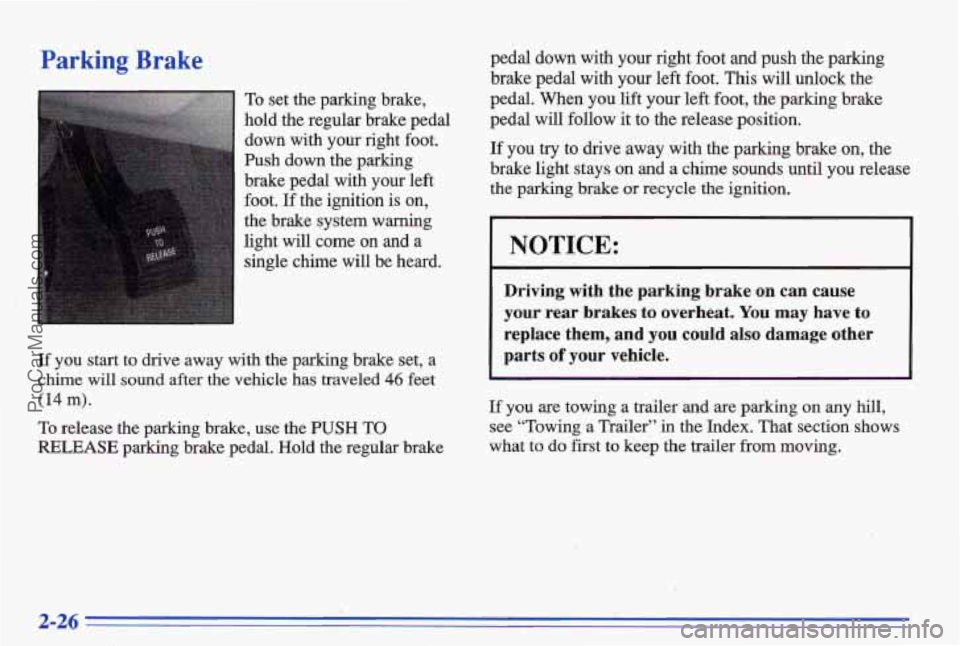
To set the parking brake,
hold the regular brake pedal down- with
your right foot.
Push down the
parking
brake pedal with your left .
foot. If the ignition is on,
the brake system warning
light will come on
and a
single
chime will be heard.
If you start to drive away with the parking brake set, a
chime will sound after the vehicle has traveled 46 feet
(14
m).
To release the parking brake, use the PUSH TO
RELEASE parking brake pedal. Hold the regular brake pedal down with
your right foot and push the parking
brake pedal with your left foot. This will unlock the
pedal. When you lift your left foot, the parking brake
pedal will
follow it to the release position.
If you try to drive away with the parlung brake on, the
brake light stays
on and a chime sounds until you release
the parking brake or recycle^ the ignition.
I
NOTICE:
Driving with the parking brake on can cause
your rear brakes to overheat.
You may have to
replace them, and you could also damage other
parts
of your vehicle.
If you are towing a trailer and are parking on any hill,
see “Towing a Trailer” in the Index. That section shows
what
to do first to keep the trailer from moving.
2-26
ProCarManuals.com
Page 88 of 387
Windshield Washer
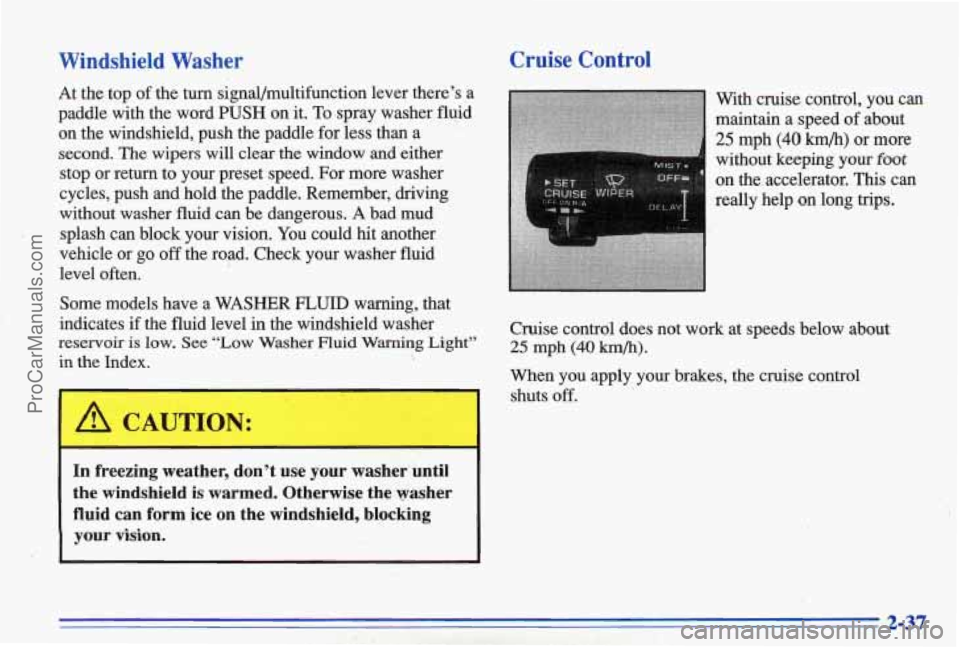
At the top of the turn signal/multifunction lever there’s a
paddle with the word
PUSH on it. To spray washer fluid
on the windshield, push the paddle for less than a
second. The wipers
will clear the window and either
stop or return to your preset speed. For more washer
cycles, push and hold the paddle. Remember, driving
without washer fluid can be dangerous.
A bad mud
splash can block your vision. You could hit another
vehicle or go
off the road. Check your washer fluid
level often.
Some models have a WASHER
FLUID warning, that
indicates
if the fluid level in the windshield washer
reservoir is low. See “Low Washer Fluid Warning Light”
in
the Index.
A CAUTION:
In freezing weather, don’t use your washer until
the windshield is warmed. Otherwise the washer fluid can form ice on the windshield, blocking
your vision.
Cruise Control
on the accelerator. his can
really help
on long trips.
Cruise control does not work at speeds below about
25 mph (40 km/h).
When you apply your brakes, the cruise control
shuts
off.
ProCarManuals.com
Page 92 of 387
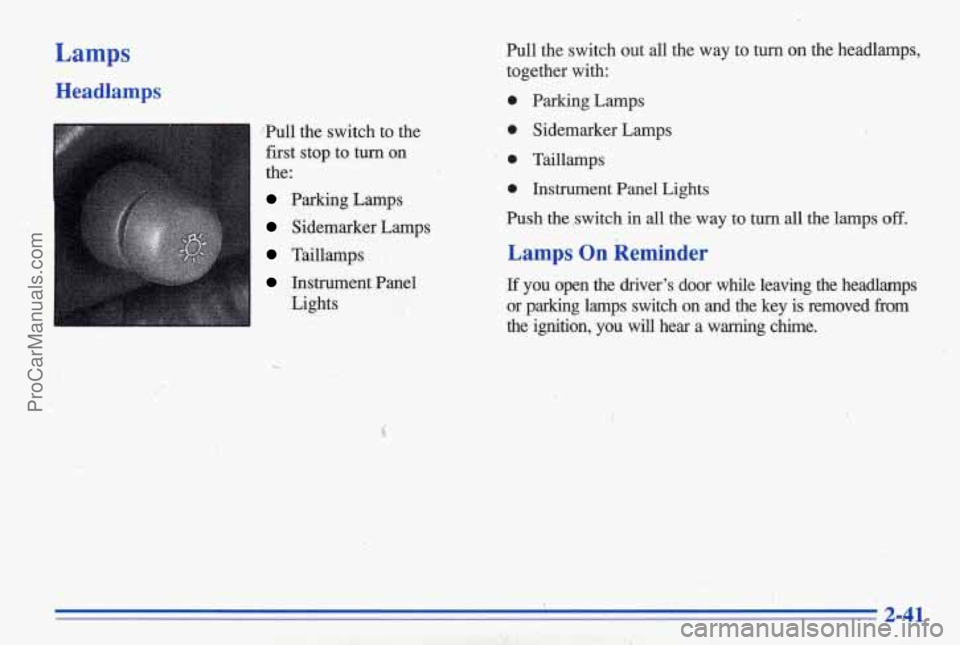
Lamps
Headlamps
'Pull the switch to the first stop to
turn on
the:
Parking Lamps
Sidemarker Lamps
Taillamps
Instrument Panel
Lights
I'
Pull the switch out all the way to turn on the headlamps,
together with:
0 Parking Lamps
0 Sidemarker Lamps
0 Taillamps
0 Instrument Panel Lights
Push the switch
in all the way to turn all the lamps off.
Lamps On Reminder
If you open the driver's door while leaving the headlamps
or parking lamps switch
on and the key is removed from
the ignition, you will hear a
warning chime.
I .. ,i. '
ProCarManuals.com
Page 108 of 387
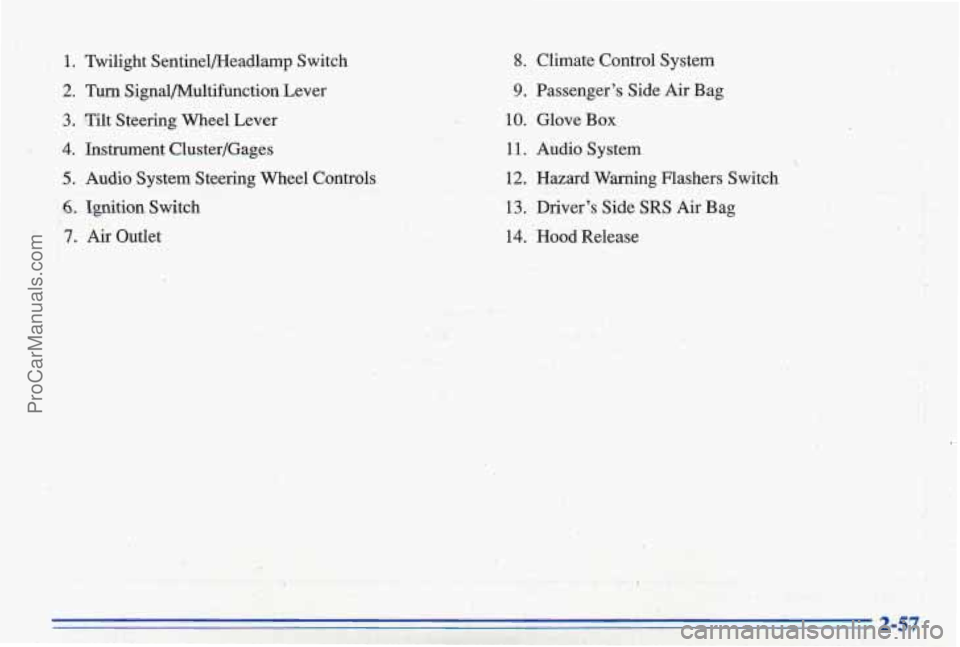
1. Twilight Sentinelmeadlamp Switch
2.
Turn Signal/Multifunction Lever
3. Tilt Steering Wheel Lever
I 2 ,,: '14. Instrument Cluster/Gages
c3; ;,5. Audio System Steering Wheel Controls
. ..
6. Ignition Switch
7. Air Outlet
8. Climate Control System
9. Passenger's Side Air Bag
10. Glove Box
11. Audio System
12. Hazard Warning Flashers Switch
.' -
13. Driver's Side SRS Air Bag
14. Hood Release
. .. .;: I . ,.< , , . I. . .. , , , ..
i: .
. I.
i
2-57
ProCarManuals.com