overheating PONTIAC BONNEVILLE 1997 Owners Manual
[x] Cancel search | Manufacturer: PONTIAC, Model Year: 1997, Model line: BONNEVILLE, Model: PONTIAC BONNEVILLE 1997Pages: 405, PDF Size: 18.83 MB
Page 123 of 405
Low Coolant Warning Light
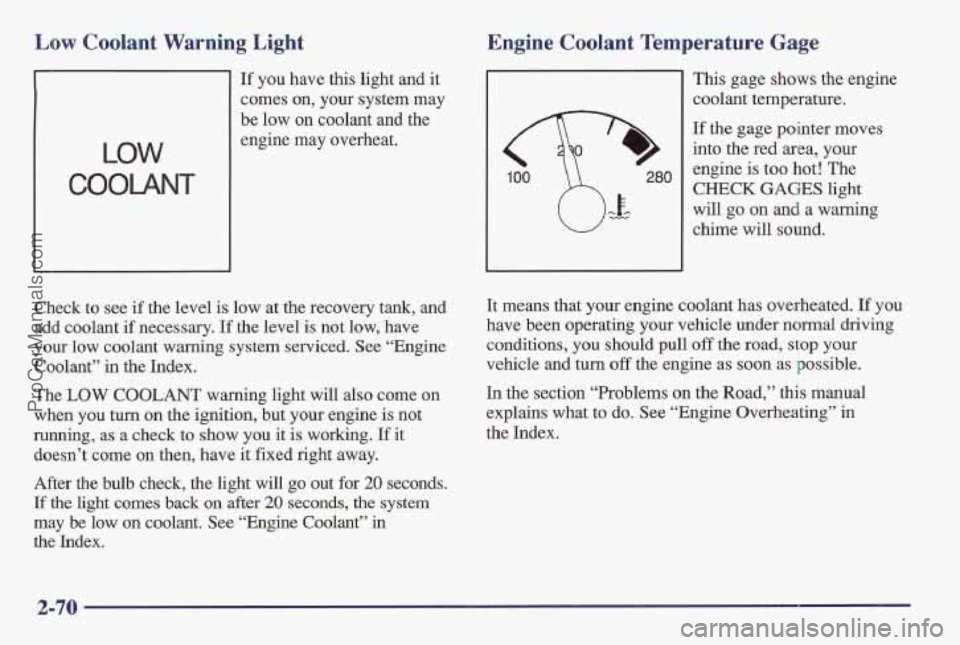
LOW
COOLANT
If you have this light and it
comes on, your system may
be low on coolant and the
engine may overheat.
Check
to see if the level is low at the recovery tank, and
add coolant
if necessary. If the level is not low, have
your low coolant
warning system serviced. See “Engine
Coolant” in the Index.
The
LOW COOLANT warning light will also come on
when you turn on the ignition, but your engine
is not
running, as a check to show you it is working. If it
doesn’t come on then, have
it fixed right away.
After the bulb check, the light will
go out for 20 seconds.
If the light comes back on after 20 s’ecoaads, the system
may be low
on coolant. See “Engine COQ~~”~II
the Index.
.. .-,.%.. - ,
Engine Coolant Temperature Gage
100 280
This gage shows the engine
coolant temperature.
If the gage pointer moves
into the red area, your
engine is too
hot! The
CHECK GAGES light
will go on and a warning
chime
will sound.
It means that your engine coolant has overheated. If you
have been operating your vehicle under normal driving
conditions, you should pull
off the road, stop your
vehicle and turn
off the engine as soon as possible.
In the section “Problems on the Road,”
this manual
explains what to do. See “Engine Overheating’’ in
the Index.
2-70
ProCarManuals.com
Page 214 of 405
Section 5 Problems on the Road
Here you’ll find what to do about some problems that can occur on the road.
5-2
5-3
5-3
5-8
5-16 Hazard Warning
Flashers
Other Warning Devices
Jump Starting
Towing Your Vehicle
Engine Overheating 5-18
Cooling System
5-26 Changing a Flat Tire
5-38 Compact Spare Tire
5-39 If You’re Stuck: In Sand, Mud, Ice or Snow
5-26 If a Tire Goes Flat
5-1
ProCarManuals.com
Page 229 of 405
Engine Overheating
You will find a coolant temperature gage or the warning
light about a hot engine on your Pontiac’s instrument
panel. See “Coolant Temperature
G’age” and “Coolant
Temperature Warning Light” in the Index.
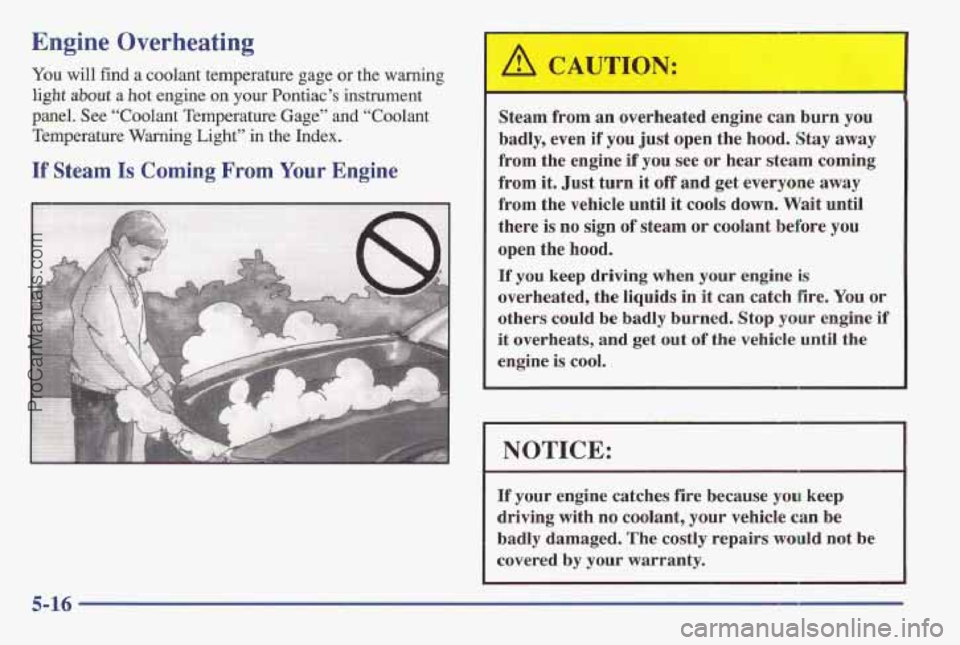
If Steam Is Coming From Your Engine
Steam from an overheated engine can burn you
badly, even if you just open the hood. Stay away
from the engine if
you see or hear steam coming
from it. Just turn it off and get everyone away
fro’m the vehicle until it cools down. Wait until
there
is no sign of steam or coolant before you
open
the ho’od.
If you keep driving when your engine is
overheated, the liquids in it can catch fire. You
or
others could be badly burned. Stop your engine if
it overheats, and get out of the vehicle until the
engine
is cool.
NOTICE:
If your engine catches fire because you keep
driving with no coolant, your vehicle can be
badly damaged. The costly repairs would not be ~
covered by your warranty.
5-16
ProCarManuals.com
Page 232 of 405
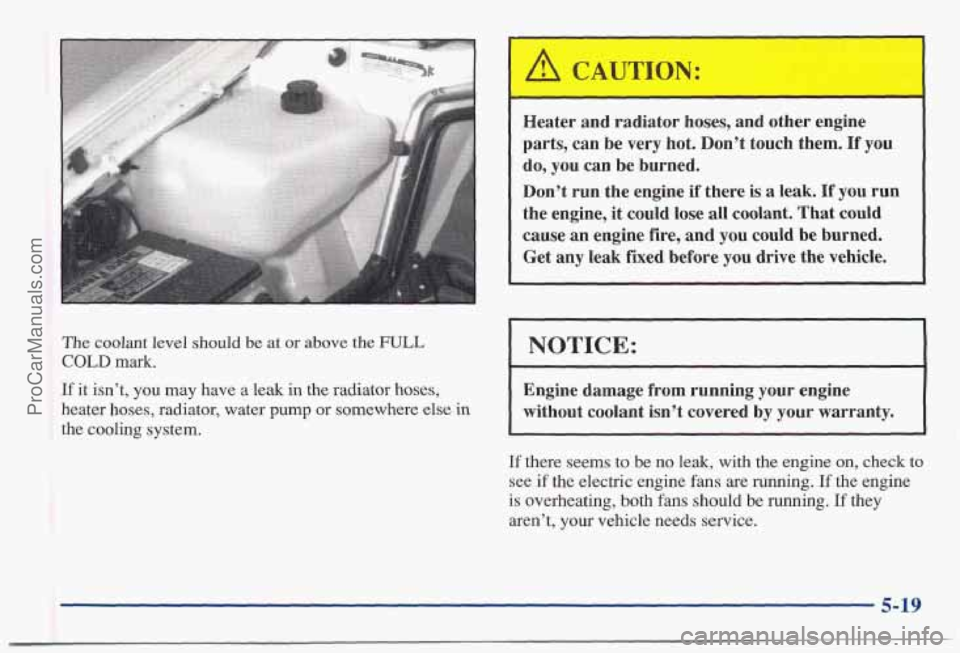
The coolant level should be at or above the FULL
COLD mark.
If it isn’t, you may have a leak in the radiator hoses,
heater hoses, radiator, water
pump or somewhere else in
the cooling system. Heater and radiator
hoses, and other engine
parts, can be
very hot. Don’t touch them. If you
do, you can be burned.
Don’t run the engine if there is
a leak. If you run
the engine, it could lose all coolant. That could
cause an engine fire, and you could be burned.
Get any leak fixed before you drive the vehicle.
I NOTICE: I
Engine damage from running your engine
without coolant isn’t covered by your warranty.
If there seems to
be no leak, with the engine on, check to
see if the electric engine fans are running. If the engine
is overheating, both
fans should be running. If they
aren’t, your vehicle needs service.
5-19
ProCarManuals.com
Page 277 of 405
How to Add Fluid
Refer to the Maintenance Schedule to determine what
kind of transaxle fluid to use. See “Recommended
Fluids and Lubricants” in the Index.
If
the fluid level is low, add only enough of the proper
fluid to bring the level into the cross-hatched area on
the dipstick.
1. Pull out the dipstick.
2. Using a long-neck funnel, add enough fluid ,. @e
dipstick hole to bring it to’ the proper level.
It doesn’t take much fluid, generally less than one
pint
(0.5 L). Don’t overjU.
NOTICE:
We recommend you use only fluid labeled
DEXRON@-111, because fluid with that label i,s
made especially for your automatic transaxle.
Damage caused by fluid other than DEXRON-I11
is not covered by your new vehicle warranty.
3. After adding fluid, recheck the fluid level as
described under “How to Check.”
4. When the correct fluid level is obtained, push the
dipstick back in all the way.
Engine Coolant
The cooling s stem in your vehicle is filled with
DEX-COOL engine coolant. This coolant is designed
to remain in your vehicle for
5 years or 150,000 miles
(240 000 km) whichever occurs first, if you add only
DEX-COOL6 extended life coolant.
The following explains your cooling system and how to
add coolant when it is low. If you have ;e problem with
engine overheating, see “Engine Overheating” in
the
Index.
A 50J50 mixture of water and DEX-COOL@
coolant will:
Give freezing protection down to -34°F (-37°C).
Give boiling protection up to 2685 “F (129 O C).
Protect against rust and corrosion.
Help keep the proper engine temperature.
Llet the warning lights and gages work as
8
they should.
6-24
ProCarManuals.com
Page 280 of 405
If this light comes on,
it means you’re low on
LOW
COOLANT
engine coolant.
Adding Coolant
If you need more coolant, add the proper DEX-COOL@
coolant mixture at the coolant recovery tank, but be
careful not to spill
it.
Turning the radiator pressure cap when the
engine and radiator are hot can allow steam and
scalding liquids to blow out and burn you badly.
With the coolant recovery tank, you will almost
never have to add coolant
at the radiator.
Never turn the radiator pressure cap
-- even a
little
-- when the engine and radiator are hot. You
can be
burned if you spill coolant on hot
engine parts. Coolant contains ethylene glycol,
and it will burn
if the engine parts are hot
enough. Don’t spill coolant on a hot engine.
Radiator Pressure Cap
NOTICE:
Your radiator cap is a 15 psi (105 kPa)
pressure-type cap and must be tightly installed to
prevent coolant loss and possible engine damage
from overheating. Be sure the arrows on the cap
line up with the overflow tube on the radiator
filler neck.
6-27
ProCarManuals.com
Page 295 of 405
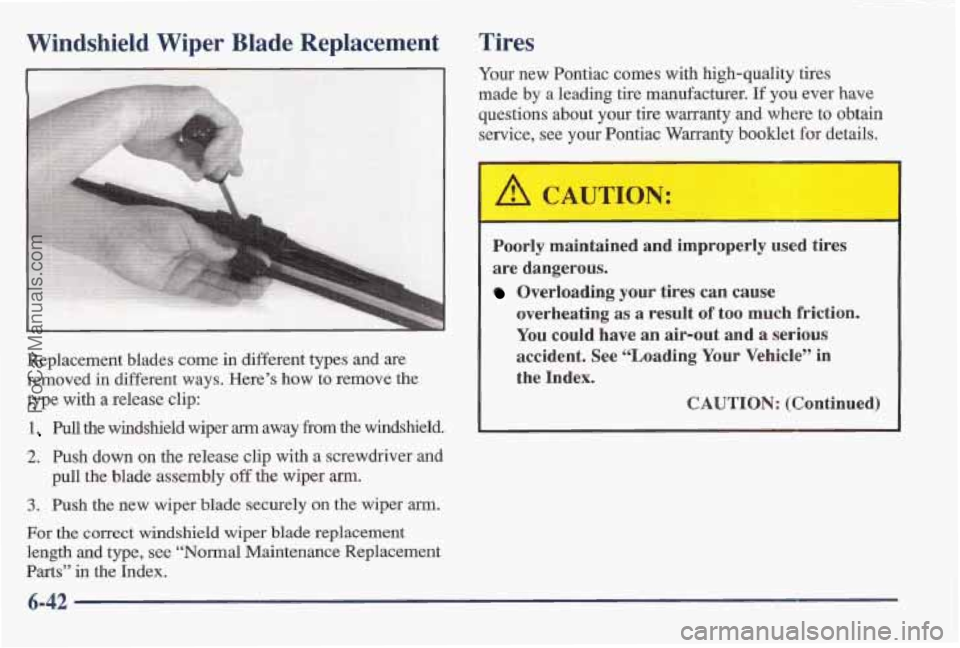
Windshield Wiper Blade Replacement
Replacement blades come in different types and are
removed in different ways. Here’s how to remove the
type with a release clip:
1 Pull the windshield wiper ann away from the windshield.
2. Push down on the release clip with a screwdriver and
pull the
blade assembly off the wiper m.
3. Push the new wiper blade securely on the wiper am.
For the correct windshield wiper blade replacement
length
and type, see “Normal Maintenance Replacement
Parts” in the Index,
Tires
Your new Pontiac comes with high-quality tires
made
by a l’eading tire manufacturer. If you ever have
questions about your tire warranty and where to obtain
service,
see your Pontiac Warranty booklet for details.
Poorly maintained and improperly used tires
are dangerous.
Overloading your tires ‘can cause
overheating as a result of too much friction.
You could have an air-out and a serious
accident. See “Loading Your Vehicle” in
the Index.
CAUTION: (Continued)
6-42
ProCarManuals.com