power steering PONTIAC BONNEVILLE 1997 Owners Manual
[x] Cancel search | Manufacturer: PONTIAC, Model Year: 1997, Model line: BONNEVILLE, Model: PONTIAC BONNEVILLE 1997Pages: 405, PDF Size: 18.83 MB
Page 73 of 405

Ignition Positions
C
A E
With the ignition key in the ignition switch, you can turn
the switch to five positions.
ACCESSORY (A): An on position in which you can
operate your electrical power accessories. Press in the
ignition switch as you
turn the top of it toward you.
LOCK (B): The only position in which you can
remove the key. This locks your steering wheel, ignition
and transaxle.
OFF (C): Unlocks the steering wheel, ignition and
transaxle, but does not send electrical power to any
accessories. Use this position if your vehicle must be
pushed
or towed, but never try to push-start your
vehicle.
A warning chime will sound if you open the
driver’s door when the ignition
is OFF and the key is in
the ignition.
RUN (D): An on position to which the switch returns
after you start your engine and release the switch. The
switch stays in the RUN position when the engine is
running. But even when the engine is not running, you
can use RUN
to operate your electrical power
accessories, and
to display some instrument panel
warning lights.
START (E): Starts the engine. When the engine starts,
release the key. The ignition switch will return to RUN
for normal driving.
Note that even
if the engine is not running, the positions
ACCESSORY and RUN are on positions that allow
you
to operate your electrical accessories, such as the radio.
2-20
ProCarManuals.com
Page 74 of 405
NOTICE:
If your key seems stuck in LOCK and you can’t
turn
it, be sure you are using the correct key; if
so, is it all the way in? If it is, then turn the
steering wheel left and right while you turn the
key hard. But turn the key only with your hand.
Using
a tool to force it could break the key or th’e
ignition switch.
If none of this works, then your
vehicle needs service.
Key Reminder Warning
If you leave your key in the ignition, in the OFF
position, you will hear a warning tone when you open
the driver’s door.
Retained Accessory Power
If you have this option, after you turn your ignition off
and even remove the key, you will
still have electrical
power to such accessories as the radio and power
windows for up
to 10 minutes. But if you open a door,
the power is turned off.
Starting Your Engine
Move your shift lever to PARK (P) or NEUTRAL (N).
Your engine won’t start in any other position
-- that’s a
safety feature.
To restart when you’re already moving,
use
NEUTRAL (N) only.
I
NOTICE:
Don’t try to shift to PARK (P) if your Pontiac
is moving.
If you do, you could damage the
transaxle. Shift to
PARK (P) only when your
vehicle is stopped.
Starting Your 3800 Series I1 Engine
1. Without pushing the accelerator pedal, turn your
ignition key to
START. When the engine starts, let
go of the key. The idle speed will go down as your
engine gets warm.
2-21
ProCarManuals.com
Page 183 of 405
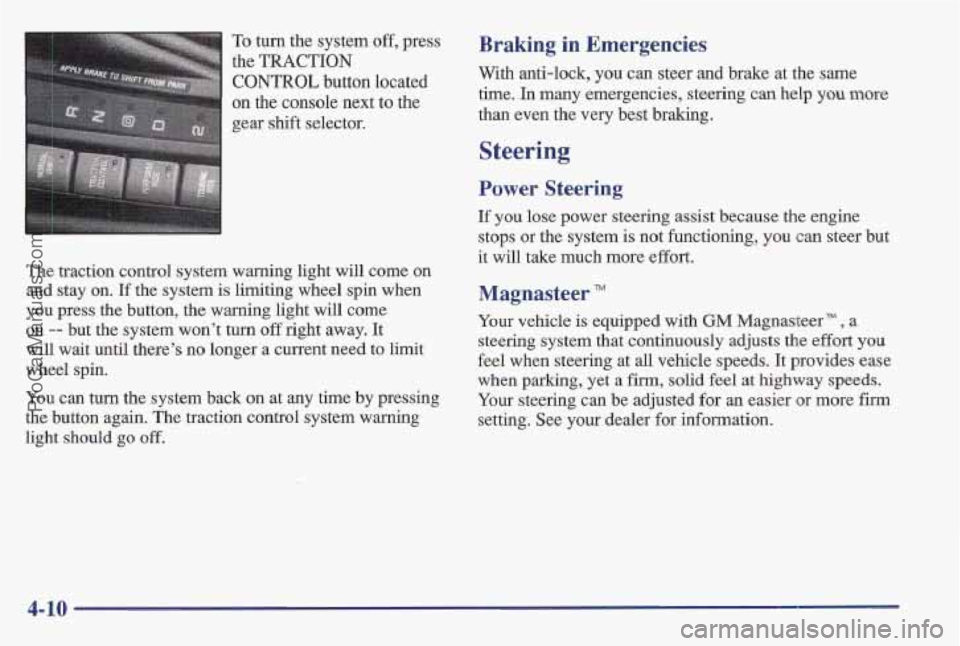
To turn the system off, press
the
TRACTION
CONTROL button located
on the console next to the
gear shift selector.
The traction control system warning light will come
on
and stay on. If the system is limiting wheel spin when
you press the button, the warning light will come
on -- but the system won’t turn off right away. It
will wait until there’s no longer a current need to limit
wheel spin.
You can
hm the system back on at my time by pressing
the button again. The traction control system warning
light should
go off.
Braking in Emergencies
With anti-lock, you can steer and brake at the same
time. In many emergencies, steering can help
you more
than even the very best braking.
Steering ~
Power Steering
If you lose power steering assist because the engine
stops or the system
is not functioning, you can steer but
it will take much more effort.
Magnasteer TM
Your vehicle is equipped with GM Magnasteer TM ? a
steering system that continuously
adjusts the effort you
feel when steering at
all vehicle speeds. It provides ease
when parking, yet a firm, solid feel at highway speeds.
Your steering can be adjusted for an easier or more firm
setting. See your dealer for information.
4- 10
ProCarManuals.com
Page 254 of 405
v Section 6 Service and Appearance Care
Here you will find information about the care of your Pontiac. This section begins with service and fuel information,
and then it shows how to check important fluid and lubricant levels. There is also technical information about your
vehicle, and a
part devoted to its appearance care.
6-2
6-3
6-5
6-6
6-9
6-13
6-18
6-2 1
6-24
6-27
6-28
6-29
6-30
6-33
6-34
6-42
6-42
6-50 Service
Fuel
Fuels in Foreign Countries
Filling Your Tank
Checking Things Under the Hood
Engine Oil
Air Cleaner
Automatic Transaxle Fluid
Engine Coolant
Radiator Pressure Cap
Power Steering Fluid
Windshield Washer Fluid
Brakes
Battery
Bulb Replacement
Windshield Wiper Blade Replacement
Tires
Appearance
Care
6-5 1
6-53
6-53
6-54
6-55
6-56
6-56
6-56
6-57 6-58
6-58
6-59
6-65
6-66
6-66
6-67
6-67
6-67 Cleaning the Inside
of
Your Pontiac
Care
of Safety Belts
Cleaning Glass Surfaces Cleaning the Outside of Your Pontiac
Cleaning Aluminum
or Chrome Wheels
Cleaning Tires Sheet Metal Damage
Finish Damage
Appearance Care Materials Chart
Vehicle Identification Number (VIN)
Service Parts Identification Label
Electrical System
Replacement Bulbs
Capacities and Specifications
Air Conditioning Refrigerants
Engine Specifications
Normal Maintenance Replacement Parts
Vehicle Dimensions
ProCarManuals.com
Page 281 of 405

Thermostat
Engine coolant temperature is controlled by a thermostat
in the engine coolant system. The thermostat stops the
flow
of coolant through the radiator until the coolant
reaches a preset temperature.
Power Steering Fluid
When to Check Power Steering Fluid
It is not necessary to regularly check power steering
fluid unless you suspect there is a leak
in the system or
you hear an unusual noise. A fluid loss in this system
could indicate a problem. Have the system inspected
and repaired.
How To Check Power Steering Fluid
When the engine compartment is cool, unscrew the cap
and wipe the dipstick with a clean rag. Replace the cap
and completely tighten it. Then remove the cap again
and look at the fluid level on the dipstick.
The level should be at the FULL COLD mark. If
necessary, add only
enough fluid to bring the level up to
the
mark.
What to Use
To determine what kind of fluid to use, see
“Recommended Flui’ds and Lubricants” in the Index.
Always use
the proper fluid. Failure to use the proper
fluid can cause leaks
and damage hoses and seals.
6-28
ProCarManuals.com
Page 321 of 405

L36 Engine Accessory Belt
The L36 engine uses an engine accessory belt. This
diagram shows the features connected and the routing.
See “Maintenance Schedule” in the Index for when to
check the belt.
A
C
A. Power Steering
B. Generator
C. Air Conditioning
D. Crank
E. Coolant Pump
E Idler
6-68
ProCarManuals.com
Page 322 of 405

L67 Engine Accessory Belt
The Supercharged 3800 (L67) engine uses two accessory
drive belts. The inner belt drives the generator, power
steering pump, coolant pump
and air conditioning. The
outer belt drives the supercharger. Each belt has its own
temioner and idler pulley. See “Maintenance Schedule’’
in the Index for when to check the accessory drive belts
and the supercharger oil level. Have your dealer check
the
oil level in the supercharger.
F
1. Front Belt
2. Back Belt
A. Generator
B. Power Steering Pump
C. Crank
D. Supercharger
E. Coolant Pump
E Air Conditioning
6-69
ProCarManuals.com