ESP PONTIAC BONNEVILLE 1998 User Guide
[x] Cancel search | Manufacturer: PONTIAC, Model Year: 1998, Model line: BONNEVILLE, Model: PONTIAC BONNEVILLE 1998Pages: 395, PDF Size: 17.6 MB
Page 192 of 395
Hydroplaning
Hydroplaning is dangerous. So much water can build up
under your tires that they can actually ride on the water.
This can happen
if the road is wet enough and you’re
going fast enough. When your vehicle is hydroplaning,
it has little or no contact with the road.
Hydroplaning doesn’t happen often. But it can if your
tires do not have much tread or if the pressure in one or
more is low. It can happen if a lot
of water is standing on
the road. If you can see reflections from trees, telephone
poles
or other vehicles, and raindrops “dimple” the
water’s surface, there could be hydroplaning.
Hydroplaning usually happens at higher speeds. There
just
isn’t a hard and fast rule about hydroplaning. The
best advice is to slow down when it is raining.
Driving Through Deep Standing Water
NOTICE:
If you drive too quickly through deep puddles or
standing water, water can come in through your
engine’s air intake and badly damage
your
engine. Never drive through water that is slightly
lower than the underbody of your vehicle. If you
can’t avoid deep puddles
or standing water, drive
through them
very slowly.
Some Other Rainy Weather Tips
0
0
Besides slowing down, allow some extra following
distance. And
be especially careful when you pass
another vehicle. Allow yourself more clear room
ahead, and be prepared
to have your view restricted
by road spray.
Have
good tires with proper tread depth. (See
“Tires” in the Index.)
4-19
Page 201 of 395
0 Tie a red cloth to your vehicle to alert police that
you’ve been stopped by the snow.
Put
on extra clothing or wrap a blanket around you.
If you have no blankets or extra clothing, make body
insulators from newspapers, burlap bags, rags, floor mats
-- anything you can wrap around yourself or
tuck under your clothing
to keep warm.
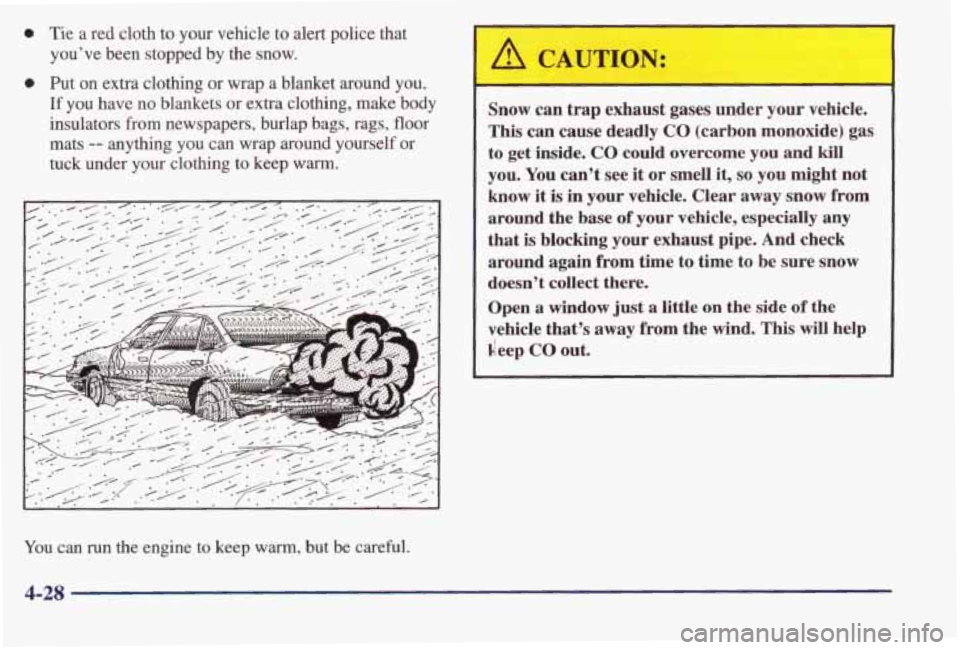
Snow can trap exhaust gases under your vehicle.
This can cause deadly
CO (carbon monoxide) gas
to get inside.
CO could overcome you and kill
you.
You can’t see it or smell it, so you might not
know it
is in your vehicle. Clear away snow from
around the base of your vehicle, especially any
that is blocking your exhaust pipe. And check
around again from time to time to be sure snow
doesn’t collect there.
Open a window just a little
on the side of the
vehicle that’s
away from the wind. This will help
ieep
co out.
you
can run the engine to keep warm, but be careful.
4-28
Page 208 of 395
Safety Chains Driving with a Trailer
Towing a trailer requires a certain amount of experience.
Before setting out for the open road,
you’ll want to get
to
know your rig. Acquaint yourself with the feel of
handling and braking with the added weight of the
trailer. And always keep in mind that the vehicle
you are
driving is now a good deal longer and not nearly as
responsive as your vehicle is
by itself.
You should always attach chains between your vehicle
and your trailer. Cross the safety chains under the tongue
of the trailer so that the tongue will not drop to the road
if it becomes separated from the hitch. Instructions
about safety chains may be provided by the hitch manufacturer or by the trailer manufacturer. Follow the
manufacturer’s recommendation for attaching safety
chains and do not attach them to the bumper. Always
leave just enough slack
so you can turn with your rig.
And, never allow safety chains to drag on the ground.
Trailer Brakes
Does your trailer have its own brakes? Be sure to read
and follow the instructions for the trailer brakes so
you’ll be able to install, adjust and maintain them properly.
Because you
have anti-lock brakes, do not try to tap into
your vehicle’s brake system.
If you do, both brake
systems won’t work well, or at all. Before you start, check the trailer hitch and platform
(and attachments), safety chains, electrical connector,
lamps, tires and mirror adjustment.
If the trailer has
electric brakes,
start your vehicle and trailer moving and
then apply the trailer brake controller by hand to
be sure
the brakes are working. This lets you check your
electrical connection at the same time.
During your trip, check occasionally to be sure that the load is secure, and that the lamps and any trailer brakes
are still working.
4-35
Page 211 of 395
When You Are Ready to Leave After
Parking
on a Hill
1. Apply your regular brakes and hold the pedal down
while you:
Start your engine;
0 Shift into a gear; and
0 Release the parking brake.
2.
Let up on the brake pedal.
3. Drive slowly until the trailer is clear of the chocks.
4. Stop and have someone pick up and store the chocks.
Maintenance When Trailer Towing
Your vehicle will need service more often when you’re
pulling a trailer.
See the Maintenance Schedule for more
on
this. Things that are especially important in trailer
operation
are automatic transaxle fluid (don’t overfill),
engine oil, belt(s), cooling system and brake adjustment.
Each
of these is covered in this manual, and the Index
will help you find them quickly.
If you’re trailering, it’s
a good idea to review these sections before
you start
your trip.
Check periodically to see that all hitch nuts and bolts
Engine Cooling When Ier Towing
fight.
-
Your cooling system may temporarily overheat during
severe operating conditions. See “Engine Overheating”
in the Index.
4-38
Page 238 of 395

If a Tire Goes Flat Changing a Flat Tire
It’s unusual for a tire to “blow out” while you’re \
driving,
especially if you maintain your tires properly.
If air goes
out
of a tire, it’s much more likely to leak out slowly.
But if you should ever have a “blowout,” here are a few\
tips about what to expect and what to do:
If a front tire
fails, the flat tire will create a drag that
pulls the vehicle toward that side. Take your foot
off the
accelerator pedal and grip the steering wheel firmly.
Steer to maintain lane position, and then gently brake to
a stop well out
of the traffic lane.
A rear blowout, particularly on a curve, acts much like a
skid and may require the same correction you’d use in a
skid. In any rear blowout, remove your foot from the
accelerator pedal. Get the vehicle under control
by
steering the way you want the vehicle to go. It may be
very bumpy and noisy, but you can still steer. Gently
brake
to a stop -- well off the road if possible.
If
a tire goes flat, the next part shows how to use your
jacking equipment to change a flat tire safely. If
a tire goes flat, avoid further tire and wheel damage
by driving slowly to a level place.
Turn on your hazard
warning flashers.
‘A C ‘JTION:
.-
r
Changing a tire can cause an injury. The vehicle
can slip off the jack and roll over you or other
people. You and they could be badly injured.
Find
a level place to change your tire. To help
prevent the vehicle from moving:
1. Set the parking brake firmly.
2. Put the shift lever in PARK (P).
3. Turn off the engine.
To be even more certain the vehicle won’t move,
you can put blocks at the front and rear of the
tire farthest away from the one being changed.
That would be the tire on the other side
of the
vehicle, at the opposite end.
Page 272 of 395
NOTICE:
Too much or too little fluid can damage your
transaxle.
Too much can mean that some of the
fluid could come out and
fall on hot engine parts
or exhaust system parts, starting a fire. Be sure to get
an accurate reading if you check your
transaxle fluid.
I I
Wait at least 30 minutes before checking the transaxle
fluid level
if you have been driving:
0 When outside temperatures are above 90°F (32" C).
At high speed for quite a while.
0 In heavy traffk -- especially in hot weather.
0 While pulling a trailer.
To get the right reading, the fluid should be at
normal operating temperature, which
is 180 OF to
200°F (82°C to 93°C).
Get the vehicle warmed up by driving about 15 miles
(24 km) when outside temperatures are above 50°F
(10°C). If it's colder than 50°F (lO°C), you may have
to drive longer.
Checking the Fluid Level
Park your vehicle on a level place. Keep the
engine running.
With the parking brake applied, place the shift lever
in PARK (P).
With your foot on the brake pedal, move the shift
lever through each gear range, pausing for about
three seconds in each range. Then, position the
shift
lever in PARK (P).
Let the engine run at idle for three to five minutes.
Then, without shutting
off the engine, follow these steps:
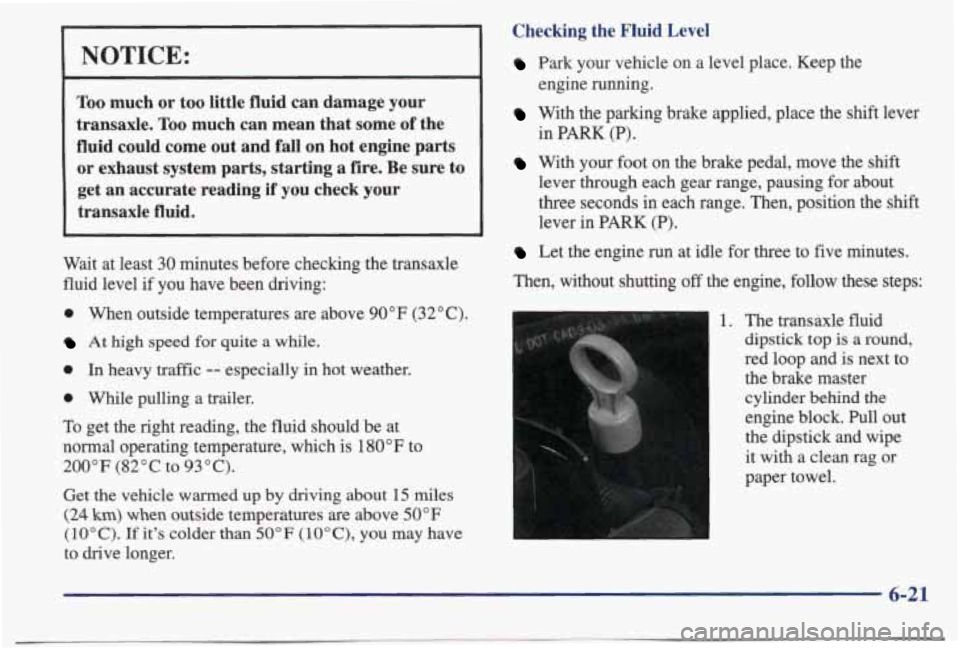
1. The transaxle fluid
dipstick top is a round,
red loop and is next to
the brake master
cylinder behind the
engine block. Pull out
the dipstick and wipe
it with a clean rag or
paper towel.
6-21
-
Page 273 of 395
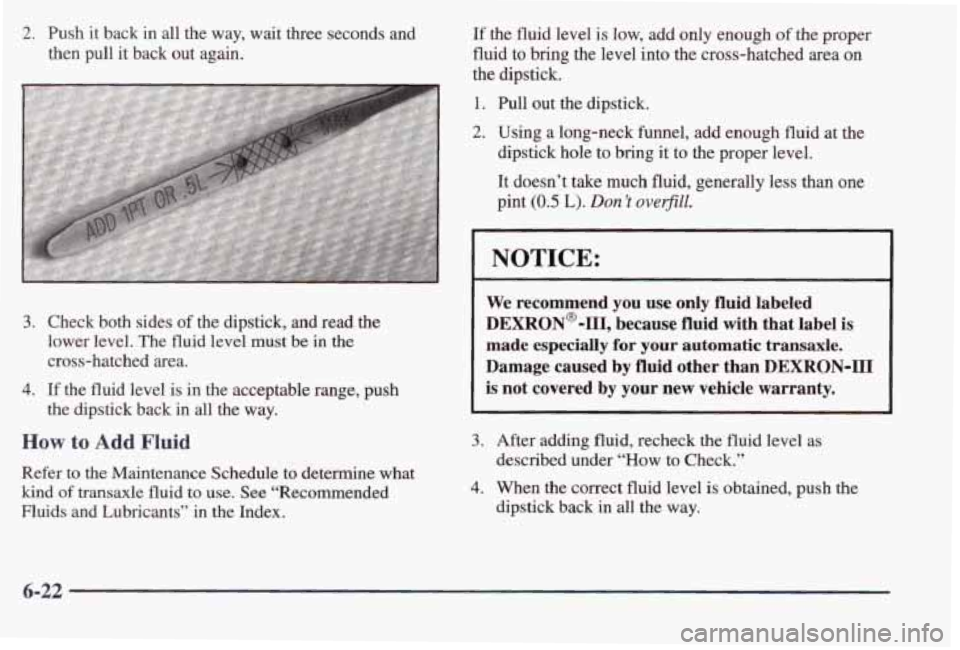
2. Push it back in all the way, wait three seconds and
then pull it back out again.
3. Check both sides of the dipstick, and read the
lower level. The fluid level must be in the
cross-hatched area.
4. If the fluid level is in the acceptable range, push
the dipstick back in all the way.
How to Add Fluid
Refer to the Maintenance Schedule to determine what
kind
of transaxle fluid to use. See “Recommended
Fluids and Lubricants” in the Index.
If the fluid level is low, add only enough of the proper
fluid to bring the level into the cross-hatched area on
the dipstick.
1. Pull out the dipstick.
2. Using a long-neck funnel, add enough fluid at the
dipstick hole to bring it to
the proper level.
It doesn’t take much fluid, generally less than one
pint
(0.5 L). Don’t oveflll.
~
NOTICE:
We recommend you use only fluid labeled
DEXRON@-III, because fluid with that label is
made especially for your automatic transaxle.
Damage corused by fluid other than DEXRON-111
is not covered by your new vehicle warranty.
3. After adding fluid, recheck the fluid level as
described under “HOW to Check.”
4. When the correct fluid level is obtained, push the
dipstick back
in all the way.
6-22
Page 296 of 395
Mixing tires could cause you to lose control while
driving.
If you mix tires of different sizes or types
(radial and bias-belted tires), the vehicle may not
handle properly, and you could have
a crash.
Using tires
of different sizes may also cause
damage to your vehicle. Be sure to use the same
size and type tires on all wheels.
It’s all right to drive with your compact spare,
though.
It was developed for use on your vehicle.
I a CAUTION:
If you use bias-ply tires on your vehicle, the
wheel rim flanges could develop cracks after
many miles
of driving. A tire and/or wheel could
fail suddenly, causing a crash. Use only radial-ply
tires with the wheels on your vehicle.
Uniform Tire Quality Grading
The following information relates to the system
developed by the United States National Highway
Traffic Safety Administration, which grades tires by
treadwear, traction
and temperature performance. (This
applies only to vehicles sold
in the United States.) The
grades are molded on the sidewalls
of most passenger
car tires. The Uniform Tire Quality Grading system does
not apply to deep tread, winter-type snow tires, space-saver or temporary use spare tires, tires with
nominal
rim diameters of 10 to 12 inches (25 to 30 cm),
or to some limited-production tires.
While the tires available on General Motors passenger cars and light
trucks may vary with respect to these
grades, they
must also conform to Federal safety
requirements and additional General Motors Tire
Performance Criteria
(PC) standards.
6-45
Page 297 of 395
Treadwear
The treadwear grade is a comparative rating based on
the wear rate
of the tire when tested under controlled
conditions on a specified government test course.
For example, a tire graded 150 would wear one
and a
half (1 1/2) times as well on the government course
as a tire graded 100. The relative performance of tires
depends upon the actual conditions
of their use,
however, and may depart significantly from the norm
due to variations
in driving habits, service practices
and differences in road characteristics and climate.
Traction -- A, B, C
The traction grades, from highest to lowest, are A, B,
and C, and they represent the tire’s ability to stop on
wet pavement as measured under controlled conditions
on specified government test surfaces of asphalt
and concrete.
A tire marked C may have poor
traction performance.
Warning: The traction grade assigned
to this tire is based
on braking (straight ahead) traction tests and does not
include cornering (turning) traction.
Temperature -- A, B, C
The temperature grades are A (the highest), B, and C,
representing the tire’s resistance to the generation of
heat and its ability to dissipate heat when tested under
controlled conditions on a specified indoor laboratory
test wheel. Sustained high temperature can cause the
material
of the tire to degenerate and reduce tire life, and
excessive temperature can lead to sudden
tire failure.
The grade
C corresponds to a level of performance
which
all passenger car tires must meet under the
Federal Motor Vehicle Safety Standard
No. 109. Grades
B and A represent higher levels of performance on the
laboratory test wheel
than the minimum required by law.
Warning: The temperature grade for this tire is
established for a tire that is properly inflated and not
overloaded. Excessive speed, underinflation, or
excessive loading, either separately or in combination,
can cause heat buildup and possible tire failure.
6-46