service PONTIAC BONNEVILLE 1998 User Guide
[x] Cancel search | Manufacturer: PONTIAC, Model Year: 1998, Model line: BONNEVILLE, Model: PONTIAC BONNEVILLE 1998Pages: 395, PDF Size: 17.6 MB
Page 85 of 395
Computer Command Ride (Option)
Vehicles equipped with computer command ride provide
improved passenger ride comfort under
a variety of road
and driving conditions.
For normal driving conditions, press the
TOURING
RIDE button to get a more refined comfortable ride.
When driving conditions require improved
handling,
press the PERFORM RIDE button to get a fm ride.
This mode minimizes how much the passenger
compartment leans in turns,
and decreases the
up-and-down motion of the front and rear
of the vehicle
during acceleration or
braking.
Even in the TOURING RIDE mode, the system will
adjust
to rapid cornering, acceleration or braking.
If the computer command ride detects a problem in the
system, the lights on the
TOURING RIDE and
PERFORM RIDE buttons will both come on. If this
happens, have your vehicle serviced.
Parking Brake
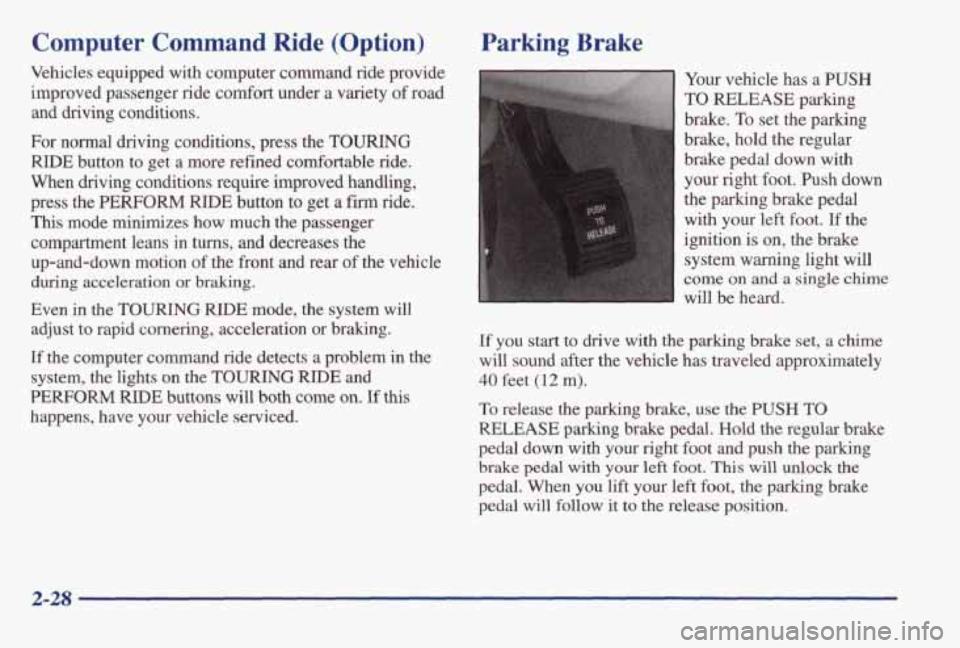
Your vehicle has a PUSH
TO RELEASE parking
brake.
To set the parking
brake, hold the regular
brake pedal down with
your right foot. Push down
the parking brake pedal
with your left foot.
If the
ignition is on, the brake
system warning light will
come on and a single chime
will be heard.
If you start to drive with the parking brake set, a chime
will sound after
the vehicle has traveled approximately
40 feet (12 m).
To release the parking brake, use the PUSH TO
RELEASE parking brake pedal. Hold the regular brake
pedal down with
your right foot and push the parking
brake pedal with your left foot. This will unlock the
pedal. When you lift your left foot, the parking brake
pedal will follow
it to the release position.
2-28
Page 89 of 395
Torque Lock
If you are parking on a hill and you don’t shift your
transaxle into
PARK (P) properly, the weight of the
vehicle may put too much force on the parking pawl in
the transaxle. You may find it difficult to pull the
shift
lever out of PARK (P). This is called “torque lock.” To
prevent torque lock, set the parking brake and then shift
into
PARK (P) properly before you leave the driver’s
seat.
To find out how, see “Shifting Into PARK (P)” in
the Index.
When you are ready to drive, move the shift lever out of
PARK (P) before you release the parking brake.
If torque lock does occur, you may need to have another
vehicle push yours a little uphill to take some of the
pressure from the parking pawl in the transaxle,
so you
can pull the shift lever out of PARK
(P).
Shifting Out of PARK (P)
Your vehicle has a Brake-Transaxle Shift Interlock
(BTSI). You have to fully apply your regular brake
before you can shift from PARK (P) when the ignition is
in
RUN. See “Automatic Transaxle” in the Index.
If you cannot
shift out of PARK (P), ease pressure on
the
shift lever -- push the shift lever all the way into
PARK (P) as you maintain brake application. Then
move
the shift lever into the gear you want. If you ever
hold the brake pedal down but still can’t shift out of
PARK (P), try this:
1. Turn the ignition key to OFF. Open and close the
driver’s door
to turn off the Retained Accessory
Power feature.
2. Apply and hold the brake until the end of Step 4.
3. Shift to NEUTRAL (N).
4. Start the vehicle and then shift to the drive gear
you want.
5. Take your vehicle to an authorized service center as
soon as you can.
2-32
Page 120 of 395
Safety Belt Reminder Light
When the key is turned to RUN or START, a chime will
come on for about eight seconds to remind people to
fasten their safety belts.
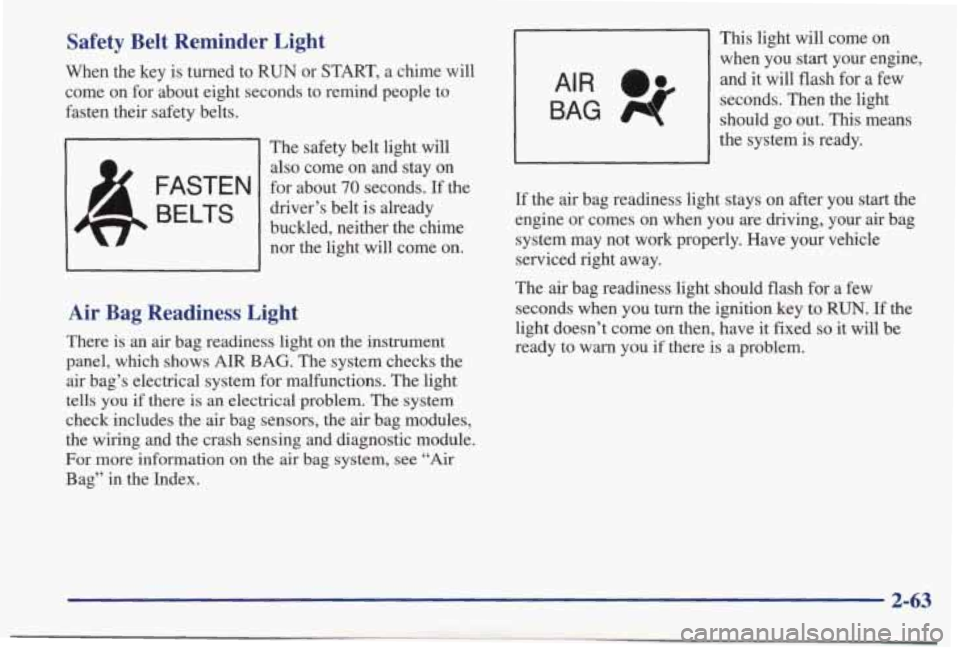
The safety belt light
will
also come on and stay on
for about
70 seconds. If the
driver’s belt is already
buckled, neither the chime nor the light will come
on.
Air Bag Readiness Light
There is an air bag readiness light on the instrument
panel, which shows
AIR BAG. The system checks the
air bag’s electrical system for malfunctions. The light
tells you if there
is an electrical problem. The system
check includes
the air bag sensors, the air bag modules,
the wiring and the crash sensing and diagnostic module.
For more information on
the air bag system, see “Air
Bag” in the Index.
BAG 4
AIR a*
This light will come on
when you start your engine,
and it will flash
for a few
seconds. Then the light
should go
out. This means
the system is ready.
If the air bag readiness light stays on after you start the
engine or comes on when you are driving, your
air bag
system may not work properly. Have your vehicle
serviced right away.
The
air bag readiness light should flash for a few
seconds when you
turn the ignition key to RUN. If the
light doesn’t come on then, have it fixed
so it will be
ready to
warn you if there is a problem.
2-63
Page 121 of 395
Battery Light (If Equipped)
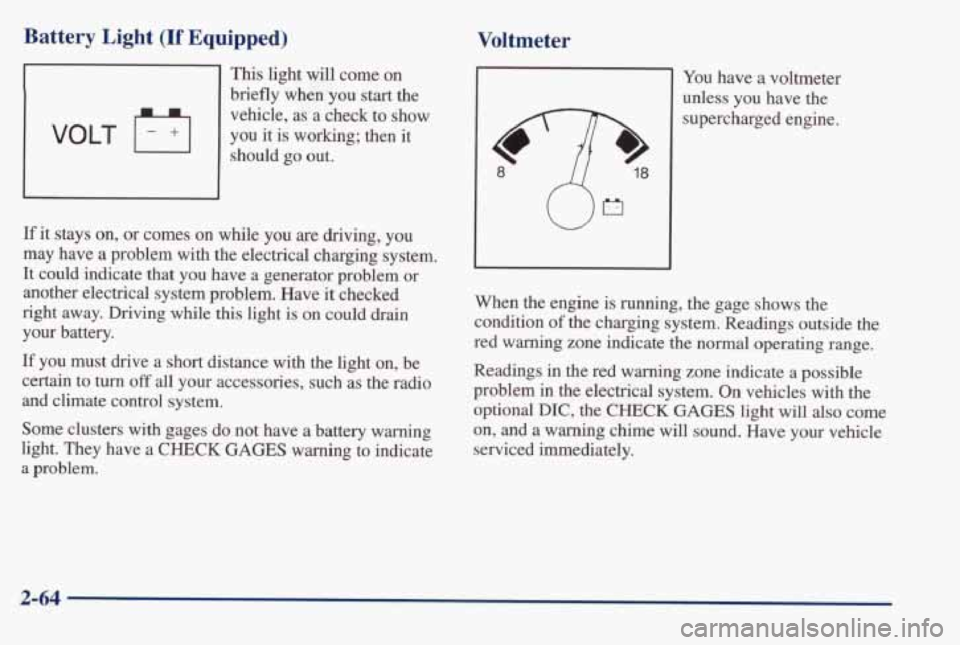
This light will come on
briefly when you start the
vehicle, as a check to
show
should go out. VOLT F+I you it is working; then it
If it stays on, or comes on while you are driving, you
may have a problem with the electrical charging system.
It could indicate that you have a generator problem or
another electrical system problem. Have it checked
right away. Driving while
this light is on could drain
your battery.
If you must drive a short distance with the light on, be
certain to turn off all your accessories, such as the radio
and climate control system.
Some clusters with gages do not have a battery warning
light. They have
a CHECK GAGES warning to indicate
a problem.
Voltmeter
I You have a voltmeter
unless you have the
supercharged engine.
When the engine is running, the gage shows the
condition
of the charging system. Readings outside the
red
warning zone indicate the normal operating range.
Readings
in the red warning zone indicate a possible
problem in the electrical system.
On vehicles with the
optional DIC,
the CHECK GAGES light will also come
on, and
a warning chime will sound. Have your vehicle
serviced immediately.
2-64
Page 122 of 395
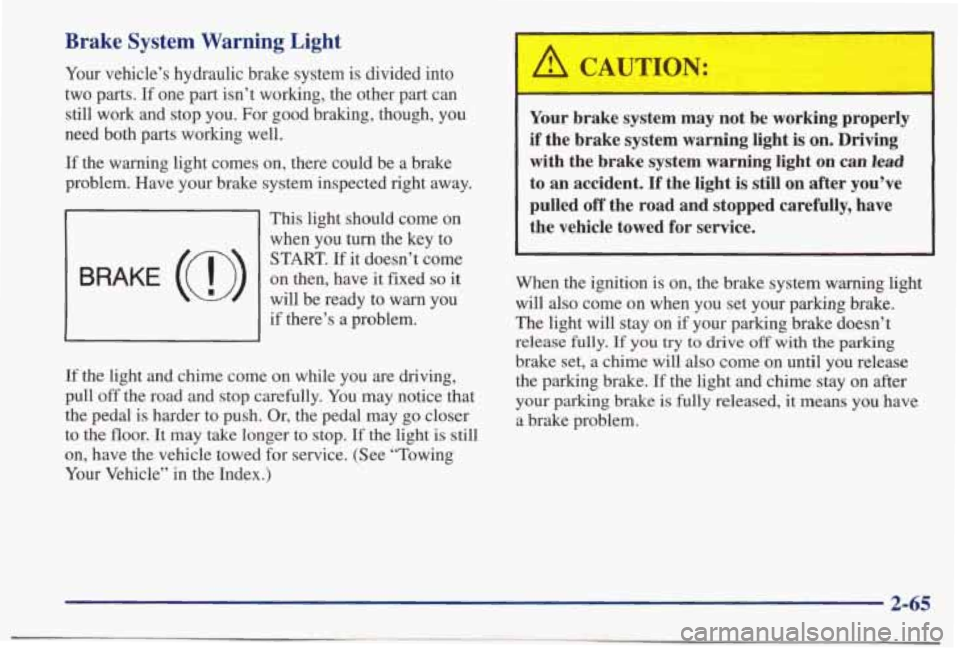
Brake System Warning Light
Your vehicle’s hydraulic brake system is divided into
two parts. If one part isn’t working, the other part can still work and stop you. For good braking, though, you
need both parts working well.
If the warning light comes on, there could be a brake
problem. Have your brake system inspected right away.
BRAKE (0)
This light should come on
when you turn the key to
START. If it doesn’t come
on then, have it fixed so it
will be ready to warn you
if there’s a problem.
If the light and chime come on while you are driving,
pull
off the road and stop carefully. You may notice that
the pedal is harder to push. Or, the pedal may go closer
to the floor. It may take longer to stop.
If the light is still
on, have the vehicle towed for service. (See “Towing
Your Vehicle” in the Index.)
A CAUTION:
Your brake system may not be working properly
if the brake system warning light is on.
Driving
with the brake system warning light on can lead
to an accident. If the light is still on after you’ve
pulled
off the road and stopped carefully, have
the vehicle towed for service.
When the ignition is on, the brake system warning light
will also come on when you set your parking brake.
The light will stay on if your parking brake doesn’t
release
fully. If you try to drive off with the parking
brake set, a chime will also come on until you release
the parking brake. If the light and chime stay on after
your parking brake is fully released. it means you have
a brake problem.
2-65
Page 123 of 395
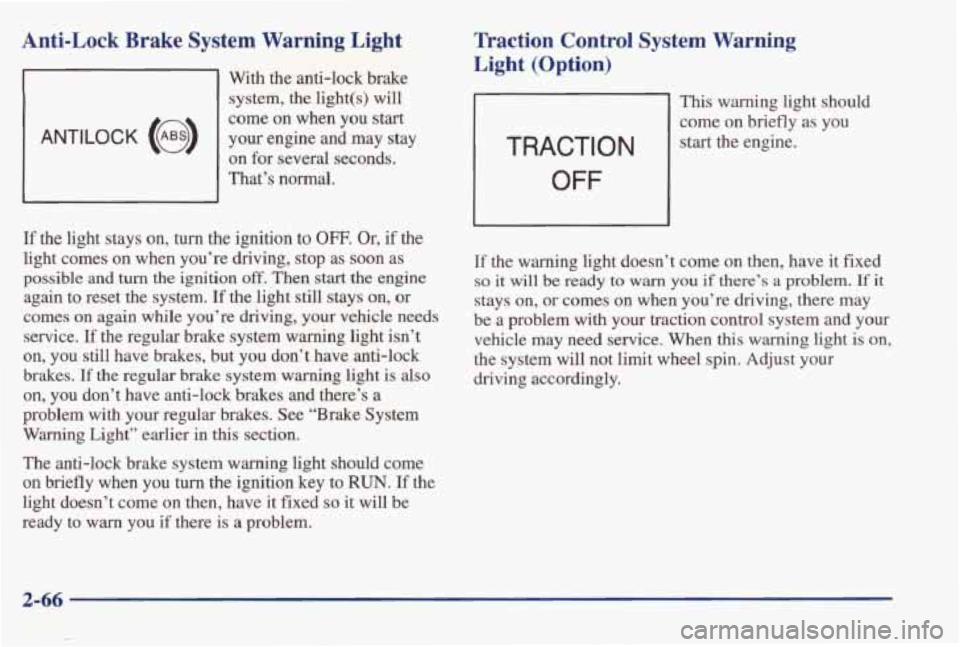
Anti-Lock Brake System Warning Light
ANTILOCK (@)
With the anti-lock brake system,
the light(s) will
come on when
you start
your engine and may stay
on for several seconds.
That’s normal.
llraction Control System Warning
Light (Option)
TRACTION
OFF
This warning light should
come on briefly as you
start the engine.
If the light stays on, turn the ignition to OFF. Or, if the
light comes on when you’re driving, stop as soon as
possible
and turn the ignition off. Then start the engine
again to reset the system.
If the light still stays on, or
comes on again while you’re driving, your vehicle needs
service. If the regular brake system warning light isn’t
on, you still have brakes, but you don’t have anti-lock
brakes.
If the regular brake system warning light is also
on, you don’t have anti-lock brakes and there’s a
problem with your regular brakes. See “Brake System
Warning Light” earlier in
this section.
If the warning light doesn’t come on then, have it fixed
so it will be ready to warn you if there’s a problem. If it
stays on, or comes on when you’re driving, there may
be a problem with your traction control system and your
vehicle may need service. When this warning light is on,
the system will not limit wheel spin. Adjust your
driving accordingly.
The anti-lock brake system warning light should come
on briefly when you turn the ignition key to RUN. If the
light doesn’t come on then, have it fixed
so it will be
ready to
warn you if there is a problem.
Page 124 of 395
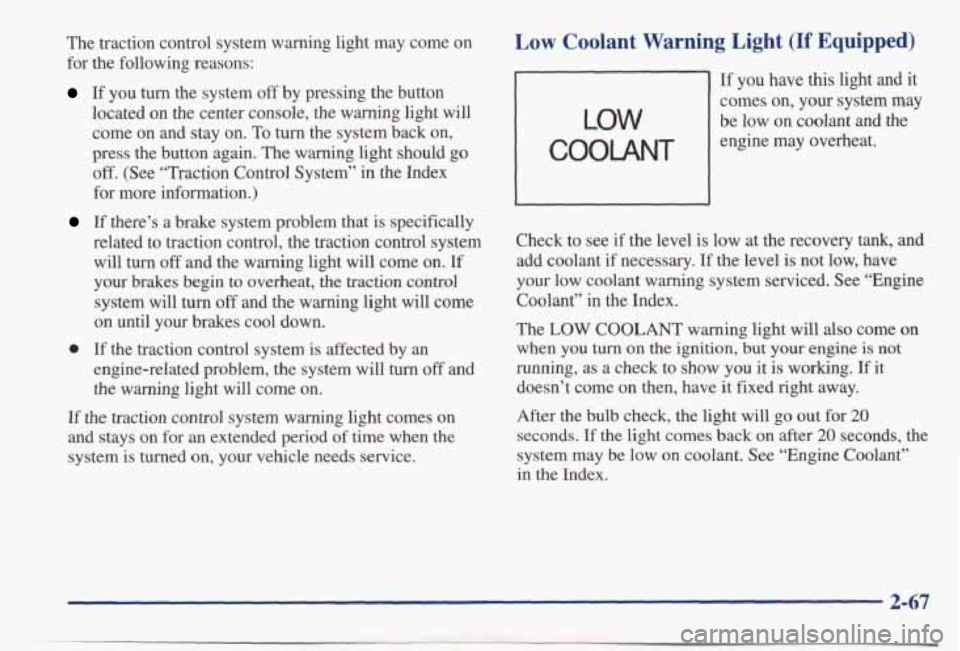
The traction control system warning light may come on
for the following reasons:
If you turn the system off by pressing the button
located on the center console, the warning light will come on and stay on.
To turn the system back on,
press the button again.
The warning light should go
off. (See “Traction Control System” in the Index
for more information.)
Low Coolant Warning Light (If Equipped)
LOW
COOLANT
’ If you have this light and it
comes on, your system may
be low on coolant and the
engine may overheat.
If there’s a brake system problem that is specifically
related to traction control, the traction control system will turn
off and the warning light will come on. If
your brakes begin to overheat, the traction control
system will
turn off and the warning light will come
on until your brakes cool down.
engine-related problem, the system will
turn off and
the warning light will come on.
0 If the traction control system is affected by an
If the traction control system warning light comes on
and stays on for
an extended period of time when the
system is turned on, your vehicle needs service. Check to see if
the level is low at the recovery tank, and
add coolant
if necessary. If the level is not low, have
your low coolant warning system serviced. See “Engine
Coolant” in the Index.
The
LOW COOLANT warning light will also come on
when you
turn on the ignition, but your engine is not
running, as a check to show you it is working. If it
doesn’t come on then, have it fixed right away.
After the bulb check, the light will
go out for 20
seconds. If the light comes back on after 20 seconds, the
system may be low on coolant. See “Engine Coolant”
in the Index.
2-67
Page 125 of 395
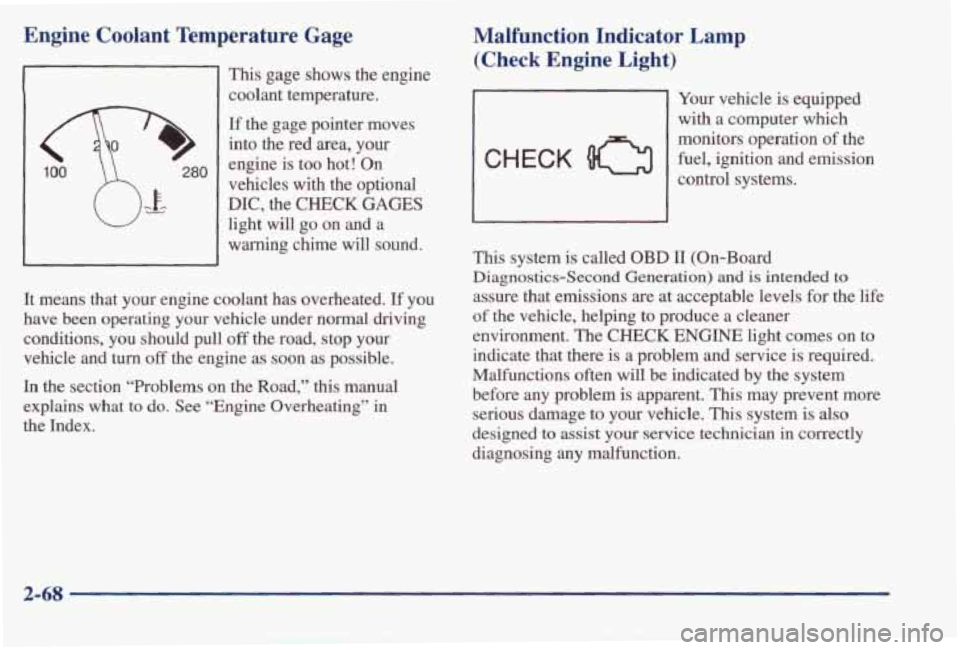
Engine Coolant Temperature Gage
280
This gage shows the engine
coolant temperature.
If the gage pointer moves
into
the red area, your
engine is too hot! On
vehicles
with the optional
DIC, the CHECK GAGES
light will go on and a
warning chime will sound.
It means that your engine coolant has overheated.
If you
have been operating your vehicle under normal driving
conditions, you should pull
off the road, stop your
vehicle and
turn off the engine as soon as possible.
In the section “Problems
on the Road,” this manual
explains what to
do. See “Engine Overheating” in
the Index.
Malfunction Indicator Lamp (Check Engine Light)
CHECK 0
Your vehicle is equipped
with a computer which
monitors operation of the
fuel, ignition and emission
control systems.
This system is called OBD II (On-Board
Diagnostics-Second Generation)
and is intended to
assure that emissions are at acceptable levels for the life
of the vehicle, helping to produce a cleaner
environment. The
CHECK ENGINE light comes on to
indicate that there is a problem and service is required.
Malfunctions often will be indicated by the system
before any problem is apparent. This may prevent more
serious damage to your vehicle. This system is also
designed to assist your service technician in correctly
diagnosing any malfunction.
2-68
Page 126 of 395
NOTICE:
If you keep driving your vehicle with this light on, after a while, your emission controls may not
work as well,
your fuel economy may not be as
good and your engine may not run as smoothly.
This could lead
to costly repairs that may not be
covered by your warranty. If the
Light Is Flashing
The
following may prevent more serious damage to
your vehicle:
Reducing vehicle speed.
Avoiding hard accelerations.
0 Avoiding steep uphill grades.
0 If you are towing a trailer, reduce the amount of
cargo being hauled as soon as it is possible.
This light should come on, as a check to show you it is
working, when the ignition is on and the engine is not
running. If the light doesn’t come on, have it repaired.
This light will also come on during a malfunction in one
of two ways:
0 Light Flashing -- A misfire condition has been
detected.
A misfire increases vehicle emissions and
may damage the emission control system on your vehicle. Dealer or qualified service center diagnosis
and service may be required.
malfunction has been detected on your vehicle.
Dealer
or qualified service center diagnosis and
service
may be required.
0 Light On Steady -- An emission control system If
the light stops flashing and remains
on steady, see
“If the Light Is On Steady” following.
If the light continues to flash, when it is safe to do so,
stop the vehicle. Find a safe place to park your vehicle.
Turn the key off, wait at least 10 seconds and restart the
engine. If the light remains on steady, see “If the Light
Is On Steady” following. If the light is still flashing,
follow the previous steps, and drive the vehicle to your
dealer or qualified service center for service.
2-69
Page 127 of 395
If the Light Is On Steady
You may be able to correct the emission system
malfunction by considering the following:
Did you recently put fuel into your vehicle?
If so, reinstall the fuel cap, making sure to fully install
the cap. The diagnostic system can determine
if the fuel
cap has been left
off or improperly installed. A loose or
missing fuel cap will allow fuel to evaporate into the
atmosphere.
A few driving trips with the cap properly
installed should
turn the light off.
Did you just drive through a deep puddle of water?
If so, your electrical system may be wet. The condition
will usually be corrected when the electrical system
dries out.
A few driving trips should turn the light off.
Have you recently changed brands of fuel?
If so, be sure to fuel your vehicle with quality fuel (see
“Fuel” in the Index). Poor fuel quality will cause your \
engine not to
run as efficiently as designed. You may
notice
this as stalling after start-up, stalling when you
put the vehicle into gear, misfiring, hesitation on
acceleration or stumbling on acceleration. (These
conditions may go away once the engine is warmed up.)
This will be detected by the system and cause the light
to turn on.
If you experience one or more of these conditions,
change the fuel brand you use.
It will require at least one
full
tank of the proper fuel to turn the light off.
If none of the above steps have made the light turn off,
have your dealer or qualified service center check the
vehicle. Your dealer
has the proper test equipment and
diagnostic tools to
fix any mechanical or electrical
problems
that may have developed.
2-70