steering PONTIAC BONNEVILLE 1998 User Guide
[x] Cancel search | Manufacturer: PONTIAC, Model Year: 1998, Model line: BONNEVILLE, Model: PONTIAC BONNEVILLE 1998Pages: 395, PDF Size: 17.6 MB
Page 93 of 395
Tilt Wheel Turn SignallMultifunction Lever
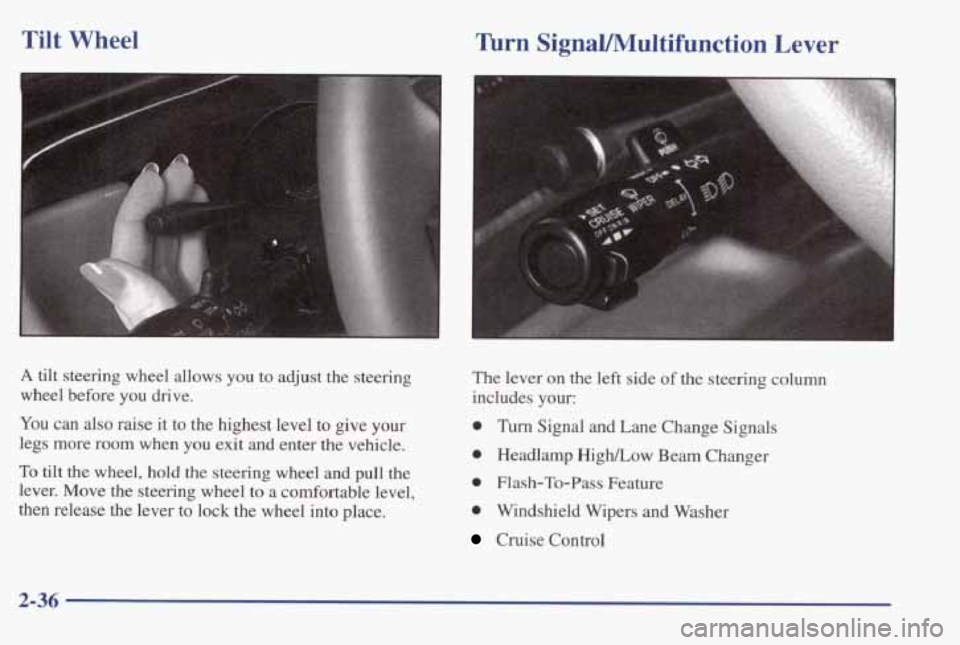
A tilt steering wheel allows you to adjust the steering
wheel before you drive.
You can also raise it to the highest level to give your
legs more room when
you exit and enter the vehicle.
To
tilt the wheel, hold the steering wheel and pull the
lever. Move the steering wheel to a comfortable level,
then release the lever to lock the wheel into place.
The lever on the left side of the steering column
includes your:
0 Turn Signal and Lane Change Signals
0 Headlamp HighLow Beam Changer
0 Flash-To-Pass Feature
0 Windshield Wipers and Washer
Cruise Control
2-36
Page 114 of 395
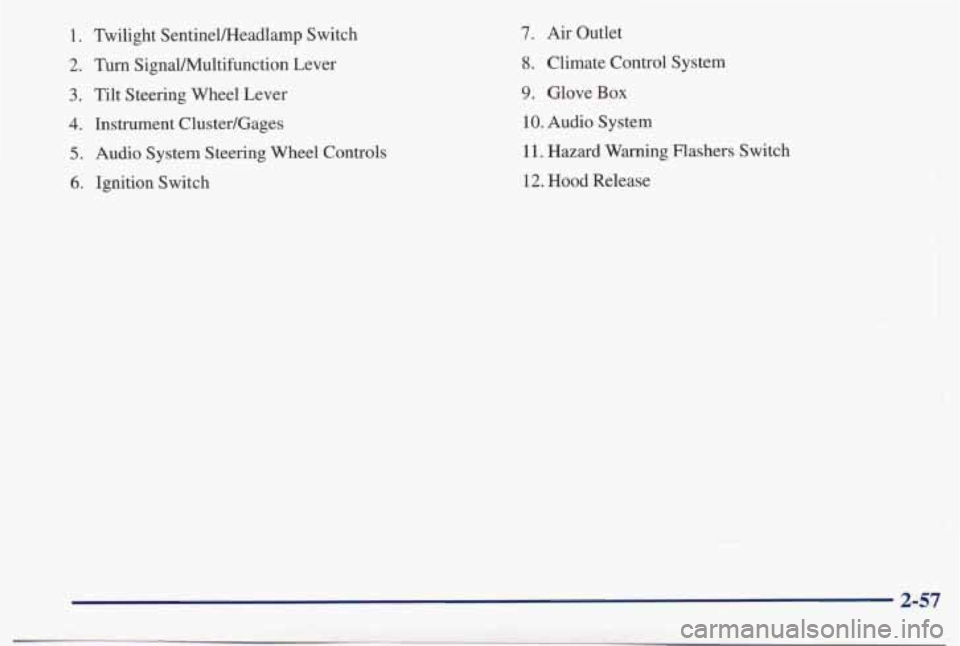
1. Tbilight SentineVHeadlamp Switch
2. Turn SignaVMultifunction Lever
3. Tilt Steering Wheel Lever
4. Instrument Cluster/Gages
5. Audio System Steering Wheel Controls
6. Ignition Switch
7. Air Outlet
8. Climate Control System
9. Glove Box
10. Audio System
1 1. Hazard Warning Flashers Switch
12. Hood Release
Page 133 of 395
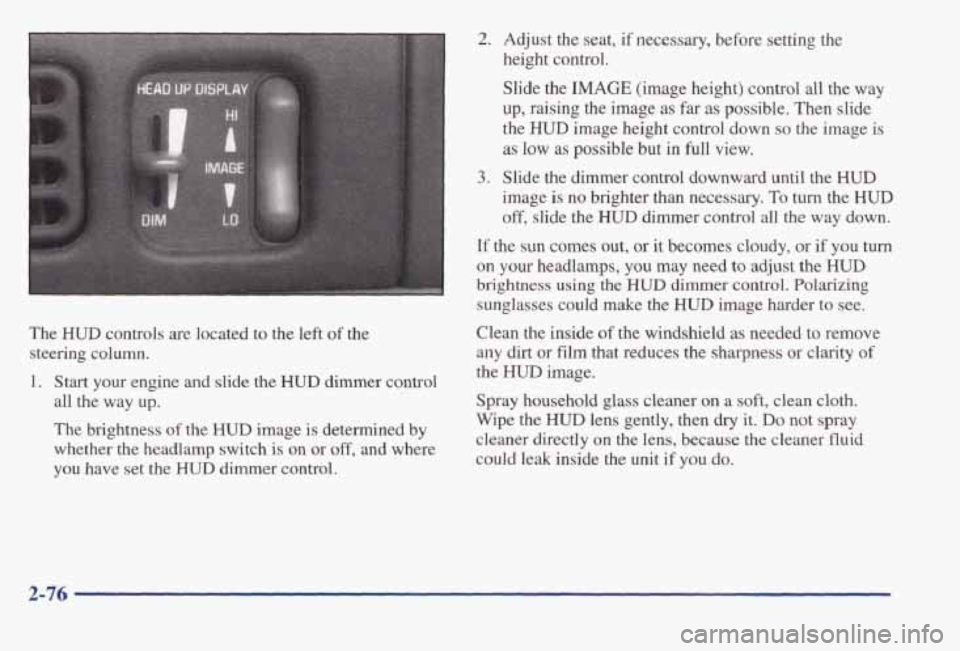
The HUD controls are located to the left of the
steering column. 1. Start your engine and slide the
HUD dimmer control
all the way up.
The brightness
of the HUD image is determined by
whether
the headlamp switch is on or off, and where
you have set the
HUD dimmer control.
2. Adjust the seat, if necessary, before setting the
height control.
Slide the
IMAGE (image height) control all the way
up, raising the image as far as possible. Then slide
the
HUD image height control down so the image is
as low as possible but in full view.
image
is no brighter than necessary. To turn the HUD
off, slide the HUD dimmer control all the way down.
If the sun comes out, or it becomes cloudy, or if you turn
on your headlamps, you may need to adjust the HUD
brightness using the HUD dimmer control. Polarizing
sunglasses could make the
HUD image harder to see.
Clean the inside
of the windshield as needed to remove
any dirt or film that reduces the sharpness or clarity of
the
HUD image.
Spray household
glass cleaner on a soft, clean cloth.
Wipe the
HUD lens gently, then dry it. Do not spray
cleaner directly on the lens, because
the cleaner fluid
could leak inside the
unit if you do.
3. Slide the dimmer control downward until the HUD
2-76
Page 142 of 395

v
Section 3 Comfort Controls and Audio Systems
In this section, you’ll find out how to operate the comfort control and audio systems offered w\
ith your vehicle. Be
sure to read about the particular systems supplied
with your vehicle.
3-2
3-5
3-6 3-6 3-8
3-8
3-9
3-9
3-9
3-
10
3-11
3-15
Comfort Controls Air Conditioning
Heating Ventilation System Defogging and Defrosting
Rear Window Defogger
Audio Systems Setting
the Clock for AM-FM Stereo
Setting the Clock for All Systems Except
AM-FM Stereo
AM-FM Stereo
AM-FM Stereo with Cassette Tape Player
(If Equipped)
AM-FM Stereo with Cassette Tape Player and
Equalizer (If Equipped) 3-
18
3-21
3-24
3-26
3-27
3-27
3-28
3-29 3-29
3-30
3-30
AM-FM Stereo with Compact Disc Player
(If Equipped)
AM-FM Stereo with Compact Disc Player and
Equalizer (If Equipped)
Theft-Deterrent Feature
Audio Steering Wheel Controls (If Equipped)
Understanding Radio Reception
Tips About Your Audio System
Care of Your Cassette Tape Player
Care
of Your Compact Discs
Care of Your Compact Disc Player
Fixed Mast Antenna
Power Antenna Mast Care
3-1
Page 167 of 395
Audio Steering Wheel Controls
(If Equipped)
A
SEEK t
t,
1
[f your vehicle has this
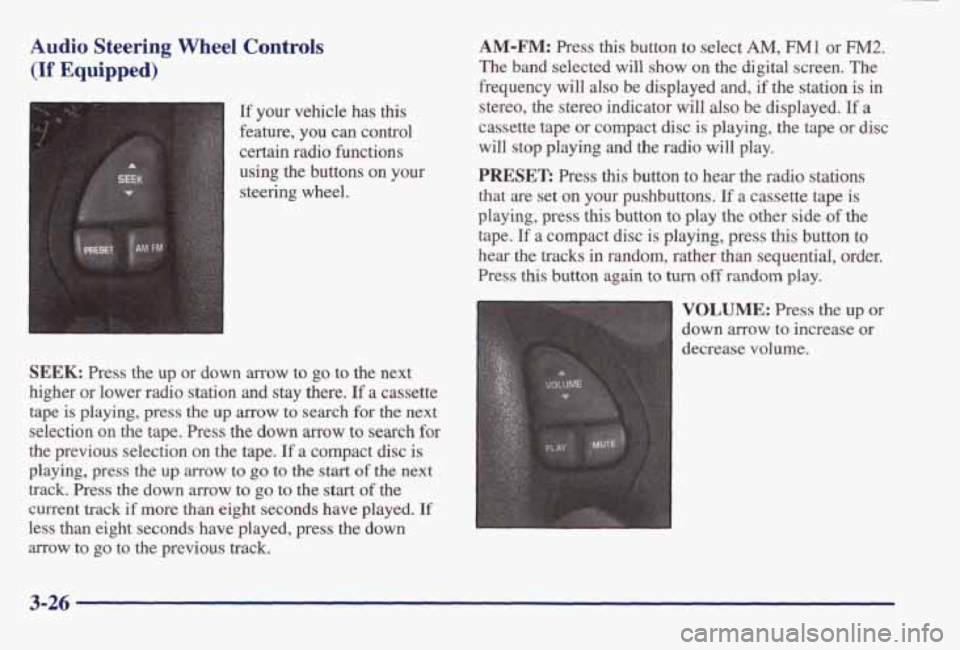
feature, you can control
certain radio functions
using the buttons
on your
steering wheel.
SEEK: Press the up or down arrow to go to the next
higher or lower radio station
and stay there. If a cassette
tape is playing, press the up
arrow to search for the next
selection on the tape. Press the
down arrow to search for
the previous selection on the tape. If a compact disc is
playing, press the up arrow to go to the start of the next
track.
Press the down arrow to go to the start of the
current track
if more than eight seconds have played. If
less than eight seconds have played, press the down
arrow to
go to the previous track.
AM-FM: Press this button to select AM, F"1 or FM2.
The band selected will show on the digital screen. The
frequency will
also be displayed and, if the station is in
stereo, the stereo indicator will also be displayed.
If a
cassette tape or compact disc is playing, the tape or disc
will stop playing and the radio will play.
PRESET: Press this button to hear the radio stations
that are set on
your pushbuttons. If a cassette tape is
playing, press
this button to play the other side of the
tape.
If a compact disc is playing, press this button to
hear the
tracks in random, rather than sequential, order.
Press
this button again to turn off random play.
VOLUME: Press the up or
down arrow to increase or
decrease volume.
3-26
Page 174 of 395

7
Section 4 Your Driving and the Road
Here you’ll find information about driving on different kinds\
of roads and in varying weather conditions. We’ve also
included many other useful tips on driving.
4-2
4-3
4-6
4-6
4-
10
4- 12
4-
13
4- 14
4-15
Defensive Driving Drunken Driving
Control of a Vehicle
Braking
Steering
Off-Road Recovery
Passing
Loss of Control
Driving at Night
4- 17
4-20
4-2
1
4-22
4-23
4-23
4-25
4-29
4-3 1
Driving in Rain and on Wet Roads
City Driving
Freeway Driving Before Leaving on a Long Trip
Highway Hypnosis
Hill and Mountain Roads
Winter Driving
Loading Your Vehicle
Towing a Trailer
4-1
Page 179 of 395
Control of a Vehicle
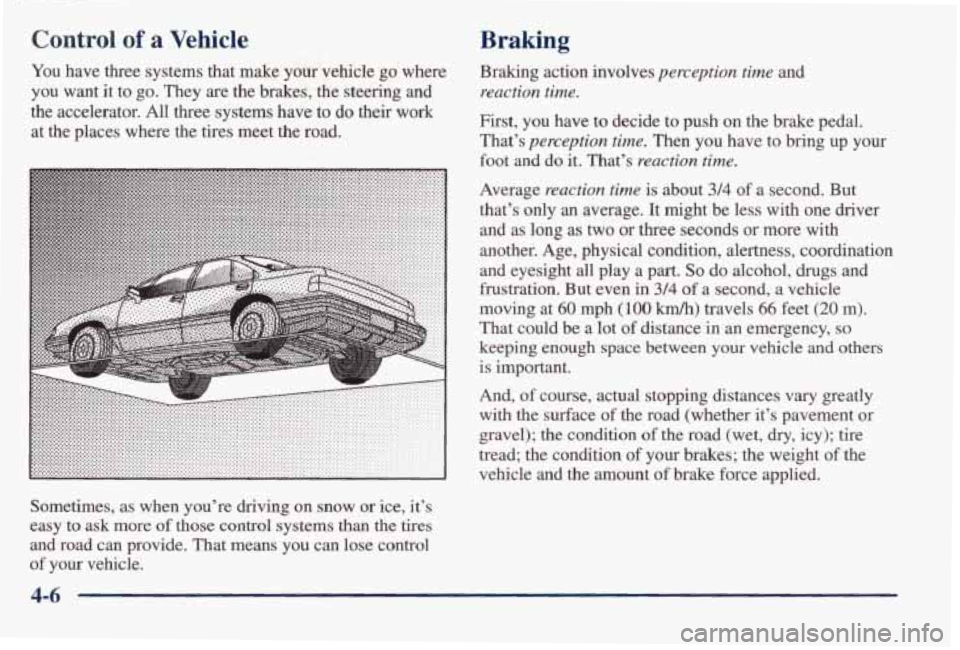
You have three systems that make your vehicle go where
you want
it to go. They are the brakes, the steering and
the accelerator.
All three systems have to do their work
at the places where the tires meet the road.
Sometimes, as when you’re driving on snow or ice, it’s
easy to ask more
of those control systems than the tires
and road can provide. That means you can lose control
of your vehicle.
Braking
Braking action involves perception time and
reaction time.
First, you have to decide to push on the brake pedal.
That’s
perception time. Then you have to bring up your
foot and do
it. That’s reaction time.
Average reaction time is about 3/4 of a second. But
that’s
only an average. It might be less with one driver
and as long as
two or three seconds or more with
another. Age, physical condition, alertness, coordination
and eyesight all play a part.
So do alcohol, drugs and
frustration. But even in
3/4 of a second, a vehicle
moving at
60 mph (100 kmk) travels 66 feet (20 m).
That could be a lot of distance in an emergency, so
keeping enough space between your vehicle and others
is important.
And, of course, actual stopping distances vary greatly
with the surface of the road (whether it’s pavement
or
gravel); the condition of the road (wet, dry, icy); tire
tread; the condition
of your brakes; the weight of the
vehicle and the amount
of brake force applied.
4-6
Page 183 of 395
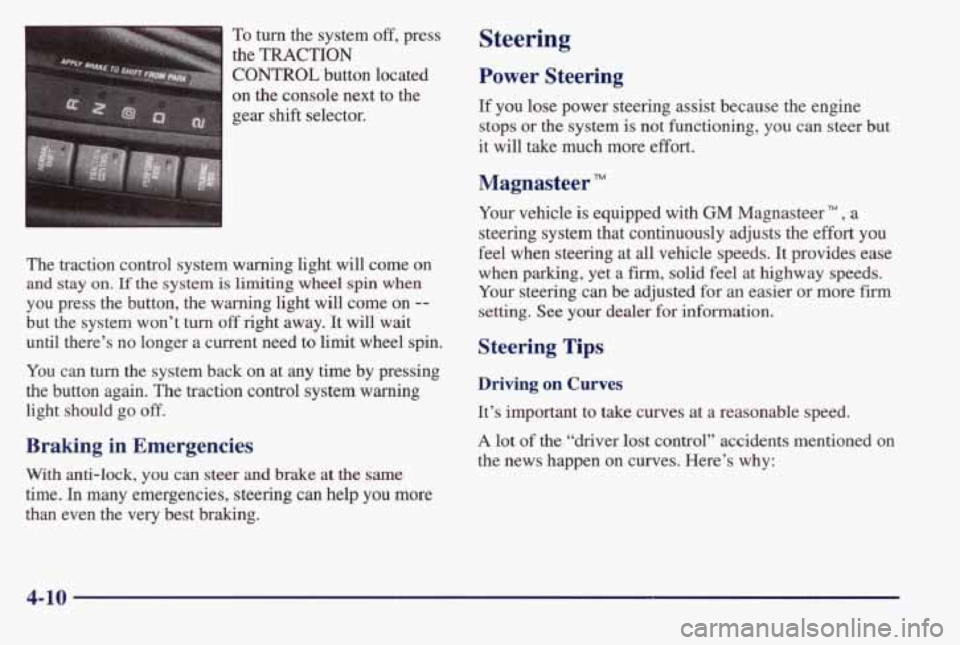
To turn the system off, press
the
TRACTION
CONTROL button located
on the console next to the
gear
shift selector.
The traction control system warning light will come on
and stay on. If the system is limiting wheel spin when
you press the button, the warning light will come on --
but the system won’t turn off right away. It will wait
until there’s no longer a current need to limit wheel spin.
You can
turn the system back on at any time by pressing
the button again. The traction control system warning
light should go
off.
Braking in Emergencies
With anti-lock, you can steer and brake at the same
time. In many emergencies, steering can help you more
than even the very best braking.
Steering
Power Steering
If you lose power steering assist because the engine
stops or the system is not functioning, you
can steer but
it will take much more effort.
Magnasteer TM
Your vehicle is equipped with GM Magnasteer m, a
steering system that continuously adjusts
the effort you
feel when steering at
all vehicle speeds. It provides ease
when parking, yet a
firm, solid feel at highway speeds.
Your steering can be adjusted for an easier or more firm
setting. See your dealer for information.
Steering Tips
Driving on Curves
It’s important to take curves at a reasonable speed.
A lot of the “driver lost control” accidents mentioned on
the news happen on curves. Here’s why:
4-10
Page 184 of 395
Experienced driver or beginner, each of us is subject to
the same laws
of physics when driving on curves. The
traction
of the tires against the road surface makes it
possible for the vehicle to change its path when you turn
the front wheels. If there’s no traction, inertia will keep
the vehicle going in the same direction. If you’ve
ever
tried to steer a vehicle on wet ice, you’ll understand this.
The traction you can get in a curve depends on the
condition
of your tires and the road surface, the angle at
which the curve
is banked, and your speed. While you’re
in a curve, speed is the one factor you can control.
Suppose you’re steering through a sharp curve. Then you suddenly accelerate. Both control systems
-- steering and
acceleration
-- have to do their work where the tires meet
the road. Adding the sudden acceleration can demand too
much of those places. You can lose control. Refer to ‘Traction Control” in the Index.
What should you do if this ever happens? Ease up on the accelerator pedal, steer the vehicle the way you want it
to go, and slow down.
Speed limit signs near curves warn that you should
adjust your speed. Of course, the posted speeds are
based on good weather and road conditions. Under less
favorable conditions you’ll want
to go slower.
If you need to reduce your speed as you approach a
curve, do it before you enter the curve, while your front
wheels are straight ahead.
Try to adjust your speed so you can “drive” through the
curve. Maintain a reasonable, steady speed. Wait to
accelerate until
you are out of the curve, and then
accelerate gently into the straightaway.
Steering in Emergencies
There are times when steering can be more effective than
braking. For example, you come over a
hill and find a
truck stopped
in your lane, or a car suddenly pulls out
from nowhere, or a child darts out from between parked
cars and stops right
in front of you. You can avoid these
problems by braking -- if you can stop in time. But
sometimes you can’t; there isn’t room. That’s the time \
for
evasive action
-- steering around the problem.
Your vehicle can perform
very well in emergencies like
these. First apply your brakes. (See “Braking in
Emergencies” earlier in this section.) It is better to
remove
as much speed as you can from a possible
collision. Then steer around the problem, to the
left or
right depending on the space available.
Page 185 of 395
An emergency like this requires close attention and a
quick decision.
If you are holding the steering wheel at
the recommended
9 and 3 o’clock positions, you can
turn it a full 180 degrees very quickly without removing
either hand. But you have
to act fast, steer quickly, and
just
as quickly straighten the wheel once you have
avoided the object.
The fact that such emergency situations
are always
possible is a good reason to practice defensive driving at
all times and wear safety belts properly.
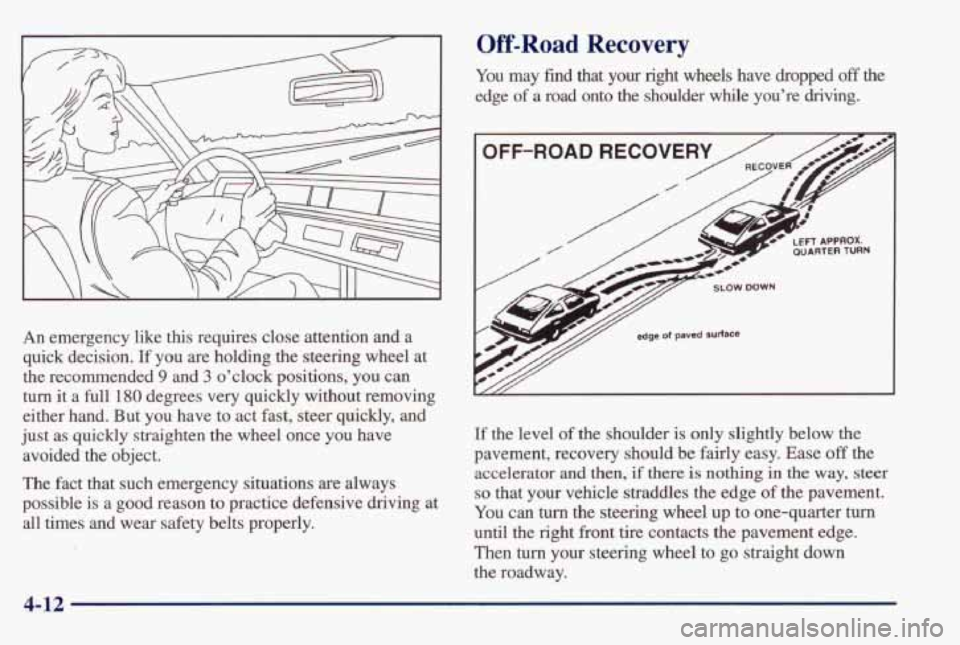
Off-Road Recovery
You may find that your right wheels have dropped off the
edge
of a road onto the shoulder while you’re driving.
I OFF-ROAD RECOVERY /
I
If the level of the shoulder is only slightly below the
pavement, recovery should
be fairly easy. Ease off the
accelerator
and then, if there is nothing in the way, steer
so that your vehicle straddles the edge of the pavement.
You can turn the steering wheel up to one-quarter turn
until the right front tire contacts the pavement edge.
Then
turn your steering wheel to go straight down
the roadway.
4-12