light PONTIAC BONNEVILLE 1999 Owner's Manual
[x] Cancel search | Manufacturer: PONTIAC, Model Year: 1999, Model line: BONNEVILLE, Model: PONTIAC BONNEVILLE 1999Pages: 392, PDF Size: 2.96 MB
Page 109 of 392

yellowblue
2-49
When this feature is turned on, the mirror automatically
changes to reduce glare from headlamps behind you. A
photocell on the mirror senses when it is becoming dark
outside. Another photocell built into the mirror face
senses when headlamps are behind you.
At night, when the glare is too high, the mirror will
gradually darken to reduce glare (this change may take a
few seconds). The mirror will return to its clear daytime
state when the glare is reduced.
Mirror Operation
To turn on the automatic dimming feature, press
AUTO. To turn off automatic dimming, press OFF.
The green indicator light will be illuminated when this
feature is active.Time Delay
The automatic mirror has a time delay feature which
prevents unnecessary switching from the night back to
the day position. This delay prevents rapid changing of
the mirror as you drive under lights and through traffic.
Cleaning the Photocells
Use a cotton swab and glass cleaner to clean the
photocells when necessary.
Manual Remote Control Mirror
The outside rearview mirror should be adjusted so you
can just see the side of your vehicle when you are sitting
in a comfortable driving position.
Adjust the driver's side outside mirror with the control
lever on the driver's door.
To adjust your passenger's side mirror, sit in the driver's
seat and have a passenger adjust the mirror for you.
Page 113 of 392
yellowblue
2-53 Convenience Net (Option)
Your vehicle may have a convenience net. You'll see it
just inside the back wall of the trunk.
Put small loads, like grocery bags, behind the net. It can
help keep them from falling over during sharp turns or
quick starts and stops. For heavier loads, store them in
the trunk as far forward as you can.
You can unhook the net so that it will lie flat when
you're not using it.
Ashtrays and Cigarette Lighter
Lift the cover to reveal the front ashtray.
To clean the ashtray, lift it out by pulling on the snuffer.
On models without a console, there's an
ashtray/cupholder under the instrument panel. To clean
the ashtray, lift it out by pulling up on the tabs on either
side. It snaps back into place.
To open the rear ashtrays, lift the cover.
NOTICE:
Don't put papers and other things that burn into
your ashtrays. If you do, cigarettes or other
smoking materials could set them on fire,
causing damage.
Page 114 of 392
yellowblue
2-54
To use a lighter, just push the center in all the way and
let it go. When it is ready, the center will pop back by
itself. Pull out the entire unit to use it.
NOTICE:
Don't hold a cigarette lighter in with your hand
while it is heating. If you do, it won't be able to
back away from the heating element when it's
ready. That can make it overheat, damaging the
lighter and the heating element.
Sun Visors
To block out glare, you can swing down the visors. You
can also remove them from the center mount and swing
them to the side, while the auxiliary sunshade remains to
block glare from the front.
Visor Vanity Mirror
Open the cover to expose the vanity mirror.
If your vehicle has the optional lighted vanity mirrors,
the lamps come on when you open the cover. You can
adjust the brightness of the lamps by moving the switch
up or down.
Page 117 of 392

yellowblue
2-57
Sunroof (Option)
Your vehicle may be
equipped with an
express
-open sunroof. Press
the control switch rearward
and release it to open the
glass panel and sunshade.If you want to stop the sunroof in a partially open
position, lightly press the switch again. To completely
open the sunroof, press the switch rearward again. The
sunshade can also be opened by hand.
To close the sunroof, press and hold the control switch
forward to close the glass panel. Then, close the
sunshade by hand.
When the sunroof is in the closed position, press the
control switch forward to the vent position. Open the
sunshade by hand.
Press the switch rearward to close the rear vent.
The control switch will work only when the ignition is
on or during retained accessory power, if you have that
option. See ªRetained Accessory Powerº in the Index.
Page 119 of 392

yellowblue
2-59
A. Twilight Sentinel/Headlamp Switch
B. Turn Signal/Multifunction Lever
C. Tilt Steering Wheel Lever
D. Instrument Cluster/Gages
E. Audio System Steering Wheel Controls
F. Ignition SwitchG. Air Outlet
H. Climate Control System
I. Glove Box
J. Audio System
K. Hazard Warning Flashers Switch
L. Hood Release
Page 120 of 392

yellowblue
2-60
Instrument Panel Clusters
Your instrument panel clusters are designed to let you know at a glance how your vehicle is running. You'll know how
fast you're going, how much fuel you're using, and many other things you'll need to drive safely and economically.
Your vehicle is equipped with one of these instrument panel clusters, which includes indicator warning lights and
gages that are explained on the following pages.
Cluster with Gages
Page 124 of 392

yellowblue
2-64
Tachometer
The tachometer shows your
engine speed in revolutions
per minute (rpm). Do not
run your engine at speeds in
the red area.
Warning Lights, Gages
and Indicators
This part describes the warning lights and gages that
may be on your vehicle. The pictures will help you
locate them.
Warning lights and gages can signal that something is
wrong before it becomes serious enough to cause an
expensive repair or replacement. Paying attention to
your warning lights and gages could also save you or
others from injury.Warning lights come on when there may be or is a
problem with one of your vehicle's functions. As you
will see in the details on the next few pages, some
warning lights come on briefly when you start the
engine just to let you know they're working. If you are
familiar with this section, you should not be alarmed
when this happens.
Gages can indicate when there may be or is a problem
with one of your vehicle's functions. Often gages and
warning lights work together to let you know when
there's a problem with your vehicle.
When one of the warning lights comes on and stays on
when you are driving, or when one of the gages shows
there may be a problem, check the section that tells you
what to do about it. Please follow this manual's advice.
Waiting to do repairs can be costly -- and even
dangerous. So please get to know your warning lights
and gages. They're a big help.
Your vehicle may also have a driver information system
that works along with the warning lights and gages.
See ªDriver Information Systemº in the Index.
Page 125 of 392

yellowblue
2-65 Safety Belt Reminder Light
When the key is turned to RUN or START, a chime will
come on for about eight seconds to remind people to
fasten their safety belts.
The safety belt light will
also come on and stay on
for about 70 seconds. If the
driver's belt is already
buckled, neither the chime
nor the light will come on.
Air Bag Readiness Light
There is an air bag readiness light on the instrument
panel, which shows AIR BAG. The system checks the
air bag's electrical system for malfunctions. The light
tells you if there is an electrical problem. The system
check includes the air bag sensors, the air bag modules,
the wiring and the crash sensing and diagnostic module.
For more information on the air bag system, see ªAir
Bagº in the Index.
This light will come on
when you start your engine,
and it will flash for a few
seconds. Then the light
should go out. This means
the system is ready.
If the air bag readiness light stays on after you start the
engine or comes on when you are driving, your air bag
system may not work properly. Have your vehicle
serviced right away.
The air bag readiness light should flash for a few
seconds when you turn the ignition key to RUN. If the
light doesn't come on then, have it fixed so it will be
ready to warn you if there is a problem.
Page 126 of 392

yellowblue
2-66 Battery Light (If Equipped)
This light will come on
briefly when you start the
vehicle, as a check to show
you it is working; then it
should go out.
If it stays on, or comes on while you are driving, you
may have a problem with the electrical charging system.
It could indicate that you have a generator problem or
another electrical system problem. Have it checked right
away. Driving while this light is on could drain
your battery.
If you must drive a short distance with the light on, be
certain to turn off all your accessories, such as the radio
and climate control system.
Some clusters with gages do not have a battery warning
light. They have a CHECK GAGES warning to indicate
a problem.
Voltmeter
You have a voltmeter
unless you have the
supercharged engine.
When the engine is running, the gage shows the
condition of the charging system. Readings outside the
red warning zone indicate the normal operating range.
Readings in the red warning zone indicate a possible
problem in the electrical system. On vehicles with the
optional DIC, the CHECK GAGES light will also come
on, and a warning chime will sound. Have your vehicle
serviced immediately.
Page 127 of 392
yellowblue
2-67 Brake System Warning Light
Your vehicle's hydraulic brake system is divided into
two parts. If one part isn't working, the other part can
still work and stop you. For good braking, though, you
need both parts working well.
If the warning light comes on, there is a brake problem.
Have your brake system inspected right away.
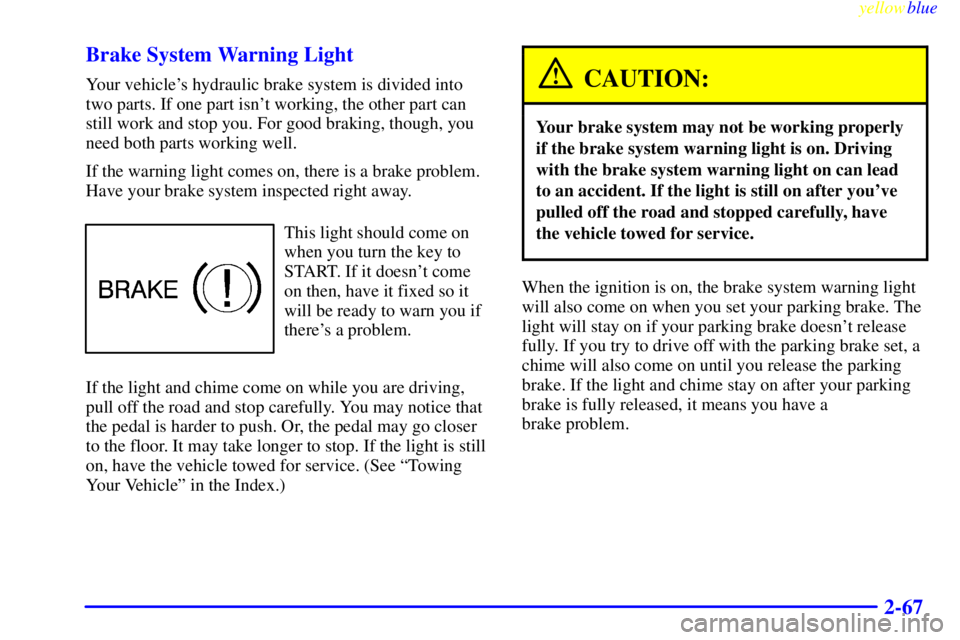
This light should come on
when you turn the key to
START. If it doesn't come
on then, have it fixed so it
will be ready to warn you if
there's a problem.
If the light and chime come on while you are driving,
pull off the road and stop carefully. You may notice that
the pedal is harder to push. Or, the pedal may go closer
to the floor. It may take longer to stop. If the light is still
on, have the vehicle towed for service. (See ªTowing
Your Vehicleº in the Index.)
CAUTION:
Your brake system may not be working properly
if the brake system warning light is on. Driving
with the brake system warning light on can lead
to an accident. If the light is still on after you've
pulled off the road and stopped carefully, have
the vehicle towed for service.
When the ignition is on, the brake system warning light
will also come on when you set your parking brake. The
light will stay on if your parking brake doesn't release
fully. If you try to drive off with the parking brake set, a
chime will also come on until you release the parking
brake. If the light and chime stay on after your parking
brake is fully released, it means you have a
brake problem.