lock PONTIAC BONNEVILLE 2000 Owners Manual
[x] Cancel search | Manufacturer: PONTIAC, Model Year: 2000, Model line: BONNEVILLE, Model: PONTIAC BONNEVILLE 2000Pages: 402, PDF Size: 2.76 MB
Page 2 of 402
Free lockout assistance
Free dead-battery assistance
Free out-of-fuel assistance
Free flat-tire change
Emergency towing
1-800-762-3743
(For vehicles purchased in Canada,
call
1-800-268-6800)
that provides in an emergency:
1-800-762-3743
(For vehicles purchased in Canada,
call
1-800-268-6800)
Bumper-to-Bumper
3-years/36,000 miles (60 000 km)
Limited Warranty
Courtesy
Transportation
Every
2000 Bonneville
under warranty is
backed with the
following
services:
Page 4 of 402
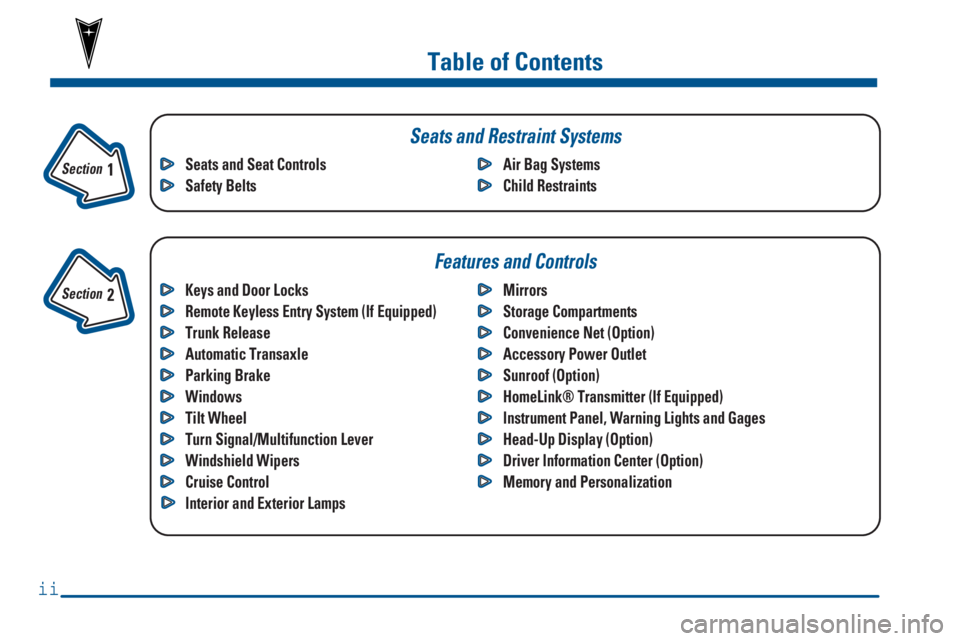
Table of Contents
Keys and Door Locks
Remote Keyless Entry System (If Equipped)
Trunk Release
Automatic Transaxle
Parking Brake
Windows
Tilt Wheel
Turn Signal/Multifunction Lever
Windshield Wipers
Cruise Control
Interior and Exterior LampsMirrors
Storage Compartments
Convenience Net (Option)
Accessory Power Outlet
Sunroof (Option)
HomeLink® Transmitter (If Equipped)
Instrument Panel, Warning Lights and Gages
Head-Up Display (Option)
Driver Information Center (Option)
Memory and Personalization Seats and Seat Controls
Safety BeltsAir Bag Systems
Child Restraints
Section
1
Section
2
Seats and Restraint Systems
Features and Controls
ii
Page 5 of 402
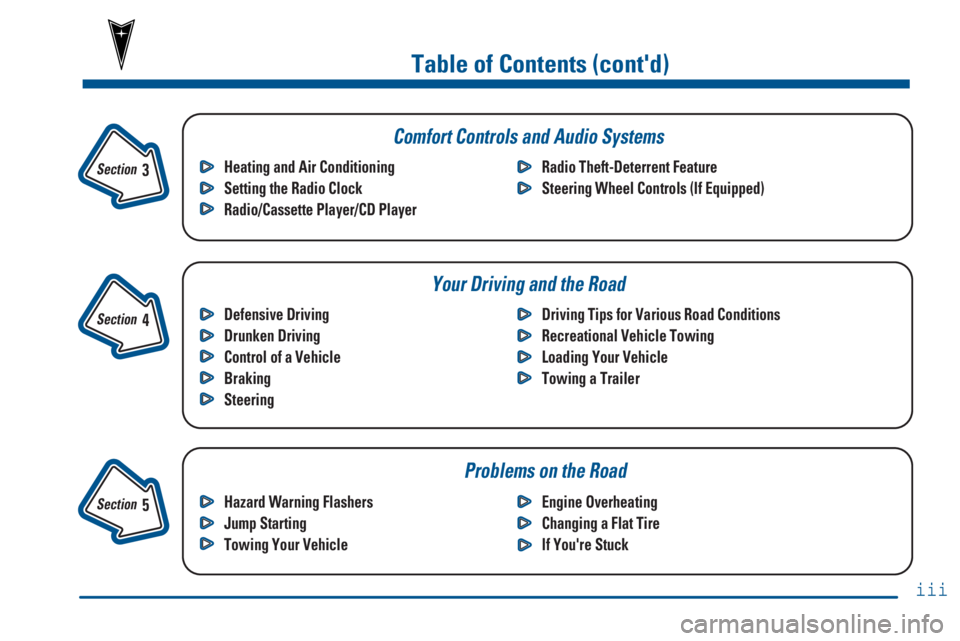
Table of Contents (cont'd)
Defensive Driving
Drunken Driving
Control of a Vehicle
Braking
SteeringDriving Tips for Various Road Conditions
Recreational Vehicle Towing
Loading Your Vehicle
Towing a Trailer Heating and Air Conditioning
Setting the Radio Clock
Radio/Cassette Player/CD PlayerRadio Theft-Deterrent Feature
Steering Wheel Controls (If Equipped)
Hazard Warning Flashers
Jump Starting
Towing Your VehicleEngine Overheating
Changing a Flat Tire
If You're Stuck
Problems on the Road
iii
Comfort Controls and Audio Systems
Your Driving and the Road
Section
3
Section
4
Section
5
Page 11 of 402

ix
For example,
these symbols
are used on an
original battery:
CAUTION
POSSIBLE
INJURY
PROTECT
EYES BY
SHIELDING
CAUSTIC
BATTERY
ACID COULD
CAUSE
BURNS
AVOID
SPARKS OR
FLAMES
SPARK OR
FLAME
COULD
EXPLODE
BATTERY
These symbols
are important
for you and
your passengers
whenever your
vehicle is
driven:
DOOR LOCK
UNLOCK
FASTEN
SEAT
BELTS
POWER
WINDOW
AIR BAG
These symbols
have to do with
your lamps:
MASTER
LIGHTING
SWITCH
TURN
SIGNALS
PARKING
LAMPS
HAZARD
WARNING
FLASHER
DAYTIME
RUNNING
LAMPS
FOG LAMPS
These symbols
are on some of
your controls:
WINDSHIELD
WIPER
WINDSHIELD
WASHER
WINDSHIELD
DEFROSTER
REAR
WINDOW
DEFOGGER
VENTILATING
FAN
These symbols
are used on
warning and
indicator lights:
ENGINE
COOLANT
TEMP
BATTERY
CHARGING
SYSTEM
BRAKE
COOLANT
ENGINE OIL
PRESSURE
ANTI-LOCK
BRAKES
Here are some
other symbols
you may see:
FUSE
LIGHTER
HORN
SPEAKER
FUEL
Vehicle Symbols
These are some of the symbols you may find on your vehicle.
Page 14 of 402
1-2
Seats and Seat Controls
This section tells you about the seats -- how to
adjust them
-- and also about reclining seatbacks
and head restraints.
Manual Front Seat
CAUTION:
You can lose control of the vehicle if you try to
adjust a manual driver's seat while the vehicle is
moving. The sudden movement could startle and
confuse you, or make you push a pedal when you
don't want to. Adjust the driver's seat only when
the vehicle is not moving.
Pull up on the control bar located under the front of the
seat to unlock it. Slide the seat to where you want it.
Then release the bar and try to move the seat with your
body to make sure the seat is locked into place.
Power Seat (If Equipped)
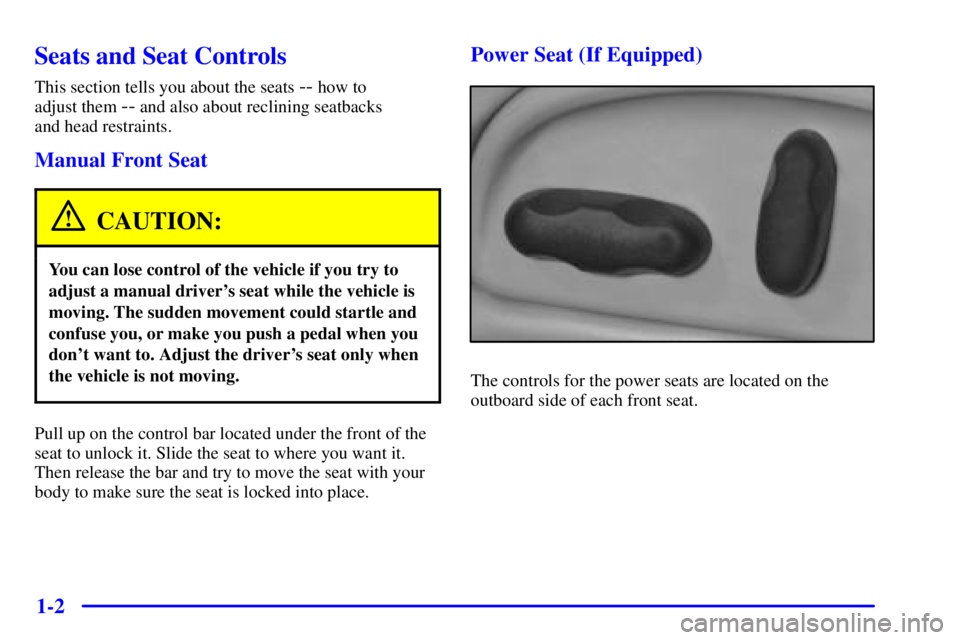
The controls for the power seats are located on the
outboard side of each front seat.
Page 17 of 402
1-5 Heated Front Seats (Option)
This option is only available if your vehicle is equipped
with the power lumbar control.
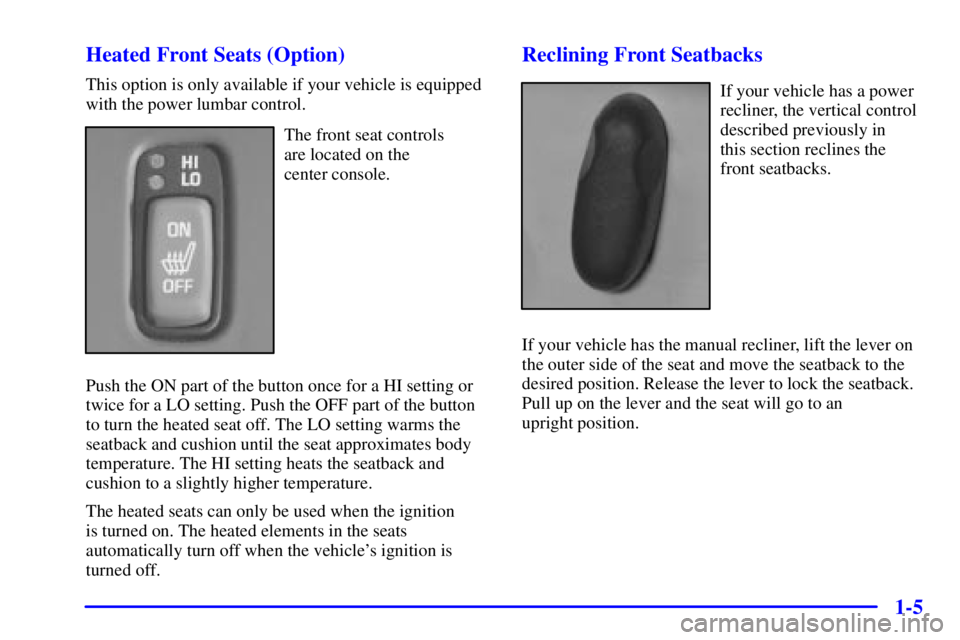
The front seat controls
are located on the
center console.
Push the ON part of the button once for a HI setting or
twice for a LO setting. Push the OFF part of the button
to turn the heated seat off. The LO setting warms the
seatback and cushion until the seat approximates body
temperature. The HI setting heats the seatback and
cushion to a slightly higher temperature.
The heated seats can only be used when the ignition
is turned on. The heated elements in the seats
automatically turn off when the vehicle's ignition is
turned off.
Reclining Front Seatbacks
If your vehicle has a power
recliner, the vertical control
described previously in
this section reclines the
front seatbacks.
If your vehicle has the manual recliner, lift the lever on
the outer side of the seat and move the seatback to the
desired position. Release the lever to lock the seatback.
Pull up on the lever and the seat will go to an
upright position.
Page 25 of 402
1-13 Lap-Shoulder Belt
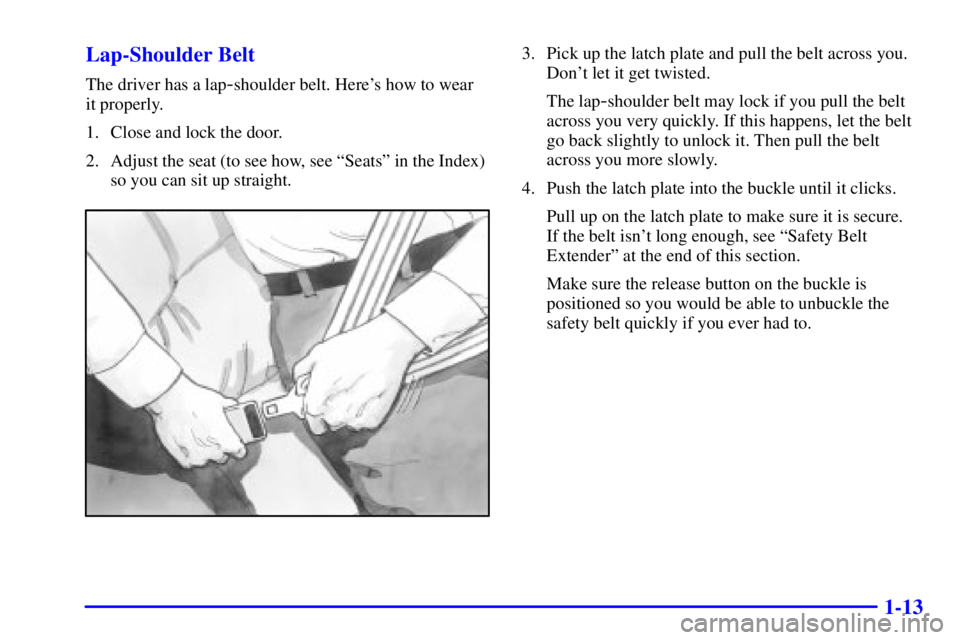
The driver has a lap-shoulder belt. Here's how to wear
it properly.
1. Close and lock the door.
2. Adjust the seat (to see how, see ªSeatsº in the Index)
so you can sit up straight.
3. Pick up the latch plate and pull the belt across you.
Don't let it get twisted.
The lap
-shoulder belt may lock if you pull the belt
across you very quickly. If this happens, let the belt
go back slightly to unlock it. Then pull the belt
across you more slowly.
4. Push the latch plate into the buckle until it clicks.
Pull up on the latch plate to make sure it is secure.
If the belt isn't long enough, see ªSafety Belt
Extenderº at the end of this section.
Make sure the release button on the buckle is
positioned so you would be able to unbuckle the
safety belt quickly if you ever had to.
Page 26 of 402

1-14
The lap part of the belt should be worn low and snug on
the hips, just touching the thighs. In a crash, this applies
force to the strong pelvic bones. And you'd be less
likely to slide under the lap belt. If you slid under it, the
belt would apply force at your abdomen. This could
cause serious or even fatal injuries. The shoulder belt
should go over the shoulder and across the chest.
These parts of the body are best able to take belt
restraining forces.
The safety belt locks if there's a sudden stop or crash,
or if you pull the belt very quickly out of the retractor.
Page 32 of 402
1-20
The best way to protect the fetus is to protect the
mother. When a safety belt is worn properly, it's more
likely that the fetus won't be hurt in a crash. For
pregnant women, as for anyone, the key to making
safety belts effective is wearing them properly.
Right Front Passenger Position
To learn how to wear the right front passenger's
safety belt properly, see ªDriver Positionº earlier in
this section.
The right front passenger's safety belt works the same
way as the driver's safety belt
-- except for one thing.
If you ever pull the lap portion of the belt out all the
way, you will engage the child restraint locking feature.
If this happens, just let the belt go back all the way and
start again.
If your vehicle has a center passenger position,
be sure to use the correct buckle when buckling your
lap
-shoulder belt. If you find that the latch plate will not
go fully into the buckle, see if you are using the buckle
for the center passenger position.
Air Bag Systems
This part explains the frontal and side impact air
bag systems.
Your vehicle has four air bags
-- a frontal air bag for
the driver, another frontal air bag for the right front
passenger, a side impact air bag for the driver, and
another side impact air bag for the right front passenger.
Frontal air bags are designed to help reduce the risk
of injury from the force of an inflating frontal air bag.
But these air bags must inflate very quickly to do their
job and comply with federal regulations.
Here are the most important things to know about the
air bag systems:
Page 37 of 402
1-25
CAUTION:
If something is between an occupant and an
air bag, the bag might not inflate properly or
it might force the object into that person.
The path of an inflating air bag must be kept
clear. Don't put anything between an occupant
and an air bag, and don't attach or put anything
on the steering wheel hub or on or near any other
air bag covering and don't let seat covers block
the inflation path of a side impact air bag.
When should an air bag inflate?
The driver's and right front passenger's frontal air bags
are designed to inflate in moderate to severe frontal or
near
-frontal crashes. The frontal air bags are designed
to inflate only if the impact speed is above the system's
designed ªthreshold level.º If your vehicle goes straight
into a wall that doesn't move or deform, the threshold
level is about 11 to 16 mph (18 to 26 km/h). The
threshold level can vary, however, with specific vehicle design, so that it can be somewhat above or below this
range. If your vehicle strikes something that will move
or deform, such as a parked car, the threshold level
will be higher. The driver's and right front passenger's
frontal air bags are not designed to inflate in rollovers,
side impacts, or rear impacts, because inflation would
not help the occupant.
The side impact air bags are designed to inflate in
moderate to severe side crashes. A side impact air bag
will inflate if the crash severity is above the system's
designed ªthreshold level.º The threshold level can vary
with specific vehicle design. Side impact air bags are not
designed to inflate in frontal or near
-frontal impacts,
rollovers or rear impacts, because inflation would not
help the occupant. A side impact air bag will only
deploy on the side of the vehicle that is struck.
In any particular crash, no one can say whether an air
bag should have inflated simply because of the damage
to a vehicle or because of what the repair costs were.
For frontal air bags, inflation is determined by the angle
of the impact and how quickly the vehicle slows down
in frontal and near
-frontal impacts. For side impact
air bags, inflation is determined by the location and
severity of the impact.