lock PONTIAC BONNEVILLE 2002 Owners Manual
[x] Cancel search | Manufacturer: PONTIAC, Model Year: 2002, Model line: BONNEVILLE, Model: PONTIAC BONNEVILLE 2002Pages: 427, PDF Size: 2.78 MB
Page 8 of 427
1-2
Seats and Seat Controls
This section tells you about the seats -- how to adjust
them
-- and also about reclining seatbacks and the
head restraints.
Manual Front Seat
CAUTION:
You can lose control of the vehicle if you try to
adjust a manual driver's seat while the vehicle is
moving. The sudden movement could startle and
confuse you, or make you push a pedal when you
don't want to. Adjust the driver's seat only when
the vehicle is not moving.
Pull up on the control bar located under the front of the
seat to unlock it. Slide the seat to where you want it and
then release the bar. Try to move the seat with your body
to make sure the seat is locked into place.
Manual Lumbar Support
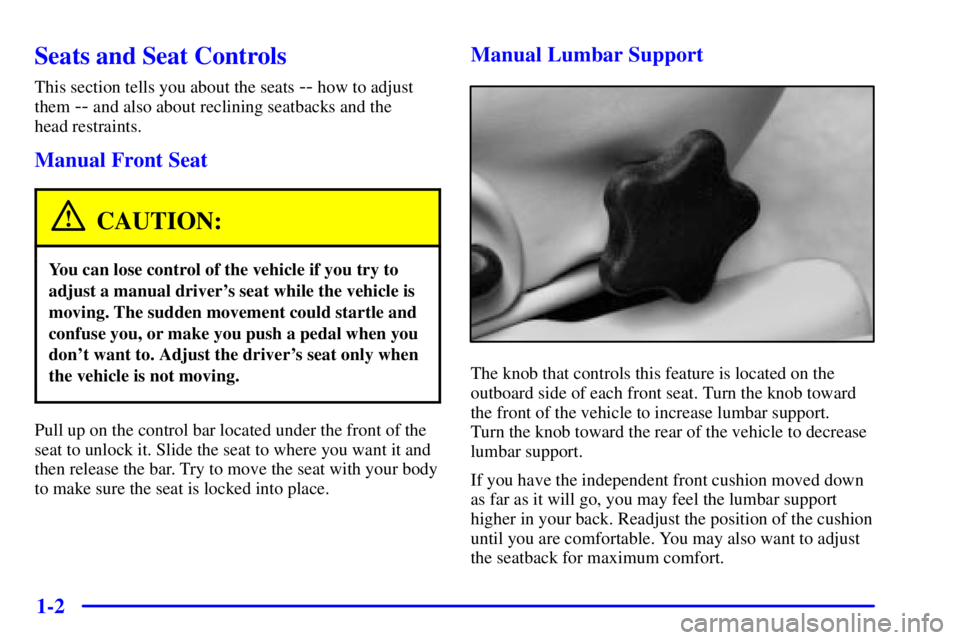
The knob that controls this feature is located on the
outboard side of each front seat. Turn the knob toward
the front of the vehicle to increase lumbar support.
Turn the knob toward the rear of the vehicle to decrease
lumbar support.
If you have the independent front cushion moved down
as far as it will go, you may feel the lumbar support
higher in your back. Readjust the position of the cushion
until you are comfortable. You may also want to adjust
the seatback for maximum comfort.
Page 11 of 427
1-5
Mirror and lumbar positions will not be stored or
recalled for the exit position.
To recall your memory positions, your vehicle must
be in PARK (P). Push and release the memory
button (1 or 2) corresponding to the desired driving
position. The seat and mirrors will move to the position
previously stored for the identified driver. You will hear
one beep.
To recall the exit position, your vehicle must be in
PARK (P). Push and release the EXIT button and the
seat will move to the exit position previously stored for
the currently identified driver. You will hear one beep.
If an exit position has not been stored for the currently
identified driver, the seat will move all the way back.
To stop recall movement of the seat at any time, press
the power seat control located on the outboard side of
the driver's front seat.
If you would like your stored driving or exit position
to be recalled when unlocking your vehicle with the
transmitter, see ªDIC Personalization Programmingº
in the Index.Heated Front Seats (Option)
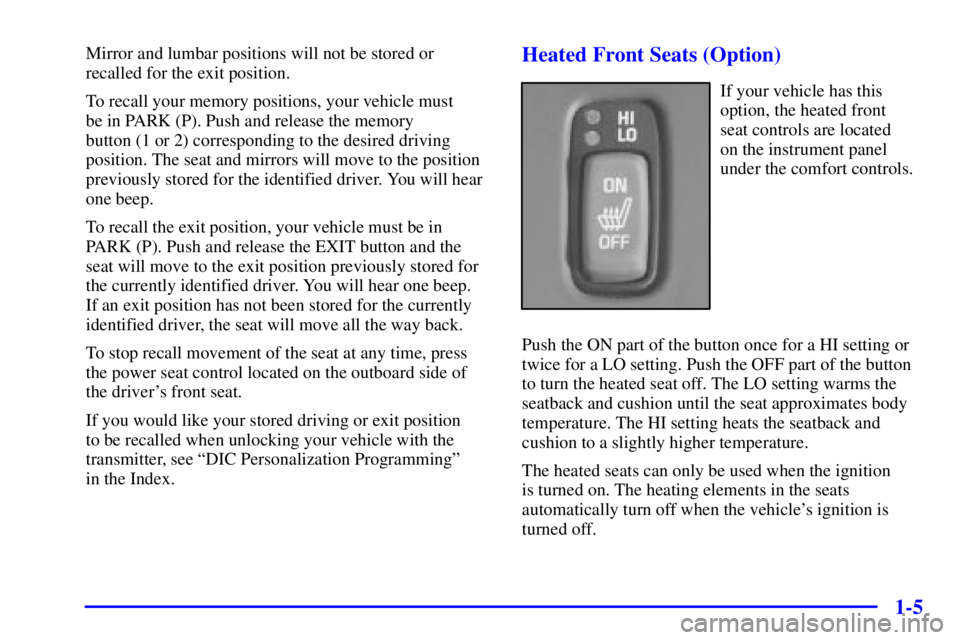
If your vehicle has this
option, the heated front
seat controls are located
on the instrument panel
under the comfort controls.
Push the ON part of the button once for a HI setting or
twice for a LO setting. Push the OFF part of the button
to turn the heated seat off. The LO setting warms the
seatback and cushion until the seat approximates body
temperature. The HI setting heats the seatback and
cushion to a slightly higher temperature.
The heated seats can only be used when the ignition
is turned on. The heating elements in the seats
automatically turn off when the vehicle's ignition is
turned off.
Page 12 of 427
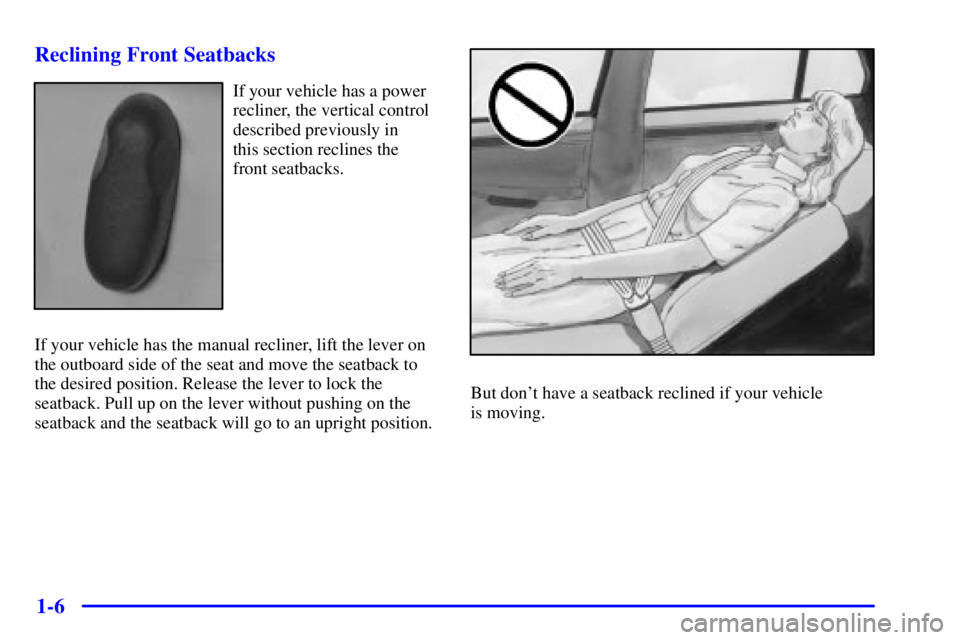
1-6 Reclining Front Seatbacks
If your vehicle has a power
recliner, the vertical control
described previously in
this section reclines the
front seatbacks.
If your vehicle has the manual recliner, lift the lever on
the outboard side of the seat and move the seatback to
the desired position. Release the lever to lock the
seatback. Pull up on the lever without pushing on the
seatback and the seatback will go to an upright position.
But don't have a seatback reclined if your vehicle
is moving.
Page 20 of 427
1-14
How to Wear Safety Belts Properly
Adults
This part is only for people of adult size.
Be aware that there are special things to know
about safety belts and children. And there are
different rules for smaller children and babies. If a
child will be riding in your vehicle, see the part of this
manual called ªChildren.º Follow those rules for
everyone's protection.
First, you'll want to know which restraint systems your
vehicle has.
We'll start with the driver position.
Driver Position
This part describes the driver's restraint system.
Lap-Shoulder Belt
The driver has a lap-shoulder belt. Here's how to wear
it properly.
1. Close and lock the door.
2. Adjust the seat so you can sit up straight.
To see how, see ªSeatsº in the Index.
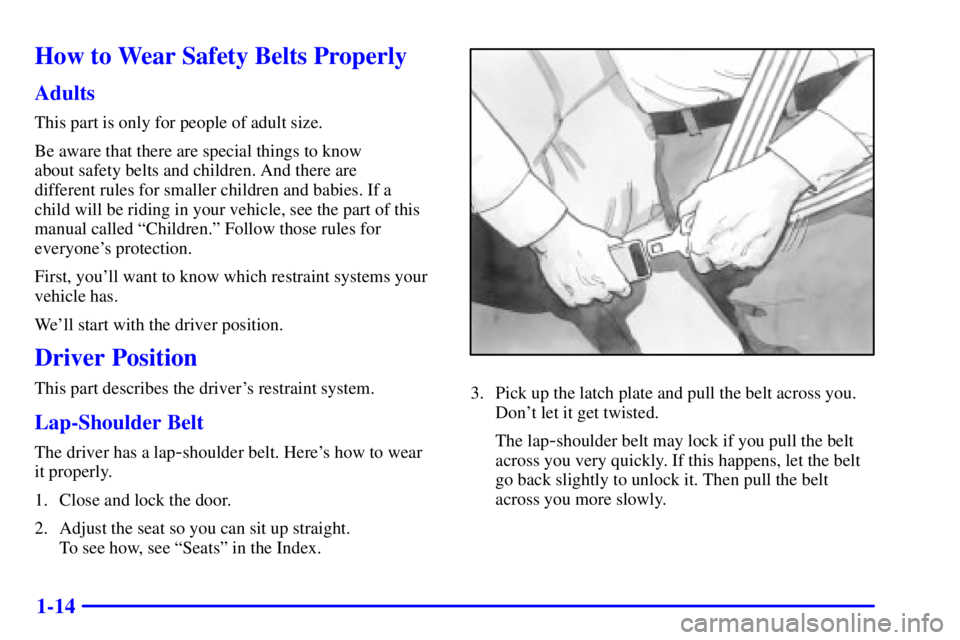
3. Pick up the latch plate and pull the belt across you.
Don't let it get twisted.
The lap
-shoulder belt may lock if you pull the belt
across you very quickly. If this happens, let the belt
go back slightly to unlock it. Then pull the belt
across you more slowly.
Page 21 of 427

1-15
4. Push the latch plate into the buckle until it clicks.
Pull up on the latch plate to make sure it is secure.
If the belt isn't long enough, see ªSafety Belt
Extenderº at the end of this section.
Make sure the release button on the buckle is
positioned so you would be able to unbuckle the
safety belt quickly if you ever had to.The lap part of the belt should be worn low and snug on
the hips, just touching the thighs. In a crash, this applies
force to the strong pelvic bones. And you'd be less
likely to slide under the lap belt. If you slid under it, the
belt would apply force at your abdomen. This could
cause serious or even fatal injuries. The shoulder belt
should go over the shoulder and across the chest.
These parts of the body are best able to take belt
restraining forces.
The safety belt locks if there's a sudden stop or crash,
or if you pull the belt very quickly out of the retractor.
Page 27 of 427
1-21
The best way to protect the fetus is to protect the
mother. When a safety belt is worn properly, it's more
likely that the fetus won't be hurt in a crash. For
pregnant women, as for anyone, the key to making
safety belts effective is wearing them properly.
Right Front Passenger Position
To learn how to wear the right front passenger's safety belt
properly, see ªDriver Positionº earlier in this section.
The right front passenger's safety belt works the same
way as the driver's safety belt
-- except for one thing.
If you ever pull the lap portion of the belt out all the
way, you will engage the child restraint locking feature.
If this happens, just let the belt go back all the way and
start again.
If your vehicle has a center passenger position,
be sure to use the correct buckle when buckling your
lap
-shoulder belt. If you find that the latch plate will not
go fully into the buckle, see if you are using the buckle
for the center passenger position.
Air Bag Systems
This part explains the frontal and side impact air
bag systems.
Your vehicle has four air bags
-- a frontal air bag for
the driver, another frontal air bag for the right front
passenger, a side impact air bag for the driver, and
another side impact air bag for the right front passenger.
Frontal air bags are designed to help reduce the risk
of injury from the force of an inflating frontal air bag.
But these air bags must inflate very quickly to do their
job and comply with federal regulations.
Page 32 of 427
1-26
CAUTION:
If something is between an occupant and an air
bag, the bag might not inflate properly or it
might force the object into that person causing
severe injury or even death. The path of an
inflating air bag must be kept clear. Don't put
anything between an occupant and an air bag,
and don't attach or put anything on the steering
wheel hub or on or near any other air bag
covering. Don't let seat covers block the inflation
path of a side impact air bag.
When should an air bag inflate?
The driver's and right front passenger's frontal air bags
are designed to inflate in moderate to severe frontal or
near
-frontal crashes. But they are designed to inflate
only if the impact speed is above the system's designed
ªthreshold level.º
In addition, your vehicle has ªdual stageº frontal air
bags, which adjust the amount of restraint according to
crash severity. For moderate frontal impacts, these air
bags inflate at a level less than full deployment.For more severe frontal impacts, full deployment occurs.
If the front of your vehicle goes straight into a wall
that doesn't move or deform, the threshold level
for the reduced deployment is about 10 to 16 mph
(18 to 26 km/h), and the threshold level for a full
deployment is about 18 to 24 mph (29 to 38.5 km/h).
The threshold level can vary, however, with specific
vehicle design, so that it can be somewhat above or
below this range.
If your vehicle strikes something that will move or
deform, such as a parked car, the threshold level will be
higher. The driver's and right front passenger's frontal
air bags are not designed to inflate in rollovers, rear
impacts, or in many side impacts because inflation
would not help the occupant.
The side impact air bags are designed to inflate in
moderate to severe side crashes. A side impact air bag
will inflate if the crash severity is above the system's
designed ªthreshold level.º The threshold level can vary
with specific vehicle design. Side impact air bags are not
designed to inflate in frontal or near-frontal impacts,
rollovers or rear impacts, because inflation would not
help the occupant. A side impact air bag will only
deploy on the side of the vehicle that is struck.
Page 34 of 427
1-28
What will you see after an air bag inflates?
After an air bag inflates, it quickly deflates, so quickly
that some people may not even realize the air bag
inflated. Some components of the air bag module
-- the
steering wheel hub for the driver's air bag, the
instrument panel for the right front passenger's bag, the
side of the seatback closest to the door for the driver and
right front passenger's side impact air bags
-- will be
hot for a short time. The parts of the bag that come into
contact with you may be warm, but not too hot to touch.
There will be some smoke and dust coming from the
vents in the deflated air bags. Air bag inflation doesn't
prevent the driver from seeing or being able to steer the
vehicle, nor does it stop people from leaving the vehicle.
CAUTION:
When an air bag inflates, there is dust in the
air. This dust could cause breathing problems
for people with a history of asthma or other
breathing trouble. To avoid this, everyone in the
vehicle should get out as soon as it is safe to do so.
If you have breathing problems but can't get out
of the vehicle after an air bag inflates, then get
fresh air by opening a window or a door.
Your vehicle has a feature that will automatically unlock
the doors and turn the interior lamps on when the air
bags inflate (if battery power is available). You can lock
the doors again and turn the interior lamps off by using
the door lock and interior lamp controls.
Page 38 of 427
1-32
Rear Seat Passengers
It's very important for rear seat passengers to buckle up!
Accident statistics show that unbelted people in the rear
seat are hurt more often in crashes than those who are
wearing safety belts.
Rear passengers who aren't safety belted can be thrown
out of the vehicle in a crash. And they can strike others
in the vehicle who are wearing safety belts.
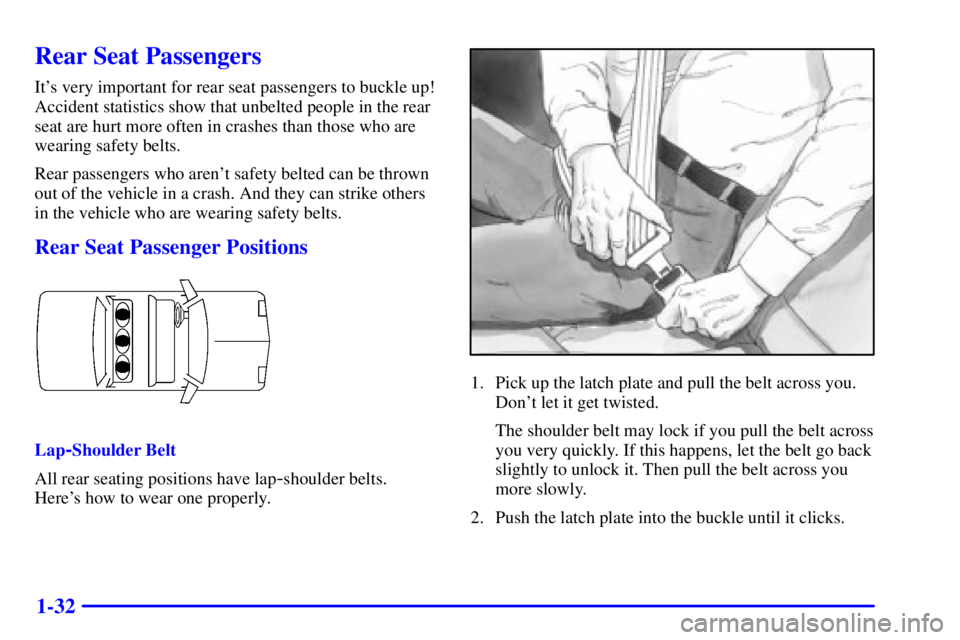
Rear Seat Passenger Positions
Lap-Shoulder Belt
All rear seating positions have lap
-shoulder belts.
Here's how to wear one properly.
1. Pick up the latch plate and pull the belt across you.
Don't let it get twisted.
The shoulder belt may lock if you pull the belt across
you very quickly. If this happens, let the belt go back
slightly to unlock it. Then pull the belt across you
more slowly.
2. Push the latch plate into the buckle until it clicks.
Page 40 of 427
1-34
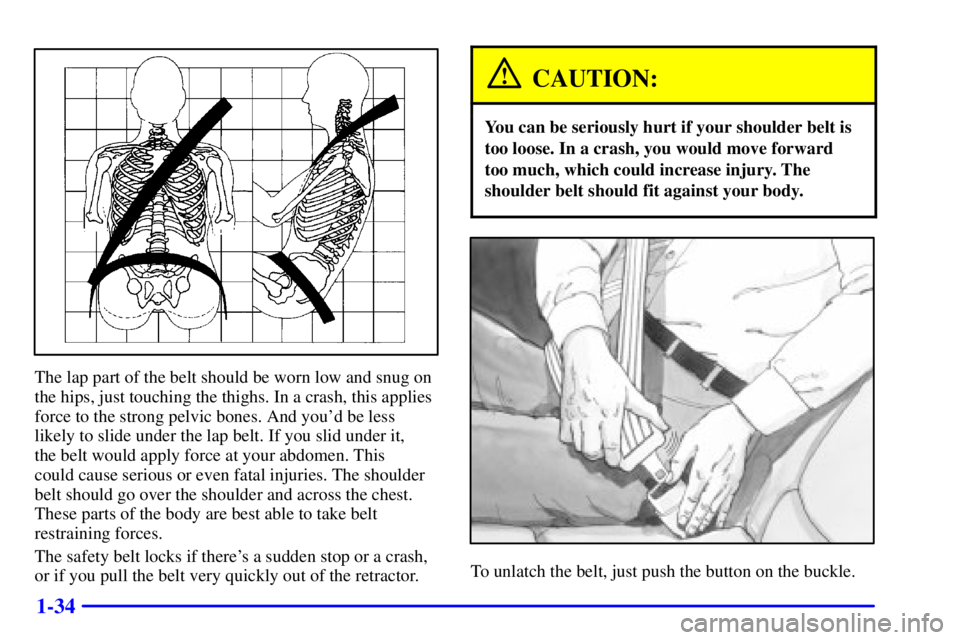
The lap part of the belt should be worn low and snug on
the hips, just touching the thighs. In a crash, this applies
force to the strong pelvic bones. And you'd be less
likely to slide under the lap belt. If you slid under it,
the belt would apply force at your abdomen. This
could cause serious or even fatal injuries. The shoulder
belt should go over the shoulder and across the chest.
These parts of the body are best able to take belt
restraining forces.
The safety belt locks if there's a sudden stop or a crash,
or if you pull the belt very quickly out of the retractor.
CAUTION:
You can be seriously hurt if your shoulder belt is
too loose. In a crash, you would move forward
too much, which could increase injury. The
shoulder belt should fit against your body.
To unlatch the belt, just push the button on the buckle.