child seat PONTIAC BONNEVILLE 2003 User Guide
[x] Cancel search | Manufacturer: PONTIAC, Model Year: 2003, Model line: BONNEVILLE, Model: PONTIAC BONNEVILLE 2003Pages: 418, PDF Size: 20.24 MB
Page 41 of 418
r
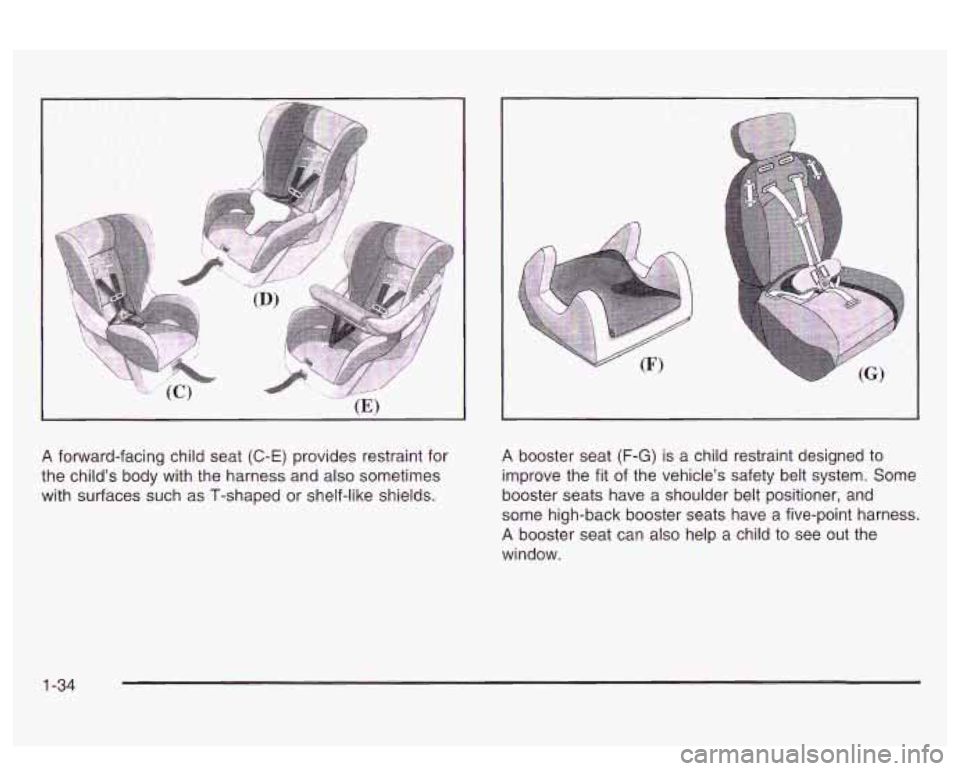
A forward-facing child seat (C-E) provides restraint for
the child's body with the harness and also sometimes
with surfaces such as T-shaped or shelf-like shields. A booster seat (F-G) is a child restraint designed to
improve the fit
of the vehicle's safety belt system. Some
booster seats have a shoulder belt positioner, and
some high-back booster seats have a five-point harness.
A booster seat can also help a child to see out the
window.
1 -34
Page 42 of 418
Q: How do child restraints work?
A: A child restraint system is any device designed for
use in a motor vehicle to restrain, seat, or position
children.
A built-in child restraint system is a
permanent part of the motor vehicle. An add-on
child restraint system is a portable one, which
is purchased by the vehicle’s owner.
For many years, add-on child restraints have used
the adult belt system in the vehicle. To help
reduce the chance of injury, the child also has to be
secured within the restraint. The vehicle’s belt
system secures the add-on child restraint in the
vehicle, and the add-on child restraint’s harness
system holds the child in place within the restraint.
One system, the three-point harness, has straps
that come down over each of the infant’s shoulders
and buckle together at the crotch. The five-point
harness system has two shoulder straps, two
hip straps and a crotch strap.
A shield may take the
p!aw of hi? straps. A T-shaped shield has
shoulder straps that are attached to a flat pad
which rests low against the child’s body.
A shelf- or
armrest-type shield has straps that are attached
to a wide, shelf-like shield that swings up or to
~ ~~~ ~ the side. ~~~~~~~~~~~~~~
~~~ ~ ~
When choosing a child restraint, be sure the child
restraint is designed to be used in a vehicle.
If it is,
it will have a label saying that it meets federal motor
vehicle safety standards.
Then follow the instructions for the restraint. You may
find these instructions on the restraint itself or in a
booklet, or both. These restraints use the belt system in
your vehicle, but the child also has to be secured
within the restraint to help reduce the chance of personal
injury. When securing an add-on child restraint, refer
to the instructions that come with the restraint which may
be on the restraint itself or in a booklet, or both, and
to this manual. The child restraint instructions are
important,
so if they are not available, obtain a
replacement copy from the manufacturer.
1-35
Page 43 of 418

Where to Put the Restraint
Accident statistics show that children are safer if they
are restrained in the rear rather than the front seat.
General Motors, therefore, recommends that child
restraints be secured in
a rear seat, including an infant
riding in a rear-facing infant seat, a child riding in a
forward-facing child seat and an older child riding in a
booster seat.
Never put a rear-facing child restraint
in the front passenger seat. Here’s why:
CAUT’3N:
A child in a rear-facing child restraint can be
seriously injured or killed
if the right front
passenger’s air bag inflates. This
is because
the back of the rear-facing child restraint
would be very close to the inflating air bag.
Always secure a rear-facing child restraint
in a
rear seat.
You may secure a forward-facing child restraint
in the right front seat, but before you
do, always move the front passenger seat as
far back
as it will go. It’s better to secure the
child restraint
in a rear seat.
A child in a child restraint in the center front
seat can be badly injured or killed by the right
front passenger’s air bag if
it inflates. Never
secure a child restraint in the center front seat.
It’s always better to secure a child restraint in
the rear seat. You may secure a forward-facing
child restraint
in the right front passenger seat,
but before you do, always move the front
passenger seat as far back as
it will go. It’s
better to secure the child restraint in a
rear seat.
Wherever you install it, be sure to secure the child
restraint properly.
Keep in mind that an unsecured child restraint can
move around in a collision or sudden stop and injure
people in the vehicle. Be sure to properly secure
any child restraint in your vehicle
- even when no child
is in it.
1-36
Page 45 of 418

Anchor the top strap to one of the following anchor
points. Be sure to use an anchor point located on the
same side of the vehicle as the seating position
where the child restraint will be placed.
Once you have the top strap anchored, you’ll be ready
to secure the child restraint itself. Tighten the top
strap when and as the child restraint manufacturer’s
instructions say. Top Strap Anchor Location
Your vehicle has top strap anchors already installed for
the rear seating positions. You’ll find them behind
the rear seat on the filler panel.
In order to get to
a bracket, you’ll have to open the
trim cover.
1-38
Page 46 of 418

Lower Anchorages and Top Tethers
for Children (LATCH System)
Your vehicle has the LATCH system. You’ll find
anchors
(A) in all three rear seat positions.
To assist you in locating
the lower anchors for this
child restraint system,
each seating position with
the LATCH system will
have a label sewn into the
seatback at each anchor
point. In
order to use the system, you need either a
forward-facing child restraint that has attaching
points
(B) at its base and a top tether anchor (C), or a
rear-facing child restraint that has attaching points
(B),
as shown here.
1 -39
Page 47 of 418

If a LATCH-type lild restrair ‘t attached to
its anchorage points, the restraint won’t be
able to protect a child sitting there.
In a crash,
the child could be seriously injured or killed. Make sure that a LATCH-type child restraint
is
properly installed using the anchorage points,
or use the vehicle’s safety belts to secure the restraint. See “Securing a Child Restraint
Designed for the LATCH System’’ or “Securing
a Child Restraint in a Rear Seat Position”
in
the Index for information on how to secure a
child restraint
in your vehicle.
With this system, use the
LATCH system instead of the
vehicle’s safety belts to secure
a child restraint.
1-40
Page 48 of 418

Securing a Child Restraint Designed
for the LATCH System
1. Find the anchors for the seating position you want
to use, where the bottom of the seatback meets the
back of the seat cushion.
2. Put the child restraint on the seat.
3. Attach the anchor points on the child restraint to the
anchors in the vehicle. The child restraint
instructions will show you how.
4. If the child restraint is forward-facing, attach the top
strap to the top strap anchor. See
Top Strap on
page 1-37.
Tighten the top strap according to
the child restraint instructions.
5. Push and pull the child restraint in different
directions to be sure it is secure.
Securing a Child Restraint in a Rear
Seat Position
If your child restraint is equipped with the LATCH
system, see
Lower Anchorages and Top Tethers for
Children (LATCH System) on page 1-39.
To remove the child restraint, simply unhook the top
strap frnm the top tether anchor and then disconnect the
anchor points.
1-41
Page 49 of 418

A child in a child restraint in the center front
seat can be badly injured or killed by the right
front passenger’s air bag if
it inflates. Never
secure a child restraint
in the center front seat.
It’s always better to secure a child restraint in
the rear seat. You may secure a forward-facing
child restraint
in the right front passenger seat,
but before you do, always move the front
passenger seat as far back
as it will go. It’s
better to secure the child restraint in a rear
seat.
You’ll be using the lap-shoulder belt. See
Top Strap on
page 1-37 if the child restraint has one. Be sure to
follow the instructions that came with the child restraint.
Secure the child in the child restraint when and as
the instructions say.
1. Put the restraint on the seat.
2. Pick up the latch plate, and run the lap and shoulder
portions of the vehicle’s safety belt through or
around the restraint. The child restraint instructions
will show you how. Tilt the
latch plate to adjust the belt
if needed.
1-42
Page 51 of 418

Securing a Child Restraint in the
Right Front Seat Position
Your vehicle has a right front passenger air bag.
Never put a rear facing child restraint in this seat.
t e’s why:
A child in a rear-facing child restraint can be
seriously injured or killed if the right front passenger’s air bag inflates. This is because
the back
of the rear-facing child restraint
would be very close to the inflating air bag. Always secure
a rear-facing child restraint in a
rear seat.
Although a rear seat is a safer place, you can secure a
forward-facing child restraint in the right front seat.
You’ll be using the lap-shoulder belt. See
Top Strap on
page 1-37 if the child restraint has one. Be sure to
follow the instructions that came with the child restraint.
Secure the child
in the child restraint when and as
the instructions say.
1. Because your vehicle has a right front passenger
air bag, always move the seat as far back as it will
go before securing a forward-facing child restraint.
See
Power Seats on page 1-2.
2. Put the restraint on the seat.
3. Pick up the latch plate, and run the lap and shoulder
portions of the vehicle’s safety belt through or
around the restraint. The child restraint instructions
will show you how.
1-44
Page 80 of 418
Overriding Lock Delay
If you need to lock your doors before shifting out of
PARK (P), just use the manual door lock or the power
door lock switch to lock the doors.
Rear Door Security Locks
I
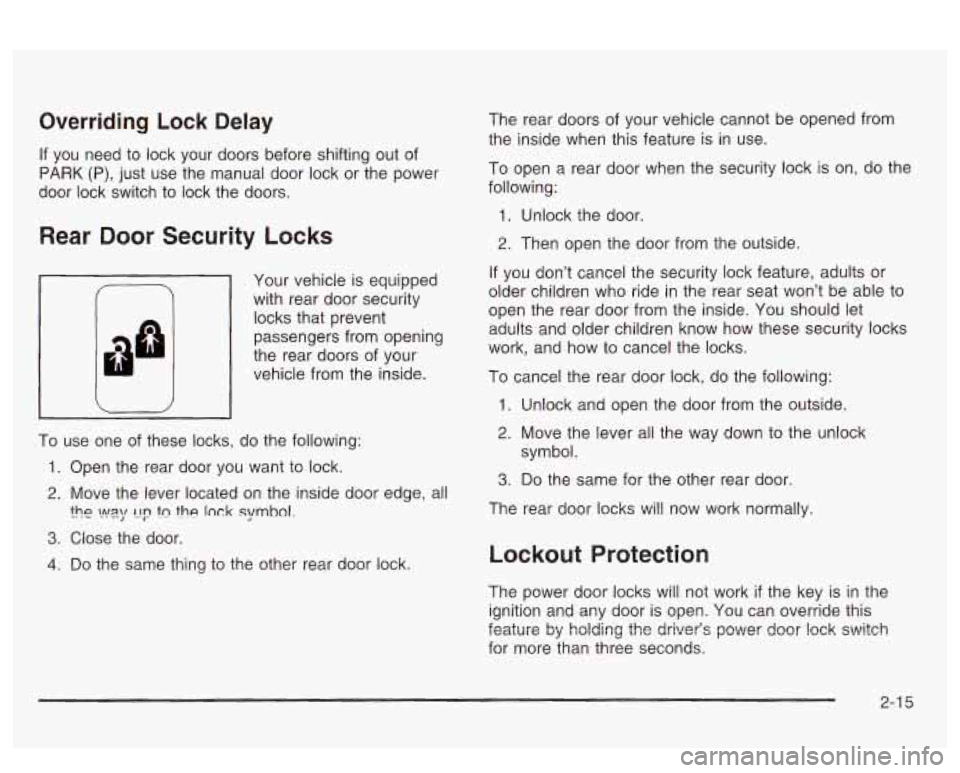
Your vehicle is equipped
with rear door security
locks that prevent
passengers from opening
the rear doors of your
vehicle from the inside.
To use one of these locks, do the following:
1. Open the rear door you want to lock.
2. Move the lever located on the inside door edge, all
3. Close the door.
?he vyq 1-19 tn the lnck symhol.
4. Do the same thing to the other rear door lock. The
rear doors of your vehicle cannot be opened from
the inside when this feature is in use.
To open a rear door when the security lock is on, do the
following:
1. Unlock the door.
2. Then open the door from the outside.
If you don’t cancel the security lock feature, adults or
older children who ride
in the rear seat won’t be able to
open the rear door from the inside. You should let
adults and older children know how these security locks
work, and how to cancel the locks.
To cancel the rear door lock, do the following:
1. Unlock and open the door from the outside.
2. Move the lever all the way down to the unlock
3. Do the same for the other rear door.
symbol.
The rear door locks will now work normally.
Lockout Protection
The power door locks will not work if the key is in the
ignition and any door is open. You can override this
for more than three seconds.
Fnr.+, It;arul& ,r bj holdi~g the driver’s newer IJ deer !ock ssvitch
2-1 5