ignition PONTIAC BONNEVILLE 2004 Owners Manual
[x] Cancel search | Manufacturer: PONTIAC, Model Year: 2004, Model line: BONNEVILLE, Model: PONTIAC BONNEVILLE 2004Pages: 446, PDF Size: 2.81 MB
Page 11 of 446
Heated Seats
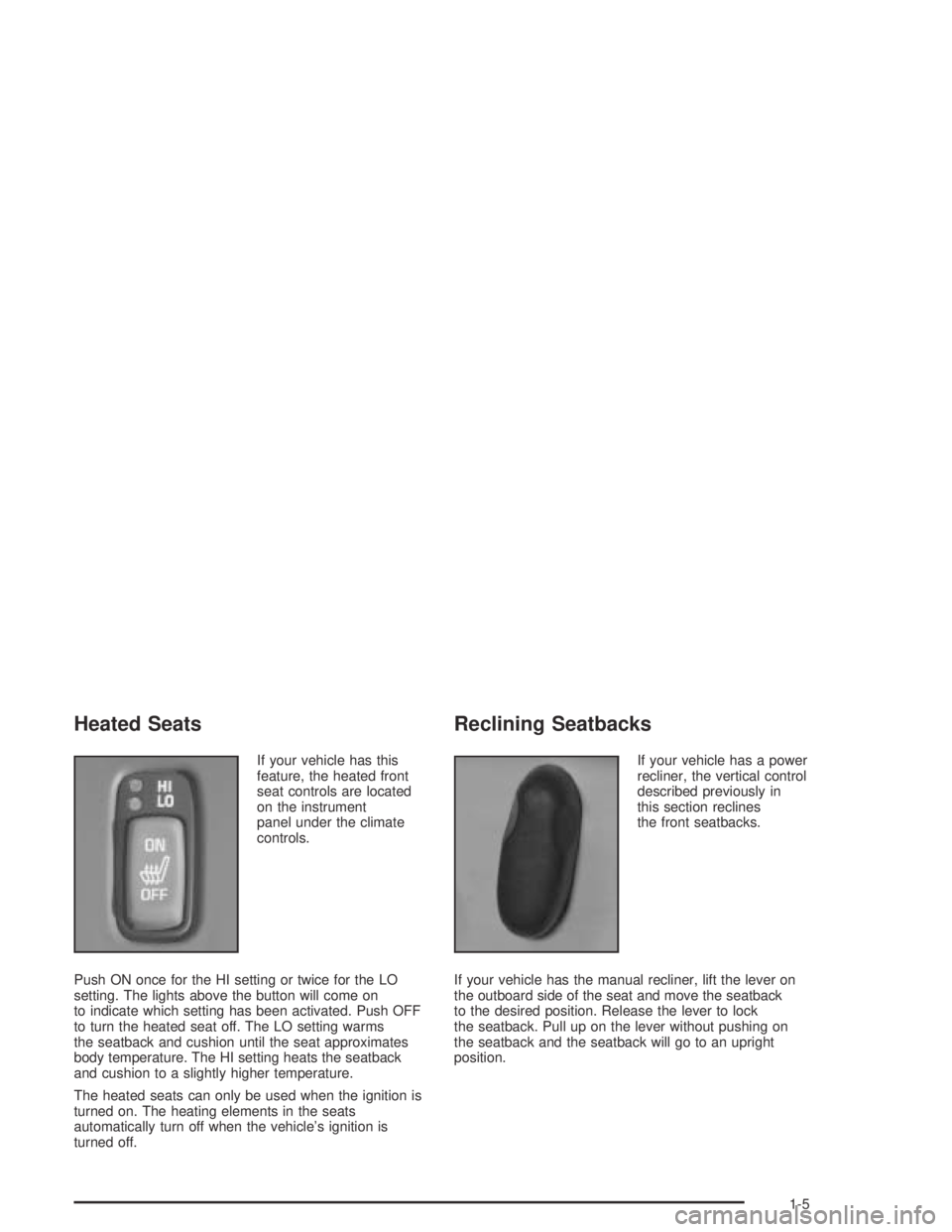
If your vehicle has this
feature, the heated front
seat controls are located
on the instrument
panel under the climate
controls.
Push ON once for the HI setting or twice for the LO
setting. The lights above the button will come on
to indicate which setting has been activated. Push OFF
to turn the heated seat off. The LO setting warms
the seatback and cushion until the seat approximates
body temperature. The HI setting heats the seatback
and cushion to a slightly higher temperature.
The heated seats can only be used when the ignition is
turned on. The heating elements in the seats
automatically turn off when the vehicle’s ignition is
turned off.
Reclining Seatbacks
If your vehicle has a power
recliner, the vertical control
described previously in
this section reclines
the front seatbacks.
If your vehicle has the manual recliner, lift the lever on
the outboard side of the seat and move the seatback
to the desired position. Release the lever to lock
the seatback. Pull up on the lever without pushing on
the seatback and the seatback will go to an upright
position.
1-5
Page 66 of 446

Servicing Your Air Bag-Equipped
Vehicle
Air bags affect how your vehicle should be serviced.
There are parts of the air bag systems in several places
around your vehicle. Your dealer and the service manual
have information about servicing your vehicle and the air
bag systems. To purchase a service manual, seeService
Publications Ordering Information on page 7-12.
{CAUTION:
For up to 10 seconds after the ignition key is
turned off and the battery is disconnected, an
air bag can still inate during improper
service. You can be injured if you are close to
an air bag when it inates. Avoid yellow
connectors. They are probably part of the air
bag system. Be sure to follow proper service
procedures, and make sure the person
performing work for you is qualied to do so.
The air bag systems do not need regular maintenance.
Restraint System Check
Checking Your Restraint Systems
Now and then, make sure the safety belt reminder light
and all your belts, buckles, latch plates, retractors
and anchorages are working properly. Look for any other
loose or damaged safety belt system parts. If you see
anything that might keep a safety belt system from doing
its job, have it repaired.
Torn or frayed safety belts may not protect you in a
crash. They can rip apart under impact forces. If a belt
is torn or frayed, get a new one right away.
Also look for any opened or broken air bag covers, and
have them repaired or replaced. (The air bag system
does not need regular maintenance.)
1-60
Page 69 of 446
Keys...............................................................2-3
Remote Keyless Entry System.........................2-5
Remote Keyless Entry System Operation...........2-6
Doors and Locks............................................2-10
Door Locks..................................................2-10
Central Door Unlocking System......................2-11
Power Door Locks........................................2-11
Delayed Locking...........................................2-12
Programmable Automatic Door Locks..............2-13
Rear Door Security Locks..............................2-15
Lockout Protection........................................2-16
Leaving Your Vehicle....................................2-16
Trunk..........................................................2-16
Windows........................................................2-19
Power Windows............................................2-20
Sun Visors...................................................2-21
Theft-Deterrent Systems..................................2-21
Universal Theft-Deterrent...............................2-21
Content Theft-Deterrent.................................2-22
PASS-Key
®III ..............................................2-23
PASS-Key®III Operation...............................2-23Starting and Operating Your Vehicle................2-25
New Vehicle Break-In....................................2-25
Ignition Positions..........................................2-26
Starting Your Engine.....................................2-27
Engine Coolant Heater..................................2-28
Automatic Transaxle Operation.......................2-29
Parking Brake..............................................2-32
Shifting Into Park (P).....................................2-33
Shifting Out of Park (P).................................2-36
Parking Over Things That Burn.......................2-36
Engine Exhaust............................................2-37
Running Your Engine While You Are Parked.......2-38
Mirrors...........................................................2-39
Manual Rearview Mirror.................................2-39
Automatic Dimming Rearview Mirror................2-39
Outside Power Mirrors...................................2-40
Outside Curb View Assist Mirror.....................2-41
Outside Convex Mirror...................................2-41
Outside Heated Mirrors..................................2-41
OnStar
®System.............................................2-42
HomeLink®Transmitter...................................2-44
Programming the HomeLink®Transmitter.........2-45
Section 2 Features and Controls
2-1
Page 71 of 446
Keys
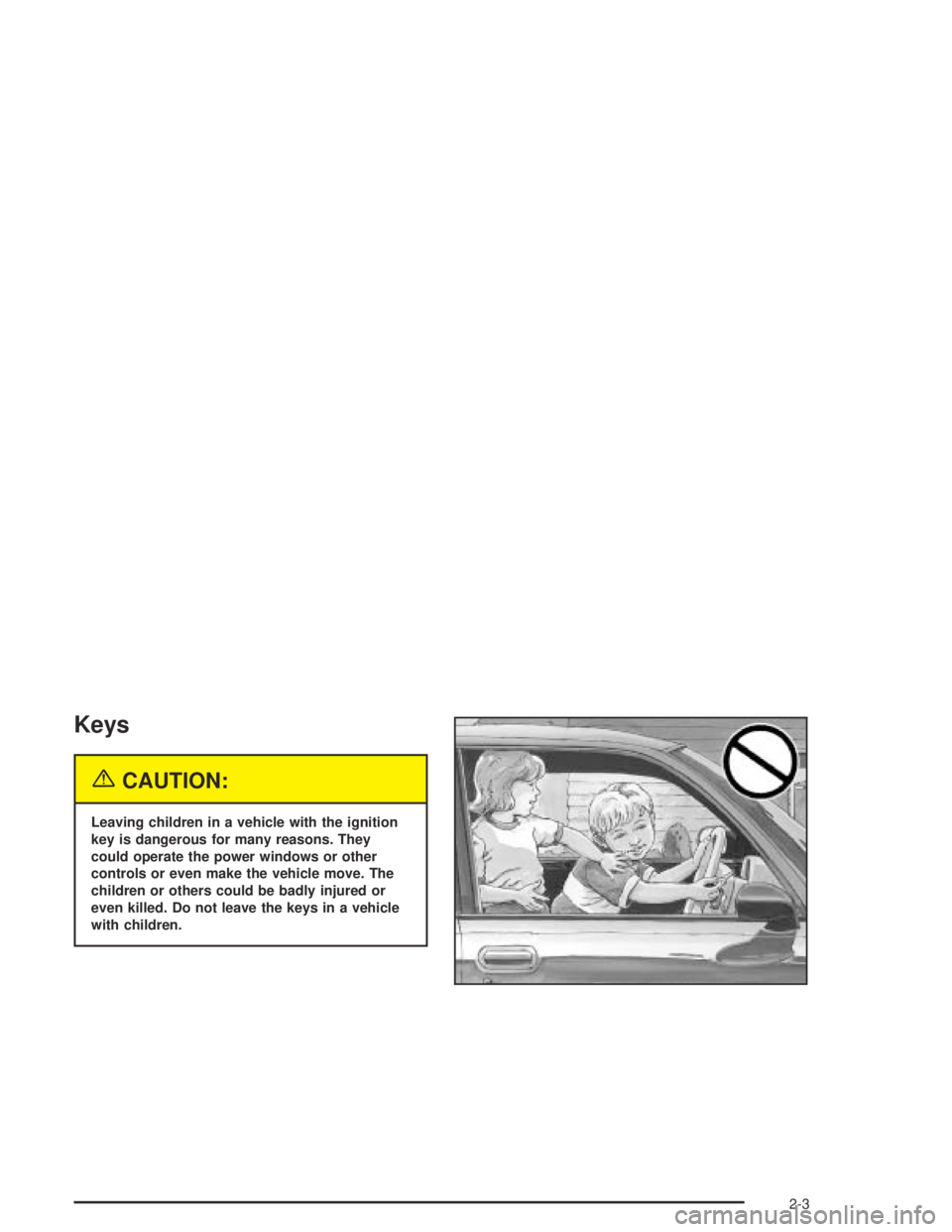
{CAUTION:
Leaving children in a vehicle with the ignition
key is dangerous for many reasons. They
could operate the power windows or other
controls or even make the vehicle move. The
children or others could be badly injured or
even killed. Do not leave the keys in a vehicle
with children.
2-3
Page 72 of 446
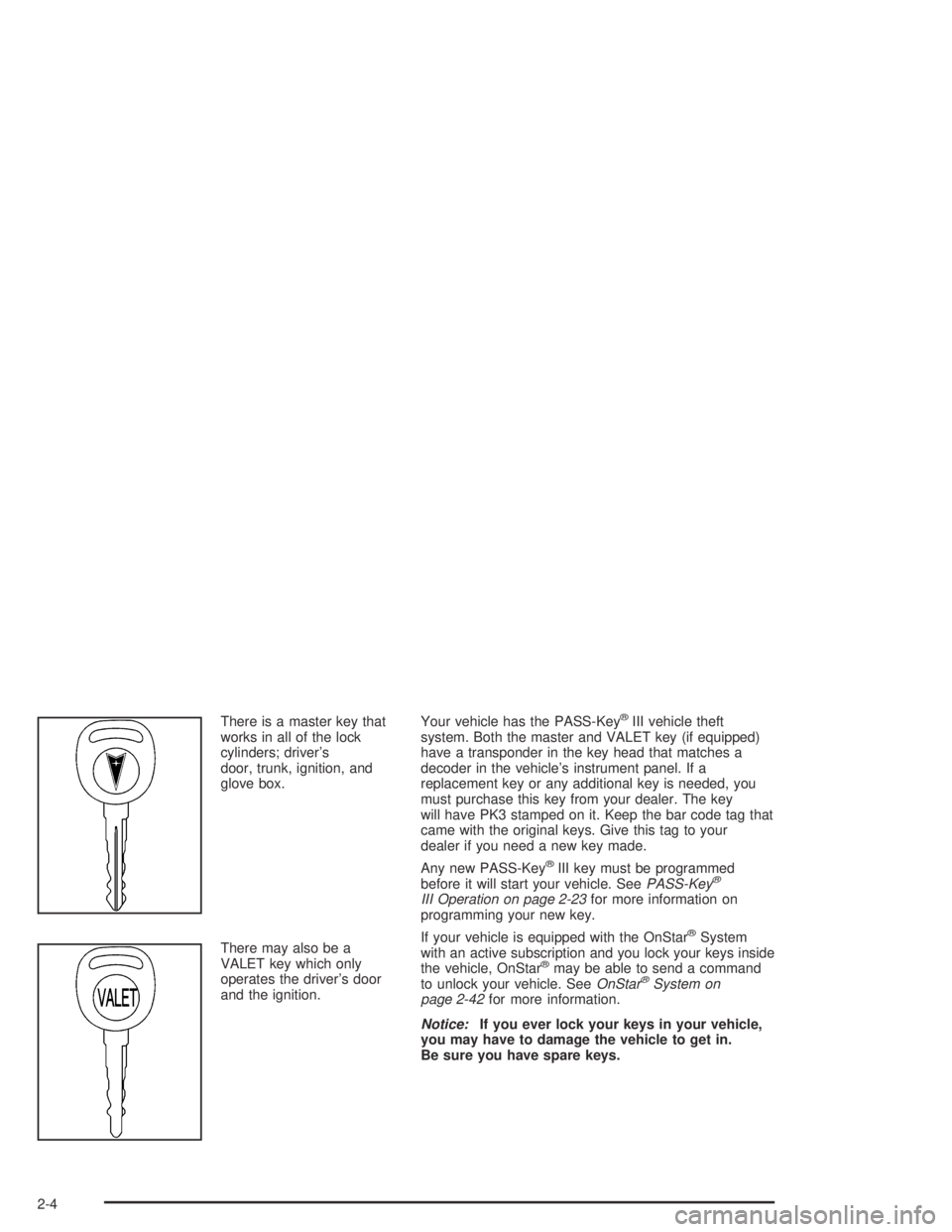
There is a master key that
works in all of the lock
cylinders; driver’s
door, trunk, ignition, and
glove box.
There may also be a
VALET key which only
operates the driver’s door
and the ignition.Your vehicle has the PASS-Key®III vehicle theft
system. Both the master and VALET key (if equipped)
have a transponder in the key head that matches a
decoder in the vehicle’s instrument panel. If a
replacement key or any additional key is needed, you
must purchase this key from your dealer. The key
will have PK3 stamped on it. Keep the bar code tag that
came with the original keys. Give this tag to your
dealer if you need a new key made.
Any new PASS-Key
®III key must be programmed
before it will start your vehicle. SeePASS-Key®
III Operation on page 2-23for more information on
programming your new key.
If your vehicle is equipped with the OnStar
®System
with an active subscription and you lock your keys inside
the vehicle, OnStar
®may be able to send a command
to unlock your vehicle. SeeOnStar®System on
page 2-42for more information.
Notice:If you ever lock your keys in your vehicle,
you may have to damage the vehicle to get in.
Be sure you have spare keys.
2-4
Page 74 of 446
Remote Keyless Entry System
Operation
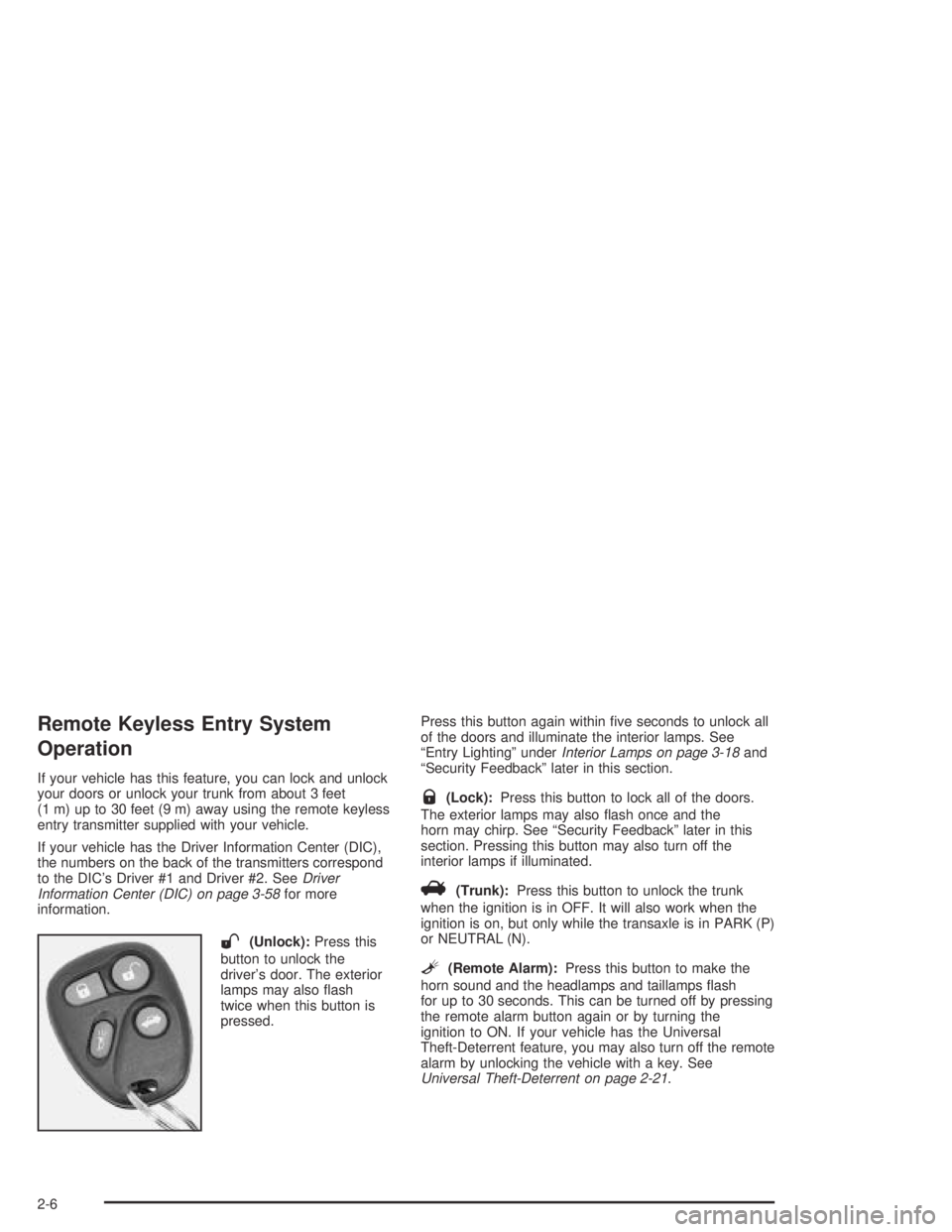
If your vehicle has this feature, you can lock and unlock
your doors or unlock your trunk from about 3 feet
(1 m) up to 30 feet (9 m) away using the remote keyless
entry transmitter supplied with your vehicle.
If your vehicle has the Driver Information Center (DIC),
the numbers on the back of the transmitters correspond
to the DIC’s Driver #1 and Driver #2. SeeDriver
Information Center (DIC) on page 3-58for more
information.
W(Unlock):Press this
button to unlock the
driver’s door. The exterior
lamps may also ash
twice when this button is
pressed.Press this button again within ve seconds to unlock all
of the doors and illuminate the interior lamps. See
“Entry Lighting” underInterior Lamps on page 3-18and
“Security Feedback” later in this section.
Q(Lock):Press this button to lock all of the doors.
The exterior lamps may also ash once and the
horn may chirp. See “Security Feedback” later in this
section. Pressing this button may also turn off the
interior lamps if illuminated.
V(Trunk):Press this button to unlock the trunk
when the ignition is in OFF. It will also work when the
ignition is on, but only while the transaxle is in PARK (P)
or NEUTRAL (N).
L(Remote Alarm):Press this button to make the
horn sound and the headlamps and taillamps ash
for up to 30 seconds. This can be turned off by pressing
the remote alarm button again or by turning the
ignition to ON. If your vehicle has the Universal
Theft-Deterrent feature, you may also turn off the remote
alarm by unlocking the vehicle with a key. See
Universal Theft-Deterrent on page 2-21.
2-6
Page 75 of 446
Personalization Features
The following features, if available on your vehicle, can
be programmed to each driver’s preference.
Programmable Automatic Door Locks
Security Feedback
Delayed Locking
Perimeter Lighting
Seat and Mirror Recall
If your vehicle is equipped with the Driver Information
Center (DIC), you must program these features through
the DIC. SeeDIC Vehicle Personalization on page 3-64.
Security Feedback
This feature provides feedback to the driver when the
vehicle receives a command from the remote keyless
entry transmitter. Feedback is only provided if all doors
are closed, the ignition is off and the Retained
Accessory Power (RAP) is inactive.If your vehicle is equipped with the Driver Information
Center (DIC), you must program this feature through the
DIC. SeeDIC Vehicle Personalization on page 3-64.
The following modes may be selected:
Mode 1:No feedback when locking or unlocking
vehicle.
Mode 2:Parking lamps and the daytime running lamps
will ash twice when unlocking the vehicle and will
ash once when locking the vehicle.
Mode 3:Horn will chirp when all doors are unlocked
(second unlock button press) and when locking
the vehicle.
Mode 4:Parking lamps and the daytime running lamps
will ash twice each time the button with the unlock
symbol is pressed; the horn will chirp when all doors are
unlocked. Parking lamps and the exterior lamps will
ash once and the horn will chirp when locking
the vehicle.
2-7
Page 76 of 446
Each remote keyless entry transmitter can be
programmed to a different mode according to the user’s
preference. To change to another mode, do the
following:
1. Keep all doors closed, the vehicle in PARK (P) and
the ignition on throughout this procedure.
2. Press and hold the driver’s power door lock switch
in LOCK through Step 4.
3. Press the button with the trunk symbol on the
transmitter. The transmitter will remain in its
current mode and the horn will chirp as feedback.
4. Press the button with the trunk symbol again. Each
time the transmitter’s trunk button is pressed, the
mode will advance by one, going from Mode 2 to 3
to 4, etc. and the horn will chirp as feedback.
5. Release the power door lock switch. The security
feedback will remain in the most recent mode
selected.
To verify the mode selected, remove the key from the
ignition and close all of the doors after you have
exited the vehicle. Press the lock button on the
transmitter to be veried and conrm the appropriate
feedback. Repeat with the unlock button.Matching Transmitter(s) to Your
Vehicle
Each remote keyless entry transmitter is coded to
prevent another transmitter from unlocking your vehicle.
If a transmitter is lost or stolen, a replacement can
be purchased through your dealer. Remember to bring
any remaining transmitters with you when you go to
your dealer. When the dealer matches the replacement
transmitter to your vehicle, any remaining transmitters
must also be matched. Once your dealer has coded the
new transmitter, the lost transmitter will not unlock
your vehicle. Each vehicle can have a maximum of four
transmitters matched to it.
See your dealer to match additional transmitters to your
vehicle.
2-8
Page 80 of 446
Delayed Locking
This feature lets the driver delay the actual locking of
the vehicle. When the driver’s power door lock switch or
the remote keyless entry transmitter lock button is
pressed, with the key removed from the ignition and the
driver’s door open, a chime will sound three times to
signal that the delayed locking system is active. When
all doors have been closed, the doors will lock
automatically after ve seconds. If any door is opened
before this, the ve-second timer will reset itself once all
the doors have been closed again.
Pressing a power door lock switch or the remote
keyless entry transmitter lock button again will override
this feature.
Personalization Programming
The delayed locking feature can be turned on or off.
If your vehicle is equipped with the Driver Information
Center (DIC), you must program this feature through the
DIC. SeeDIC Vehicle Personalization on page 3-64.If your vehicle is not equipped with remote keyless
entry, the delayed locking feature can be turned on or
off by using the following procedure:
1. Keep all doors closed, the vehicle in PARK (P) and
the ignition on throughout this procedure.
2. Press and hold the driver’s power door lock switch
in LOCK through Step 4.
3. Cycle the parking lamp switch from off to on six
times. On the sixth cycle, the doors will unlock to
conrm that the feature has been turned on.
Your doors will remain locked if delayed locking is
off. If the doors unlock, delayed locking is on.
4. To change modes, cycle the parking lamp switch
once more. A locking action will conrm the new
mode.
5. Release the power door lock switch.
To turn the feature off, repeat the previous procedure.
2-12
Page 81 of 446
If your vehicle is equipped with remote keyless entry,
your vehicle can be programmed to each driver’s
preference for each of the transmitters. Use the following
procedure to turn the feature off using the corresponding
transmitter:
1. Keep all doors closed, the vehicle in PARK (P) and
the ignition on throughout this procedure.
2. Press and hold the power door lock switch in LOCK
throughout this procedure. All the doors will lock.
3. Press the button with the unlock symbol on the
transmitter. The lock delay is still on and all the
doors will unlock.
4. Press the button with the unlock symbol on the
transmitter again. Lock delay is now off and all
the doors will lock.
5. Release the power door lock switch.
To turn this feature on, repeat the previous procedure.
This procedure changes the mode for only the
transmitter used to change this setting. The procedure
will need to be repeated for the second transmitter.Programmable Automatic Door
Locks
Close the doors and turn on the ignition. Every time you
move the shift lever out of PARK (P), all of the doors
will lock. And, every time you stop and move the
shift lever into PARK (P), the doors will unlock. If
someone needs to get out while you are not in
PARK (P), have that person use the manual door lock
or the power door lock switch. When the door is
closed again, it will not lock automatically. Use the
manual door lock or the power door lock switch to lock
the door again.
Personalization Programming
You can program the automatic door lock feature to
change to the following modes:
Mode 0:No automatic door lock or unlock.
Mode 1:All doors automatically lock when shifted out
of PARK (P). No automatic door unlock.
Mode 2:All doors automatically lock when shifted out
of PARK (P). Only the driver’s door automatically
unlocks when shifted into PARK (P).
2-13