trailer PONTIAC FIREBIRD 1994 User Guide
[x] Cancel search | Manufacturer: PONTIAC, Model Year: 1994, Model line: FIREBIRD, Model: PONTIAC FIREBIRD 1994Pages: 290, PDF Size: 14.84 MB
Page 150 of 290
When You Are Ready to Leave after
Parking on a
Hill
1. Apply your regular brakes and hold
the pedal down while you:
0 Start your engine;
0 Shift into a gear; and
0 Release the parking brake.
2. Let up on the brake pedal.
.
3. Drive slowly until the trailer is clear
4. Stop and have someone pick up and
of the chocks.
store the chocks.
Maintenance When Trailer Towing
Your vehicle will need service more often
when you're pulling a trailer. See the
Maintenance Schedule for more on this.
Things that are especially important in
trailer operation are automatic
transmission fluid (don't overfill), engine
oil, axle lubricant, belts, cooling system,
and brake adjustment. Each of these
is
covered in this manual, and the Index will
help you find them quickly. If you're
trailering, it's a good idea to review these
sections before you start your trip.
Check periodically to see that all hitch
nuts and bolts .are tight.
I
I
149.. .
ProCarManuals.com
Page 163 of 290

Problems on the Road
If your engine catches fire because
you keep driving with no coolant,
your vehicle can be badly darhaged.
The costly repairs would not be
covered by your warranty.
If No Steam Is Coming from Your
Engine:
If you get the overheat warning but see
or hear
no steam, the problem may not be
too serious. Sometimes the engine can gel
a little too hot when you:
Climb a long hill on a hot day.
Stop after high speed driving.
0 Idle for long periods in traffic.
0 Tow a trailer. If you
get the overheat warning with
no
sign of steam, try this for a minute or so:
1. If you have an air conditioner, turn it
2. Turn on your heater to full hot at the
off.
highest
fan speed and
open the
window as necessary.
3. Try to keep your engine under load
(in a drive gear where the engine runs
slower).
If you no longer have the overheat
warning, you can drive. Just to be safe,
drive slower for about
ten minutes. If the
warning doesn’t come back
on, you can
drive normally.
If the warning continues, pull over, stop,
and park your vehicle right away.
If there’s still no sign of steam,
you can
idle the engine for two or three minutes
while you’re parked, to see if the warning
stops. But then, if you still have the
warning, TURN
OFF THE ENGINE
AND GET EVERYONE OUT
OF THE
VEHICLE until it cools down.
You may decide not to lift the hood but to
get service help right away.
Cooling System
When you decide it’s safe to lift the hood,
here’s what you’ll see on the V6 engine:
1. Coolant recovery tank
2. Radiator pressure cap
3. Electric engine fan
. . .I62
ProCarManuals.com
Page 196 of 290

When to Change Engine Oil:
See if any one of these is true for you:
Most trips are less than 4 miles
0 It’s below freezing outside and most
trips are less than
10 miles ( 16 km).
The engine is at low speed most of
the time (as in door-to-door delivery,
or
in stop-and-go traffic).
(6 km).
You tow a trailer often.
Most trips are through dusty places.
If any one of these is true for your
vehicle, then you need to change your
and filter every
3,000 miles (5 000 km) or
3 months - whichever comes first.
If none of them is true, change the oil
every
7,500 miles (12 500 km) or 12
months
- whichever comes first.
Change the filter at the first oil change
and at every other oil change after that.
Engine Coolant Heater (Engine Block
Heater):
An engine coolant heater can be a big
help if you have to park outside in very
cold weather,
0°F (-18°C) or colder. If
your vehicle has this option, see “Engine Coolant Heater” in the Index.
What to Do with Used Oil:
Did you know that used engine oil
:ontains elements that may be unhealthy
:or your skin and could even cause
:ancer? Don’t let used oil stay on your
;kin for very long. Clean your skin and
lails with soap and water, or a good hand
:leaner. Wash or properly throw away
:lothing or rags containing used engine
il. (See the manufacturer’s warnings
ibout the use and disposal of oil
xoducts.)
Used oil can be a real threat to the
mvironment. If you change your own oil,
)e sure to drain all free-flowing oil from
:he filter before disposal. Don’t ever
jispose of oil by putting it in the trash,
2ouring it on the ground, into sewers, or
into streams or bodies
of water. Instead,
recycle it by taking it to a place that
collects used oil. If you have a problem
properly disposing of your used oil, ask
your dealer, a service station or a local
recycling center for help.
3.4L L32 (Code S
Air Cleaner
iefer to the Maintenance Schedule to
letermine when to replace the air filter.
See “Scheduled Maintenance Services”
In the Index.
t
195 ...
ProCarManuals.com
Page 199 of 290
Service and Appearance Care
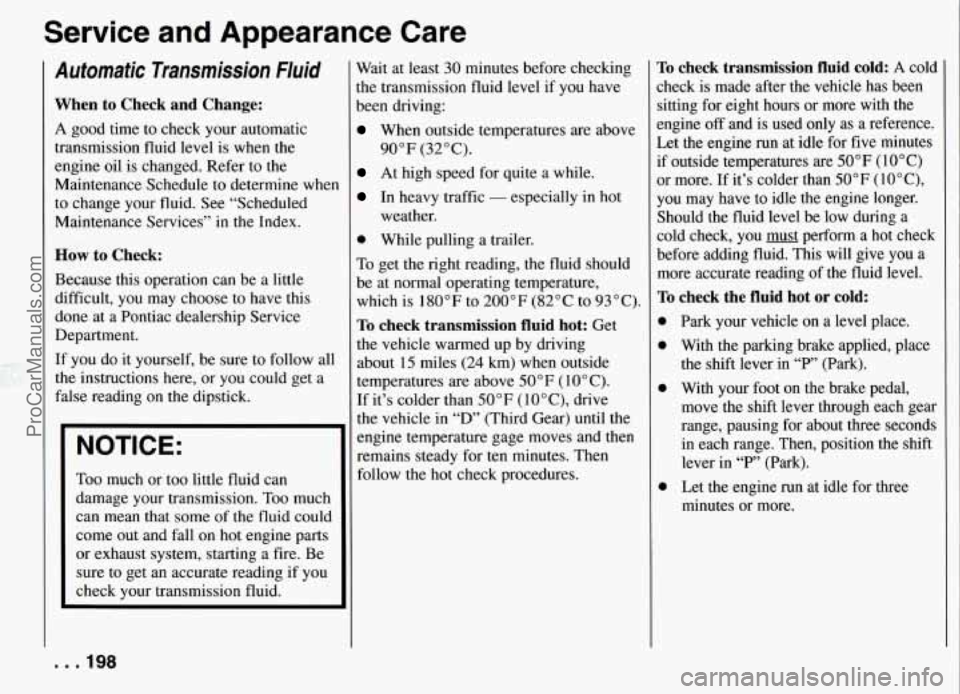
Automatic Transmission Fluid
When to Check and Change:
A good time to check your automatic
transmission fluid level
is when the
engine oil is changed. Refer to the
Maintenance Schedule to determine when
to change your fluid. See “Scheduled
Maintenance Services” in the Index.
How to Check:
Because this operation can be a little
difficult, you may choose to have this
done at a Pontiac dealership Service
Department.
If you do it yourself, be sure to follow all
the instructions here, or
you could get a
false reading on the dipstick.
Too much or too little fluid can
damage your transmission. Too much
can mean that some of the fluid could
come out and fall on hot engine parts
or exhaust system, starting a fire. Be
sure to get an accurate reading
if you
check your transmission fluid. Wait
at least 30 minutes before checking
the transmission fluid level if you have
been driving:
When outside temperatures are above
At high speed for quite a while.
In heavy traffic - especially in hot
90°F (32°C).
weather.
While pulling a trailer.
To get the right reading, the fluid should
be at normal operating temperature,
which is 180°F to 200°F (82°C to 93°C).
To check transmission fluid hot: Get
the vehicle warmed up by driving
about
15 miles (24 km) when outside
temperatures
are above 50°F ( 10°C).
If it’s colder than 50°F ( lO”C), drive
the vehicle in
“D’ (Third Gear) until the
engine temperature gage moves and then
remains steady for
ten minutes. Then
follow the hot check procedures.
To check transmission fluid cold: A cold
check is made after the vehicle has been
sitting for eight hours or more with the
engine
off and is used only as a reference.
Let the engine run at idle for five minutes
if outside temperatures are 50°F
(10°C)
or more. If it’s colder than 50°F (lO°C),
you may have to idle the engine longer.
Should the fluid level be low during a
cold check, you must perform a hot check
before adding fluid. This will give you a
more accurate reading of the fluid level.
To check the fluid hot or cold:
0
Park your vehicle on a level place.
With the parking brake applied, place
the shift lever
in “P” (Park).
With your foot on the brake pedal,
move the shift lever through each gear
range, pausing for about three seconds
in each range. Then, position the shift
lever in “P” (Park).
Let the engine
run at idle for three
minutes or more.
. . .I98
ProCarManuals.com
Page 242 of 290

“Section C: Periodic Maintenance
Inspections” explains important
inspections that your Pontiac dealer’s
service department or another qualified
service center should perform.
“Section
D: Recommended Fluids and
Lubricants” lists some products GM
recommends to help keep your vehicle
properly maintained. These products,
or
their equivalents, should be used whether
you do the work yourself or have it done.
“Section
E: Maintenance Record”
provides a place for you to record the
maintenance perfowed on your vehicle.
Whenever any maintenance is performed,
be
sure to write it down in this section.
This will help you determine when your
next maintenance should be done. In
addition, it is a good idea to keep your
maintenance receipts. They may be
needed to qualify your vehicle for
warranty repairs.
Using Your Maintenance
Schedules
This section tells you the maintenance
services you should have done and when
you should schedule them. Your Pontiac
dealer knows your vehicle best and wants
you to be happy
with it. If you go to your
dealer for your service needs, you’ll know
that GM-trained and supported service
people will perform the work using
genuine GM parts.
These schedules are for vehicles that:
carry passengers and cargo within
recommended limits. You will find
these limits on your vehicle’s
Tire-Loading Information label. See
“Loading Your Vehicle”
in the Index.
are driven on reasonable road surfaces
within legal driving limits.
use the recommended unleaded fuel.
See “Fuel” in the Index.
Selecting the Right Schedule
First you’ll need to decide which of the
two schedules is right for your vehicle.
Here’s how to decide which schedule to
follow:
Schedule
I
Is any one of these true for your vehicle?
Most trips are less than 4 miles (6 km).
Most trips are less than 10 miles (1 6
km) when outside temperatures are
below freezing.
0 The engine is at low speed most of the
time (as
in door-to-door delivery, or in
stop-and-go traffic).
e You operate your vehicle in dusty
e You tow a trailer.
If any one (or more) of these is true for
your driving, follow Schedule
I.
Schedule 11
Follow Schedule I1 QI& if none of the
above conditions is true.
areas.
241 . .
ProCarManuals.com
Page 243 of 290
Maintenance Schedule
C L Section A: Scheduled Maintenance Services
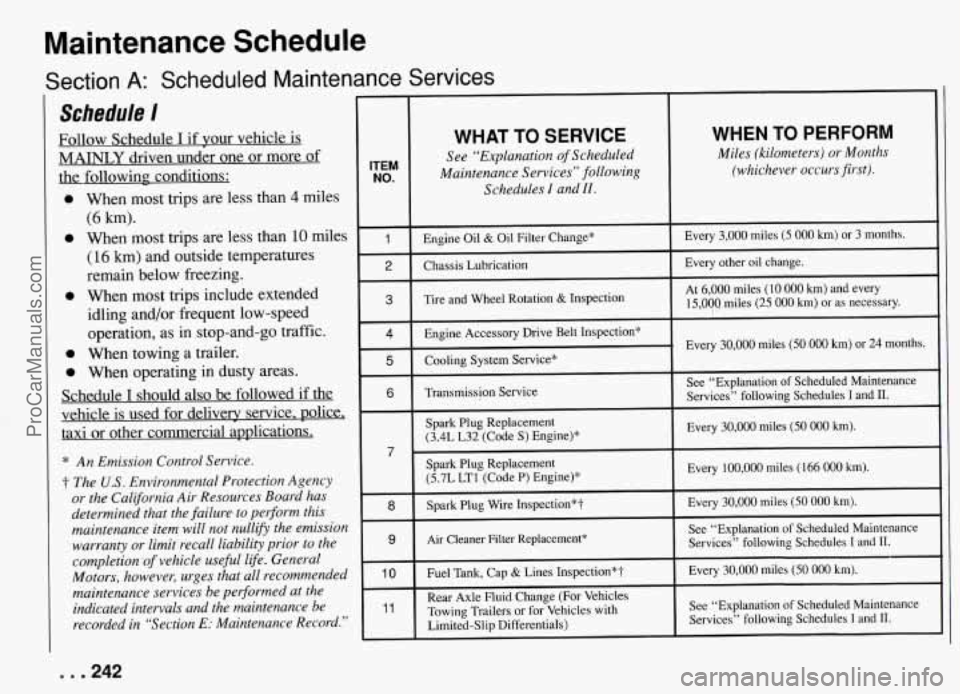
Schedule I
Follow Schedule I if your vehicle is
MAINLY driven under one or more of
the following conditions:
When most trips are less than
4 miles
(6 km).
When most trips are less than
10 miles
(16 km) and outside temperatures
remain below freezing.
When most trips include extended
idling and/or frequent low-speed
operation, as in stop-and-go traffic.
When towing a trailer.
When operating in dusty areas.
Schedule
I should also be followed if the
vehicle is used for delivery service. police,
taxi or other commercial aqdications.
* An Emission Control Service.
t The U.S. Environmental Protection Agency
or the California Air Resources Board has
determined that the failure to perform this
maintenance item will not nullify the emission
warranty
or limit recall liability prior to the
completion ‘of vehicle useful life. General
Motors, however, urges that all recommended
maintenance services be performed at the
indicated intervals and the maintenance be
recorded in “Section
E: Maintenance Record.”
ITEM NO.
-
1
3
-
4
6
-
7
9
11
WHAT TO SERVICE
See “Explanation of Scheduled
Maintenance Services” following
Schedules
I and II.
~
Engine Oil & Oil Filter Change*
Chassis Lubrication
Tire and Wheel Rotation
& Inspection
Engine Accessory Drive Belt Inspection*
Cooling System Service*
Transmission Service
Spark Plug Replacement
(3.4L L32 (Code
S) Engine)*
Spark Plug Replacement
(5.7L LTl (Code P) Engine)*
Spark Plug Wire Inspection*?’
Air Cleaner Filter Replacement*
Fuel Tank, Cap
& Lines Inspeclion*t
Rear Axle Fluid Change (For Vehicles
Towing Trailers or for Vehicles with
Limited-Slip Differentials)
WHEN TO PERFORM
Miles (kilometers) or Months
(whichever occursfirst).
Every 3,000 miles (5 000 km) or 3 months.
Every other oil change.
At
6,000 miles (10 000 km) and every
15,000 miles (25 000 km) or as necessary.
Every
30,000 miles (50 000 km) or 24 months.
See “Explanation of Scheduled Maintenance
Services” following Schedules I and
II.
Every 30,000 miles (50 000 km).
Every 100,000 miles (166 000 km).
Every 30,000 miles (50 000 km).
See “Explanation of Scheduled Maintenance
Services” following Schedules I and 11.
Every 30,000 miles
(50 000 km).
~ ~~ ~~~
See “Explanation of Scheduled Maintenance
Services” following Schedules
I and 11.
. . .242
ProCarManuals.com
Page 248 of 290

ITEM
NO. SERVICE
6 Transmission Service - For
manual transmissions, fluid
doesn’t require changing. See
“Periodic Maintenance
Inspections.”
For automatic transmissions,
change both the fluid and filter
every 15,000 miles
(25 000 km)
if the vehicle is mainly driven
under one
or more of these
conditions:
In heavy city traffic where the
outside temperature regularly
reaches
90°F (32°C) or
higher.
In hilly or mountainous
terrain.
When doing frequent trailer
towing.
Uses such as found in taxi,
police car or delivery service.
If you do not use your vehicle
under any of these conditions,
change both the fluid and
filter every
100,000 miles
(166 000 km).
ITEM
NO. SERVICE
7
8
9
10
Spark Plug Replacement* -
Replace spark plugs with the
proper type. See “Replacement
Parts” in the Index.
Spark Plug Wire InsPection*t
-
Inspect for burns, cracks or other
damage. Check the boot fit at the
distributor and at the spark plugs.
Replace wires as needed.
Air Cleaner Filter Replacement”
- Replace every 30,000 miles
(50 000 km) or more often under
dusty conditions. Ask your
dealer for the proper replacement
intervals for your driving
conditions.
Fuel Tank. Cap and Lines
Inspection*-/-
- Inspect fuel tank,
cap and lines (including fuel rails
and injection assembly) for
damage or leaks. Inspect fuel cap
gasket for an even filler neck
imprint or any damage. Replace
parts as needed. Periodic
replacement of the fuel filter is
not required.
ITEM
NO. SERVICE
11 Rear Axle Fluid Change - If your
vehicle is used to pull a trailer,
have the rear axle gear lubricant
changed every
7,500 miles
(12 500 km).
If your vehicle is not used to pull
a trailer, but has a limited-sli,p
differential, have the rear axle
gear lubricant changed once, after
the first
7,500 miles (12 500.h).
* An Emission Control Service.
j- The US. Environmental Protection Agency
or the California Air Resources Board has
determined that the failure to pe$orm this
maintenance item will not nullify the emission
warranty
or limit recall liability prior to the
completion
of vehicle useful life. General
Motors, however, urges that all recommended
maintenance services be performed at the
indicated intervals and the maintenance be
recorded in “Section E: Maintenance Record.”
247. . .
ProCarManuals.com
Page 253 of 290

Maintenance Schedule
Section C: Periodic Maintenance Inspections (Cont.)
I INSPECTION
F Manual Transmission
I
Rear Axle Service
Brake System
Inspection
WHAT SHOULD BE DONE
Check the transmission fluid level; add if needed. See “Manual Transmission” in the Index.
A fluid
loss may indicate a problem. Check the system and repair if needed.
Check the gear lubricant level in the rear axle and add if needed. See “Rear Axle” in the Index.
A fluid loss may indicate a problem. Check the axle and repai\
r it if needed.
If your vehicle
is used to pull a trailer, have the rear axle gear lubricant changed every
7,500 miles
(12 500 km).
Inspect the complete system. Inspect brake lines and hoses for \
proper hookup, binding, leaks,
cracks, chafing, etc. Inspect disc brake pads for wear and rotors for surface condition. Also
inspect drum brake linings for wear and cracks. Inspect other \
brake parts, including drums,
wheel cylinders, calipers, parking brake, etc. The parking brake\
is self-adjusting and no manual
adjustment is required. You may need to have your brakes inspected more often if your driving
habits or conditions result in frequent braking.
NOTE: A low brake fluid level can indicate worn disc brake pads which may need to be serv-
iced. Also, if the brake system warning light stays on or comes on, something may be wrong
with the brake system.
See “Brake System Warning Light” in the Index. If your anti-lock brake \
system warning light stays on, comes on or flashes, something may be wrong with the anti-lock
brake system. See “Anti-Lock Brake System Warning Light’’ in the Index.
~~
. . .252
ProCarManuals.com
Page 270 of 290

ABS ........................ 129
Accessory Power. Retained
....... 52
Add-on Electrical Equipment
..... 228
Adding Coolant
................ 202
Additives. Engine Oil
............ 194
AirBags
...................... 23
How the System Works
........ 24
Servicing Your Air Bag-Equipped
Pontiac
................... 27
Readiness Light
.............. 24
Air Cleaner
.................... 195
Air Conditioner Controls
......... 106
Air Control
Knob ............... 104
Air Filter Replacement
........... 196
Alignment and Tire Balance.
Wheel
...................... 220
Aluminum Wheels
.............. 225
A"M Stereo
With Cassette Tape Player
...... 109
With Cassette Tape Player and
Graphic Equalizer
.......... 1 12
With Compact Disc Player
...... 115
With Compact Disc Player and
Graphic Equalizer
.......... 1 18
Antenna. Fixed Mast
............ 123
Anti-Lock Brakes
.............. 129
To Use ..................... 130
System Warning Light ......... 91
Appearance Care
............... 221
Appearance Care and Materials
.... 227 Appearance Care.
Service and
..... 183
Ashtray and Lighter
............. 85
Ashtray. Front
................. 85
Audio Systems ................. 108
Audio Systems. Comfort
Controls and
................. 103
Automatic Transmission
................ 56
Transmission Fluid
............ 198
Axle. Limited-Slip Rear
.......... 62
Axle. Rear
.................... 201
Babies. Smaller Children
and (Safety Belts)
............. 30
Balance. Wheel Alignment
and Tire
.................... 220
Battery
....................... 208
Battery Replacement. Remote Lock
Control
..................... 45
BBB Auto Line
- Alternative Dispute
Resolution Program.
GM Participation in
......... 261
Before Leaving on a Long Trip
.... 140
Belt Routing
................... 237
Belt. Lap-Shoulder
.............. 19
Bi-Level Heating
............... 105
Blizzard. If You're Caught in a
... 143
Box. Glove
.................... 83
Brakes Adjustment
.................. 208
Anti-Lock
(ABS) ............. 129 Brakes
Fluid
....................... 207
Master Cylinder
.............. 206
Parking
..................... 63
Pedal Travel ................. 207
System Parts. Replacing
........ 208
System Warning Light
......... 90
Trailer ...................... 147
Wear
...................... 207
Braking (Control of a Vehicle)
..... 128
Braking
in Emergencies ........... 132
"Break.In,
.. New Vehicle ........ 50
Brightness Control .............. 76
Bulb Replacement .............. 209
Center High-Mounted
Stoplight
.................. 210
Front Turn Signal
............. 211
Headlights
............. .' .... 209
Rear Lights
.................. 211
Rear Sidemarker
.............. 212
Bulbs, Halogen
................. 209
Bulbs. Replacement
............. 232
Canadian Roadside Assistance
... 263
Capacities and Specifications
...... 233
Carbon Monoxide
.............. 48
Care
Appearance
................. 221
Cassette Tape Player
.......... 122
Compact Discs
............... 122
Safety Belts
................. 224
269 ...
ProCarManuals.com
Page 272 of 290

Cruise Control Using on Hills
............... 75
Curves. Driving on
.............. 132
Customer Assistance for the Hearing or Speech Impaired (TDD)
..... 260
Customer Assistance Information
. . 259
Customer Satisfaction Procedure
... 260
Daytime Running Lights
....... 77
Deep Standing Water.
Driving through
.............. 54
Defects. Safety Reporting to General Motors
.... 262
Reporting to the Canadian Government
............... 262
Reporting to the United States
Government
............... 26 1
Defensive Driving .............. 126
Defogger. Rear Window
......... 107
Defogging and Defrosting Windows
................... 105
Dimensions. Vehicle
............ 236
Doing Your Own Service Work
.... 184
Door Locks
.................... 43
Door Locks. Power
............. 44
Doors. Headlight
............... 76
Driver Position (Safety Belts)
..... 19
Driving AtNight
.................... 136
City
........................ 138
Defensive
................... 126 .
Driving
Drunken
.................... 126
Freeway
.................... 139
In the Rain .................. 137
On Curves
.................. 132
On Snow or Ice
.............. 142
Through Deep Standing Water
... 54
Winter
...................... 142
With a Trailer
................ 147
Drunken Driving
............... 126
Electrical Center. Underhood
.... 231
Electrical Equipment. Add-on
..... 228
Electric Mirror Control
.......... 80
Emergencies. Braking in
......... 132
Emergencies. Steering in
......... 133
Engine
Coolant
..................... 20 1
Coolant (Block) Heater
........ 55
Coolant Temperature Gage
..... 93
Exhaust
..................... 66
Identification
................ 228
Oil
........................ 191
Oil Pressure Gage
............. 95
Overheating
................. 1 6 1
Specifications ................ 233
Starting Your
................ 52
Environment, Your Vehicle
andthe
..................... 240
Exhaust, Engine
................ 66
Extender, Safety Belt
............ 39
Fan Control Knob ............. 104
Features and Controls
........... 41
Filling Your Tank
............... 187
Filter. Air. Replacement
.......... 196
Finish Care (Paint)
.............. 225
Finish Damage (Paint)
........... 226
Fixed Mast Antenna
............. 123
Flashers. Hazard Warning
........ 152
Flat Tire. Changing a
............ 171
Flat.
If a Tire Goes .............. 170
Floormats
..................... 79
Flow-Through Ventilation System
. . 107
Fluid Automatic Transmission
....... 198
Brake
....................... 207
Manual Transmission
.......... 200
Power Steering
............ .I .. 204
Recommended ................ 253
Windshield Washer
............. 205
Fog Lights
..................... 78
Folding Rear Seatback
........... 13
Foreign Countries. Fuels in
....... 186
Foreign Material Paint Damage
.... 226
Four-Way Manual Seat
.......... 8
Freeway Driving ............... 139
Front Ashtray
..................... 85
Console
.................... 84
Map Lights
.................. 79
Seat. Manual
................ 8
271 . .
ProCarManuals.com