transmission PONTIAC FIREBIRD 1994 Owner's Manual
[x] Cancel search | Manufacturer: PONTIAC, Model Year: 1994, Model line: FIREBIRD, Model: PONTIAC FIREBIRD 1994Pages: 290, PDF Size: 14.84 MB
Page 99 of 290

Features and Controls
1. Park on a level surface. Set the
parking brake firmly, shift an
automatic transmission into
“P’ (Park:
or a manual transmission into
“R’
(Reverse). The ignition must be in the
“Acc” or “Run” position. Lower both
sun visors.
NOTICE:
Don‘t lower the top if it is damp or
wet. When the top is down, trapped
water can cause stains, mildew and
damage to the inside of your vehicle.
Be sure to dry
off the top before you
lower it.
NOTICE:
It is not recommended to lower the
top
if your vehicle is out in cold
weather,
0°F (-18°C) or lower.
... 98
)
I
..
I= 2.
NOTICE:
Before lowering the convertible top
into the storage qrea, be sure there
are no objects in
the way of the
folded, stored top. The weight
of a
stored top on items in the storage
area
will cause the convertible top
back glass to break.
Unlock the front of the convertible to;
by pushing on the smaller part of the
latch, then pulling down
on the larger
part
of the latch. Be sure the hook on
the latch that attaches into the hole at
the windshield releases.
-3
I
I
n
tl
p i~
-
fl
1. Be sure no one or nothing is on or
around the top. Push and hold the
bottom of the convertible top switch.
The switch is
on the left side of your
console. The top will automatically lower into the storage area.
nstalling the Boot Cover
ifter lowering the convertible top, you
nay want to install the boot cover. The
hree-piece boot cover
is stored in a bag
n the trunk.
ProCarManuals.com
Page 100 of 290

1.
2. Open the
trunk and remove the
two
side covers from the storage bag.
Install the two side covers by
engaging the tab into the front seatbelt
cover. Lower the covers onto vehicle. 3. Install middle section of cover by
sliding tabs into slots on right side
cover. Lower cover and engage latch.
4. Close the trunk.
To Raise Your Convertible Tap
1. Park on a level surface. Set the
parking brake firmly. If you have an
automatic transmission, shift into
“P”
(Park). If you have a manual
transmission, shift into
“R7 (Reverse).
The ignition must be in the “ACC”
or “Run” position. Lower both sun
visors. Lower both windows at least
three inches. If the boot cover is
in
place, it must be removed first.
2. Open the trunk. Remove the middle
piece
of the cover by pushing in on
the latch and lifting up on the cover.
1
99 ...
ProCarManuals.com
Page 142 of 290

Hill and Mountain
Roads
Driving on steep hills or mountains is
different from driving in flat or rolling
terrain. If you drive regularly in steep
country, or
if you’re planning to visit
there, here are some tips that can make
your trips safer and more enjoyable.
0 Keep your vehicle in good shape. Check all fluid levels and also the
brakes, tires, cooling system and
transmission. These parts can work
hard on mountain roads.
0 Know how to go down hills. The most
important thing to know is this: let
your engine do some of the slowing
down. Shift to a lower gear when you
go down a steep or long hill. Know how
to go uphill. You may
want to shift down to a lower gear.
The lower gears help cool your engine
and transmission, and you can climb
the hill better.
In hilly terrain, you may want to
switch to the
“PERFORMANCE”
mode for better performance.
Stay in your own lane when
driving on two-lane roads in hills or
mountains. Don’t swing wide or cut
across the center of the road. Drive at
speeds that let you stay in
you? own
lane.
As you go over the top of a hill, be
alert. There could be something in
your lane, like a stalled car or’an
accident.
You may see highway signs on
mountains that warn of special
problems. Examples are long grades,
passing or no-passing zones, a’ falling
rocks area, or winding roads. Be alert
to these and take appropriate action.
141 ...
ProCarManuals.com
Page 146 of 290

NOTICE:
Pulling a trailer improperly can
damage your vehicle and result in
costly repairs not covered by your
warranty.
To pull a trailer correctly,
follow the advice in this section, and
see your Pontiac dealer for important
information about towing a trailer
with your vehicle.
Your vehicle can tow a trailer if it is
equipped with the proper trailer towing
equipment. To identify what the vehicle
trailering capacity is for your vehicle, you
should read the information in “Weight
of the Trailer” that appears later in this
section. But trailering is different than just
driving your vehicle by itself. Trailering
means changes
in handling, durability,
and fuel economy. Successful, safe
trailering takes correct equipment, and
it has to be used properly.
That’s the reason for this section. In it are
many time-tested, important trailering
tips and safety rules. Many of these are
important for your safety and that of your
passengers.
So please read this section
carefully before you pull a trailer. Load-pulling components such
as the
engine, transmission, rear axle, wheel
assemblies, and tires are forced to work
harder against the drag of the added
weight, The engine is required to operate
at relatively higher speeds and under
greater loads, generating extra heat.
What’s more, the trailer adds considerably
to wind resistance, increasing the pulling
requirements.
If You Do Decide to Pull a Trailer
If you do, here are some important points.
0 There are many different laws,
including speed limit restrictions,
having to do with trailering. Make
sure your rig will be legal, not only
where you live but also where you’ll
be driving.
A good source for this
information can be state or provincial
police.
0 Consider using a sway control. You
can ask a hitch dealer about sway
controls.
0 Don’t tow a trailer at all during the
first 1,000 miles (1 600 km) your
new vehicle is driven. Your engine,
axle or other parts could be damaged.
(800 km) that you tow a trailer, don’t
drive over
50 mph (SO h/h) and don’t
make starts at full throttle. This heips
your engine and other parts of your
vehicle wear in at the heavier loads.
Obey speed limit restrictions when
towing a trailer. Don’t drive faster
than the maximum posted speed for
trailers (or no more than
55 mph
(90 km/h)) to save wear on your
vehicle’s parts.
Three important considerations have to do
with weight:
., )I
Weight of the .Trailer $:
How heavy can a trailer safelyabe?
It should never weigh more th&
1,500 pounds (680 kg) under nQrmal
driving conditions. It should n&er
weigh more than
1,000 pounds
(450 kg) when driven on long grades
at high ambient temperatures. But
even that can be too heavy.
ProCarManuals.com
Page 149 of 290

Your Driving and the Road
Backing Up
Hold the bottom of the steering wheel
with one hand. Then, to move the trailer
to the left, just move that hand to the left.
To move the trailer to the right, move
your hand to the right. Always back up
slowly and, if possible, have someone
guide you.
Making 7hms
When you’re turning with a trailer, make
wider turns than normal.
Do this so your
trailer won’t strike soft shoulders, curbs,
road signs, trees, or other objects. Avoid
jerky or sudden maneuvers. Signal well in
advance.
Thrn Signals When Towing a Trailer
When you tow a trailer, your vehicle has
to have a different turn signal flasher and
extra wiring. The green arrows on your
instrument panel will flash whenever you signal a turn or lane change. Properly
hooked up, the trailer lights will also
flash, telling other drivers you’re about to
turn, change lanes or stop. When
towing a trailer, the green arrows
on your instrument panel will flash for
turns even
if the bulbs on the trailer are
burned out. Thus, you may think drivers
behind you are seeing your signal when
they are not. It’s important to check
occasionally to be sure the trailer bulbs
are still working.
Driving on Grades
Reduce speed and shift to a lower gear
before you start down a long or steep
downgrade. If you don’t shift down, you
might have to use your brakes
so much
that they would get hot and no longer
work well.
On a long uphill grade, shift down and
reduce your speed to around
45 mph
(70 km/h) to reduce the possibility of
engine and transmission overheating.
If you are towing a trailer and you
have an automatic transmission with
Overdrive, you may prefer to drive in
“D”
instead of Overdrive (or, as you need to, a
lower gear). Or,
if you have a manual
transmission with fifth (or sixth) gear and
you are towing a trailer, it’s better not to
use fifth (or sixth) gear. Just drive in
fourth gear (fifth gear if you have a six-speed manual transmission) or, as you
need to, a lower gear.
Parking on Hills
You really should not park your vehicle,
with a trailer attached, on a hill. If
-
something goes wrong, your rig could
start to move. People can be injured, and
both your vehicle and the trailer can be
damaged.
But if you ever have to park your rig on a
hill, here’s how to do it:
1. Apply your regular brakes, but don’t
shift into
“P” (Park) yet, or into gear
for a manual transmission.
2. Have someone place chxks under the
3. When the wheel chocks are in place,
release the regular brakes until the
chocks absorb the load. trailer wheels.
4. Reapply the regular brakes. Then
apply your parking brake, and then shift to
“P” (Park), or “R” (Reverse)
for a manual transmission.
5. Release the regular brakes.
. . .I48
ProCarManuals.com
Page 150 of 290
When You Are Ready to Leave after
Parking on a
Hill
1. Apply your regular brakes and hold
the pedal down while you:
0 Start your engine;
0 Shift into a gear; and
0 Release the parking brake.
2. Let up on the brake pedal.
.
3. Drive slowly until the trailer is clear
4. Stop and have someone pick up and
of the chocks.
store the chocks.
Maintenance When Trailer Towing
Your vehicle will need service more often
when you're pulling a trailer. See the
Maintenance Schedule for more on this.
Things that are especially important in
trailer operation are automatic
transmission fluid (don't overfill), engine
oil, axle lubricant, belts, cooling system,
and brake adjustment. Each of these
is
covered in this manual, and the Index will
help you find them quickly. If you're
trailering, it's a good idea to review these
sections before you start your trip.
Check periodically to see that all hitch
nuts and bolts .are tight.
I
I
149.. .
ProCarManuals.com
Page 154 of 290

Jump Starting
If your battery has run down, you may
want to use another vehicle and some
jumper cables to start your Pontiac. But
please follow the steps below to do
it
safely.
11 other. lt tney are, 11 COUIU cause a
NOTICE:
I1
ground connection you don’t want.
You wouldn’t be able to start your
Ignoring these steps could result
in
costlj damage to your vehicle that
wouidn”t be covered by your war-
ranty.
Trying to start your Pontiac by push-
ing or pulling it could damage your
yehicle, even if you have a manual
tran’smission. And if you have
an
automatic transmission, it won’t start
that way.
ro Jump Start Your Pontiac:
1. Cheik the other vehicle. It must have
a 12-volt battery with a negative
If the other system isn’t a 12-volt
system with. a negative ground, both
2. Get the vehicles close enough so the
jumper cables can reach, but be sure
the vehicles aren’t touching each Pontiac, and the
bad grounding could
damage the electrical systems.
3. Turn off the ignition on both vehicles.
Turn
off all lights that aren’t needed,
and radios. This will avoid
sparks and
help save both batteries. And it‘could
save your radio!
I NOTICE:
If you leave your radio on, it could be
badly damaged. The repairs woddn’t
be covered by your warranty.
1
ground system. 4. Open the hoods and locate the
NOTICE: batteries.
153 ...
ProCarManuals.com
Page 159 of 290
Problems on the Road
When your vehicle is being towed, have
the ignition key off. The steering wheel
should be clamped in a straight-ahead
position, with a clamping device designed
for towing service. Do not use the
vehicle’s steering column lock for this.
The transmission should be in “Neutral”
and the parking brake released.
Don’t have your vehicle towed on the rear
wheels, unless you must. If the vehicle
must be towed on the rear wheels, don’t
go more than 35 mph (55 km/h) or farther
than
50 miles (80 km) or your
transmission will be damaged. If these
limits must be exceeded, then the rear
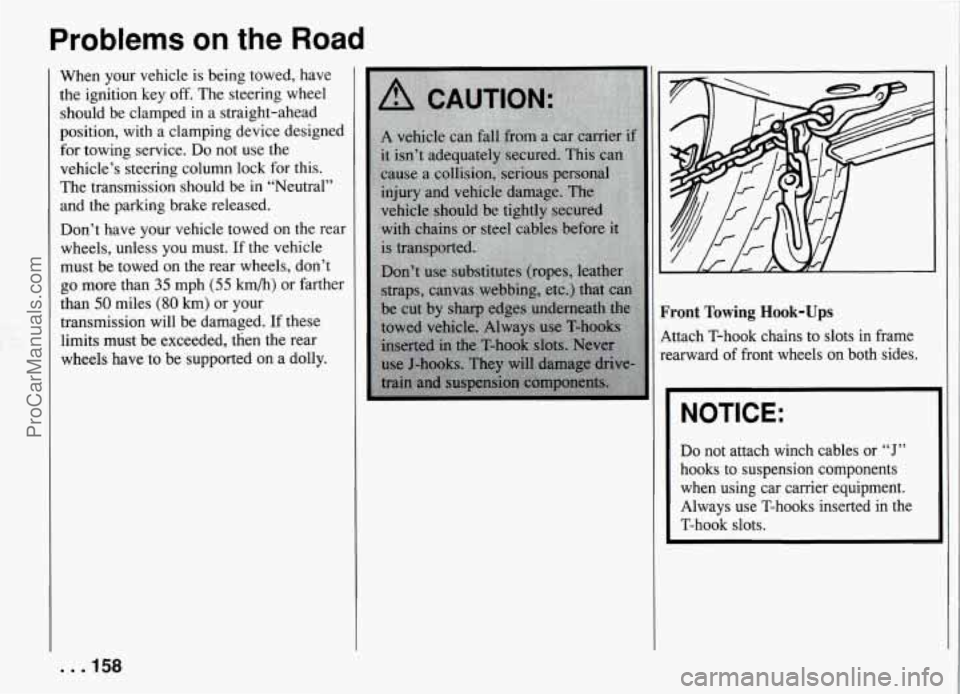
wheels have to be supported on a dolly. Front Towing Hook-Ups
Attach T-hook chains to slots in frame
rearward
of front wheels on both sides.
NOTICE:
Do not attach winch cables or “J”
hooks to suspension components
when using car carrier equipment.
Always use T-hooks inserted in the
T-hook slots.
1
. . .158
ProCarManuals.com
Page 182 of 290

NOTICE:
Spinning your wheels can destroy
parts of your vehicle as well as the
tires.
If you spin the wheels too fast
while shifting your transmission back
and forth, you can destroy your trans-
mission.
Rocking your vehicle to get it out:
First, turn your steering wheel left and
right. That will clear the area around your
front wheels. If your vehicle has traction
control, you should
turn the system off.
(See “Traction Control System” in the
Index.) Then shift back and forth’ between
“R’ (Reverse) and a forward gear (or with
a manual transmission, between First or
Second gear and Reverse), spinning the
wheels as little as possible. Release the
accelerator pedal while you shift, and
press lightly on the accelerator pedal
when the transmission is in gear.
If that
doesn’t get you out after a few tries,
you
may need to be towed out. If you:do need
to be towed out, see “Towing
Yow
Vehicle” in the Index. .’
181 ...
ProCarManuals.com
Page 184 of 290
I I
Here you will find information
about the care of your Pontiac
.
This part begins with service and fuel information. and then
it
shows how to check important
fluid and lubricant levels
. There
is also technical information
about your vehicle. and a section devoted
to its
appearance care
.
Part b
Service 8t Appearance Care
Service .........................................................
Fuel ...........................................................
Checking Things under the Hood ....................................
HoodRelease ..................................................
184
185
188
188
Engineoil
.................................................... 191
Aircleaner
.................................................... 195
Automatic Transmission Fluid
..................................... 198
Manual Transmission Fluid
....................................... 200
Hydraulic Clutch
............................................... 201
RearAxle
..................................................... 201
Enginecoolant
................................................. 201
Power Steering fluid
............................................ 204
Windshield Washer Fluid
......................................... 205
Brake Master Cylinder
........................................... 206
Bulb Replacement
................................................ 209
Battery
....................................................... 208
LoadingYourVehicle
............................................. 213
Tires
........................................................... 215
Appearance Care
................................................. 221
Appearance Care and Maintenance Materials
.......................... 227
Vehicle Identification Number (VIN)
................................. 228
Service Parts Identification Label
.................................... 228
Add-on Electrical Equipment
....................................... 228
Fuses and Circuit Breakers
......................................... 228
ReplacementBulbs
............................................... 232
Capacities and Specifications
........................................ 233
183 ...
ProCarManuals.com