heating PONTIAC FIREBIRD 1994 Owners Manual
[x] Cancel search | Manufacturer: PONTIAC, Model Year: 1994, Model line: FIREBIRD, Model: PONTIAC FIREBIRD 1994Pages: 290, PDF Size: 14.84 MB
Page 4 of 290
How to Use This
Manual
Many people read their owner’s manual
from beginning to end when they first
receive their new vehicle. This will help you learn about the features and controls
for your vehicle. In this manual, you’ll
find that pictures and words work
together to explain things quickly.
~ Index: A good place to look for what
you need is the Index
in back of the
manual. It’s an alphabetical list of all
that’s in the manual, and the page
number where you’ll find it.
Parts 1-8: Each part of this manual
begins with a brief list of its contents,
so
you can often find at a glance if a part
contains the information you want.
How to Use This Manual: This part
tells you how to use your manual and
includes safety and vehicle damage
warnings and symbols.
Part 1 - Seats & Restraint Systems:
This part tells you how to use your seats
and safety belts properly.
It also
explains the air bag system.
Part 2 - Features & Controls: This
part explains how to start and operate
your Pontiac.
Part 3 - Comfort Controls & Audio
Systems:
This part tells you how to
adjust the comfort controls and how
to
operate your sound system.
Part 4 - Your Driving and the Road:
Here you’ll find helpful information
and tips about the road and how to drive
under different conditions.
Part 5 - Problems on the Road: This
part tells you what to do if you have a
problem while driving, such as a flat
tire or engine overheating, etc.
Part 6 - Service & Appearance
Care:
Here the manual tells you
how to keep your Pontiac running
properly and looking good.
Part 7 - Maintenance Schedule:
This part tells when to perform vehicle
maintenance and what fluids and
lubricants to use.
Part 8 - Customer Assistance
Information:
This part includes
important information about reporting
safety defects and gives
you details
about the “Roadside Assistance” program.
You will also find customer
satisfaction phone numbers (including
customer satisfaction numbers for the
hearing and speech impaired), as well
as the mediatiodarbitration procedure.
We’ve also included ordering
information for service publications in
this part.
Service Station Information: This is
a quick reference of service
information.
You can find it on the last
page of this manual.
3...
ProCarManuals.com
Page 86 of 290

c
w Sun Visors
To block out glare, you can swing down
the visors. You can also swing them to
the side. The elastic bands on your visor
provide extra strorage for maps or papers.
Covered Visor Vanity Mirror
Pull down the sun visor and lift the cover
to expose the vanity mirror.
Ashtray and Lighter
Front Ashtray
Lift up the cover to open the ashtray.
To remove it, lift up on either side of
the ashtray. If you have an automatic
transmission, the ashtray is near the front
of your console. If you have a manual
transmission, the ashtray is near your
cupholder.
NOTICE:
Don’t put papers and other things
that burn into your ashtray. If you do,
cigarettes or other smoking materials
could set them on fire, causing
damage.
Cigarette Lighter
To use the lighter, push it in all the way
and let go. When it’s ready, it will pop
back by itself.
NOTICE:
Don’t hold a cigarette 1ighter:in with
your hand while it is heating. If you
do,
it won’t be able to back away
from the heating element when it’s
ready. That can make it overheat,
damaging the lighter and the heating
element.
If you plug accessories into your cigarette
lighter, such as heating devices or air corn.
pressors, these accessories should have a
rated current of less than
15 amps. Exceed
ing this limit will result in a blown fuse.
85.
’-- ;P ’ 3
ProCarManuals.com
Page 93 of 290

Features and Controls
-
I
1:
4
i;
S
S
1
S
C
s
C
S
1
t
... 92
ABS
INOP
f the anti-lock brake system warning
ight stays on longer than normal after
rou’ve started your engine, turn the
gnition
off. Or, if the light comes on and
tays on when you’re driving, stop as
oon as possible and turn the ignition
off.
rhen start the engine again to reset the
‘ystem. If the light still stays on, or
:omed on again while you’re driving,
rour Pontiac needs service. If the light is
In but not flashing and the regular brake
,ystem warning light isn’t on, you still
lave brakes, but you don’t have anti-lock
wakes.
TCS
OFF
kaction Control System Warning
,ight (Option)
men the traction control system is off,
he “TCS OFF” light will come on. This
ight will also come on for three seconds
:ach time you start your vehicle as a bulb
:heck and if there’s a system failure. See
‘Traction Control System” in the Index.
The traction control system will shut
lown partially due to brake overheating
)ut the “TCS OFF” light will not come
m. If there is throttle relaxer overheating,
he “TCS
OFF” light will illuminate
md the system will shut down. Once
werything cools
off, the system will
)perate normally again.
ProCarManuals.com
Page 94 of 290

When this warning light is on, the system
will not limit wheel spin. Adjust your
driving accordingly.
Low Traction Light
When your anti-lock system is adjusting
brake pressure to help avoid a braking
skid, the “LOW TRAC” light will appear
on your instrument cluster. If you have
the traction control system, this light will
also come on when the system is limiting
wheel spin. Slippery road conditions may
exist if this light comes on,
so adjust your
driving accordingly. The light will stay
or
for a few seconds after the anti-lock
system stops adjusting brake pressure or
the traction control system stops limiting
wheel spin. The “LOW TRAC” light also
comes
on briefly, as a bulb check, when
the engine is started.
Sngine Coolant Temperature Gage
’his gage shows the engine coolant
emperature.
If the gage pointer moves
nto the red area, your engine is too, hot!
t means that your engine coolant fias
werheated. If you have been operiting
‘our vehicle under normal driving-
onditions, you should pull off the road,
top your vehicle and turn
off the engine
s soon as possible.
IOT COOLANT CAN BURN
YOU
iADLY!
n “Problems on the Road,” this manual
hows what
to do. See “Engine
Iverheating” in the Index.
93 ...
ProCarManuals.com
Page 98 of 290
9
!I LOW
COOLANT
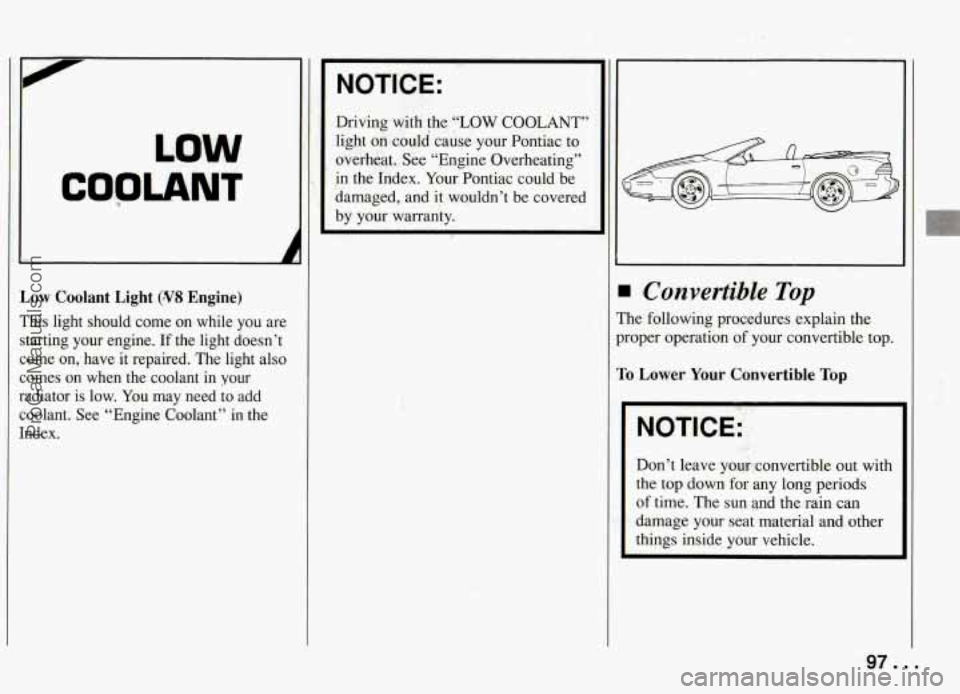
Low Coolant Light (4% Engine)
This light should come on while you are
starting your engine.
If the light doesn’t
come on, have it repaired. The light also
comes on when the coolant in your
radiator
is low. You may need to add
coolant. See “Engine Coolant”
in the
NOTICE:
Driving with the “LOW COOLANT”
light on could cause
your Pontiac to
overheat. See “Engine Overheating”
in the Index. Your Pontiac could
be
damaged, and it wouldn’t be covered
by your warranty.
Convertible Top
The following procedures explain the
proper operation of your convertible top.
To Lower Your Convertible Top
NOTICE:
Don’t leave yoqxconvertible out with
the top down for any long periods
of time. The sun and the rain can
damage your seat material and other
things inside your vehicle.
97. .
ProCarManuals.com
Page 104 of 290

Part 3
In this part you’ll find out how
o operate the comfort control
iystems and audio systems
Iffered with your Pontiac
. Be
ure to read about the particular
iystem supplied with your
lehicle
.
Comfort Controls & Audio
Systems
Comfort Controls ................................................ 104
Heater Controls
............................................... 104
Heating
...................................................... 104
Bi-Level Heating
.............................................. 105
Ventilation ................................................... 105
Defogging and Defrosting Windows
............................... 105
Air Conditioner Controls
........................................ 106
Cooling
...................................................... 106
Rear Window Defogger
......................................... 107 __
Flow-Through Ventilation System .................................
Audiosystems ..................................................
107
108
Settingtheclock
.............................................. 109
AMPM Stereo with Cassette Tape Player
........................... 109
AM/FM Stereo with Cassette Tape Player and Graphic Equalizer
........ 112
AM/FM Stereo with Compact Disc Player and Graphic Equalizer
........ 118
AM/FM
Stereo with Compact Disc Player
.......................... 115
Understanding Radio Reception
.................................. 121 .
Care of Your Cassette Tape Player .................................
Care of Your Compact Discs .....................................
FixedMastAntenna ............................................
122
123
123
103 ...
ProCarManuals.com
Page 105 of 290

Comfort Controls and Audio Systems
Comfort Controls
With this system, you can control the
heating and ventilation in your Pontiac. If
you have the air conditioning option, you
can also control cooling.
Your vehicle also has the flow-through
ventilation system described later in this
section.
Heater Controls
Fan Control Knob
8 : Turn this knob to select the force of
air you want.
. .IO4
Temperature Control Knob
Turn the knob to change the temperature
of the air flowing from the heating
system. Turn it to the right for warmer air
and to the left for cooler air. The
temperature of the air can not be less than
the temperature of the outside air.
Air Control Knob
OFF:
The system is off.
2 : Air flows through the upper air
vents.
-3 : Air is directed through the upper air
vents and the heater ducts.
.A : This setting directs most of the air
through the heater ducts and some
of the
air through the windshield defroster vents.
3 : Air is directed through the
windshield defroster vents and the heater
ducts.
9 : This setting directs most of the air
through the windshield defroster vents and some of the air through the heater
ducts.
Heating
The heater works best if you keep your
windows closed while using it.
1. Turn the air control knob to ./J .
2. Turn the fan control knob to the right.
3. Turn the temperature control knob to a
comfortable setting.
ProCarManuals.com
Page 106 of 290

During initial start-up only, if your
vehicle is eduipped with an optional
engine coolant heater, you can
use i't in
cold weather (around
+20°F/-8" C or
lower) to heat the passenger areq better
than without it. Because an engine coolant
heater warms the engine coolant, your
vehicle's Heating system can more
efficiently provide heat for the passenger
area
of your vehicle. See "Engine Coolant
Heater" in the Index.
Bi-Level Heating
You may want to use bi-level heating on
cool, but sunny days. This setting directs
cool air toward your body and warmer air
toward your feet.
1. Turn the air control knob to ,d .
2. Turn the temperature control knob to
3. Turn the fan control knob to the right.
a
comfortable setting.
VentiMon
?or mild outside temperatures when little
leating or cooling
is needed, you can still
iirect outside air through your vehicle.
I. Turn the air control knob to 2 .
2. Turn the temperature control knob to a
3. Turn the fan control knob to the right.
comfortable setting.
3efogging and Defrosting
Windows
I. Tui-n
the air control knob to
!. Turn the temperature control knob all
1. Turn the fan control knob to the: right.
P.
the way to the right.
105 ...
ProCarManuals.com
Page 107 of 290

Comfort Controls and Audio Systems
I‘
Air Conditioner Controls (OPTIoN)
The air conditioning system uses the same
controls
as the heating system, except that
the air control knob has two extra
settings, described below. For
an
explanation of all the controls, see
“Heater Controls” earlier in this part.
MAX: Provides maximum cooling or
quick cool-down on very hot days. This
setting recirculates most of the air inside
your vehicle. If it is used for long periods
of time, the air may become
dry. This
setting directs air through the upper air
vents.
. . .lo6
A/C: Use for normal cooling on hot days
This setting cools outside air and directs
through the upper air vents.
The air conditioner comtxessor oDerates
in
“MAX,” “NC” and ii VJ , ,% and
9 when the outside temperature is
a6&e freezing. When the air conditioner
is on, you may sometimes notice slight
changes in your vehicle’s engine speed
and power. This is normal because the
system is designed
to cycle the
compressor on and
off to keep the desirec
cooling and help fuel economy.
Cooling
The air conditioner works best
if you keep
your windows closed. On very hot days,
open the windows just long enough for
the hot air to escape.
1. Turn the air control knob to “NC” for
normal cooling. For faster cooling
move the knob to
‘“AX.”
2. Turn the temperature control knob to
3. Turn the fan control knob to the right. a comfortable setting.
ProCarManuals.com
Page 149 of 290

Your Driving and the Road
Backing Up
Hold the bottom of the steering wheel
with one hand. Then, to move the trailer
to the left, just move that hand to the left.
To move the trailer to the right, move
your hand to the right. Always back up
slowly and, if possible, have someone
guide you.
Making 7hms
When you’re turning with a trailer, make
wider turns than normal.
Do this so your
trailer won’t strike soft shoulders, curbs,
road signs, trees, or other objects. Avoid
jerky or sudden maneuvers. Signal well in
advance.
Thrn Signals When Towing a Trailer
When you tow a trailer, your vehicle has
to have a different turn signal flasher and
extra wiring. The green arrows on your
instrument panel will flash whenever you signal a turn or lane change. Properly
hooked up, the trailer lights will also
flash, telling other drivers you’re about to
turn, change lanes or stop. When
towing a trailer, the green arrows
on your instrument panel will flash for
turns even
if the bulbs on the trailer are
burned out. Thus, you may think drivers
behind you are seeing your signal when
they are not. It’s important to check
occasionally to be sure the trailer bulbs
are still working.
Driving on Grades
Reduce speed and shift to a lower gear
before you start down a long or steep
downgrade. If you don’t shift down, you
might have to use your brakes
so much
that they would get hot and no longer
work well.
On a long uphill grade, shift down and
reduce your speed to around
45 mph
(70 km/h) to reduce the possibility of
engine and transmission overheating.
If you are towing a trailer and you
have an automatic transmission with
Overdrive, you may prefer to drive in
“D”
instead of Overdrive (or, as you need to, a
lower gear). Or,
if you have a manual
transmission with fifth (or sixth) gear and
you are towing a trailer, it’s better not to
use fifth (or sixth) gear. Just drive in
fourth gear (fifth gear if you have a six-speed manual transmission) or, as you
need to, a lower gear.
Parking on Hills
You really should not park your vehicle,
with a trailer attached, on a hill. If
-
something goes wrong, your rig could
start to move. People can be injured, and
both your vehicle and the trailer can be
damaged.
But if you ever have to park your rig on a
hill, here’s how to do it:
1. Apply your regular brakes, but don’t
shift into
“P” (Park) yet, or into gear
for a manual transmission.
2. Have someone place chxks under the
3. When the wheel chocks are in place,
release the regular brakes until the
chocks absorb the load. trailer wheels.
4. Reapply the regular brakes. Then
apply your parking brake, and then shift to
“P” (Park), or “R” (Reverse)
for a manual transmission.
5. Release the regular brakes.
. . .I48
ProCarManuals.com