transmission PONTIAC FIREBIRD 1995 User Guide
[x] Cancel search | Manufacturer: PONTIAC, Model Year: 1995, Model line: FIREBIRD, Model: PONTIAC FIREBIRD 1995Pages: 386, PDF Size: 19.66 MB
Page 75 of 386

0 To Stop: Let up on the accelerator pedal and press
the brake pedal. Just before the vehicle stops, press
the clutch pedal and the brake pedal, and shift to
NEUTRAL.
NEUTRAL (N): Use this position when you start or
idle your engine.
REVERSE (R): To back up, press down the clutch
pedal
and shift ipto REVERSE (R). Let up on the
clutch pedal slowly while pressing the accelerator
pedal.
F
NOTICE:
Shift to REVERSE (R) only after your vehicle is
stopped. Shifting to REVERSE
(R) while your
vehicle is moving could damage your
transmission.
Also, use Reverse, along with the parking brake, for
parking your vehicle.
I
2-28
Six-Speed
3 5 R
2 4 6
This is your shift pattern. Here’s how to operate your
transmission:
FIRST (1): Press the clutch pedal and shift into
FIRST (1). Then, slowly let up on the clutch pedal as
you press the accelerator pedal.
ProCarManuals.com
Page 76 of 386

You can shift into FIRST (1) when you’re going less
than
20 mph (32 kmk). If you’ve come to a
complete stop and it’s hard to shift into FIRST
(1)
put the shift lever in NEUTRAL and let up on the
clutch. Press the clutch pedal back down. Then shift
into FIRST
(1).
0 SECOND (2): Press the clutch pedal as you let up
on the accelerator pedal and shift into SECOND (2).
Then, slowly let up on the clutch pedal as you press
the accelerator pedal.
THIRD, FOURTH, FIFTH, and SIXTH (3,4,5,
and 6 Gears): Shift into THIRD (3), FOURTH (4),
FIFTH (5) and SIXTH (6) the same way you do for
SECOND (2). Slowly let up on the clutch pedal as
you press the accelerator pedal.
0 To Stop: Let up on the accelerator pedal and press
the brake pedal. Just before the vehicle stops, press
the clutch pedal and the brake pedal, and shift
to“Neutra1.”
0
0
NEUTRAL (N): Use this position when you start or
idle your engine.
REVERSE (R): To back up, press down the clutch
pedal and shift into REVERSE (R). Let up on the
clutch pedal slowly while pressing the accelerator
pedal. If you
shift from SIXTH (6) into REVERSE
(R) the shift lever must be first placed in the
NEUTRAL position centered between SECOND
(2)
and THIRD (3) prior to shfting into REVERSE (R).
Your six-speed manual transmission has a feature that
allows you to safely shift into REVERSE (R) while the
vehicle is rolling (at less than
5 mph). You will be
locked-out if you try to shift into REVERSE (FQ while
your vehicle is moving faster than
5 mph.
If you have turned your ignition off and wish to park
your vehicle
in Reverse, you will have to move the shift
lever quickly to the right, “crashing” through the high
load spring and then into gear.
I
/ I
I I 2-29
f
1
ProCarManuals.com
Page 77 of 386
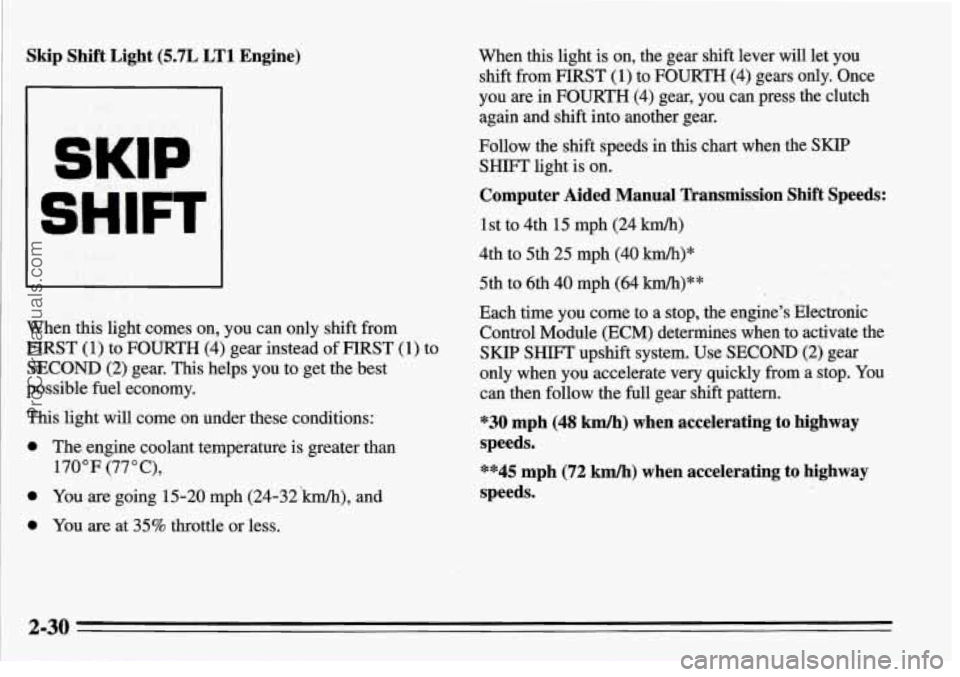
Skip Shift Light (5.7L LTl Engine)
When this light comes on, you can only shift from
FIRST (1) to FOURTH (4) gear instead
of FIRST (1) to
SECOND (2) gear. This helps you to get the best
possible fuel economy.
This light will come on under these conditions:
0 The engine coolant temperature is greater than
170°F (77"C),
0 You are going 15-20 mph (24-32.'km/h), and
0 You are at 35% throttle or less.
When this light is on, the gear shift lever will let you
shift from
FIRST (1) to FOURTH (4) gears only. Once
you are in FOURTH (4) gear, you can press the clutch
again and shift into another gear.
Follow the shift speeds in this chart when the SKIP
SHIFT light is on.
Computer Aided Manual Transmission Shift Speeds:
1st to 4th 15 mph (24 km/h)
4th to 5th 25 mph (40 km/h)*
5th to 6th 40 mph (64 km/h)**
Each time you come to a stop, the engine's Electronic
Control Module (ECM) determines when to activate the
SKIP SHIFT upshift system. Use SECOND (2) gear
only when you accelerate very quickly from
a stop. You
can then follow the
full gear shift pattern.
"30 mph (48 km/h) when accelerating to highway
speeds.
**45 mph (72 krn/h) when accelerating to highway
speeds.
2-30
ProCarManuals.com
Page 78 of 386
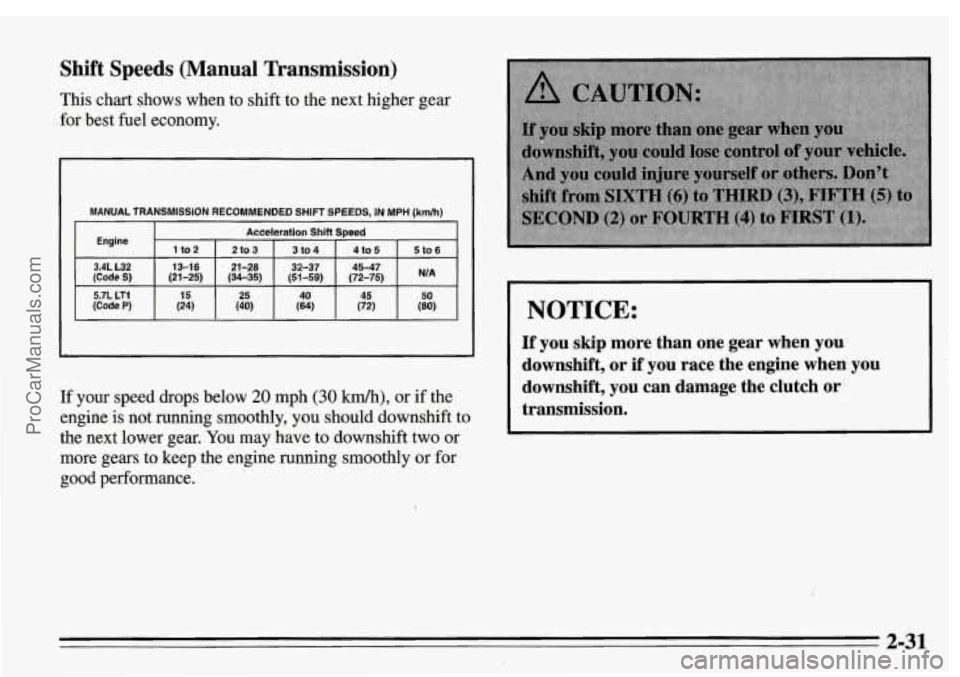
Shift Speeds (Manual Transmission)
This chart shows when to shift to the next higher gear
.for best fuel economy.
I MANUAL TRANSMISSION RECOMMENDED SHIFT SPEEDS, IN MPH (kmh) I
Engine Acceleration Shifi Speed
1 to 2 2 to 3 3 to 4 4t0 5 5 to 6 r
(Code S) 3.4L L32 13-16 21-28 32-37 (21-25) (34-35) (51-59) (72-75) 45-47 NIA
If your speed drops below 20 mph (30 kmk), or if the
engine
is not running smoothly, you should downshift to
the next lower gear.
You may have to downshift two or
more gears to keep the engine running smoothly or for
good performance.
NOTICE: I
If you skip more than one gear when you)
downshift, or if you race the engine wheaiyou
downshift, you can
damage the clutch or"
transmission.
2-31
ProCarManuals.com
Page 82 of 386

2. Move the shift lever into PARK (P) position like
this:
Hold in the button on the lever, and push the
lever all the way toward the front of your car.
3. Move the ignition key to LOCK.
4. Remove the key and take it with you. If you can
walk away from your car with the ignition key in
your hand, your car
is in PARK (P).
Leaving Your Vehicle With the Engine
Running (Automatic Transmission Models
Only)
If you have to leave your vehicle with the engine
running, be sure your vehicle is in PARK (P) and your
parking brake is firmly set before you leave it. After
you’ve moved the shift lever into the PARK (P)
position, hold the regular brake pedal down. Then, see if
you can move the shift lever away from PARK (P)
without first pushing the button. If you can, it means
that the shift lever wasn’t fully locked into PARK
(P).
Torque Lock (Automatic Transmission)
If you are parking on a hill and you don’t shift your
transmission into PARK (P) properly, the weight of the
vehicle may put too much force on the parking pawl in
the transmission. You may find it difficult to pull the
shift lever out of PARK (P). This is called “torque lock.”
To prevent torque lock, set the parking brake and then
shift into PARK
(P) properly before you leave the
driver’s seat. To find out how, see “Shifting Into
PARK
(P)” in the Index.
When you are ready to drive, move the shift lever out of
PARK (P)
before you release the parking brake.
If “torque lock” does occur, you may need to have
another vehicle push
yours a little uphill to take some of
the pressure from the transmission,
so you can pull the
shift lever out of PARK (P).
2-35
ProCarManuals.com
Page 83 of 386

Shiftiqg out of PARK (P)
(Authmatic .. .. Transmission)
Parking Your Vehicle
(Manual Transmission)
Your Pontic has a brake-transmission shift interlock. Before you get out of your vehicle, put your manual
You hqve to hlly apply your regular brake before you transmission in REVERSE (R) and firmly apply the
ca~ shjft from PARK (P) when the ignition is in the parking brake.
RUN position. See “Automatic Transmission” in the
Index.
If yov cmot shift out of PARK (P), ease pressure on
the shift lever - push the shift lever all the way into
PARK (P) and release the shift lever button as you
maintain brake application. Then press the shift lever
button
and move the shift lever into the gear you wish.
If you per hold the brake pedal down but still can’t
shift out
of PARK (P), try this:
1. Turn @e key to OFF.
If your vehicle is equipped to tow a trailer, see “Towing
a Trailer” in the Index.
2, Apply and hold the brake.
3. Shift to NEUTRAL (N).
4. St& the vehicle and then shift to the drive gear you
5. Have the vehicle fixed as soon as you can,
ww!.
ProCarManuals.com
Page 85 of 386

Running Your Engine While You’re
Parked (Automatic Transmission)
It’s better not to park with the engine running. But if you
ever have to, here are some things to know.
Follow the proper steps to be sure your vehicle won’t
move. See “Shifting Into
PARK (P)” in the Index.
If you are parking on a hill and if you’re pulling a
trailer, also see “Towing a Trailer” in the Index.
2-38
ProCarManuals.com
Page 92 of 386

Cruise Control (Option)
With cruise control, you can maintain a speed of about
25 rnph (40 km/h) or more without keeping your foot on the
accelerator.
This can really help on long trips. Cruise control
does not work at speeds below about
25 mph (40 km/h).
When you apply your brakes, or push the clutch pedal,
if you have a manual transmission, the cruise control
shuts
off.
If your vehicle is in cruise control when the optional
traction control system begins to limit wheel spin,
the cruise control will automatically disengage. (See
“Traction Control” in the Index.) When road conditions
allow you to safely use it again, you may
turn the cruise
back on.
2-45
ProCarManuals.com
Page 95 of 386

To Reduce Speed While Using Cruise
Control
There are two ways to reduce your speed while using
cruise control:
1. Push the button at the end of the lever until you
reach the lower speed you want, then release it.
2. To slow down in very small amounts, push the
button for less than half a second. Each time you do
this, you’ll go about
1 mph (1.6 km/h) slower.
Passing Another Vehicle While Using
Cruise Control
Use the accelerator pedal to increase your speed. When
you take your foot
off the pedal, your vehicle will slow
down to the cruise control speed you set earlier.
Using Cruise Control on Hills
How well your cruise control will work on hills depends
upon your speed, load, and the steepness of
the hills.
When going up steep hills, you may have to step on the
accelerator
pedal to maintain your speed. When going
downhill, you may have to brake or
shift to a lower gear to
keep your speed down. Of course, applying the brake takes you out of cruise control. Many drivers find
this to be too
much trouble and don’t use cruise control on steep
hills.
To Get Out of Cruise Control
There are several ways to turn off the cruise control:
1. Step lightly on the brake pedal or clutch pedal, if you
have a manual transmission; or
2. Move the cruise switch to OW.
2-48
ProCarManuals.com
Page 109 of 386
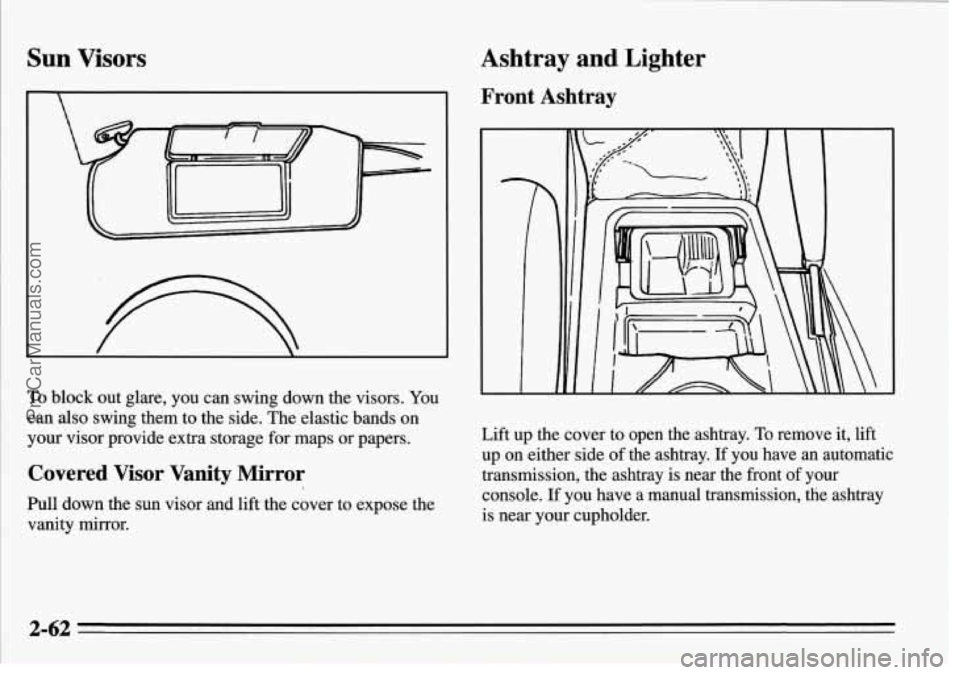
Sun Visors
To block out glare, you can swing down the visors. You
can also swing them to the side. The elastic bands on
your visor provide extra storage for maps or papers.
Covered Visor Vanity Mirror I
Pull down the sun visor and lift the cover to expose the
vanity mirror.
Ashtray and Lighter
Front Ashtray
Lift up the cover to open the ashtray. To remove it, lift
up on either side
of the ashtray. If you have an automatic
transmission, the ashtray is near the front of your
console. If you have
a manual transmission, tfie ashtray
is near your cupholder.
ProCarManuals.com