brake PONTIAC FIREBIRD 1995 Workshop Manual
[x] Cancel search | Manufacturer: PONTIAC, Model Year: 1995, Model line: FIREBIRD, Model: PONTIAC FIREBIRD 1995Pages: 386, PDF Size: 19.66 MB
Page 269 of 386

Open the cap labeled WASHER FLUID ONLY. Add
washer fluid until the tank is full.
NOTICE:
When using concentrated washer fluid,
follow the manufacturer’s instructions for
adding water.
0 Don’t mix water with ready-to-use washer
fluid. Water can cause the solution to freeze
and damage your washer fluid tank and
other parts of the washer system. Also,
water doesn’t clean as well as washer fluid.
0 Fill your washer fluid tank only 3/4 full
when it’s very cold. This allows for
expansion, which could damage the tank
if
it is completely full.
windshield washer. It can damage your
washer system and paint.
0 Don’t use radiator antifreeze in your
Brake Master Cylinder
Your brake master cylinder is here. It is filled with
DOT-3 brake fluid.
There are only two reasons why the brake fluid level in
your master cylinder might go down. The first is that the
brake fluid goes down to an acceptable level during
normal brake lining wear. When new linings are put in,
the fluid level goes back up. The other reason is that
fluid is leaking out
of the brake system. If it is, you
should have your brake system fixed, since a leak means
that sooner or later your brakes won’t work well, or
6-36
ProCarManuals.com
Page 270 of 386

I
won’t work at all. So, it isn’t a good idea to “top off’
your brake fluid. Adding brake fluid won’t correct a
leak. If
you add fluid when your linings are worn, then
you’ll have too much fluid when you get new brake
linings.
You should add (or remove) brake fluid, as
necessary, only when work is done
on the brake
hydraulic system.
Refer to the Maintenance Schedule to determine when to
check your brake fluid. See “Periodic Maintenance
Inspections”
in the Index.
To Check Brake Fluid
You can check the brake fluid without taking off the cap.
Just look at the brake fluid reservoir. The fluid
level
should be above the plastic seam in the reservoir. If it
isn’t, have your brake system checked to see if there is a
leak.
After work is done on the brake hydraulic system, make
sure the level
is above the plastic seam, near the base of
the filler neck.
6-37
ProCarManuals.com
Page 271 of 386

What to Add
When you do need brake fluid, use only DOT-3 brake
fluid
-- such as Delco Supreme 11 @ (GM Part
No. 1052535). Use new brake fluid from a sealed
container only,
and always clean the brake fluid
reservoir cap before removing it.
c,
NOTICE:
Don’t let someone put in the wrong kind of
fluid. For example, just a few drops of
mineral-based oil, such as engine oil, in
your brake system can damage brake
system parts
so badly that they’ll have to be
replaced.
Brake fluid can damage paint, so be careful
not to spill brake fluid on your vehicle.
If
you do, wash it off immediately. See
“Appearance Care” in the Index.
Brake Wear
Unless you have the four-wheel disc brake option, your
Pontiac has front disc brakes and rear drum brakes.
Disc brake pads have built-in wear indicators that make a
high-pitched wanzing sound when the brake pads are
worn and new pads
are needed. The sound may come and
go or be heard all the time your vehicle is moving (except
when you
are pushing on the brake pedal firmly).
NOTICE:
Continuing to drive with worn-out brake pads
could result in costly brake repair.
6-38
ProCarManuals.com
Page 272 of 386

Some driving conditions or climates may cause a brake
squeal when the brakes are first applied or lightly
applied, This does not mean something is wrong with
your brakes.
If you have rear drum brakes, they don’t have wear
indicators, but if you ever hear a rear brake rubbing
noise, have the rear brake linings inspected.
Also, the
rear brake drums should be removed and inspected each
time the tires are removed for rotation or changing.
When you have the front brakes replaced, have the rear
brakes inspected, too.
Brake linings should always be replaced as complete
axle sets.
Brake Pedal Travel
See your dealer if the brake pedal does not return to
normal height, or
if there is a rapidincrease in pedal
travel.
This could be a sign of brake trouble.
Brake Adjustment
Every time you make a moderate brake stop, your disc
brakes adjust for wear. If you rarely make a moderate or
heavier stop, then your brakes might not adjust correctly.
If you drive in that way, then -- very carefully -- make
a few moderate brake stops about every 1,000 miles
(1 600 km), so your brakes will adjust properly.
If your brake pedal goes down farther than norrid, your
rear drum brakes may need adjustment. Adjdsi them by
backing up and firmly applying the brakes a few times.
Replacing Brake System Parts
The braking system on a modern vehicle is complkx. Its
many parts have to be of top quality and wokk well.
together if the vehicle is to have really good briking.
Vehicles
we design and test have top-quality GM brake
parts
in them, as your Pontiac does when it is new.
When you replace parts of your braking system, -- for
example, when your brake linings wear down dnd yob .
have to have new ones put in -- be sure you get new
genuine
GM replacement parts. If you don’t, yuia
brakes
may no longer work properly. For em$le, if
someone puts in brake linings that are wrong
€& ybuf
vehicle, the balance between your front and re& btakes
can change
-- for the worse. The braking perfoi-mhnce ,
you’ve come to expect can change in many other way$ if
someone puts in the wrong replacement brake parts.
,& b .. - i*
t
-
,%
ProCarManuals.com
Page 288 of 386

NOTICE:
The wrong wheel can also cause problems with
bearing life, brake cooling,
speedometer/odometer calibration, headlamp
aim, bumper height, vehicle ground clearance,
and tire or tire chain clearance to the body and
chassis.
Used Replacement Wheels
Tire Chains
NOTICE:
If your Pontiac has P235/55R16, or P245/50ZR16
size tires, don’t use tire chains; they can dqpage
your vehicle.
If you have other tires, use tire chains only where
legal and only when you must. Use only
SAE
Class “S” type chains that are the proper size for
your tires. Install them on the rear tires and
tighten them as tightly
as possible with the ends
securely fastened. Drive slowly and follow the
chain manufacturer’s instructions.
If you can
hear the chains contacting your vehicle, stop and
retighten them.
If the contact continues, slow
down until
it stops. Driving too fast or spinning
the wheels with chains
on will damage your
vehicle.
6-55
ProCarManuals.com
Page 301 of 386

5. PCM IGN: Powertrain Control Module; Fuel Pump
Re1ay;Theft Deterrent Module; Engine Mass Air
Flow Sensor (V8 Engine)
6. STOP/HAZARD: Brake Light/Cruise Release
Switch; Hazard Flasher
7. PWR ACCY: Power Door Locks; Power Mirrors;
Hatch Release Switch; Auxiliary Accessory Wire
8. COURTESY: Audio Alarm Module; Courtesy
Lamps: Console Compartment, Glove Box, Dome,
Trunk, Rear Courtesy, Rearview Mirror; Radio;
Theft Deterrent Module; SECURITY Indicator;
Hatch Release Relay; Keyless Entry Receiver
9. GAGES: Audio Alarm Module; Daytime Running
Lamps Module (Canada); Diagnostic Energy
Reserve Module; Instrument Cluster; Keyless Entry
Receiver; Brake Switch Assembly; Auxiliary
Accessory Wire
10. TAIL LTS: Exterior Lighting
11.
CIGAR/HORN: Cigarette Lighter; Horn Relay;
12. DEFOGBEATS: Power Seats; Rear Defogger
13.
IP DIMMER: Brightness Control
14.
WIPEWASH: Windshield Wipermasher
15. WINDOWS: Power Windows, Convertible Top
Data Link Connector
Switch (Circuit Breaker); Cooling Level Latching
Module
16. CRANK: Diagnostic Energy Reserve Module
17.
RADIO: Radio Amplifier; Steering Wheel Controls
ProCarManuals.com
Page 302 of 386

Underhood Electrical Center
LJ
INJECTOR
D7.52 I INJECTOR I
Relays
B: Air Conditioning Compressor
C: Anti-Lock Brake System
D: Coolant Fan Number 1
E: Air Pump
F: Coolant Fan Number 2
G: Traction Control System
H: Fog Lamps
J: Cooling Fan Number 3
6-69
ProCarManuals.com
Page 303 of 386

Fuses
1. ABS BAT Electronic Brake Control Module
2. FOG LTS: Fog Lamps
3. R HDLP DR: Headlamp Doors Module
4. L HDLP DR: Headlamp Doors Module
5. ABS IGN: Anti-Lock Brake System
6. FANS/ACTR: Coolant Fan Relays; EVAP Canister
Purge So1enoid;Exhaust Gas Recirculation; Reverse
Lockout So1enoid;Skip
Shift Solenoid; Heated
Oxygen Sensors
(V8 Engine)
7. AIR PUMP: Air Pump Relay
8. PCM: Powertrain Control Module
9. INJECTOR: Fuel Injectors
10. INJECTOR: Fuel Injectors
11. IGNITION: VIN Engine Code S: Camshaft Position
Sensor;Crankshaft Position Sensor; Ignition Control
Modu1e;Automatic Transmission; Ignition Coil (V-8 Engine); Ignition Coil Module (V-8 Engine)
12. A/C-CRUISE: Air Conditioning Compressor Relay;
Cruise Control Switches and Module
ProCarManuals.com
Page 353 of 386
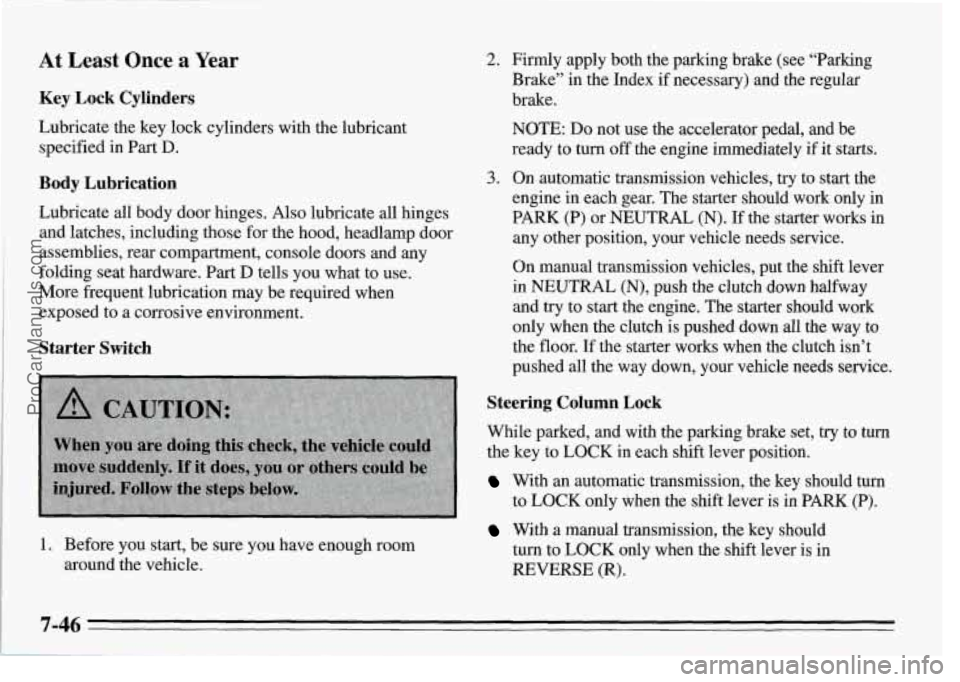
At Least Once a Year
Key Lock Cylinders
Lubricate the key lock cylinders with the lubricant
specified in Part
D.
Body Lubrication
Lubricate all body door hinges. Also lubricate all hinges
and latches, including those for the hood, headlamp door
assemblies, rear compartment, console doors and any
folding seat hardware.
Part D tells you what to use.
More frequent lubrication may be required when
exposed to
a corrosive environment.
Starter Switch
1. Before you start, be sure you have enough room
around the vehicle.
2. Firmly apply both the parking brake (see “Parking
Brake” in the Index if necessary) and the regular
brake.
NOTE:
Do not use the accelerator pedal, and be
ready to turn
off the engine immediately if it starts.
3. On automatic transmission vehicles, try to start the
engine
in each gear. The starter should work only in
PARK (P) or NEUTRAL (N). If the starter works in
any other position, your vehicle needs service.
On manual transmission vehicles, put the shift lever
in NEUTRAL
(N), push the clutch down halfway
and
try to start the engine. The starter should work
only when the clutch
is pushed down all the way to
the floor. If the starter works when the clutch isn’t
pushed
all the way down, your vehicle needs service.
Steering Column Lock
While parked, and with the parking brake set, try to turn
the key to LOCK in each shift lever position.
With an automatic transmission, the key should turn
to LOCK only when the shift lever is in PARK (P).
With a manual transmission, the key should
turn to LOCK only when the shift lever is in
REVERSE (R).
7-46
_I
ProCarManuals.com
Page 354 of 386

On vehicles with a key release button, try to turn the key Park on a fairly steep hill, with the vehicle facing
to LOCK without pressing the button. The key should downhill. Keeping your foot on the regular brake, set the
turn to LOCK only with the key button depressed. parking brake.
On all vehicles, the key should come out only in LOCK. 0 To check the parking brake: With the engine running
Parking Brake and Automatic Transmission PARK foot pressumfrom the regular brake pedal. Do this
(P) Mechanism Check until the vehicle is held by the parking brake only.
and transmission in NEUTRAL (N), slowly remove
0 To check the PARK (P) mechanism's holding ability:
Shift to PARK (P). Then release all brakes.
Underbody Flushing
At least every spring, use plain water to flush any
corrosive materials from the underbody. Take care to
clean thoroughly
any areas where mud and other debris
can collect.
t '. . .. , . 5; 1
f'
7-47
ProCarManuals.com