manual transmission PONTIAC FIREBIRD 1997 Owner's Manual
[x] Cancel search | Manufacturer: PONTIAC, Model Year: 1997, Model line: FIREBIRD, Model: PONTIAC FIREBIRD 1997Pages: 410, PDF Size: 19.2 MB
Page 208 of 410

To turn off the flashers, pull
out on the collar.
When the hazard warning flashers
are on, your turn
signals won’t work.
Other Warning Devices
If YOU carry reflective triangles, you can set one up at
the side
of the road about 300 feet (100 m) behind
your vehicle.
Jump Starting
If your battery has run down, you may want to use
another vehicle and some jumper cables to start your
Pontiac. But please use the following steps to do
it safely.
JA NTION:
I
Batteries can hurt you. They can be dangerous
because:
They contain acid that can burn you.
They contain gas that can explode or ignite.
They contain enough electricity to burn you.
If you don’t follow these steps exactly, some or all
of these things can hurt you.
NOTICE:
Ignoring these steps could result in costly damage
to your vehicle that wouldn’t be covered by
your warranty.
Trying to start your Pontiac by pushing
or
pulling it could damage your vehicle, even if you
have a manual transmission. And if you have an
automatic transmission,
it won’t start that way.
5-3
Page 231 of 410
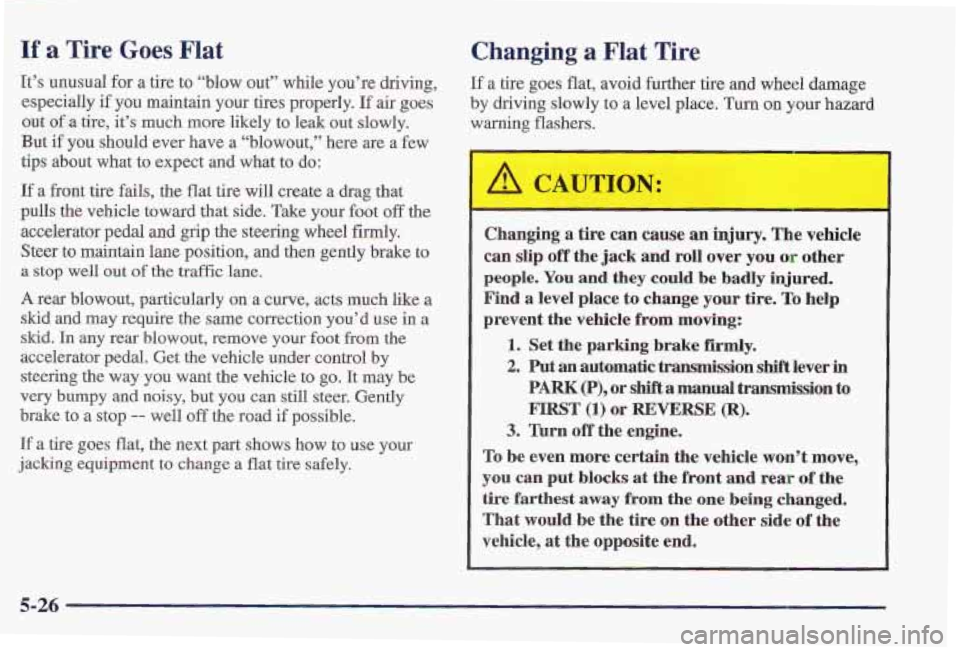
If a Tire Goes Flat
It’s unusual for a tire to ‘‘blow out’’ while you’re driving,
especially if you maintain your tires properly. If air goes
out of a tire, it’s much more likely to leak out slowly.
But
if you should ever have a “blowout,” here are a few
tips about what to expect and what to do:
If a front tire fails, the flat tire will create a drag that
pulls the vehicle toward that side. Take your foot off the
accelerator pedal and
grip the steering wheel firmly,
Steer to maintain lane position, and then gently brake to
a st,ot, well out of the traffic lane.
A rear blowout, particularly on a curve, acts much like a
skid and may require the same correction you’d use in a
skid. In any rear blowout, remove your foot from the
accelerator pedal. Get the vehicle under control
by
steering the way you want the vehicle to go, It may be
very bumpy and noisy, but you can still steer. Gently
brake
to a stop -- well off the road if possible,
If
a tire goes flat, the next part shows how to use your
jacking equipment to change a flat tire safely.
Changing a Flat Tire
If a tire goes flat, avoid further tire and wheel damage
by driving slowly t,o a level place.
Turn on your hazard
warning flashers.
Cham- ng a tire can cause an injury. The vehicle
can
slip off the jack and roll over you or other
people. You and they could be badly injured.
Find
a level place to change your tire. To help
prevent the vehicle from moving:
1. Set the parking brake firmly,
2. Put an automatic transmission shift lever in
PARK (P), or shift a manual transmission tu
FIRST (1) or REWRSE (R).
3. Turn off the engine.
To be even more certain the vehicle wan? move,
you can put blocks at the front and rear of the
tire farthest away from the one being changed.
That would
be the tire on the other side of the
vehicle, at the opposite ~ end,
5-26
Page 245 of 410

NOTICE:
b
Spinning your wheels can destroy parts of your
vehicle as well
as the tires. If you spin the wheels
too
fast while shifting your transmission back
and forth, you can destroy your transmission.
For information about using tire chains on your vehicle,
see “Tire Chains” in the Index.
Rocking Your Vehicle To Get It Out
First, turn your steering wheel left and right. That will
clear the area around your front wheels.
If your vehicle
has traction control, you should turn the system off. (See
“Traction Control System”
in the Index.) Then shift
back and forth between
REVERSE (R) and a forward
gear
(or with a manual transmission, between FIRST (I)
I or SECOND (2) and REVERSE (R)), spinning the
wheels
as little as possible. Release the accelerator pedal
while you shift, and press lightly on the accelerator
pedal when the transmission is
in gear. If that doesn’t
get you out after
a few tries, you may need to be towed
out. If you do need to be towed out, see “Towing Your
Vehicle’’ in the Index.
5-40
Page 246 of 410

Section 6 Service and Appearance Care
Here you will find information about the care of your Pontiac. This section begins with service and fuel information,
and then it shows how to check imDortant fluid and lubricant levels. There is also technical information about your I
vehicle, and a part devoted to its appearance care.
6-2 Service
6-3 Fuel
6-5 Fuels in Foreign Countries
6-6 Filling Your Tank
6- 8 Checking Things Under the Hood
6- 12 Engine Oil
6-18 Air Cleaner
6-22 Automatic Transmission Fluid 6-27 Manual Transmission Fluid
6-29 Engine Coolant
6-3
3 Power Steering Fluid
6-35 Windshield Washer Fluid
6-36 Brakes
6-40 Battery
6-4
1 Bulb Replacement 6-49
6-58
6-5
8
6-6 1
6-63
6- 64
4-65
6-66
6- 67
6-68
6-68
6-68
6-73
6-73
Tires
Appearance Care Cleaning the Inside
of Your Pontiac
Care
of Safety Belts
Cleaning the Outside
of Your Pontiac
Aluminum
or Chrome Wheels
Tires
Underbody Maintenance
Appearance Care Materials Chart
Vehicle Identification Number (VIN)
Service Parts Identification Label
Electrical System
Replacement
Bulbs
Capacities and Specifications
6-1
Page 272 of 410

Manual Transmission Fluid
When to Check
A good time to have it checked is when the engine oil is
changed. However, the fluid in your manual
transmission doesn’t require changing.
How to Check
Because this operation can be difficult, you may
choose to have this done at your Pontiac dealership
Service Department.
If you do it yourself, be sure to follow all the
instructions here, or
you could get a false reading.
NOTICE:
Too much or too little fluid can damage your
transmission.
Too much ‘can mean that some of
the fluid could come out and fall on hot engine parts
or exhaust system parts, starting a fire. Be
: sure to get an accurate reading if you check your
I transmission fluid.
Check the fluid level only when your engine is off, the
vehicle is parked on a level place and the transmission is
cool
enough for you to rest your fingers on the
transmission case.
Then, follow these steps:
1. Remove the filler plug.
2. Check that the lubricant level is up to the bottom
of the filler plug hole.
3. If the fluid level is good, install the plug and be sure
it is fully seated. If the fluid level
is low, add more
fluid as described in the next steps.
How to Add Fluid
Here’s how to add fluid. Refer to the Maintenance
Schedule to determine what kind of fluid to use. See
“Recommended Fluids and Lubricants” in the Index.
1. Remove the filler plug.
2. Add fluid at the filler plug hole. Add only enough
fluid to bring the fluid level up to the bottom of
the filler plug hole.
3. Install the filler plug. Be sure the plug is fully seated.
6-27
Page 319 of 410

Capacities (Approximate)
The following approximate capacities are given in
English. and metric conversions. Please refer to
“Recommended Fluids and Lubricants” in the Index
for more information.
Air Conditioning?
, ... See the refrigerant
information label
under the hood.
Automatic Transmission Drain and Refill
............... 10 pints (4.7 L)*
Overhaul
VIN Engine Code K ........ 17.6 pints (8.3 L)*
VIN Engine Code P ....... 2 1.6 pints (10.2 L)*
Cooling System
VIN Engine Code K
With Manual Transmission . . 12.5 quarts (11.8 L)
With Automatic Transmission 12.3 quarts (1 1.6 L)
VIN Engine Code P
With Manual Transmission . 15.3 quarts (14.5 L)
With Automatic Transmission 15.1 quarts (14.3 L)
Crankcase
Oil and Filter Change
3800 (VIN K) ........... 4.5 quarts (4.3 L)**
5.7L (VIN P ) ............ 5.0 quarts (4.7 L)**
Fuel Tank
.................. 15.5 gallons (58.7 L)
Manual Transmission
Five-Speed
........... , . 6.8 pints (3.2 L)*
Six-Speed .......... ..... 8.0 pints (3.8L)*
Rear Axle Lubricant ............ 3.5 pints (1.7L)
Not all air conditioning refrigerants are the same.
If the air conditioning system in your vehicle needs
refrigerant, be sure the proper refrigerant is used.
If you’re not sure, ask your Pontiac dealer,
* Recheck fluid level after filling. See “Automatic
Transmission Fluid”
or “Manual Transmission Fluid”
in the Index.
** Recheck the oil level after filling. See “Engine Oil”
in
the Index.
6-74
Page 331 of 410

I Short Trip/City Maintenance Schedule I
I!T9000 Miles (25 000. km)
0 Change engine oil and filter (or every
3 months, whichever occurs first).
An,Emission Control Service.
0 Inspect air cleaner filter if you are driving
in dusty conditions. Replace filter if
necessary.
An Emission Control Servic'e. (See
footnote"f.)
0 Change 'automatic transmission fluid and
filter
if the vehicle is mainly driven I.-- ler
one or more of these conditions:
- In heavy city traffic where the outside
temperature regularly reaches
90 OF
(32°C) or higher.
- In hilly or mountainous terrain.
- When doing frequent trailer towing.
- Uses such as found in taxi, poli'ce or
delivery service.
lf you do not use your vehicle under any of
these conditions, change the fluid and filter at
~00,000 miles (166 000 km).
Manual transmission fluid doesn't
require chanqe.
- -
DATE
SERVICED BY: ACTUAL MILEAGE -
i
Page 334 of 410
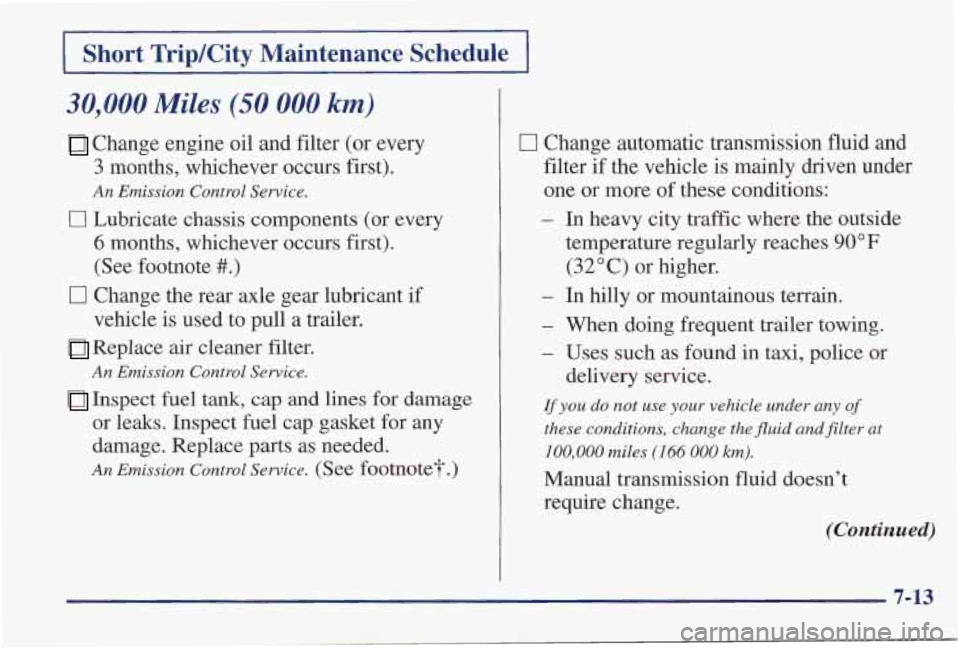
Short Trip/City Maintenance Schedule
30,000 Miles (50 000 km)
Change engine oil and filter (or every
3 months, whichever occurs first).
An Emission Control Service.
0 Lubricate chassis components (or every
6 months, whichever occurs first).
(See footnote
#.)
0 Change the rear axle gear lubricant if
vehicle is used to pull a trailer.
Replace air cleaner filter.
Inspect fuel tank, cap and lines for damage
or leaks. Inspect fuel cap gasket for any
damage. Replace parts as needed.
An Emission Control Service. (See footnote?.)
An Emission Control Service.
0 Change automatic transmission fluid and
filter if the vehicle is mainly driven under
one
or more of these conditions:
- In heavy city traffic where the outside
temperature regularly reaches
90" F
(32°C) or higher.
- In hilly or mountainous terrain.
- When doing frequent trailer towing.
- Uses such as found in taxi, police or
If you do not use your vehicle under any of
these conditions, change the fluid and-filter at
100,000 miles (166 000 km).
Manual transmission fluid doesn't
require change.
delivery service.
(Continued)
Page 338 of 410

I Short Trip/City Maintenance Schedule I
~~
Manual transmission fluid doesn’t require change.
in dusty conditions. Replace filter if
necessary.
An Emission Control Service.
(See footnote?.)
Inspect air cleaner filter if you are driving
t
DATE
SERVICED BY: ACTUAL MILEAGE
.
48,000 Miles (80 000 km)
Change engine oil and filter (or every
3 months, whichever occurs first).
An Emission Control Service.
Lubricate chassis components (or every
6 months, whichever occurs first).
(See footnote
#.)
Cl Change the rear axle gear lubricant if
vehicle
is used to pull a trailer.
0 Rotate tires. See “Tire Inspection and
Rotation” in the Index for proper rotation
pattern and additional information.
(See footnote
+.) (Also see footnote ++.)
DATE SERVICED BY: ACTUAL MILEAGE
7-17
Page 341 of 410

I Short Trip/City Maintenance Schedule I
60,000 Miles (I00 000 km) (Continued)
- Uses such as found in taxi, police or
If you do not use your vehicle under any of
these conditions, change the fluid and filter at
lO0,OOO miles (166 000 km).
Manual transmission fluid doesn’t
require change.
0 Inspect engine accessory drive belt.
0 Replace air cleaner filter.
delivery
service.
An Emission Control Service.
0 Inspect fuel tank, cap and lines for damage
or leaks. Inspect fuel cap gasket €or any
damage. Replace parts as needed.
An Emission Control Service. (See footnote?.)
0 Rotate tires. See “Tire Inspection and
Rotation’’ in the Index for proper rotation
pattern and additional
information.
(See footnote +.) (Also see hotnote ++.)