oil level PONTIAC FIREBIRD 1997 Owners Manual
[x] Cancel search | Manufacturer: PONTIAC, Model Year: 1997, Model line: FIREBIRD, Model: PONTIAC FIREBIRD 1997Pages: 410, PDF Size: 19.2 MB
Page 137 of 410

Low Oil Light
LOW
OIL
Your vehicle is equipped
with an oil level monitoring
system. When you start
your engine, the warning
light will come on briefly. If
the light doesn’t come on,
have it repaired.
If the light stays on after starting your engine, your
engine
oil level may be too low. You may need to add
oil. See “Engine Oil” in the Index.
NOTICE:
The oil level monitoring system only checks the
oil level when
you are starting your engine. It
does not keep monitoring the level once
your
engine is running. Also, the oil level check only
works when the engine has been turned off long
enough for the oil to drain back into the oil pan.
2-88
Page 187 of 410

Once you are moving on the freeway, make certain you
allow a reasonable following distance. Expect to move
slightly slower at night.
When you want to leave
the freeway, move to the proper
lane well in advance.
If you miss your exit, do not,
under any circumstances, stop
and back up. Drive on to
the next exit.
The exit ramp can
be curved, sometimes quite sharply.
The exit speed is usually posted.
Reduce
your speed according to your speedometer, not
to your sense of motion. After driving for any distance
at higher speeds, you may tend to think you are going
slower
than you actually are,
Before Leaving on a Long Trip
Make sure you’re ready. Try to be well rested. If you
must start when you’re not fresh
-- such as after a day’s
work
-- don’t plan to make too many miles that first part
of the journey. Wear comfortable clothing and shoes you
can easily drive in,
Is your vehicle ready for a long trip? If you keep it
serviced and maintained, it’s ready
to go. If it needs
service, have it done before starting out. Of course,
you’ll find experienced and able service experts in
Pontiac dealerships all across North America.
They’ll be
ready and willing to help if you need it.
Here are
some things you can check before a trip:
0
a
a
a
a
0
Windshield Washer Fluid: Is the reservoir full? Are
all windows clean inside and outside?
Wiper Blades: Are they in good shape?
Fuel, Engine Oil, Other Fluids: Have you checked
all levels?
Lamps: Are they all worlung? Are the lenses clean?
Tires: Th’ey are vitally important to a safe,
trouble-free trip.
Is the tread good enough for
long-distance driving? Are the tires all inflated to the
recomended pressure?
Weather Fureecasts: What’s the weather outlook
along your route? Should you delay
your trip a short
time to avoid a major storm system?
Maps: Do you have up-to-date maps?
4-22
Page 222 of 410

Heater and radiator hoses, and other engine
parts, can be very hot. Don’t touch them.
If you
do, you can be burned.
Don’t run the engine if there is a leak.
If you run
the engine,
it could lose all coolant. That could
cause an engine fire, and you could be burned.
Get any leak fixed before you drive the vehicle.
NOTICE:
Engine damage from running your engine
without coolant isn’t covered
by your warranty.
If there seems to be no leak, with the engine on, check to
see if the electric engine fans are running. If the engine
is overheating, both fans should be running. If they
aren’t, your vehicle needs service.
How to Add Coolant to the Coolant
Recovery Tank
If you haven’t found a problem yet, but the coolant level
isn’t at
FULL COLD add a 50/50 mixture of clean water
(preferably distilled) and DEX-COOL@ (silicate-free)
antifreeze at the coolant recovery tank. (See “Engine,
Coolant’’
in the Index for more information.)
Adding only plain water to your cooling system
can be dangerous. Plain water,
or some other
liquid like alcohol, can boil before the proper
coolant mix will. Your vehicle’s coolant warning
system is set for the proper coolant mix. With
plain
water or the wrong mix, your engine could
get too hot but you wouldn’t get the overheat
warning. Your engine could catch fire and you
or
others could be burned. Use a 50/50 mix of clean
water and DEX-COOL@coolant.
5-17
Page 246 of 410

Section 6 Service and Appearance Care
Here you will find information about the care of your Pontiac. This section begins with service and fuel information,
and then it shows how to check imDortant fluid and lubricant levels. There is also technical information about your I
vehicle, and a part devoted to its appearance care.
6-2 Service
6-3 Fuel
6-5 Fuels in Foreign Countries
6-6 Filling Your Tank
6- 8 Checking Things Under the Hood
6- 12 Engine Oil
6-18 Air Cleaner
6-22 Automatic Transmission Fluid 6-27 Manual Transmission Fluid
6-29 Engine Coolant
6-3
3 Power Steering Fluid
6-35 Windshield Washer Fluid
6-36 Brakes
6-40 Battery
6-4
1 Bulb Replacement 6-49
6-58
6-5
8
6-6 1
6-63
6- 64
4-65
6-66
6- 67
6-68
6-68
6-68
6-73
6-73
Tires
Appearance Care Cleaning the Inside
of Your Pontiac
Care
of Safety Belts
Cleaning the Outside
of Your Pontiac
Aluminum
or Chrome Wheels
Tires
Underbody Maintenance
Appearance Care Materials Chart
Vehicle Identification Number (VIN)
Service Parts Identification Label
Electrical System
Replacement
Bulbs
Capacities and Specifications
6-1
Page 257 of 410

Before closing the hood, be sure all the filler caps
are on.
Then just pull the hood down and close it firmly.
Engine Oil
LOW
It’s a good idea to check your engine oil every time you
get fuel. In order to get an accurate reading, the oil must
be warm and the vehicle must be on level ground.
Th,e engine
oil dipstick is the yellow loop near the back
of the engine.
If the LOW OIL light on the instrument panel comes on,
it means you need to check your engine oil level right
away.
For more information, see “Low Oil Light” in the
Index. You should check your engine oil level regularly;
this is an added reminder.
5.7L Engine Oil Dipstick
6- 12
Page 258 of 410

3800 Engine
3800 L36 (Code K) Oil Dipstick
Turn off the engine and give the oil a few minutes to
drain back into the oil pan.
If you don’t, the oil dipstick
might not show
the actual level.
Checking Engine Oil
Pull out the dipstick and clean it with a paper towel or
cloth, then push it back in all the way. Remove it again,
keeping the tip down, and check the level.
5.7L Engine
Page 259 of 410

When to Add Oil
If the oil is at or below the ADD line, then you’ll
need to add some oil. But you must use the right
kind. This part explains what kind
of oil to use, For
crankcase capacity, see “Capacities and Specifications”
in the Index,
NOTICE:
Don’t add too much oil. If your engine has
so much oil that the oil level gets above the
cross-hatched area that shows the proper
operating
range, your engine could be damaged,
b-
Just fill it enough to put the level somewhere in the
proper operating range.
Push the dipstick all the way
back in when you’re through.
What Kind of Oil to Use
Oils recommended for your vehicle can be identified by
looking for the “Starburst” symbol. This symbol
indicates that the oil has been certified by the American
Petroleum Institute
(BPI). Do not use any oil which
does not
carry this Starburst symbol.
If you change your own oil,
c the Starburst symbol on the
you have your oil changed
: for you, be sure the oil put ’ into your engine is
American Pewoleurn
P Institute certified for
L be sure you use oil that has
P front of the oil container. If
I --- gasoline engines.
You should also use the proper viscosity oil for your
vehicle,
as shown in the following chart:
6-14
Page 267 of 410
1 Vf a I IJ
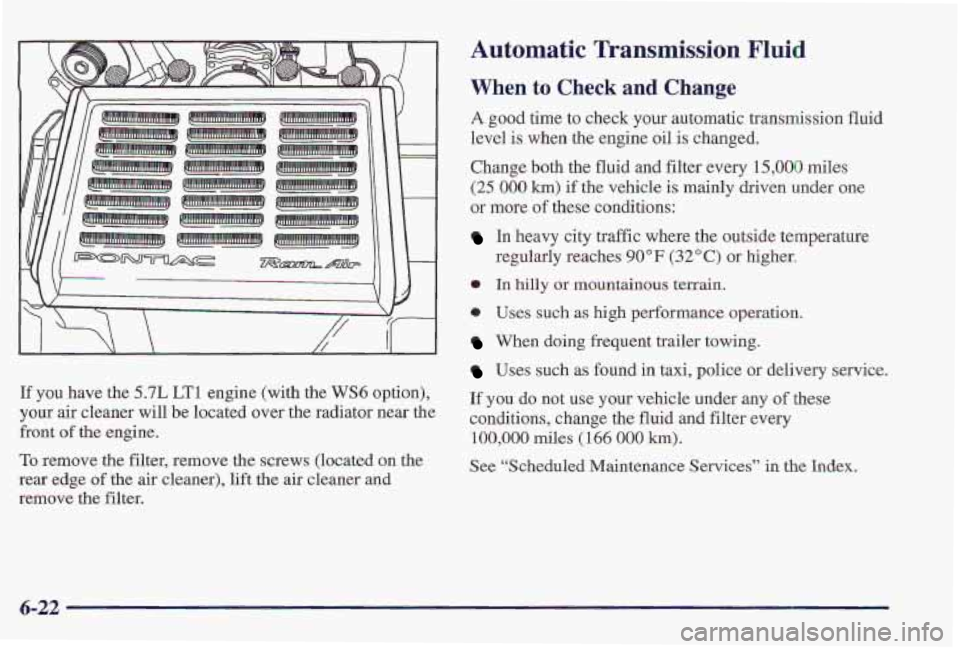
If you have the 5.7L LT1 engine (with the WS6 option),
your air cleaner will be located over the radiator near the
front
of the engine.
To remove the filter, remove the screws (located on the
rear edge of the air cleaner), lift the air cleaner and
remove
the filter.
Automatic Transmission Fluid
When to Check and Change
A good time to check your automatic transmission fluid
level is when the engine oil is changed.
Change both the fluid and filter every 15,000 miles
(25 000 km) if the vehicle is mainly driven under one
or more of these conditions:
In heavy city traffic where the outside temperature
0 In hilly or mountainous terrain.
regularly reaches
90” F (32” C) or higher.
0 Uses such as high
performance operation.
When doing frequent trailer towing.
Uses such as found in taxi, police or delivery service.
If you do
not use your vehicle under any of these
conditions, change the fluid and filter every
100,000 miles ( 166 000 km),
See “Scheduled Maintenance Services” in the Index.
6-22
Page 272 of 410

Manual Transmission Fluid
When to Check
A good time to have it checked is when the engine oil is
changed. However, the fluid in your manual
transmission doesn’t require changing.
How to Check
Because this operation can be difficult, you may
choose to have this done at your Pontiac dealership
Service Department.
If you do it yourself, be sure to follow all the
instructions here, or
you could get a false reading.
NOTICE:
Too much or too little fluid can damage your
transmission.
Too much ‘can mean that some of
the fluid could come out and fall on hot engine parts
or exhaust system parts, starting a fire. Be
: sure to get an accurate reading if you check your
I transmission fluid.
Check the fluid level only when your engine is off, the
vehicle is parked on a level place and the transmission is
cool
enough for you to rest your fingers on the
transmission case.
Then, follow these steps:
1. Remove the filler plug.
2. Check that the lubricant level is up to the bottom
of the filler plug hole.
3. If the fluid level is good, install the plug and be sure
it is fully seated. If the fluid level
is low, add more
fluid as described in the next steps.
How to Add Fluid
Here’s how to add fluid. Refer to the Maintenance
Schedule to determine what kind of fluid to use. See
“Recommended Fluids and Lubricants” in the Index.
1. Remove the filler plug.
2. Add fluid at the filler plug hole. Add only enough
fluid to bring the fluid level up to the bottom of
the filler plug hole.
3. Install the filler plug. Be sure the plug is fully seated.
6-27
Page 274 of 410

Rear Axle
When to Check and Change Lubricant
Refer to the Maintenance Schedule to determine how
often to check the lubricant and when to change it. See
“Scheduled Maintenance Services” in the Index.
How to Check Lubricant
If the level is below the bottom of the filler plug hole,
you’ll need to add some lubricant. Add enough lubricant
to raise the level to the bottom
of the filler plug hole,
What to Use
Standard Differential
Use Axle Lubricant (GM Part No. 12345977) or SAE
80W-90 GL-5 gear lubricant.
Limited-Slip Differential
To add lubricant when the level is low, use Axle
Lubricant (GM
Part No. 12345977). To completely refill
after draining, add 4 ounces
(1 18 ml) of Limited-Slip
Differential Lubricant Additive (GM Part
No. 1052358).
Then fill to the bottom of the filler plug hole with Axle
Lubricant
(GM Part No. 12345977).
Engine Coolant
The cooling s stem in your vehicle is filled with new
DEX-COOL 8 engine coolant. This coolant is designed
to remain in your vehicle for
5 years or 150,000 miles
(240
000 km) whichever occurs first, if you add only
DEX-COOL’ extended life coolant.
The following explains your cooling system and how
to add coolant when it is low. If you have a problem
with engine overheating or if you need to add coolant
to your radiator, see “Engine Overheating” in the Index.
A
50150 mixture’ of water and DEX-COOL@
coolant will:
Give freezing protection down to -34°F (-37°C).
Give boiling protection up to 265°F (129°C).
Protect against rust and corrosion.
e Help keep the proper engine temperature.
Let the warning lights and gages work as
they should.