Running PONTIAC FIREBIRD 1998 Owners Manual
[x] Cancel search | Manufacturer: PONTIAC, Model Year: 1998, Model line: FIREBIRD, Model: PONTIAC FIREBIRD 1998Pages: 406, PDF Size: 18.23 MB
Page 2 of 406

The 1998 Pontiac Firebird Owner’s Manual
1-1
2-1
3-1
4-1
5-1
Seats and Restraint Systems
This section tells you how to use your seats and safety belts\
properly. It also explains the “SRS” system.
Features and Controls
This section explains how to start and operate your vehicle.
Comfort Controls and Audio Systems
This section tells you how to adjust the ventilation and comfo\
rt controls and how to operate your audio system.
Your Driving and the Road
Here you’ll find helpful information and tips about the road\
and how to drive under different conditions.
Problems on the Road
This section tells what to do if you have a problem while driving,\
such as a flat tire or overheated engine, etc.
6-1 Service and Appearance Care
Here the manual tells you how to keep your vehicle running properly and looking good.
7-1
8-1
Maintenance Schedule
This section tells you when to perform vehicle maintenance and \
what fluids and lubricants to use.
Customer Assistance Information
This section tells you how to contact Pontiac for assistance and ho\
w to get service and owner publications.
It also gives you information on “Reporting Safety Defects”
on page 8-10.
9-1 Index
Here’s an alphabetical listing of almost every subject in this manual. You can use it to quickly find
something you want to read.
i
Page 6 of 406
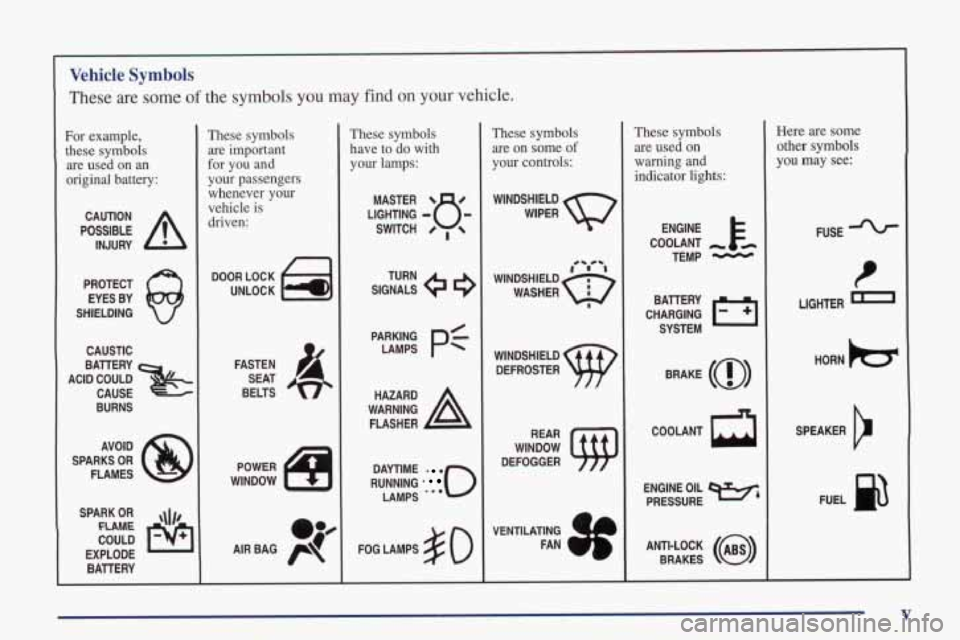
Vehicle Symbols
These are some of the symbols you may find on your vehicle.
For example,
these symbols are used on an
original battery:
POSSIBLE A
CAUTION
INJURY
PROTECT EYES BY
SHIELDING
CAUSTIC
BURNS
SPARK
OR ,\I/,
COULD
FLAUE
EXPLODE BAllERY
These symbols are important
for you and
your passengers whenever your
vehicle
is
driven:
DOOR LOCK
UNLOCK
FASTEN SEAT
BELTS
e?
AIR BAG p
These symbols
have to do with
your lamps:
SIGNALS @ 9
TURN
PARKING
pf
LAMPS
RUNNING
' 0
DAYTIME * 0
LAMPS
FOG LAMPS
$0
These symbols
are on some of
your controls:
WIPER 9
WINDSHIELD
DEFROSTER
WINDOW
DEFOGGER
VENTILATING
'*
FAN '-d
These symbols are used on
warning and
indicator lights:
COOLANT
TEMP
-
CHARGING I-1
BATTERY
SYSTEM
BRAKE
(a)
COOLANT a
ENGINE OIL
PRESSURE
ANTI-LOCK
(@)
BRAKES
Here are some
other symbols
you may see:
FUSE
P
LIGHTER -
HORN )d.
SPEAKER
k
FUEL la
V
Page 56 of 406

Section 2 Features and Controls
Here you can learn about the many standard and optional features on your vehicle, and inform\
ation on starting,
shifting and braking. Also explained are the instrument panel a\
nd the warning systems that tell you if everything
is
working properly -- and what to do if you have a problem.
2-2
2-4
2-6
2-11
2-13
2- 14
2-17
2-18
2-23
2-24
2-26 2-29
2-30
2-35
2-39
2-4 1
Keys
Door Locks
Remote Keyless Entry System
Hatch Theft
Content Theft-Deterrent System
(If Equipped)
PASS-Key@
I1
Feature Customization (If Equipped)
New Vehicle “Break-In”
Ignition Positions Starting Your Engine
Engine Coolant Heater (Canada Only)
Automatic Transmission Operation
Manual Transmission Operation
Shifting Into PARK (P)
(Automatic Transmission Only)
Shifting Out of PARK (P)
(Automatic Transmission)
2-4 1
2-42
2-42
2-43
2-44
2-45
2-46
2-46 2-52
2-55
2-57
2-58
2-62
2-69
2-76
2-79
Parking Your Vehicle (Manual Transmission)
Parking Over Things That Burn
Engine Exhaust
Running Your Engine While You’re Parked
(Automatic Transmission)
Parking Brake
Windows
Tilt Steering Wheel
Turn SignalMultifunction Lever
Exterior Lamps Interior Lamps
Mirrors Storage Compartments
%in Lift-off Roof Panels
(If Equipped)
Convertible
Top
Instrument Panel
Waming Lights, Gages and Indicators
2-1
Page 79 of 406

Ignition Positions
C
1
A i E
With the ignition key in the ignition, you can turn the
switch to five positions.
ACC (A): Position in which you can operate your
electrical power accessories. Push in the ignition switch
as you turn
it toward you.
LOCK (B): The only position from which you can
remove the key. This locks your steering wheel, ignition
and automatic transmission.
If you have an automatic transmission, the ignition
switch can’t be turned to
LOCK unless the shift lever is
in
PARK (P).
OFF (C): Unlocks the steering wheel, ignition and
automatic transmission, but does not send electrical
power to any accessories. Use this position if your
vehicle must be pushed or towed.
A warning tone will
sound
if you open the driver’s door when the ignition is
off and the key is in the ignition.
RUN (D): Position to which the switch returns after you
start your engine and release the switch. The switch
stays
in RUN when the engine is running. But even
when the engine
is not running, you can use RUN to
operate your electrical power accessories and to display some instrument panel warning and indicator lights.
START (E): Starts the engine. When the engine starts,
release the key. The ignition will return to RUN for
normal driving.
2-24
Page 80 of 406

Note that even if the engine is not running, ACC and
RUN allow you to operate your electrical accessories,
such as the radio and ventilation fan.
A CAUTION:
On manual transmission vehicles, turning the key
to
LOCK will lock the steering column and result
in a loss of ability to steer the vehicle. This could
cause a collision.
If you need to turn the engine
off while the vehicle is moving, turn the key only
to
OFF. Don’t press the key release button while
the vehicle is moving.
NOTICE:
If your key seems stuck in LOCK and you can’t
turn it, be sure you are using the correct key; if
so, is it all the way in? If it is, then turn the
steering wheel left and right while you turn the
key hard. But turn the key only with your hand.
Using
a tool to force it could break the key or the
ignition switch.
If none of this works, then your
vehicle needs service.
Key Release Button
If you have a manual
transmission, your ignition
lock has a key release
button.
You must press the
key release button to put the
ignition key in the
LOCK
position before you can take your key out.
2-25
Page 86 of 406
A CAUTION:
It is dangerous to get out of your vehicle if the
shift lever is not fully in PARK (P) with the
parking brake firmly set. Your vehicle can roll.
Don’t leave your vehicle when the engine is
running unless you have to.
If you have left the
engine running, the vehicle can move suddenly.
You
or others could be injured. To be sure your
vehicle won’t move, even when you’re on fairly
level ground, always set your parking brake and
move the shift lever to PARK
(P).
See “Shifting Into PARK (P)” in the Index. If
you’re pulling a trailer, see “Towing a Trailer” in
the Index. Ensure the
shift lever is fully
in PARK (P) before
starting the engine. Your vehicle has a
Brake-Transmission Shift Interlock
(BTSI). You have to
fully apply your regular brakes before you can shift
from PARK (P) when the ignition key is in RUN. If you
cannot shift out of PARK (P), ease pressure on the shift
lever. Push the shift lever all the way into PARK (P) and
also release the shift lever button on floor shift console
models as
you maintain brake application. Then move
the shift lever into the gear you wish. See “Shifting Out
of PARK (P)” in this section.
REVERSE (R): Use
this gear to back up.
I NOTICE:
Shifting to REVERSE (R) while your vehicle is
moving forward could damage your
transmission. Shift to REVERSE
(R) only after
your vehicle
is stopped.
To rock your vehicle back and forth to get out of snow,
ice or sand without damaging your transmission, see
“Stuck:
In Sand, Mud, Ice or Snow” in the Index.
2-31
Page 87 of 406
NEUTRAL (N): In this position, your engine
doesn’t connect with the wheels.
To restart when you’re
already
moving, use NEUTRAL (N) only. Also, use
NEUTRAL (N) when your vehicle is being towed.
Shifting out
of PARK (P) or NEUTRAL (N) while
your engine is “racing” (running
at high speed) is
dangerous. Unless your foot
is firmly on the
brake pedal, your vehicle could move very
rapidly. You could lose control and hit people or
objects. Don’t shift out
of PARK (P) or
NEUTRAL (N) while your engine is racing.
NOTICE:
Damage to your transmission caused by shifting
out
of PARK (P) or NEUTRAL (N) with the
engine racing isn’t covered by
your warranty.
I
AUTOMATIC OVERDRIVE (03): This position is
for normal driving. If you need more power for passing,
and you’re:
Going less than about 35 mph (56 km/h), push your
Going about 35 mph (56 km/h) or more, push the
You’ll shift down to the next gear and have more power.
THIRD (3): This position is also used for normal
driving, however, it offers more power and lower fuel
economy
than AUTOMATIC OVERDRIVE (a).
Here are some times you might choose THIRD (3)
instead of AUTOMATIC OVERDRIVE (a):
When driving on hilly, winding roads.
0 When towing a trailer, so there is less shifting
When going down a steep hill.
accelerator pedal about halfway down.
accelerator
all the way
down.
between gears.
2-32
Page 92 of 406

Shift Speeds
A CAUTION:
If you skip more than one gear when you
downshift, you could lose control of your vehicle.
And you could injure yourself or others. Don’t
shift from
SIXTH (6) to THIRD (3), or FIFTH (5)
to SECOND (2) or FOURTH (4) to FIRST (1).
MANUAL TRANSMISSION RECOMMENDED SHIFT SPEEDS, IN MPH (kmlh)
Acceleration Shlft Speed Engine 1 to2
(Code K) 45-47 32-37 21 -28 13-16 NIA (72-75)
(51-59)
(34-35)
(21-25) 3800 L36
5 to 6 4 to 5
3t04
2 to 3
This chart shows when to shift to the next higher gear
for best fuel economy.
If your speed drops below 20 mph (32 km/h), or if the
engine is not running smoothly, you should downshift to
the next lower gear. You may have to downshift two or
more gears to keep the engine running smoothly
or for
good perforrnance.
NOTICE:
If you skip more than one gear when you
downshift,
or if you race the engine when you
downshift, you can damage the clutch
or transmission.
2-37
Page 94 of 406
Shifting Into PARK (P)
:Automatic Transmission Only)
A CAUTION:
It can be dangerous to get out of your vehicle if
the shift lever is not fully in
PARK (P) with the
parking brake firmly set. Your vehicle can roll.
If
you have left the engine running, the vehicle can
move suddenly. You or others could be injured.
To be sure your vehicle won’t move, even when
you’re on fairly level ground, use the steps that
follow. If you’re pulling a trailer, see “Towing a
Trailer” in the Index.
0 Hold the brake pedal down with your right foot and
set the
parking brake.
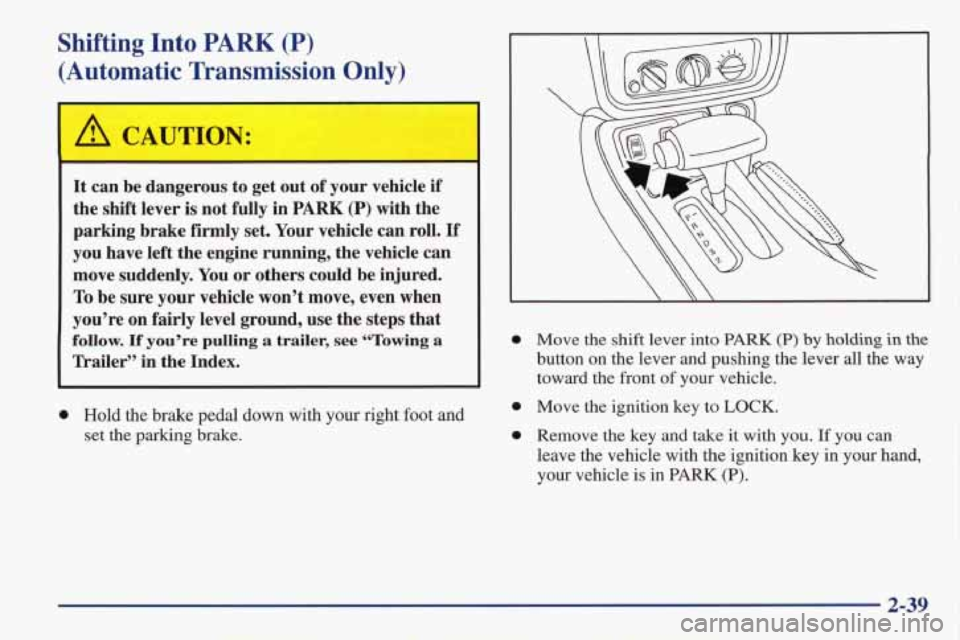
0 Move the shift lever into PARK (P) by holding in the
button on the lever and pushing the lever all the way
toward the front of your vehicle.
0 Move the ignition key to LOCK.
0 Remove the key and take it with you. If you can
leave the vehicle with the ignition key in your hand,
your vehicle
is in PARK (P).
2-39
Page 95 of 406

Leaving Your Vehicle With the Engine
Running (Automatic Transmission
Only)
It can be dangerous to leave your vehicle with the
engine running. Your vehicle could move
suddenly if the shift lever
is not fully in PARK (P)
with the parking brake firmly set. And, if you
leave the vehicle with the engine running, it could
overheat and even
catch fire. You or others could
be injured. Don’t leave your vehicle with the
engine running unless you have to.
Torque Lock (Automatic Transmission)
If you are parking on a hill and you don’t shift your
transmission into
PARK (P) properly, the weight of the
vehicle may put too much force on the parking pawl in
the transmission. You may find
it difficult to pull the
shift lever out
of PARK (P). This is called “torque lock.”
To prevent torque lock, set the parking brake and then
shift into
PARK (P) properly before you leave the
driver’s seat.
To find out how, see “Shifting Into
PARK (P)” in the Index.
When you are ready
to drive, move the shift lever out of
PARK (P) before you release the parking brake.
If torque lock does occur, you may need to have another
vehicle push
yours a little uphill to take some of the
pressure from the parking pawl
in the transmission, so
you can pull the shift lever out of PARK (P).
2-40