driver PONTIAC FIREBIRD 1999 Owners Manual
[x] Cancel search | Manufacturer: PONTIAC, Model Year: 1999, Model line: FIREBIRD, Model: PONTIAC FIREBIRD 1999Pages: 376, PDF Size: 2.86 MB
Page 7 of 376
1-
yellowblue
1-1
Section 1 Seats and Restraint Systems
Here you'll find information about the seats in your vehicle and how to use your safety belts properly. You can also
learn about some things you should not do with air bags and safety belts.
1
-2 Seats and Seat Controls
1
-9 Safety Belts: They're for Everyone
1
-13 Here Are Questions Many People Ask About
Safety Belts
-- and the Answers
1
-14 How to Wear Safety Belts Properly
1
-15 Driver Position
1
-22 Safety Belt Use During Pregnancy
1
-23 Right Front Passenger Position
1
-23 Supplemental Restraint System (SRS)1
-29 Rear Seat Passengers
1
-32 Children
1
-35 Child Restraints
1
-47 Larger Children
1
-50 Safety Belt Extender
1
-50 Checking Your Restraint Systems
1
-50 Replacing Restraint System Parts
After a Crash
Page 8 of 376
yellowblue
1-2
Seats and Seat Controls
This section tells you about the seats -- how to adjust
them and also about reclining front seatbacks, seatback
latches and the folding rear seatback.
Manual Front Seat
CAUTION:
You can lose control of the vehicle if you try to
adjust a manual driver's seat while the vehicle is
moving. The sudden movement could startle and
confuse you, or make you push a pedal when you
don't want to. Adjust the driver's seat only when
the vehicle is not moving.
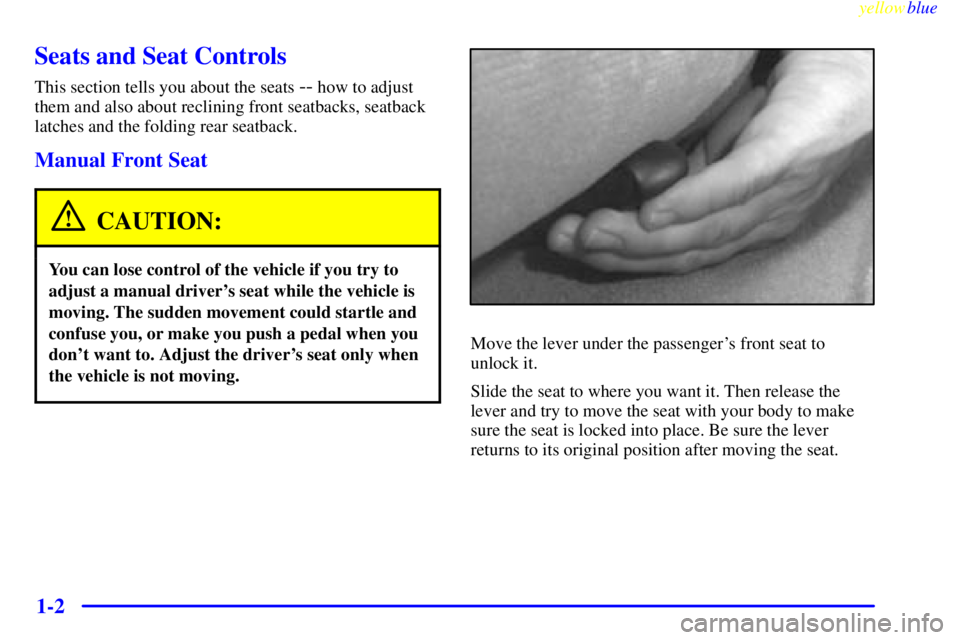
Move the lever under the passenger's front seat to
unlock it.
Slide the seat to where you want it. Then release the
lever and try to move the seat with your body to make
sure the seat is locked into place. Be sure the lever
returns to its original position after moving the seat.
Page 9 of 376
yellowblue
1-3 4-Way Manual Seat
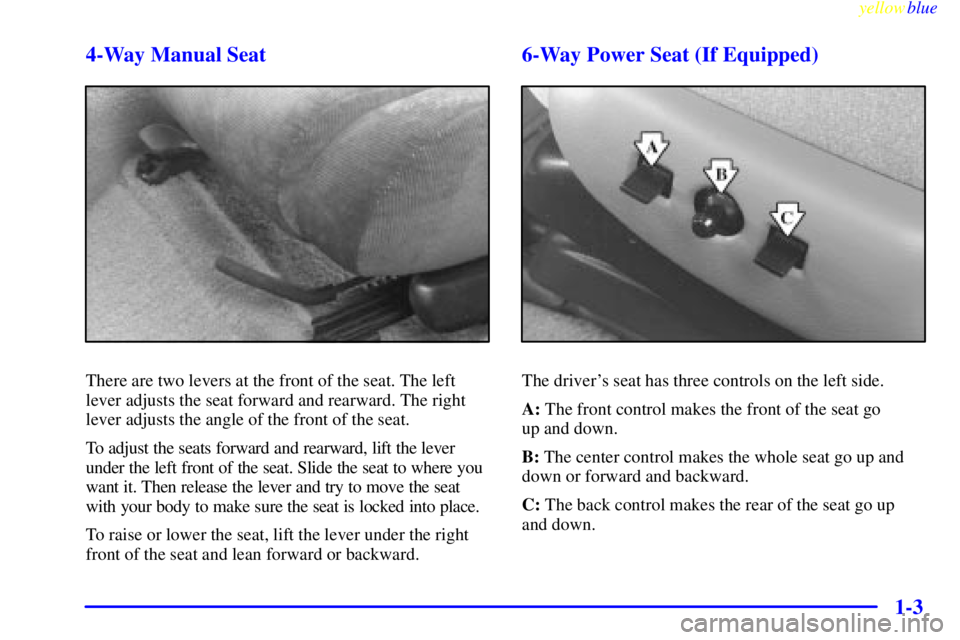
There are two levers at the front of the seat. The left
lever adjusts the seat forward and rearward. The right
lever adjusts the angle of the front of the seat.
To adjust the seats forward and rearward, lift the lever
under the left front of the seat. Slide the seat to where you
want it. Then release the lever and try to move the seat
with your body to make sure the seat is locked into place.
To raise or lower the seat, lift the lever under the right
front of the seat and lean forward or backward.
6-Way Power Seat (If Equipped)
The driver's seat has three controls on the left side.
A: The front control makes the front of the seat go
up and down.
B: The center control makes the whole seat go up and
down or forward and backward.
C: The back control makes the rear of the seat go up
and down.
Page 10 of 376
yellowblue
1-4 6-Way Power Seat with Lumbar/Lateral
Control (AQ9) (If Equipped)
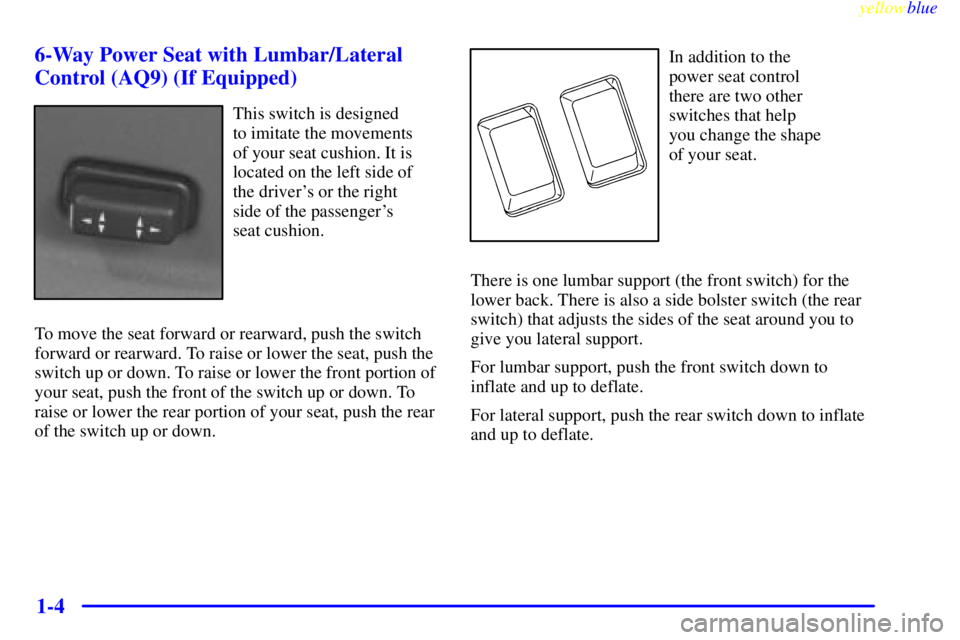
This switch is designed
to imitate the movements
of your seat cushion. It is
located on the left side of
the driver's or the right
side of the passenger's
seat cushion.
To move the seat forward or rearward, push the switch
forward or rearward. To raise or lower the seat, push the
switch up or down. To raise or lower the front portion of
your seat, push the front of the switch up or down. To
raise or lower the rear portion of your seat, push the rear
of the switch up or down.
In addition to the
power seat control
there are two other
switches that help
you change the shape
of your seat.
There is one lumbar support (the front switch) for the
lower back. There is also a side bolster switch (the rear
switch) that adjusts the sides of the seat around you to
give you lateral support.
For lumbar support, push the front switch down to
inflate and up to deflate.
For lateral support, push the rear switch down to inflate
and up to deflate.
Page 11 of 376

yellowblue
1-5 Fully Articulating Sport Seat (If Equipped)
If your vehicle has these seats, the driver's seat has the
four
-way manual seat adjuster. See ª4-Way Manual
Seatº earlier in this section. The passenger seat has the
two
-way manual seat adjuster. See ªManual Front Seatº
earlier in this section.
The switch pads on the outer side of the seats ªinflateº
and ªdeflateº parts of your seatback.
The two buttons that have ªdotsº inflate and deflate the
side bolster of the seatback. To inflate, press the raised
button. To deflate, press the indented button.
The two buttons without dots inflate and deflate the
lumbar (lower back area of the seatback) support. To
inflate, press the raised button. To deflate, press the
indented button.
Page 20 of 376

yellowblue
1-14
Q:If I'm a good driver, and I never drive far from
home, why should I wear safety belts?
A:You may be an excellent driver, but if you're in an
accident
-- even one that isn't your fault -- you and
your passengers can be hurt. Being a good driver
doesn't protect you from things beyond your
control, such as bad drivers.
Most accidents occur within 25 miles (40 km) of
home. And the greatest number of serious
injuries and deaths occur at speeds of less than
40 mph (65 km/h).
Safety belts are for everyone.
How to Wear Safety Belts Properly
Adults
This part is only for people of adult size.
Be aware that there are special things to know about
safety belts and children. And there are different rules for
smaller children and babies. If a child will be riding in
your vehicle, see the part of this manual called
ªChildren.º Follow those rules for everyone's protection.
First, you'll want to know which restraint systems your
vehicle has.
We'll start with the driver position.
Page 21 of 376
yellowblue
1-15
Driver Position
This part describes the driver's restraint system.
Lap-Shoulder Belt
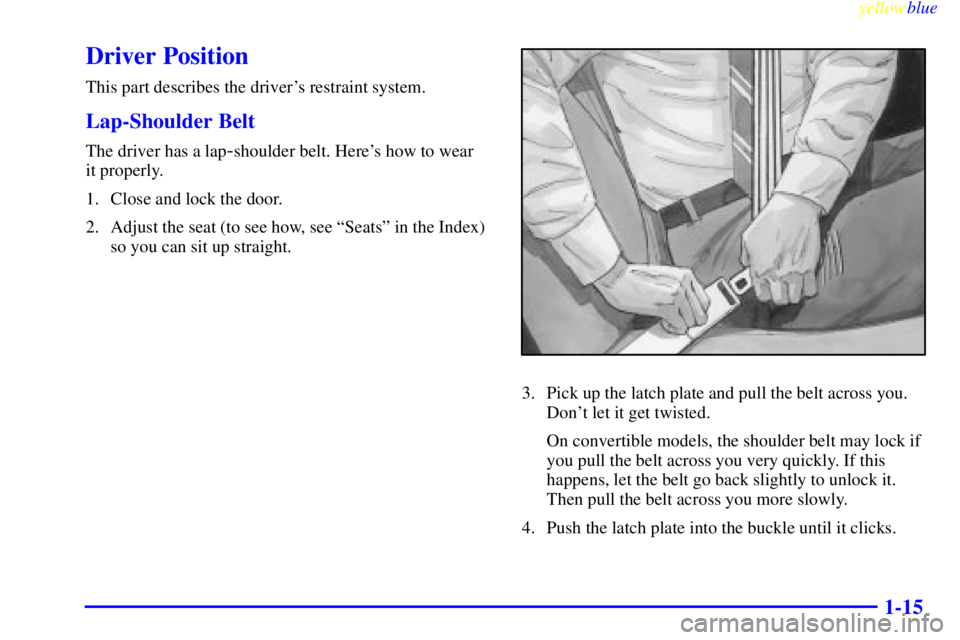
The driver has a lap-shoulder belt. Here's how to wear
it properly.
1. Close and lock the door.
2. Adjust the seat (to see how, see ªSeatsº in the Index)
so you can sit up straight.
3. Pick up the latch plate and pull the belt across you.
Don't let it get twisted.
On convertible models, the shoulder belt may lock if
you pull the belt across you very quickly. If this
happens, let the belt go back slightly to unlock it.
Then pull the belt across you more slowly.
4. Push the latch plate into the buckle until it clicks.
Page 29 of 376

yellowblue
1-23
The best way to protect the fetus is to protect the
mother. When a safety belt is worn properly, it's more
likely that the fetus won't be hurt in a crash. For
pregnant women, as for anyone, the key to making
safety belts effective is wearing them properly.
Right Front Passenger Position
The right front passenger's safety belt works the same
way as the driver's safety belt. See ªDriver Positionº
earlier in this section.
Supplemental Restraint System (SRS)
This part explains the Supplemental Restraint
System (SRS) or air bag system.
Your vehicle has ªNext Generationº frontal
air bags
-- one air bag for the driver and another
air bag for the right front passenger.
Next Generation frontal air bags are designed to help
reduce the risk of injury from the force of an inflating
air bag. But even these air bags must inflate very
quickly if they are to do their job and comply with
federal regulations.Here are the most important things to know about the
air bag system:
CAUTION:
You can be severely injured or killed in a crash if
you aren't wearing your safety belt
-- even if you
have air bags. Wearing your safety belt during a
crash helps reduce your chance of hitting things
inside the vehicle or being ejected from it. Air
bags are ªsupplemental restraintsº to the safety
belts. All air bags
-- even Next Generation air
bags
-- are designed to work with safety belts,
but don't replace them. Air bags are designed to
work only in moderate to severe crashes where
the front of your vehicle hits something. They
aren't designed to inflate at all in rollover, rear,
side or low
-speed frontal crashes. And, for
unrestrained occupants, Next Generation air
bags may provide less protection in frontal
crashes than more forceful air bags have
provided in the past. Everyone in your vehicle
should wear a safety belt properly
-- whether
or not there's an air bag for that person.
Page 30 of 376

yellowblue
1-24
CAUTION:
Air bags inflate with great force, faster than the blink
of an eye. If you're too close to an inflating air bag, as
you would be if you were leaning forward, it could
seriously injure you. This is true even with Next
Generation frontal air bags. Safety belts help keep
you in position before and during a crash. Always
wear your safety belt, even with Next Generation air
bags. The driver should sit as far back as possible
while still maintaining control of the vehicle.
CAUTION:
Children who are up against, or very close to, any
air bag when it inflates can be seriously injured or
killed. This is true even though your vehicle has
Next Generation frontal air bags. Air bags plus
lap
-shoulder belts offer the best protection for
adults, but not for young children and infants.
CAUTION: (Continued)
CAUTION: (Continued)
Neither the vehicle's safety belt system nor its air
bag system is designed for them. Young children
and infants need the protection that a child
restraint system can provide. Always secure
children properly in your vehicle. To read how, see
the part of this manual called ªChildrenº and see
the caution labels on the sunvisors and the right
front passenger's safety belt.
There is an air bag readiness
light on the instrument
panel, which shows
AIR BAG.
The system checks the air bag electrical system for
malfunctions. The light tells you if there is an electrical
problem. See ªAir Bag Readiness Lightº in the Index
for more information.
Page 31 of 376

yellowblue
1-25 How the Air Bag System Works
Where are the air bags?
The driver's air bag is in the middle of the steering wheel.
The right front passenger's air bag is in the instrument
panel on the passenger's side.