key PONTIAC G3 2009 Owner's Guide
[x] Cancel search | Manufacturer: PONTIAC, Model Year: 2009, Model line: G3, Model: PONTIAC G3 2009Pages: 348, PDF Size: 2.16 MB
Page 234 of 348
Continue to drive the vehicle slow for about 10 minutes.
Keep a safe vehicle distance from the car in front of
you. If the warning does not come back on, continue
to drive normally.
If the warning continues, pull over, stop, and park the
vehicle right away.
If there is no sign of steam, idle the engine for three
minutes while parked. If the warning is still displayed,
turn off the engine until it cools down.
Power Steering Fluid
When to Check Power Steering Fluid
The power steering uid reservoir is located toward the
front of the engine compartment on the driver’s side
of the vehicle. SeeEngine Compartment Overview on
page 5-12for reservoir location.
It is not necessary to regularly check power steering
uid unless you suspect there is a leak in the system or
you hear an unusual noise. A uid loss in this system
could indicate a problem. Have the system inspected
and repaired.
How to Check Power Steering Fluid
Turn the key off and let the engine compartment
cool down.
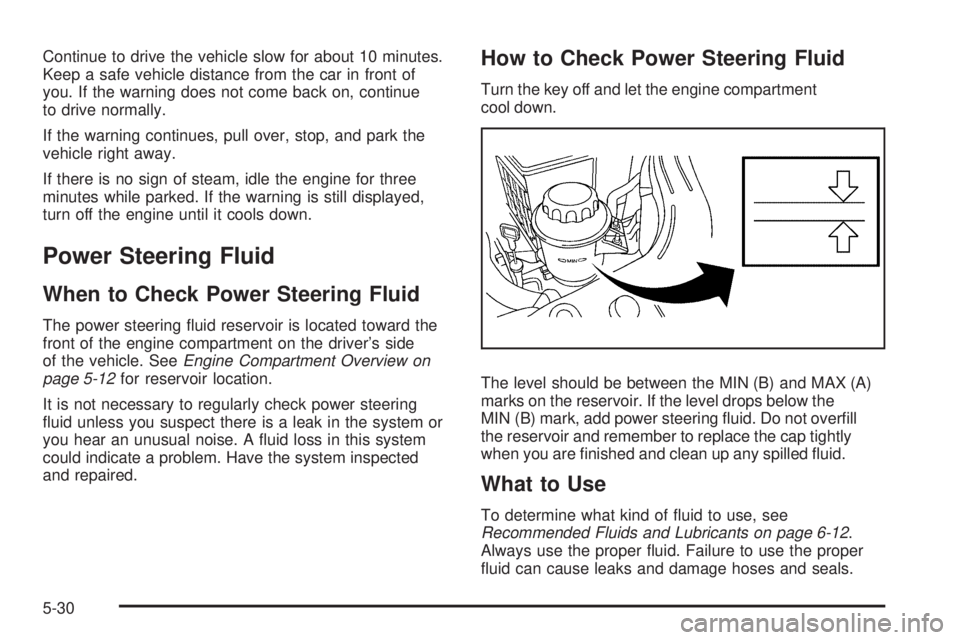
The level should be between the MIN (B) and MAX (A)
marks on the reservoir. If the level drops below the
MIN (B) mark, add power steering uid. Do not overll
the reservoir and remember to replace the cap tightly
when you are nished and clean up any spilled uid.
What to Use
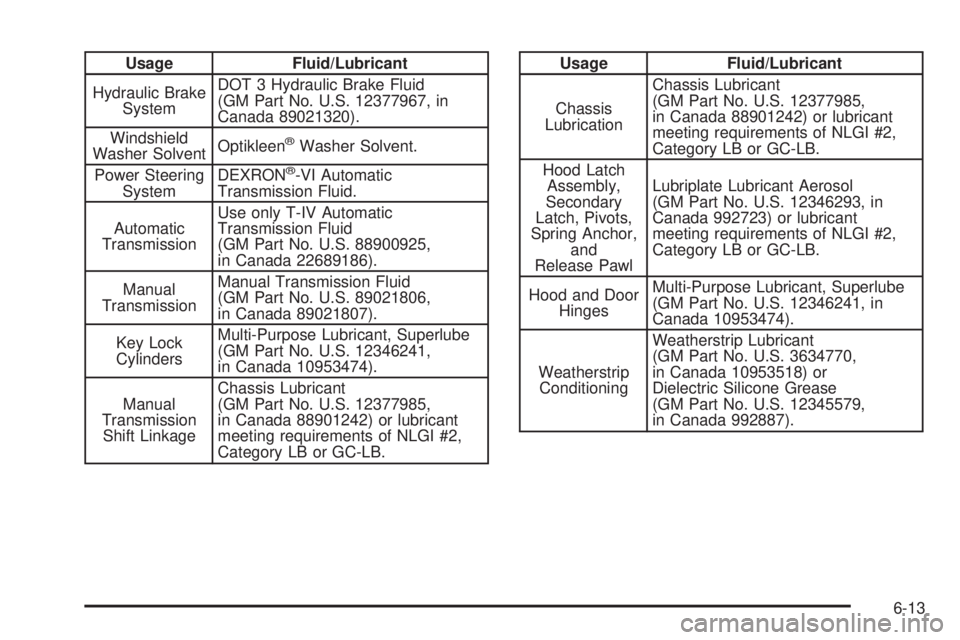
To determine what kind of uid to use, see
Recommended Fluids and Lubricants on page 6-12.
Always use the proper uid. Failure to use the proper
uid can cause leaks and damage hoses and seals.
5-30
Page 306 of 348

(c)Visually inspect hoses and have them replaced if they
are cracked, swollen, or deteriorated. Inspect all pipes,
fittings and clamps; replace with genuine parts as
needed. To help ensure proper operation, a pressure test
of the cooling system and pressure cap and cleaning the
outside of the radiator and air conditioning condenser is
recommended at least once a year.
(d)Inspect wiper blades for wear, cracking, or
contamination. Clean the windshield and wiper blades, if
contaminated. Replace wiper blades that are worn or
damaged. See Windshield Wiper Blade Replacement on
page 5-49 and Windshield and Wiper Blades on
page 5-84 for more information.
(e)Make sure the safety belt reminder light and safety
belt assemblies are working properly. Look for any
other loose or damaged safety belt system parts. If you
see anything that might keep a safety belt system
from doing its job, have it repaired. Have any torn or
frayed safety belts replaced. Also see Checking
the Restraint Systems on page 1-72.
(f)Lubricate all key lock cylinders, door hinges and
latches, hood hinges and latches, and trunk lid hinges
and latches. More frequent lubrication may be required
when exposed to a corrosive environment. Applying
silicone grease on weatherstrips with a clean cloth will
make them last longer, seal better, and not stick or
squeak.(g)Visually inspect belt for fraying, excessive cracks, or
obvious damage. Replace belt if necessary.
(h)Change automatic transmission fluid and filter if the
vehicle is mainly driven under one or more of these
conditions:
In heavy city traffic where the outside temperature
regularly reaches 90°F (32°C) or higher.
In hilly or mountainous terrain.
When doing frequent trailer towing.
Uses such as found in taxi, police, or delivery
service.
If the vehicle is not used under any of these conditions,
the fluid and filter do not require changing.
(i)Drain, flush, and refill cooling system. This service
can be complex; you should have your dealer/retailer
perform this service. See Engine Coolant on page 5-23
for what to use. Inspect hoses. Clean radiator,
condenser, pressure cap, and filler neck. Pressure test
the cooling system and pressure cap.
(j)A fluid loss in any vehicle system could indicate a
problem. Have the system inspected and repaired and
the fluid level checked. Add fluid if needed.
(k)If driving regularly under dusty conditions, inspect
the filter at each engine oil change.
(l)If driving regularly under dusty conditions, the filter
may require replacement more often.
6-8
Page 309 of 348

Automatic Transmission Shift Lock
Control System Check
{CAUTION:
When you are doing this inspection, the vehicle
could move suddenly. If the vehicle moves, you or
others could be injured.
1. Before starting this check, be sure there is enough
room around the vehicle. It should be parked on a
level surface.
2. Firmly apply the parking brake. SeeParking Brake
on page 2-26if necessary.
Be ready to apply the regular brake immediately if
the vehicle begins to move.
3. With the engine off, turn the ignition to ON/RUN,
but do not start the engine. Without applying the
regular brake, try to move the shift lever out
of P (Park) with normal effort. If the shift lever
moves out of P (Park), your vehicle needs service.
Ignition Transmission Lock Check
While parked, and with the parking brake set, try to turn
the ignition to LOCK/OFF in each shift lever position.
For automatic transmission vehicles, the ignition
should turn to LOCK/OFF only when the shift
lever is in P (Park).
For manual transmission vehicles, the ignition
should turn to LOCK/OFF only when you press the
key release button.
On all vehicles, the ignition key should come out only in
LOCK/OFF.
Turn the steering wheel to the left and to the right. It
should only lock when turned to the right.
6-11
Page 311 of 348
Usage Fluid/Lubricant
Hydraulic Brake
SystemDOT 3 Hydraulic Brake Fluid
(GM Part No. U.S. 12377967, in
Canada 89021320).
Windshield
Washer SolventOptikleen
®Washer Solvent.
Power Steering
SystemDEXRON
®-VI Automatic
Transmission Fluid.
Automatic
TransmissionUse only T-IV Automatic
Transmission Fluid
(GM Part No. U.S. 88900925,
in Canada 22689186).
Manual
TransmissionManual Transmission Fluid
(GM Part No. U.S. 89021806,
in Canada 89021807).
Key Lock
CylindersMulti-Purpose Lubricant, Superlube
(GM Part No. U.S. 12346241,
in Canada 10953474).
Manual
Transmission
Shift LinkageChassis Lubricant
(GM Part No. U.S. 12377985,
in Canada 88901242) or lubricant
meeting requirements of NLGI #2,
Category LB or GC-LB.
Usage Fluid/Lubricant
Chassis
LubricationChassis Lubricant
(GM Part No. U.S. 12377985,
in Canada 88901242) or lubricant
meeting requirements of NLGI #2,
Category LB or GC-LB.
Hood Latch
Assembly,
Secondary
Latch, Pivots,
Spring Anchor,
and
Release PawlLubriplate Lubricant Aerosol
(GM Part No. U.S. 12346293, in
Canada 992723) or lubricant
meeting requirements of NLGI #2,
Category LB or GC-LB.
Hood and Door
HingesMulti-Purpose Lubricant, Superlube
(GM Part No. U.S. 12346241, in
Canada 10953474).
Weatherstrip
ConditioningWeatherstrip Lubricant
(GM Part No. U.S. 3634770,
in Canada 10953518) or
Dielectric Silicone Grease
(GM Part No. U.S. 12345579,
in Canada 992887).
6-13
Page 334 of 348

OnStar®
If your vehicle has OnStar and you subscribe to the
OnStar services, please refer to the OnStar Terms and
Conditions for information on data collection and use.
Navigation System
If your vehicle has a navigation system, use of the
system may result in the storage of destinations,
addresses, telephone numbers, and other trip
information. Refer to the navigation system operating
manual for information on stored data and for deletion
instructions.
Radio Frequency
Identication (RFID)
RFID technology is used in some vehicles for functions
such as tire pressure monitoring and ignition system
security, as well as in connection with conveniences
such as key fobs for remote door locking/unlocking and
starting, and in-vehicle transmitters for garage door
openers. RFID technology in GM vehicles does not use
or record personal information or link with any other
GM system containing personal information.
7-18
Page 341 of 348
Horn ............................................................... 3-6
How to Wear Safety Belts Properly...................1-20
Hydraulic Clutch.............................................5-21
I
Ignition Positions.............................................2-17
Immobilizer....................................................2-13
Immobilizer Operation......................................2-14
Inadvertent Power Battery Saver.......................3-15
Infants and Young Children, Restraints...............1-36
Ination - Tire Pressure...................................5-57
Instrument Panel
Brightness..................................................3-15
Cluster.......................................................3-24
Overview..................................................... 3-4
Introduction...................................................... 6-2
J
Jump Starting.................................................5-36
K
Keyless Entry, Remote Operation........................ 2-4
Keyless Entry System....................................... 2-3
Keys............................................................... 2-2
L
Labeling, Tire Sidewall.....................................5-51
Lamp
Malfunction Indicator....................................3-32
Lamps
Daytime Running (DRL)................................3-14
Dome ........................................................3-15
License Plate..............................................5-48
Lap-Shoulder Belt...........................................1-28
LATCH System for Child Restraints...................1-44
Liftgate
Carbon Monoxide........................................2-10
Lights
Airbag Readiness........................................3-26
Antilock Brake System (ABS) Warning............3-30
Brake System Warning.................................3-28
Change Engine Oil......................................3-35
Charging System.........................................3-28
Cruise Control.............................................3-36
Daytime Running Lamps Indicator..................3-36
Door Ajar...................................................3-36
Exterior Lamps............................................3-13
Flash-to-Pass............................................... 3-8
Fog Lamp ..................................................3-35
Highbeam On.............................................3-36
High/Low Beam Changer................................ 3-8
Hold Mode .................................................3-30
7
Page 344 of 348
Power
Electrical System.........................................5-88
Steering Fluid.............................................5-30
Windows....................................................2-12
Pregnancy, Using Safety Belts..........................1-31
Privacy..........................................................7-16
Navigation System.......................................7-18
OnStar .......................................................7-18
Radio Frequency Identication (RFID).............7-18
Proposition 65 Warning, California....................... 5-4
R
Radio Frequency Identication (RFID),
Privacy......................................................7-18
Radios
AM-FM Radio.............................................3-39
Radio with CD............................................3-44
Reception...................................................3-55
Rear Door Security Locks.................................. 2-7
Rear Seat Operation.................................1-8, 1-11
Rear Window Washer/Wiper.............................3-10
Rearview Mirrors.............................................2-32
Reclining Seatbacks.......................................... 1-6
Recommended Fluids and Lubricants.................6-12Recreational Vehicle Towing.............................4-28
Reimbursement Program, GM Mobility................. 7-7
Remote Keyless Entry (RKE) System.................. 2-3
Remote Keyless Entry (RKE) System,
Operation..................................................... 2-4
Removing the Flat Tire and Installing the
Spare Tire..................................................5-73
Removing the Spare Tire and Tools...................5-72
Replacement Bulbs.........................................5-48
Replacement Parts, Maintenance......................6-14
Reporting Safety Defects
Canadian Government..................................7-15
General Motors...........................................7-15
Reporting Safety Defects to the
Canadian Government..................................7-15
Reporting Safety Defects to the
United States Government............................7-14
Restraint System Check
Checking the Restraint Systems....................1-72
Replacing Restraint System Parts
After a Crash..........................................1-73
Roadside Assistance Program............................ 7-7
Rocking Your Vehicle to Get it Out....................4-18
Roof
Sunroof......................................................2-38
Running the Vehicle While Parked.....................2-31
10