manual transmission PONTIAC G3 2009 Owners Manual
[x] Cancel search | Manufacturer: PONTIAC, Model Year: 2009, Model line: G3, Model: PONTIAC G3 2009Pages: 348, PDF Size: 2.16 MB
Page 79 of 348
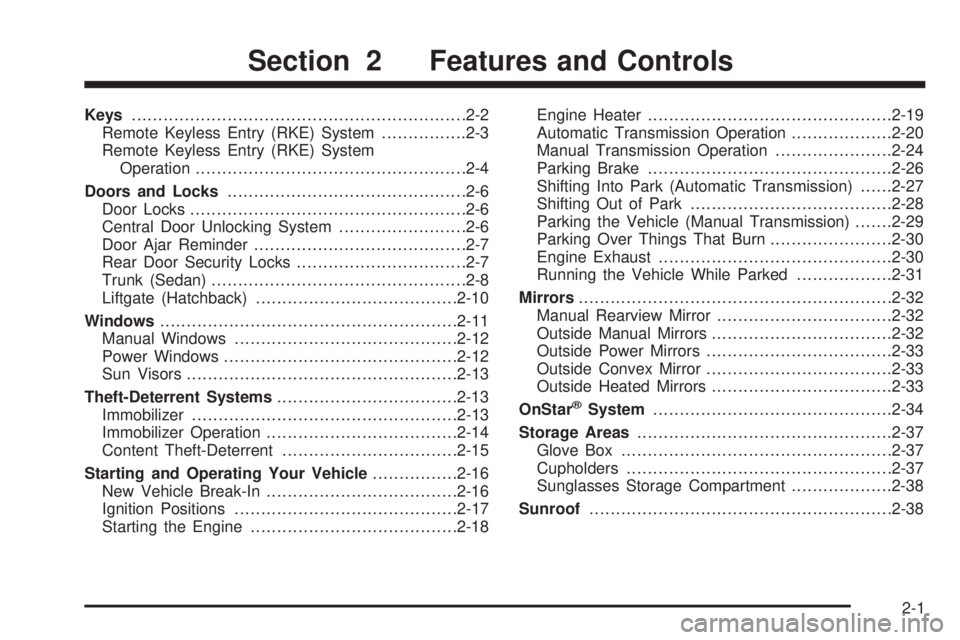
Keys...............................................................2-2
Remote Keyless Entry (RKE) System................2-3
Remote Keyless Entry (RKE) System
Operation...................................................2-4
Doors and Locks.............................................2-6
Door Locks....................................................2-6
Central Door Unlocking System........................2-6
Door Ajar Reminder........................................2-7
Rear Door Security Locks................................2-7
Trunk (Sedan)................................................2-8
Liftgate (Hatchback)......................................2-10
Windows........................................................2-11
Manual Windows..........................................2-12
Power Windows............................................2-12
Sun Visors...................................................2-13
Theft-Deterrent Systems..................................2-13
Immobilizer..................................................2-13
Immobilizer Operation....................................2-14
Content Theft-Deterrent.................................2-15
Starting and Operating Your Vehicle................2-16
New Vehicle Break-In....................................2-16
Ignition Positions..........................................2-17
Starting the Engine.......................................2-18Engine Heater..............................................2-19
Automatic Transmission Operation...................2-20
Manual Transmission Operation......................2-24
Parking Brake..............................................2-26
Shifting Into Park (Automatic Transmission)......2-27
Shifting Out of Park......................................2-28
Parking the Vehicle (Manual Transmission).......2-29
Parking Over Things That Burn.......................2-30
Engine Exhaust............................................2-30
Running the Vehicle While Parked..................2-31
Mirrors...........................................................2-32
Manual Rearview Mirror
.................................2-32
Outside Manual Mirrors..................................2-32
Outside Power Mirrors...................................2-33
Outside Convex Mirror...................................2-33
Outside Heated Mirrors..................................2-33
OnStar
®System.............................................2-34
Storage Areas................................................2-37
Glove Box...................................................2-37
Cupholders..................................................2-37
Sunglasses Storage Compartment...................2-38
Sunroof.........................................................2-38
Section 2 Features and Controls
2-1
Page 95 of 348

Ignition Positions
The ignition switch has
four different positions.
{CAUTION:
On manual transmission vehicles, turning the key
to LOCK/OFF will lock the steering column and
result in a loss of ability to steer the vehicle.
This could cause a collision. If you need to turn
the engine off while the vehicle is moving, turn the
key only to ACC/ACCESSORY. Do not push the
key in while the vehicle is moving.Notice:Using a tool to force the key to turn in the
ignition could cause damage to the switch or break
the key. Use the correct key, make sure it is all the
way in, and turn it only with your hand. If the key
cannot be turned by hand, see your dealer/retailer.
LOCK/OFF:This position locks the steering wheel,
ignition, shift lever and transmission. This is the
only position in which you can insert or remove the key.
The steering can bind with the wheels turned off
center. If this happens, move the steering wheel from
right to left while turning the key to ACC/ACCESSORY.
If this doesn’t work, then the vehicle needs service.
ACC/ACCESSORY:This position operates some of the
electrical accessories, such as the radio, but not the
climate control system.
ON/RUN:This position can be used to operate the
electrical accessories, and to display some instrument
panel cluster warning and indicator lights. The switch
stays in this position when the engine is running. If you
leave the key in the ACC/ACCESSORY or ON/RUN
position with the engine off, the battery could be drained.
You may not be able to start the vehicle if the battery
is allowed to drain for an extended period of time.
START:This is the position that starts the engine.
When the engine starts, release the key. The ignition
switch returns to ON/RUN for driving. Do not turn
the key to START if the engine is running.
2-17
Page 96 of 348

Starting the Engine
Automatic Transmission
Move the shift lever to P (Park) or N (Neutral).
The engine will not start in any other position.
To restart the engine when the vehicle is already
moving, use N (Neutral) only.
Notice:Do not try to shift to P (Park) if the
vehicle is moving. If you do, you could damage
the transmission. Shift to P (Park) only when the
vehicle is stopped.
Manual Transmission
The shift lever should be in N (Neutral) and the parking
brake engaged. Hold the clutch pedal to the oor and
start the engine. The vehicle will not start if the clutch
pedal is not all the way down.
Starting Procedure
1. With your foot off the accelerator pedal, turn the
ignition to START. When the engine starts, let go
of the key. The idle speed will go down as the
engine gets warm.
Notice:Holding the key in START for longer than
15 seconds at a time will cause the battery to be
drained much sooner. And the excessive heat candamage the starter motor. Wait about 15 seconds
between each try to help avoid draining the battery
or damaging the starter.
2. If the engine does not start, wait about 15 seconds
and try again. Wait about 15 seconds between
each try.
When the engine has run about 10 seconds to warm
up, the vehicle is ready to be driven. Do not run the
engine at high speed when it is cold.
If the weather is below freezing (32°F or 0°C), let
the engine run for a few minutes to warm up.
3. If the engine still will not start, or starts but then
stops, it could be ooded with too much gasoline.
Try pushing the accelerator pedal all the way to the
oor and holding it there as you hold the key in
START for about three seconds. If the vehicle starts
briey but then stops again, do the same thing, but
this time keep the pedal down for ve or six seconds.
This clears the extra gasoline from the engine.
Notice:The engine is designed to work with
the electronics in the vehicle. If electrical parts or
accessories are added, you could change the way the
engine operates. Before adding electrical equipment,
check with your dealer/retailer. If you do not, the
engine might not perform properly. Any resulting
damage would not be covered by the vehicle
warranty.
2-18
Page 102 of 348

Manual Transmission Operation
Five-Speed
This is your shift pattern.
1 (First):Press the clutch pedal and shift into 1 (First).
Then, slowly let up on the clutch pedal as you press
the accelerator pedal.You can shift into 1 (First) when you are going less than
20 mph (32 km/h). If you have come to a complete stop
and it is hard to shift into 1 (First), put the shift lever in
N (Neutral) and let up on the clutch. Press the clutch
pedal back down. Then shift into 1 (First).
2 (Second):Press the clutch pedal as you let up on the
accelerator pedal and shift into 2 (Second). Then, slowly
let up on the clutch pedal as you press the accelerator
pedal.
3 (Third), 4 (Fourth) and 5 (Fifth):Shift into 3 (Third),
4 (Fourth) and 5 (Fifth), the same way you do for
2 (Second). Slowly let up on the clutch pedal as
you press the accelerator pedal.
To stop, let up on the accelerator pedal and press the
brake pedal. Just before the vehicle stops, press the
clutch pedal and the brake pedal, and shift to N (Neutral).
N (Neutral):Use this position when you start or idle the
engine.
2-24
Page 103 of 348
R (Reverse):To back up, press down the clutch pedal,
lift up the ring on the shift lever and shift into R (Reverse).
Let up on the clutch pedal slowly while pressing the
accelerator pedal.
Notice:Shifting to R (Reverse) while the vehicle is
moving forward could damage the transmission.
The repairs would not be covered by the vehicle
warranty. Shift to R (Reverse) only after the vehicle
is stopped.
Also, use R (Reverse), along with the parking brake,
for parking the vehicle.
Shift Speeds
{CAUTION:
If you skip a gear when you downshift, you could
lose control of the vehicle. You could injure yourself
or others. Do not shift down more than one gear at
a time when you downshift.
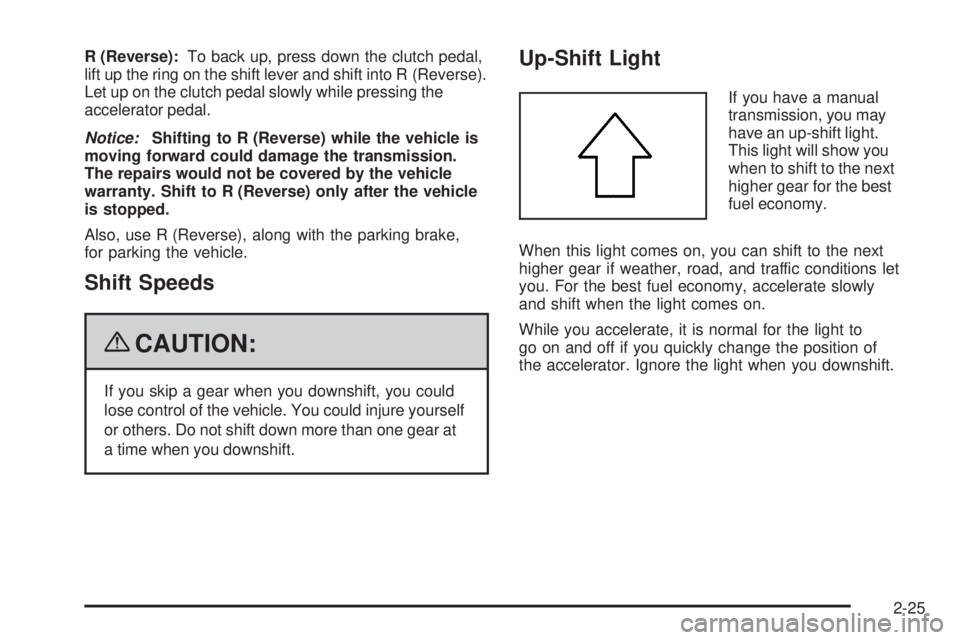
Up-Shift Light
If you have a manual
transmission, you may
have an up-shift light.
This light will show you
when to shift to the next
higher gear for the best
fuel economy.
When this light comes on, you can shift to the next
higher gear if weather, road, and traffic conditions let
you. For the best fuel economy, accelerate slowly
and shift when the light comes on.
While you accelerate, it is normal for the light to
go on and off if you quickly change the position of
the accelerator. Ignore the light when you downshift.
2-25
Page 107 of 348

4. Insert the key into the shift lock slot and press and
hold the key.
5. Shift to N (Neutral).
6. Remove the key from the slot, insert the key into
the ignition and start the engine.
7. Replace the shift-lock release slot cover.
8. Apply and hold the brake pedal fully and release
the parking brake.
9. Shift to the gear you want.
10. Have the vehicle xed as soon as you can.
Parking the Vehicle
(Manual Transmission)
Before leaving the vehicle, do the following:
1. Hold the brake pedal down and rmly apply the
parking brake.
2. Fully press in the clutch pedal and place the shift
lever into the gear position as stated below:
When parking on level ground, place the shift
lever into N (Neutral).
When parking downhill, place the shift lever in
R (Reverse).
When parking uphill, place the shift lever in
1 (First).
3. After shifting, turn the ignition to LOCK/OFF,
remove the key and release the clutch.
2-29
Page 109 of 348

Running the Vehicle While Parked
It is better not to park with the engine running. But if you
ever have to, here are some things to know.
{CAUTION:
Idling a vehicle in an enclosed area with poor
ventilation is dangerous. Engine exhaust may
enter the vehicle. Engine exhaust contains Carbon
Monoxide (CO) which cannot be seen or smelled.
It can cause unconsciousness and even death.
Never run the engine in an enclosed area that
has no fresh air ventilation. For more information,
seeEngine Exhaust on page 2-30.
{CAUTION:
It can be dangerous to get out of the vehicle if
the automatic transmission shift lever is not fully
in P (Park) with the parking brake rmly set.
The vehicle can roll. Do not leave the vehicle
when the engine is running unless you have to.
If you have left the engine running, the vehicle can
move suddenly. You or others could be injured.
To be sure the vehicle will not move, even when it is
on fairly level ground, always set the parking brake
and move the automatic transmission shift lever to
P (Park), or the manual transmission shift lever to
Neutral.
Follow the proper steps to be sure the vehicle will not
move. If the vehicle has an automatic transmission,
seeShifting Into Park (Automatic Transmission) on
page 2-27.
2-31
Page 126 of 348
Rear Window Wiper/Washer
{CAUTION:
In freezing weather, do not use your washer until
the windshield is warmed. Otherwise the washer
uid can form ice on the windshield, blocking your
vision.
The vehicle may have a rear window wiper/washer.
Turn the rear wiper/washer band to operate the
rear window wiper/washer.
OFF:Turns the rear window wiper/washer off.
Z:Turns the rear wiper on for intermittent wipes.
Y:Sprays washer uid onto the rear window and the
wiper operates continuously.
The windshield washer reservoir is used for the
windshield and rear window. Check the uid level if
either washer is not working. SeeWindshield Washer
Fluid on page 5-31.
Cruise Control
For vehicles with cruise control, a speed of about
24 mph (39 km/h) or more can be maintained without
keeping your foot on the accelerator. Cruise control
does not work at speeds below 24 mph (39 km/h).
When the brakes are applied, or the clutch pedal if you
have a manual transmission, the cruise control turns off.
{CAUTION:
Cruise control can be dangerous where you cannot
drive safely at a steady speed. So, do not use the
cruise control on winding roads or in heavy traffic.
Cruise control can be dangerous on slippery roads.
On such roads, fast changes in tire traction can
cause excessive wheel slip, and you could lose
control. Do not use cruise control on slippery roads.
3-10
Page 128 of 348
Resuming a Set Speed
If the cruise control is set to a desired speed and then
the brakes are applied, or the clutch pedal if you have a
manual transmission, the cruise control shuts off.
But it does not need to be reset.
Once the vehicle is going about 24 mph (39 km/h) or
more, briey press the RES+ button. The vehicle returns
to the previously set speed and stays there.
If the RES+ button is held, the vehicle speed will
continue to increase until the button is released or the
brake pedal is applied. Do not hold in the RES+ button,
unless you want the vehicle to go faster.
Increasing Speed While Using Cruise
Control
There are two ways to go to a higher speed.
Use the accelerator pedal to get to a higher speed.
Press the SET−button, then release the button and
the accelerator pedal.
Press the RES+ button. Hold it there until the
desired speed is reached, and then release it.
To increase the vehicle speed in small amounts,
briey press the RES+ button and then release
it. Each time this is done, the vehicle goes about
1 mph (1.6 km/h) faster.
The accelerate feature only works after the cruise
control is turned on by pressing the SET−button.
Reducing Speed While Using Cruise
Control
There are two ways to reduce the vehicle speed while
using cruise control:
Press the SET−button until the lower speed
desired is reached, then release it.
To slow down in small amounts, briey press the
SET−button. Each time this is done, the vehicle
goes about 1 mph (1.6 km/h) slower.
Passing Another Vehicle While Using
Cruise Control
Use the accelerator pedal to increase the vehicle speed.
When you take your foot off the pedal, the vehicle
slows down to the cruise control speed set earlier.
Using Cruise Control on Hills
How well the cruise control works on hills depends
upon the vehicle speed, load, and the steepness of the
hills. When going up steep hills, you might have to
step on the accelerator pedal to maintain the vehicle’s
speed. When going downhill, you might have to brake
or shift to a lower gear to keep the vehicle’s speed
down. When the brakes are applied the cruise control
turns off.
3-12
Page 129 of 348
Ending Cruise Control
There are two ways to turn off the cruise control:
Step lightly on the brake pedal, or press the clutch
pedal, if you have a manual transmission.
PressI/Oon the cruise control pad.
Erasing Speed Memory
The cruise control set speed memory is erased when
the cruise control or the ignition is turned off.
Exterior Lamps
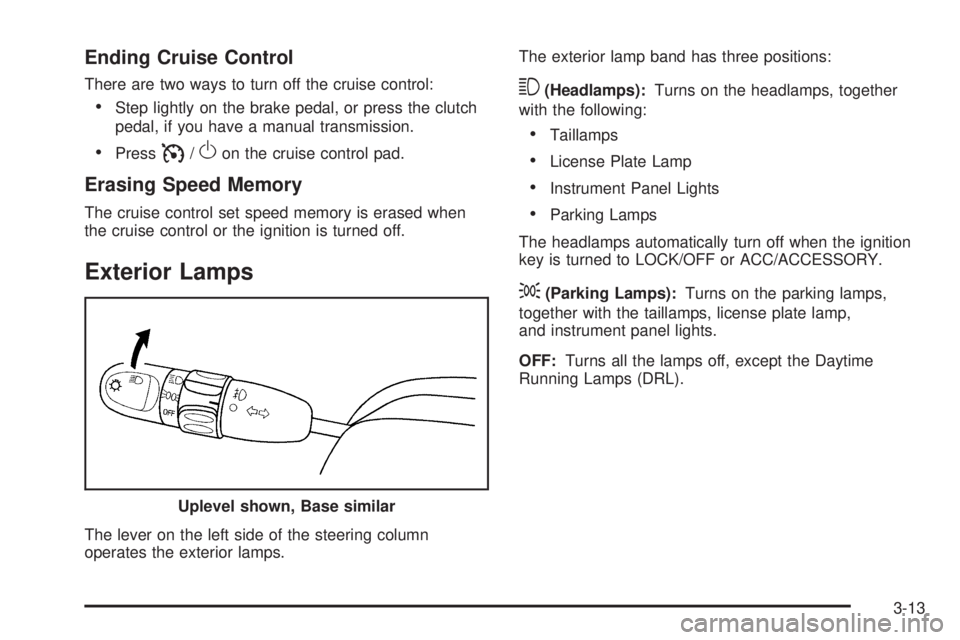
The lever on the left side of the steering column
operates the exterior lamps.The exterior lamp band has three positions:
3(Headlamps):Turns on the headlamps, together
with the following:
Taillamps
License Plate Lamp
Instrument Panel Lights
Parking Lamps
The headlamps automatically turn off when the ignition
key is turned to LOCK/OFF or ACC/ACCESSORY.
;(Parking Lamps):Turns on the parking lamps,
together with the taillamps, license plate lamp,
and instrument panel lights.
OFF:Turns all the lamps off, except the Daytime
Running Lamps (DRL).
Uplevel shown, Base similar
3-13