tow PONTIAC G5 2007 Owner's Guide
[x] Cancel search | Manufacturer: PONTIAC, Model Year: 2007, Model line: G5, Model: PONTIAC G5 2007Pages: 428, PDF Size: 2.46 MB
Page 259 of 428
Maximum trailer weight is calculated assuming
only the driver is in the tow vehicle and it has all
the required trailering equipment. The weight
of additional optional equipment, passengers and
cargo in the tow vehicle must be subtracted
from the maximum trailer weight.
You can ask your dealer for our trailering
information or advice. Also, seeCustomer
Assistance Offices on page 397for more
information.
Weight of the Trailer Tongue
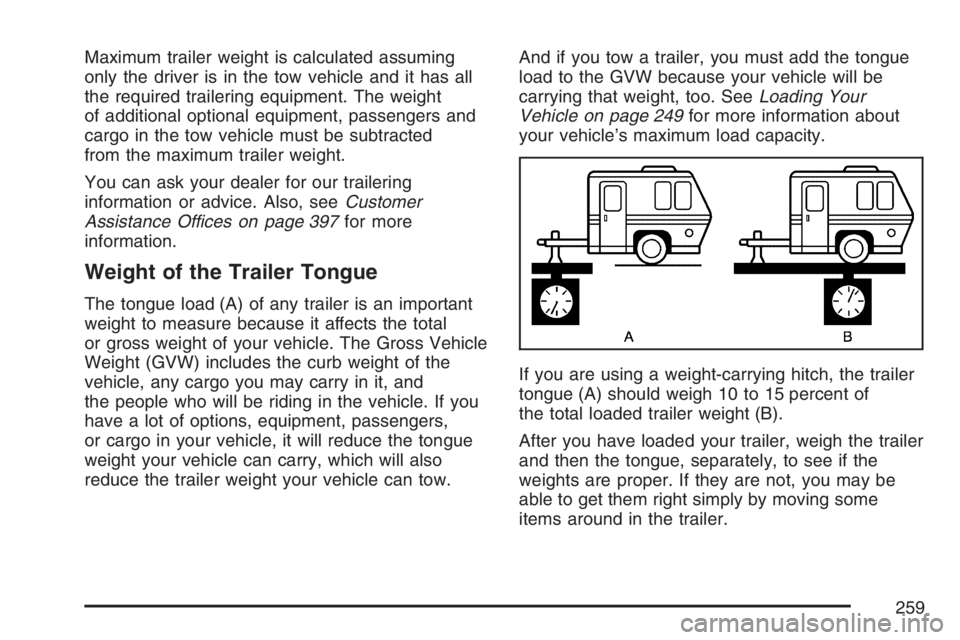
The tongue load (A) of any trailer is an important
weight to measure because it affects the total
or gross weight of your vehicle. The Gross Vehicle
Weight (GVW) includes the curb weight of the
vehicle, any cargo you may carry in it, and
the people who will be riding in the vehicle. If you
have a lot of options, equipment, passengers,
or cargo in your vehicle, it will reduce the tongue
weight your vehicle can carry, which will also
reduce the trailer weight your vehicle can tow.And if you tow a trailer, you must add the tongue
load to the GVW because your vehicle will be
carrying that weight, too. SeeLoading Your
Vehicle on page 249for more information about
your vehicle’s maximum load capacity.
If you are using a weight-carrying hitch, the trailer
tongue (A) should weigh 10 to 15 percent of
the total loaded trailer weight (B).
After you have loaded your trailer, weigh the trailer
and then the tongue, separately, to see if the
weights are proper. If they are not, you may be
able to get them right simply by moving some
items around in the trailer.
259
Page 261 of 428
Driving with a Trailer
Towing a trailer requires a certain amount of
experience. Before setting out for the open road,
you will want to get to know your rig. Acquaint
yourself with the feel of handling and braking with
the added weight of the trailer. And always
keep in mind that the vehicle you are driving is
now a good deal longer and not nearly as
responsive as your vehicle is by itself.
Before you start, check all trailer hitch parts and
attachments, safety chains, electrical connector,
lamps, tires and mirror adjustment. If the trailer has
electric brakes, start your vehicle and trailer
moving and then apply the trailer brake controller
by hand to be sure the brakes are working.
This lets you check your electrical connection at
the same time.
During your trip, check occasionally to be sure
that the load is secure, and that the lamps and any
trailer brakes are still working.
Following Distance
Stay at least twice as far behind the vehicle ahead
as you would when driving your vehicle without
a trailer. This can help you avoid situations
that require heavy braking and sudden turns.
Passing
You will need more passing distance up ahead
when you are towing a trailer. And, because the
vehicle is a good deal longer, you will need to go
much farther beyond the passed vehicle before you
can return to your lane.
Backing Up
Hold the bottom of the steering wheel with
one hand. Then, to move the trailer to the left, just
move that hand to the left. To move the trailer to the
right, move your hand to the right. Always back up
slowly and, if possible, have someone guide you.
261
Page 262 of 428

Making Turns
Notice:Making very sharp turns while
trailering could cause the trailer to come in
contact with the vehicle. Your vehicle could be
damaged. Avoid making very sharp turns
while trailering.
When you are turning with a trailer, make wider
turns than normal. Do this so your trailer will not
strike soft shoulders, curbs, road signs, trees or
other objects. Avoid jerky or sudden maneuvers.
Signal well in advance.
Turn Signals When Towing a Trailer
When you tow a trailer, your vehicle may need a
different turn signal asher and/or extra wiring.
Check with your dealer. The arrows on your
instrument panel will ash whenever you
signal a turn or lane change. Properly hooked up,
the trailer lamps will also ash, telling other
drivers you are about to turn, change lanes
or stop.When towing a trailer, the arrows on your
instrument panel will ash for turns even if the bulbs
on the trailer are burned out. Thus, you may think
drivers behind you are seeing your signal when
they are not. It is important to check occasionally to
be sure the trailer bulbs are still working.
Driving on Grades
Notice:Do not tow on steep continuous
grades exceeding 6 miles (9.6 km). Extended,
higher than normal engine and transaxle
temperatures may result and damage your
vehicle. Frequent stops are very important to
allow the engine and transaxle to cool.
Reduce speed and shift to a lower gearbefore
you start down a long or steep downgrade. If you
do not shift down, you might have to use your
brakes so much that they would get hot and
no longer work well.
Pay attention to the engine coolant gage. If the
indicator is in the red area, turn off the air
conditioning to reduce engine load. SeeEngine
Overheating on page 290.
262
Page 263 of 428
When towing under severe conditions such as hot
ambient temperatures or steep grades, your
vehicle may experience more transaxle shifting.
A COOLING MODE ON message may also appear
in the DIC. This alerts the driver that the shifting
mode is in progress and is aiding engine cooling.
SeeDIC Warnings and Messages on page 177
DIC Warnings and Messages for more information.
Parking on Hills
{CAUTION:
You really should not park your vehicle,
with a trailer attached, on a hill.
If something goes wrong, your rig could
start to move. People can be injured, and
both your vehicle and the trailer can be
damaged.But if you ever have to park your rig on a hill,
here is how to do it:
1. Apply your regular brakes, but do not shift into
PARK (P) for an automatic transaxle, or into
gear for a manual transaxle. When parking
uphill, turn your wheels away from the
curb. When parking downhill, turn your wheels
into the curb.
2. Have someone place chocks under the trailer
wheels.
3. When the wheel chocks are in place, release
the regular brakes until the chocks absorb
the load.
4. Reapply the regular brakes. Then apply your
parking brake, and then shift into PARK (P) for
an automatic transaxle or REVERSE (R) for a
manual transaxle.
5. Release the regular brakes.
263
Page 264 of 428
When You Are Ready to Leave After
Parking on a Hill
1. Apply your regular brakes and hold the pedal
down while you:
Start your engine.
Shift into a gear.
Release the parking brake.
2. Let up on the brake pedal.
3. Drive slowly until the trailer is clear of the
chocks.
4. Stop and have someone pick up and store
the chocks.
Maintenance When Trailer Towing
Your vehicle will need service more often when
you are pulling a trailer. SeeScheduled
Maintenance on page 375for more on this.
Things that are especially important in trailer
operation are automatic transaxle uid (do not
overll), engine oil, drive belt, cooling system and
brake system.
Each of these is covered in this manual, and the
Index will help you nd them quickly. If you
are trailering, it is a good idea to review this
information before you start your trip.
Check periodically to see that all hitch nuts and
bolts are tight.
Engine Cooling When Trailer Towing
Your cooling system may temporarily overheat
during severe operating conditions. SeeEngine
Overheating on page 290.
264
Page 277 of 428
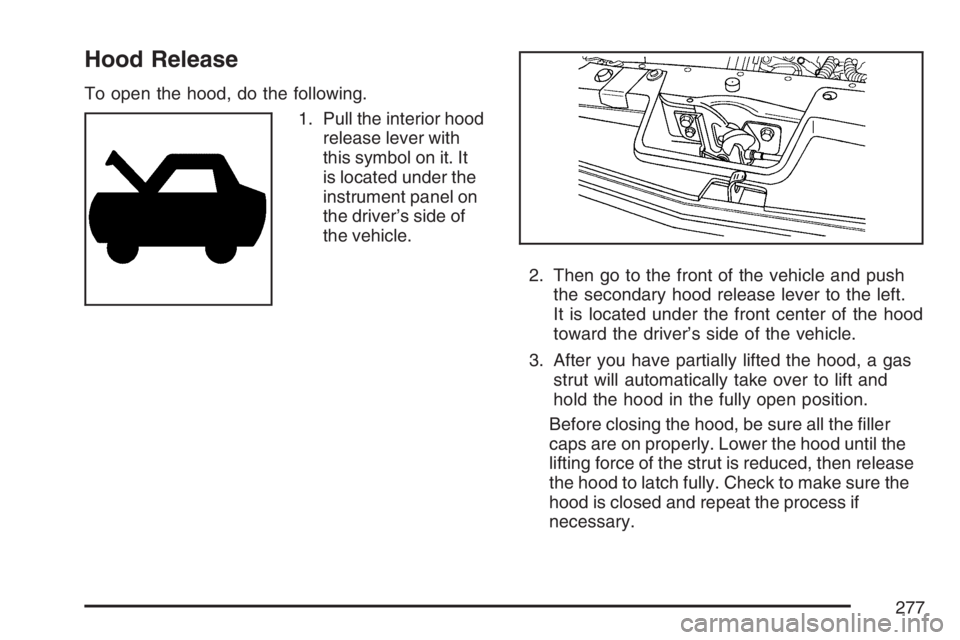
Hood Release
To open the hood, do the following.
1. Pull the interior hood
release lever with
this symbol on it. It
is located under the
instrument panel on
the driver’s side of
the vehicle.
2. Then go to the front of the vehicle and push
the secondary hood release lever to the left.
It is located under the front center of the hood
toward the driver’s side of the vehicle.
3. After you have partially lifted the hood, a gas
strut will automatically take over to lift and
hold the hood in the fully open position.
Before closing the hood, be sure all the ller
caps are on properly. Lower the hood until the
lifting force of the strut is reduced, then release
the hood to latch fully. Check to make sure the
hood is closed and repeat the process if
necessary.
277
Page 279 of 428
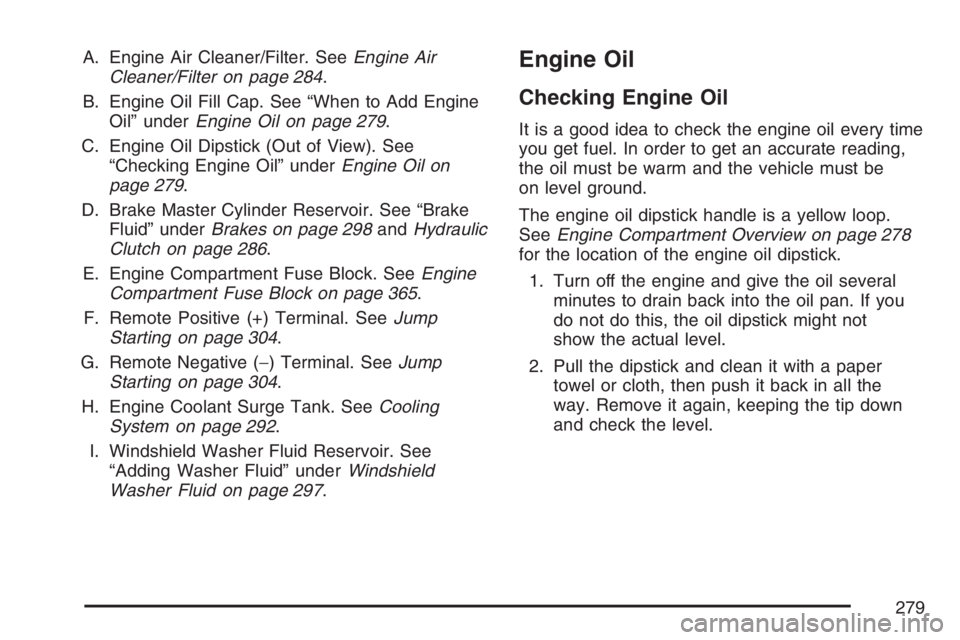
A. Engine Air Cleaner/Filter. SeeEngine Air
Cleaner/Filter on page 284.
B. Engine Oil Fill Cap. See “When to Add Engine
Oil” underEngine Oil on page 279.
C. Engine Oil Dipstick (Out of View). See
“Checking Engine Oil” underEngine Oil on
page 279.
D. Brake Master Cylinder Reservoir. See “Brake
Fluid” underBrakes on page 298andHydraulic
Clutch on page 286.
E. Engine Compartment Fuse Block. SeeEngine
Compartment Fuse Block on page 365.
F. Remote Positive (+) Terminal. SeeJump
Starting on page 304.
G. Remote Negative (−) Terminal. SeeJump
Starting on page 304.
H. Engine Coolant Surge Tank. SeeCooling
System on page 292.
I. Windshield Washer Fluid Reservoir. See
“Adding Washer Fluid” underWindshield
Washer Fluid on page 297.Engine Oil
Checking Engine Oil
It is a good idea to check the engine oil every time
you get fuel. In order to get an accurate reading,
the oil must be warm and the vehicle must be
on level ground.
The engine oil dipstick handle is a yellow loop.
SeeEngine Compartment Overview on page 278
for the location of the engine oil dipstick.
1. Turn off the engine and give the oil several
minutes to drain back into the oil pan. If you
do not do this, the oil dipstick might not
show the actual level.
2. Pull the dipstick and clean it with a paper
towel or cloth, then push it back in all the
way. Remove it again, keeping the tip down
and check the level.
279
Page 291 of 428

If Steam Is Coming From Your Engine
{CAUTION:
Steam from an overheated engine can
burn you badly, even if you just open the
hood. Stay away from the engine if you
see or hear steam coming from it. Just
turn it off and get everyone away from
the vehicle until it cools down. Wait until
there is no sign of steam or coolant
before you open the hood.
If you keep driving when your engine is
overheated, the liquids in it can catch re.
You or others could be badly burned.
Stop your engine if it overheats, and get
out of the vehicle until the engine is cool.
Notice:If your engine catches re because
you keep driving with no coolant, your vehicle
can be badly damaged. The costly repairs
would not be covered by your warranty.
If No Steam Is Coming From Your
Engine
An engine coolant temperature warning can
indicate a serious problem. SeeEngine Coolant
Temperature Warning Light on page 167.
If you get an engine coolant temperature warning,
but see or hear no steam, the problem may not
be too serious. Sometimes the engine can
get a little too hot when you:
Climb a long hill on a hot day.
Stop after high-speed driving.
Idle for long periods in traffic.
Tow a trailer.
If you get the engine coolant temperature warning
with no sign of steam, try this for a minute or so:
1. If you have an air conditioner and it is on, turn
it off.
2. In heavy traffic, let the engine idle in
NEUTRAL (N) for automatic transmission or
NEUTRAL for manual transmission, while
stopped. If it is safe to do so, pull off the road,
shift to PARK (P) or NEUTRAL (N) and let the
engine idle.
291
Page 314 of 428

3. Remove the two plastic fasteners from the
fascia.
4. Pull the front fascia back.
You may need someone else to assist you
with Steps 3 and 4.
5. Pull the headlamp assembly up on an angle
and towards the radiator to remove it.
6. Disconnect the bulb base from the wiring
harness by lifting the plastic locking tab.
7. To replace a headlamp bulb, do the following:
7.1. Disconnect the wiring harness from the
bulb socket.
7.2. Remove the black retainer by turning it
counterclockwise.8. Turn the bulb socket for the headlamp, front
turn signal, or parking lamp counterclockwise.
For the sidemarker bulb, you will need to
use a tool to assist in turning the bulb socket.
9. Pull the old bulb out of the socket.
10. Install a new bulb.
11. Reinstall the bulb assembly by reversing
Steps 1 through 8.
When reinstalling the headlamp assembly,
rst make sure that the wiring harness is
in its original position. If not, the headlamp
assembly will not t correctly.
You will also need to line up the two tabs
on the bottom of the assembly that t into
two slots in the headlamp assembly bracket.
314
Page 318 of 428
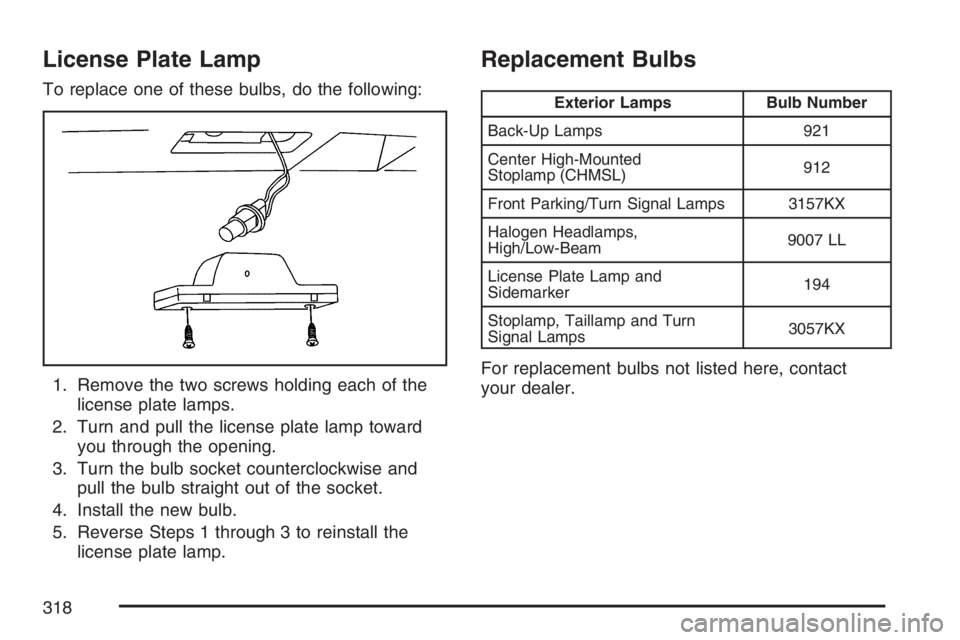
License Plate Lamp
To replace one of these bulbs, do the following:
1. Remove the two screws holding each of the
license plate lamps.
2. Turn and pull the license plate lamp toward
you through the opening.
3. Turn the bulb socket counterclockwise and
pull the bulb straight out of the socket.
4. Install the new bulb.
5. Reverse Steps 1 through 3 to reinstall the
license plate lamp.
Replacement Bulbs
Exterior Lamps Bulb Number
Back-Up Lamps 921
Center High-Mounted
Stoplamp (CHMSL)912
Front Parking/Turn Signal Lamps 3157KX
Halogen Headlamps,
High/Low-Beam9007 LL
License Plate Lamp and
Sidemarker194
Stoplamp, Taillamp and Turn
Signal Lamps3057KX
For replacement bulbs not listed here, contact
your dealer.
318