bolt PONTIAC G5 2007 Owners Manual
[x] Cancel search | Manufacturer: PONTIAC, Model Year: 2007, Model line: G5, Model: PONTIAC G5 2007Pages: 428, PDF Size: 2.46 MB
Page 264 of 428
When You Are Ready to Leave After
Parking on a Hill
1. Apply your regular brakes and hold the pedal
down while you:
Start your engine.
Shift into a gear.
Release the parking brake.
2. Let up on the brake pedal.
3. Drive slowly until the trailer is clear of the
chocks.
4. Stop and have someone pick up and store
the chocks.
Maintenance When Trailer Towing
Your vehicle will need service more often when
you are pulling a trailer. SeeScheduled
Maintenance on page 375for more on this.
Things that are especially important in trailer
operation are automatic transaxle uid (do not
overll), engine oil, drive belt, cooling system and
brake system.
Each of these is covered in this manual, and the
Index will help you nd them quickly. If you
are trailering, it is a good idea to review this
information before you start your trip.
Check periodically to see that all hitch nuts and
bolts are tight.
Engine Cooling When Trailer Towing
Your cooling system may temporarily overheat
during severe operating conditions. SeeEngine
Overheating on page 290.
264
Page 269 of 428

California Proposition 65 Warning
Most motor vehicles, including this one, contain
and/or emit chemicals known to the State of
California to cause cancer and birth defects
or other reproductive harm. Engine exhaust, many
parts and systems (including some inside the
vehicle), many uids, and some component wear
by-products contain and/or emit these chemicals.
Doing Your Own Service Work
{CAUTION:
You can be injured and your vehicle could
be damaged if you try to do service work
on a vehicle without knowing enough
about it.
Be sure you have sufficient knowledge,
experience, the proper replacement
parts, and tools before you attempt any
vehicle maintenance task.
CAUTION: (Continued)
CAUTION: (Continued)
Be sure to use the proper nuts, bolts,
and other fasteners. English and
metric fasteners can be easily
confused. If you use the wrong
fasteners, parts can later break or fall
off. You could be hurt.
If you want to do some of your own service work,
you will want to use the proper service manual.
It tells you much more about how to service your
vehicle than this manual can. To order the proper
service manual, seeService Publications Ordering
Information on page 410.
Your vehicle has an airbag system. Before
attempting to do your own service work, see
Servicing Your Airbag-Equipped Vehicle on
page 78.
You should keep a record with all parts receipts
and list the mileage and the date of any service
work you perform. SeeMaintenance Record
on page 389.
269
Page 313 of 428

Headlamps, Front Turn Signal,
Sidemarker, and Parking Lamps
A. Front Turn Signal/Parking Lamp
B. Sidemarker
C. HeadlampTo replace one of these bulbs, do the following:
1. Open the hood. SeeHood Release on
page 277for more information.
2. Remove the two hex bolts from the headlamp
assembly.
313
Page 335 of 428

Wheel Replacement
Replace any wheel that is bent, cracked, or badly
rusted or corroded. If wheel nuts keep coming
loose, the wheel, wheel bolts, and wheel nuts
should be replaced. If the wheel leaks air, replace
it (except some aluminum wheels, which can
sometimes be repaired). See your dealer if any
of these conditions exist.
Your dealer will know the kind of wheel you need.
Each new wheel should have the same
load-carrying capacity, diameter, width, offset and
be mounted the same way as the one it replaces.
If you need to replace any of your wheels, wheel
bolts, or wheel nuts, replace them only with new
GM original equipment parts. This way, you will be
sure to have the right wheel, wheel bolts, and wheel
nuts for your vehicle.{CAUTION:
Using the wrong replacement wheels,
wheel bolts, or wheel nuts on your vehicle
can be dangerous. It could affect the
braking and handling of your vehicle,
make your tires lose air and make you
lose control. You could have a collision
in which you or others could be injured.
Always use the correct wheel, wheel bolts,
and wheel nuts for replacement.
Notice:The wrong wheel can also cause
problems with bearing life, brake cooling,
speedometer or odometer calibration, headlamp
aim, bumper height, vehicle ground clearance,
and tire or tire chain clearance to the body and
chassis.
SeeChanging a Flat Tire on page 338for more
information.
335
Page 340 of 428
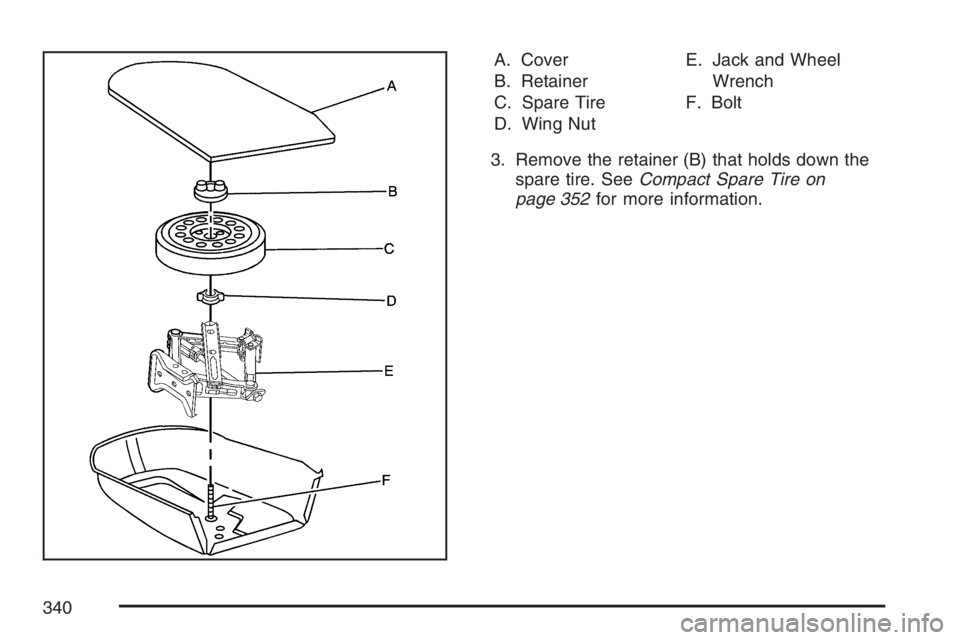
A. Cover
B. Retainer
C. Spare Tire
D. Wing NutE. Jack and Wheel
Wrench
F. Bolt
3. Remove the retainer (B) that holds down the
spare tire. SeeCompact Spare Tire on
page 352for more information.
340
Page 342 of 428
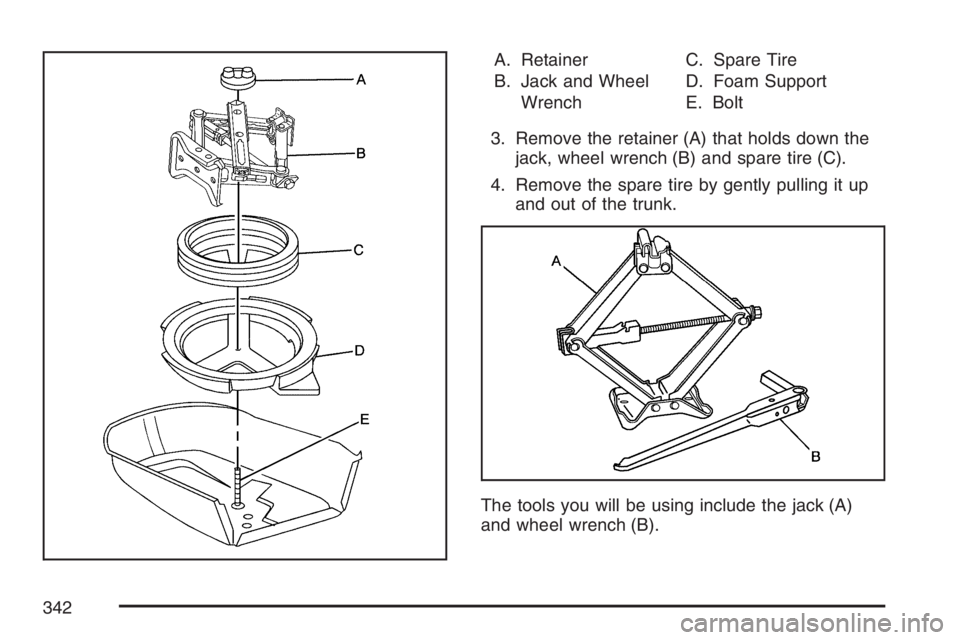
A. Retainer
B. Jack and Wheel
WrenchC. Spare Tire
D. Foam Support
E. Bolt
3. Remove the retainer (A) that holds down the
jack, wheel wrench (B) and spare tire (C).
4. Remove the spare tire by gently pulling it up
and out of the trunk.
The tools you will be using include the jack (A)
and wheel wrench (B).
342
Page 347 of 428
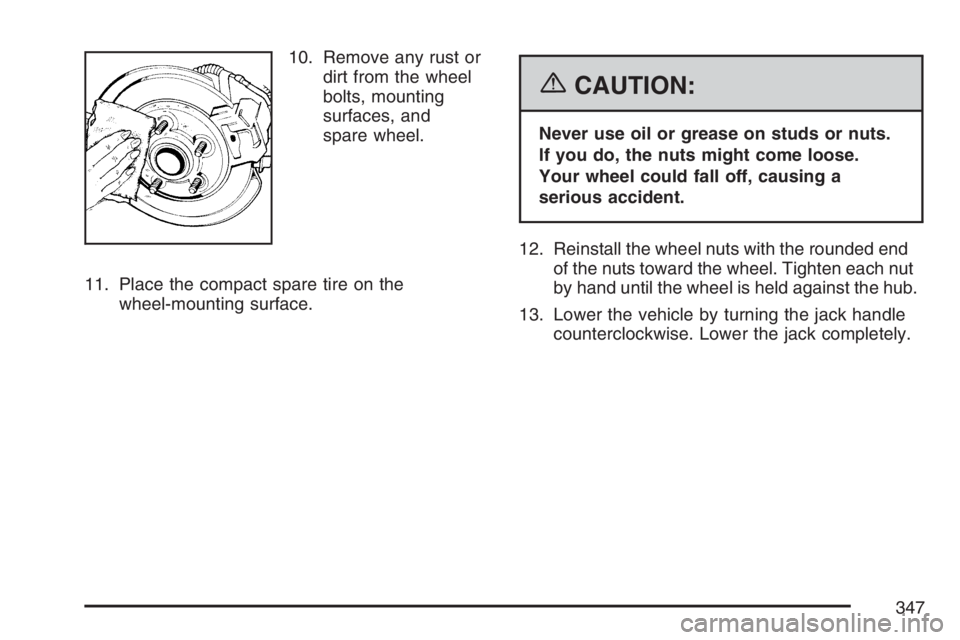
10. Remove any rust or
dirt from the wheel
bolts, mounting
surfaces, and
spare wheel.
11. Place the compact spare tire on the
wheel-mounting surface.
{CAUTION:
Never use oil or grease on studs or nuts.
If you do, the nuts might come loose.
Your wheel could fall off, causing a
serious accident.
12. Reinstall the wheel nuts with the rounded end
of the nuts toward the wheel. Tighten each nut
by hand until the wheel is held against the hub.
13. Lower the vehicle by turning the jack handle
counterclockwise. Lower the jack completely.
347
Page 350 of 428
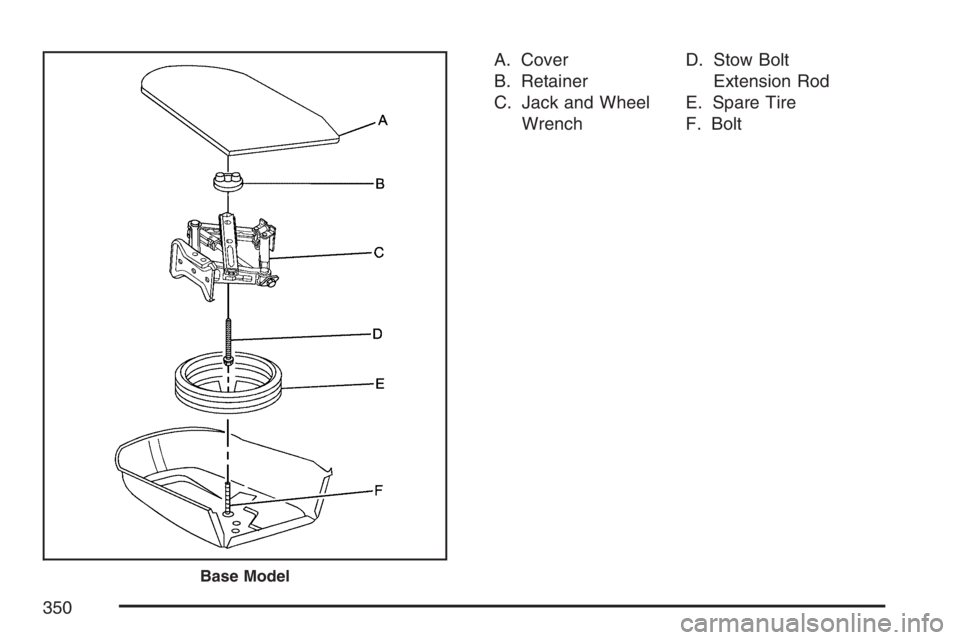
A. Cover
B. Retainer
C. Jack and Wheel
WrenchD. Stow Bolt
Extension Rod
E. Spare Tire
F. Bolt
Base Model
350
Page 351 of 428
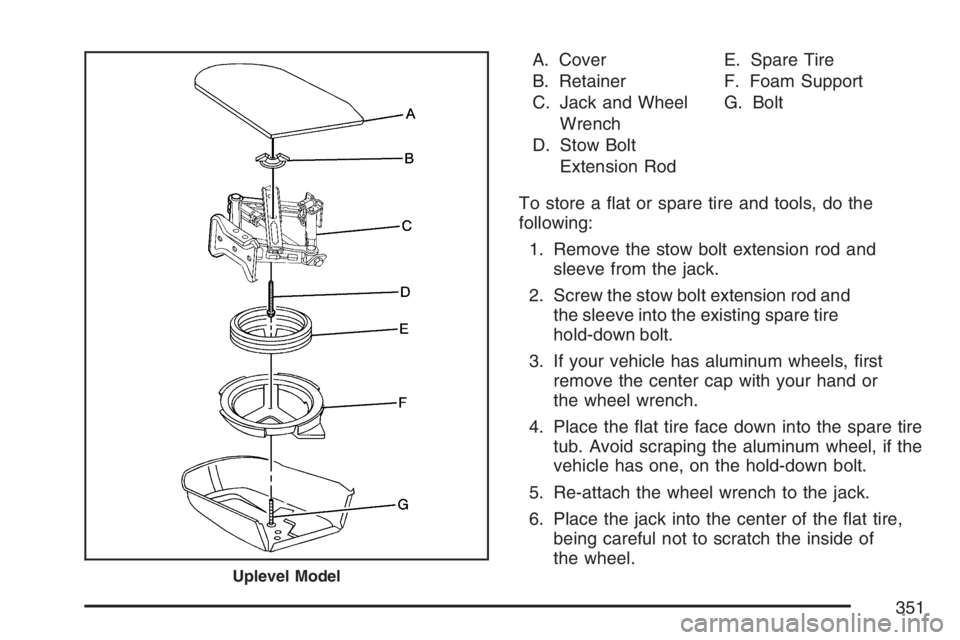
A. Cover
B. Retainer
C. Jack and Wheel
Wrench
D. Stow Bolt
Extension RodE. Spare Tire
F. Foam Support
G. Bolt
To store a at or spare tire and tools, do the
following:
1. Remove the stow bolt extension rod and
sleeve from the jack.
2. Screw the stow bolt extension rod and
the sleeve into the existing spare tire
hold-down bolt.
3. If your vehicle has aluminum wheels, rst
remove the center cap with your hand or
the wheel wrench.
4. Place the at tire face down into the spare tire
tub. Avoid scraping the aluminum wheel, if the
vehicle has one, on the hold-down bolt.
5. Re-attach the wheel wrench to the jack.
6. Place the jack into the center of the at tire,
being careful not to scratch the inside of
the wheel.
Uplevel Model
351
Page 352 of 428
7. Place the smaller jack hold-down nut (base
models only) in a safe place for use when
you put the compact spare tire back into
the trunk.
8. Remove the plastic sleeve from the stow bolt
extension rod. Secure the jack and road
wheel using the larger plastic retainer.
The compact spare tire is for temporary use only.
Replace the compact spare with a full-size tire
as soon as possible.
Compact Spare Tire
Although the compact spare tire was fully inated
when the vehicle was new, it can lose air after
a time. Check the ination pressure regularly.
It should be 60 psi (420 kPa).
After installing the compact spare on the vehicle,
stop as soon as possible and make sure the spare
tire is correctly inated. The compact spare is made
to perform well at speeds up to 65 mph (105 km/h)
for distances up to 3,000 miles (5 000 km), so you
can nish your trip and have the full-size tire
repaired or replaced at your convenience.Of course, it is best to replace the spare with a
full-size tire as soon as possible. The spare tire
will last longer and be in good shape in case it is
needed again.
Notice:When the compact spare is installed,
do not take your vehicle through an automatic
car wash with guide rails. The compact spare
can get caught on the rails. That can damage
the tire and wheel, and maybe other parts of
your vehicle.
Do not use the compact spare on other vehicles.
And do not mix the compact spare tire or wheel with
other wheels or tires. They will not t. Keep the
spare tire and its wheel together.
Notice:Tire chains will not t your compact
spare. Using them can damage your vehicle
and can damage the chains too. Do not use
tire chains on your compact spare.
352