key battery PONTIAC G5 2007 Owners Manual
[x] Cancel search | Manufacturer: PONTIAC, Model Year: 2007, Model line: G5, Model: PONTIAC G5 2007Pages: 428, PDF Size: 2.46 MB
Page 87 of 428
At times you may notice a decrease in range. This
is normal for any RKE system. If the transmitter
does not work or if you have to stand closer
to your vehicle for the transmitter to work, try this:
Check the distance. You may be too far
from your vehicle. You may need to stand
closer during rainy or snowy weather.
Check the location. Other vehicles or objects
may be blocking the signal. Take a few steps
to the left or right, hold the transmitter
higher, and try again.
Check to determine if battery replacement is
necessary. See “Battery Replacement”
underRemote Keyless Entry (RKE) System
Operation on page 87.
If you are still having trouble, see your dealer
or a qualied technician for service.
Remote Keyless Entry (RKE)
System Operation
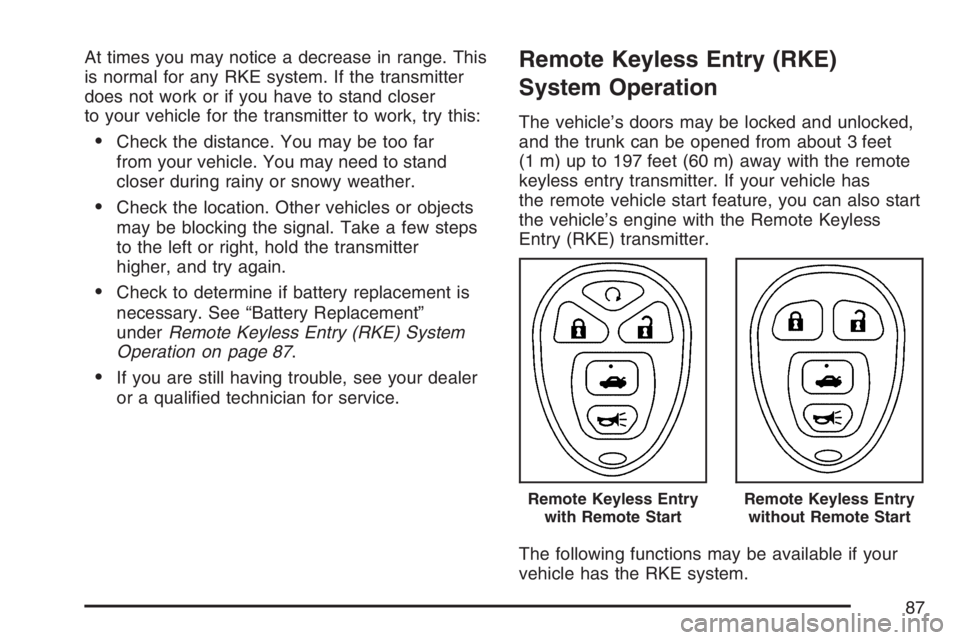
The vehicle’s doors may be locked and unlocked,
and the trunk can be opened from about 3 feet
(1 m) up to 197 feet (60 m) away with the remote
keyless entry transmitter. If your vehicle has
the remote vehicle start feature, you can also start
the vehicle’s engine with the Remote Keyless
Entry (RKE) transmitter.
The following functions may be available if your
vehicle has the RKE system.
Remote Keyless Entry
with Remote StartRemote Keyless Entry
without Remote Start
87
Page 90 of 428
Battery Replacement
Under normal use, the battery in your RKE
transmitter should last about four years.
The battery is weak if the transmitter will not work
at the normal range in any location. If you have
to get close to your vehicle before the transmitter
works, it is probably time to change the battery.
The KEY FOB BATT LOW message in the
vehicle’s DIC will display if the RKE transmitter
battery is low.
Notice:When replacing the battery, use care
not to touch any of the circuitry. Static
from your body transferred to these surfaces
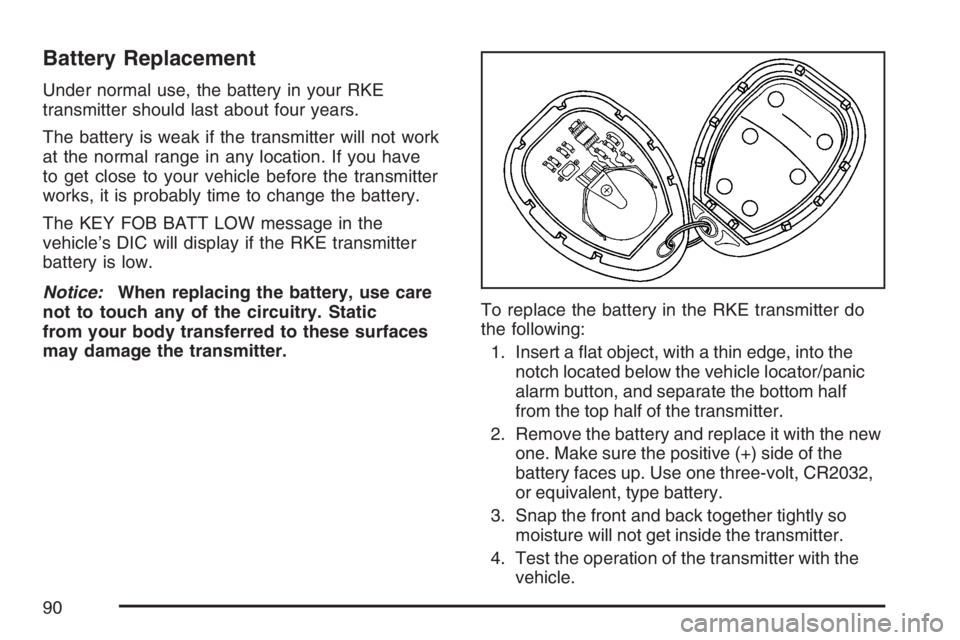
may damage the transmitter.To replace the battery in the RKE transmitter do
the following:
1. Insert a at object, with a thin edge, into the
notch located below the vehicle locator/panic
alarm button, and separate the bottom half
from the top half of the transmitter.
2. Remove the battery and replace it with the new
one. Make sure the positive (+) side of the
battery faces up. Use one three-volt, CR2032,
or equivalent, type battery.
3. Snap the front and back together tightly so
moisture will not get inside the transmitter.
4. Test the operation of the transmitter with the
vehicle.
90
Page 108 of 428

R(RUN):This is the position the switch returns
to after you start your engine and release the
switch. The switch stays in the RUN position when
the engine is running. But even when the ignition
is not running, you can use RUN to operate
your electrical accessories and to display some
warning and indicator lights.
The battery could be drained if you leave the key
in the ACC or RUN position with the engine
off. You may not be able to start your vehicle if
the battery is allowed to drain for an extended
period of time.
/(START):This position starts the engine.
When the engine starts, release the key.
The ignition switch will return to RUN for
normal driving.
A warning tone will sound if you open the driver’s
door while in LOCK or ACC, when the key has
not been removed from the ignition.
Key In the Ignition
Never leave your vehicle with the keys inside, as it
is an easy target for joy riders or thieves. If you
leave the key in the ignition and park your vehicle,
a chime will sound, when you open the driver’s
door. Always remember to remove your key from
the ignition and take it with you. This will lock
your ignition and transaxle. Also, always remember
to lock the doors.
The battery could be drained if you leave the key
in the ignition while your vehicle is parked.
You may not be able to start your vehicle after it
has been parked for an extended period of time.
108
Page 109 of 428

Column Lock Release
For vehicles with an automatic transaxle, The
following procedure allows the ignition to be turned
to LOCK and for ignition key removal in case of
a dead battery or low voltage battery.
1. Make sure the shift lever is in PARK (P).
2. Using a tool, pry off the cover from the bottom
of the steering column.3. Place your nger into the access hole and
locate the plunger.
4. Press and hold the plunger toward the driver’s
door while turning the ignition key to LOCK.
Remove the key.
Have your vehicle serviced at your GM dealer as
soon as possible.
109
Page 111 of 428
Your vehicle has a Computer-Controlled
Cranking System. This feature assists in
starting the engine and protects components.
If the ignition key is turned to the START
position, and then released when the engine
begins cranking, the engine will continue
cranking for a few seconds or until the vehicle
starts. If the engine does not start and the
key is held in START for many seconds,
cranking will be stopped after 15 seconds to
prevent cranking motor damage. To prevent
gear damage, this system also prevents
cranking if the engine is already running.
Engine cranking can be stopped by turning the
ignition switch to the ACC or LOCK position.
Notice:Cranking the engine for long periods
of time, by returning the key to the START
position immediately after cranking has ended,
can overheat and damage the cranking
motor, and drain the battery. Wait at least
15 seconds between each try, to allow
the cranking motor to cool down.2. If the engine does not start after 5-10 seconds,
especially in very cold weather (below 0°F
or−18°C), it could be ooded with too much
gasoline. Try pushing the accelerator
pedal all the way to the oor and holding it
there as you hold the key in START for up to
a maximum of 15 seconds. Wait at least
15 seconds between each try, to allow the
cranking motor to cool down. When the engine
starts, let go of the key and accelerator. If
the vehicle starts briey but then stops again,
do the same thing. This clears the extra
gasoline from the engine. Do not race the
engine immediately after starting it. Operate
the engine and transaxle gently
until the oil warms up and lubricates all
moving parts.
Notice:Your engine is designed to work with
the electronics in your vehicle. If you add
electrical parts or accessories, you could
change the way the engine operates. Before
adding electrical equipment, check with your
dealer. If you do not, your engine might not
perform properly. Any resulting damage would
not be covered by your vehicle’s warranty.
111
Page 121 of 428

Shifting Out of Park (P)
(Automatic Transaxle)
This vehicle is equipped with an electronic shift
lock release system. The shift lock release is
designed to:
Prevent ignition key removal unless the shift
lever is in PARK (P) with the shift lever
button fully released, and
Prevent movement of the shift lever out of
PARK (P) unless the ignition is in a position
other than LOCK.
The shift lock release is always functional except
in the case of a an uncharged or low voltage
(less than 9 volt) battery.
If your vehicle has an uncharged battery or a
battery with low voltage, try charging or jump
starting the battery. SeeJump Starting on
page 304for more information.To shift out of PARK (P) use the following
sequence:
1. Apply the brake pedal.
2. Then press the shift lever button.
3. Move the shift lever to the desired position.
If you still are unable to shift out of PARK (P):
1. Fully release the shift lever button.
2. While holding down the brake pedal, press
the shift lever button again.
3. Move the shift lever to the desired position.
If you still cannot move the shift lever from
PARK (P), consult your dealer or a professional
towing service.
121
Page 149 of 428

Dome Lamp
Your vehicle may have a dome lamp.
9(Off):Move the lever to this position to turn
the lamp off, even when a door is opened.
1(Door):Move the lever to this position to turn
the lamp on whenever a door is opened.
+(On):Move the lever to this position to turn
the dome lamp on.
Entry/Exit Lighting
The lamps inside your vehicle will go on when you
open any door. These lamps will fade out after
about 20 seconds after all of the doors have been
closed or when the ignition is turned to RUN. These
lamps will also go on when you press the trunk
release, unlock symbol button or the horn symbol
on the keyless entry system transmitter.
The lamps inside your vehicle will stay on for
about 20 seconds after your key is removed from
the ignition to provide an illuminated exit.
Mirror Reading Lamps
Your vehicle may have reading lamps on the
rearview mirror. Push the button to turn the reading
lamps on and off.
Electric Power Management
This vehicle has Electric Power Management
(EPM), an advanced control system. It estimates
the battery’s temperature and state of charge
and then adjusts the voltage for best performance
and extended life of the battery.
When the battery’s state of charge is low, the
voltage is raised slightly to quickly put the charge
back in. When the state of charge is high, the
voltage is lowered slightly to prevent overcharging.
If the vehicle has a voltmeter gage or voltage
display on the Driver Information Center (DIC), you
may see the voltage move up or down. This is
normal. If there is a problem, an alert will be
displayed.
149
Page 178 of 428
COOLING MODE ON
This message may display on some vehicles.
Under severe conditions, hot ambient
temperatures, steep grades, and towing, your
vehicle may experience more transaxle shifting.
This is temporary and normal under these
conditions. This does not require engine or
transaxle service.
CRUISE ENGAGED
This message displays when the cruise control
system is active. SeeCruise Control on page 143
for more information.
DOOR AJAR
This message displays if one or more of the
vehicle’s doors are not closed properly. When this
message displays, make sure that the door(s)
are closed completely.
ENGINE DISABLED
This message displays if the starting of the engine
is disabled. Have your vehicle serviced by your
dealer immediately.
ENG (Engine) PWR (Power) REDUCED
This message displays to inform you that the
vehicle has reduced engine power to avoid
damaging the engine. Reduced engine power
can affect the vehicle’s ability to accelerate. If
this message is on, but there is no reduction in
performance, proceed to your destination. The
performance may be reduced the next time the
vehicle is driven. The vehicle may be driven at a
reduced speed while this message is on, but
acceleration and speed may be reduced. Anytime
this message stays on, the vehicle should be taken
to your dealer for service as soon as possible.
ICE POSSIBLE
This message displays when the outside air
temperature is cold enough to create icy road
conditions. Adjust your driving accordingly.
KEY FOB BATT (Battery) LOW
This message displays if the Remote Keyless
Entry (RKE) transmitter battery is low. Replace
the battery in the transmitter. See “Battery
Replacement” underRemote Keyless Entry (RKE)
System Operation on page 87.
178
Page 255 of 428
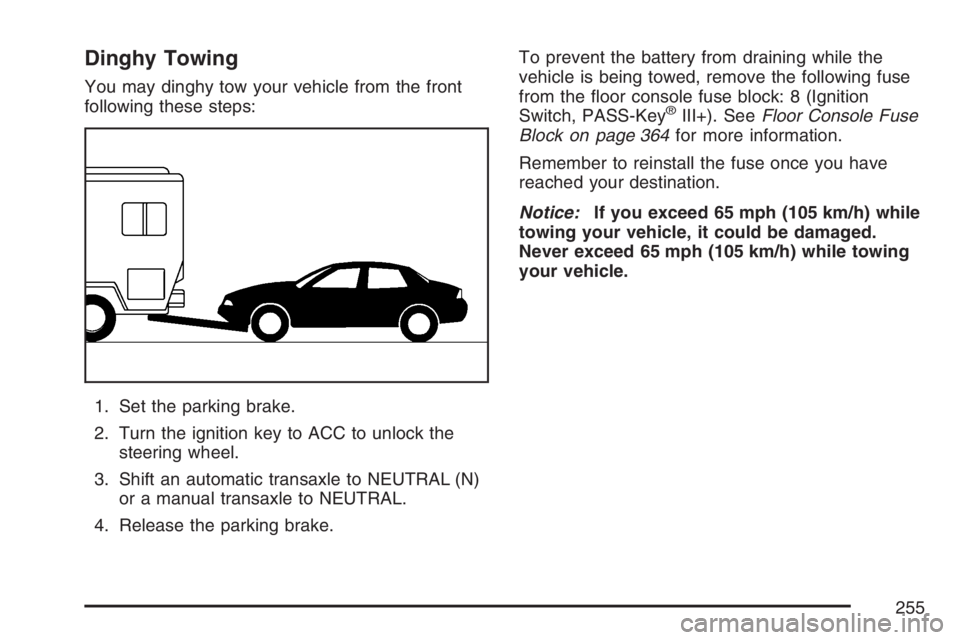
Dinghy Towing
You may dinghy tow your vehicle from the front
following these steps:
1. Set the parking brake.
2. Turn the ignition key to ACC to unlock the
steering wheel.
3. Shift an automatic transaxle to NEUTRAL (N)
or a manual transaxle to NEUTRAL.
4. Release the parking brake.To prevent the battery from draining while the
vehicle is being towed, remove the following fuse
from the oor console fuse block: 8 (Ignition
Switch, PASS-Key
®III+). SeeFloor Console Fuse
Block on page 364for more information.
Remember to reinstall the fuse once you have
reached your destination.
Notice:If you exceed 65 mph (105 km/h) while
towing your vehicle, it could be damaged.
Never exceed 65 mph (105 km/h) while towing
your vehicle.
255
Page 399 of 428

Roadside Assistance Program
As the owner of a new Pontiac vehicle, you are
automatically enrolled in the Pontiac Roadside
Assistance program. This value-added service is
intended to provide you with peace of mind as you
drive in the city or travel the open road. Contact
Pontiac’s Roadside Assistance toll-free at
1-800-ROADSIDE (762-3743). Roadside
Assistance Representatives are available 24 hours
a day, 365 days a year.
We will provide the following services during the
Bumper-to-Bumper warranty period, at no expense
to you:
Fuel Delivery:Delivery of enough fuel
($5 maximum) for the customer to get to the
nearest service station.
Lock-out Service (identication required):
Replacement keys or locksmith service will
be covered at no charge if you are unable to
gain entry into your vehicle. Delivery of
the replacement key will be covered within
10 miles (16 km).
Emergency Tow:Tow to the nearest
dealership for warranty service or in the event
of a vehicle-disabling accident. Assistance
provided when the vehicle is mired in
sand, mud, or snow.
Flat Tire Change:Installation of a spare tire
will be covered at no charge. The customer
is responsible for the repair or replacement of
the tire if not covered by a warrantable
failure.
Jump Start:No-start occurrences which
require a battery jump start will be covered at
no charge.
Dealer Locator Service
In many instances, mechanical failures are covered
under Pontiac’s Bumper-to-Bumper warranty.
However, when other services are utilized, our
Roadside Assistance Representatives will explain
any payment obligations you might incur.
399